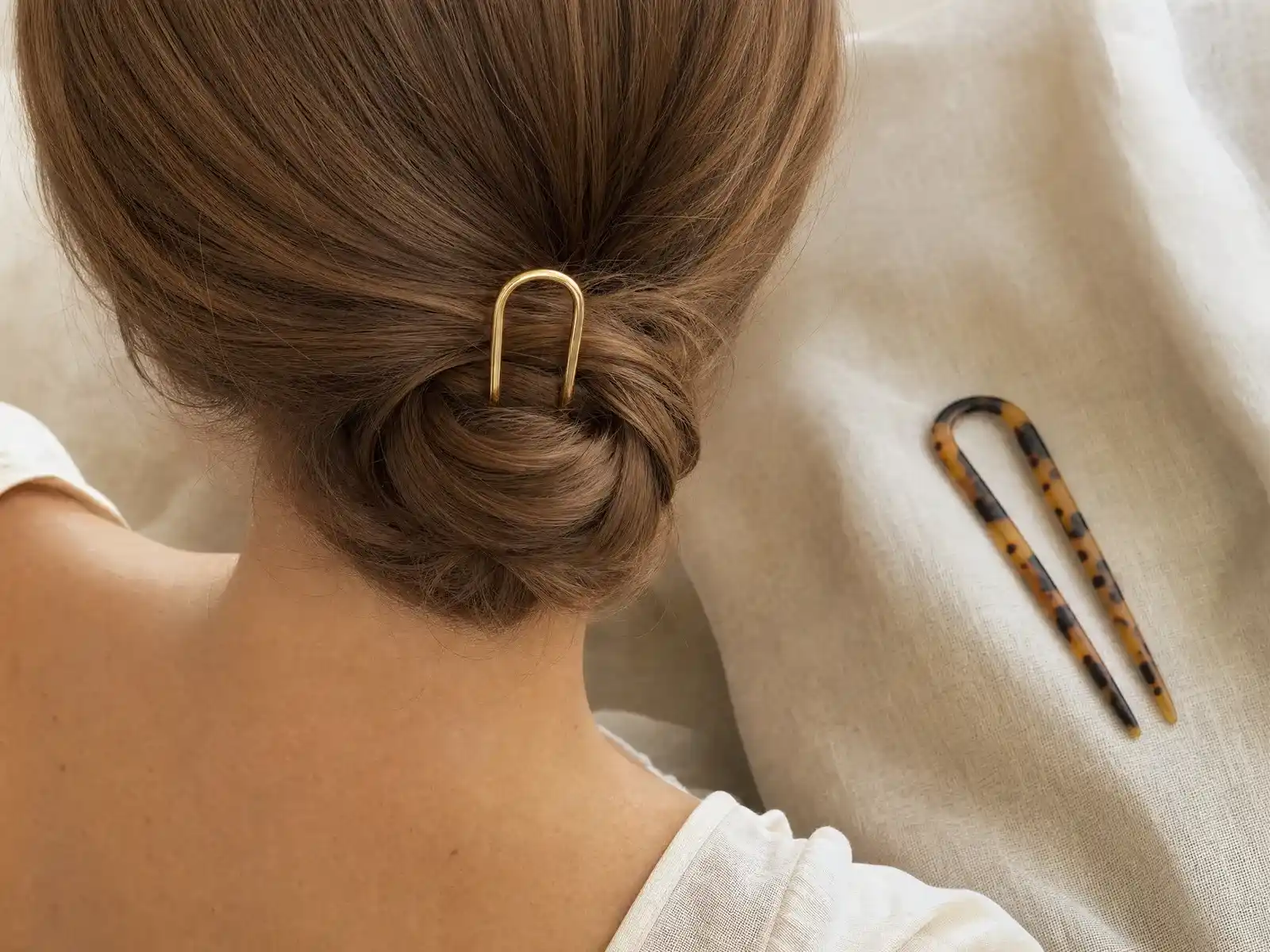
- What Is a French Hair Pin?
- How to Choose: Length, Material and Prong Spacing
- How to Use a French Hair Pin
- French Hair Pins on Long Hair
- Best French Hair Pins for Thick Hair
- Can You Use a French Hair Pin on Short Hair?
- Best French Hair Pins for Fine Hair
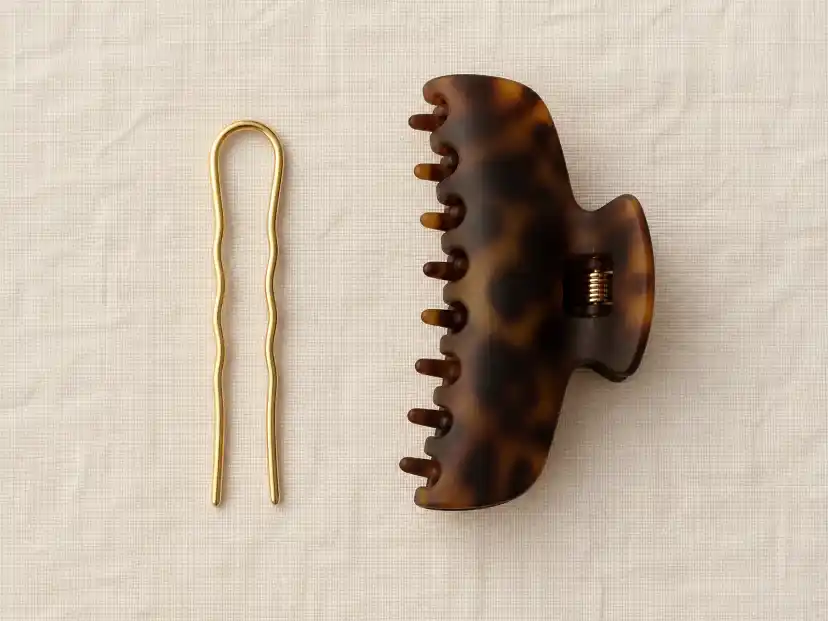
- French Hair Pin vs Claw Clip
- Why French Hair Pins Slip (and How to Fix It)
- The French Pin Chignon
- Metal vs Acetate French Hair Pins
- Decorative French Hair Pins for Weddings and Events
- Are French Hair Pins Bad for Your Hair?
- The Bottom Line
- Explore the full series
Short answer: a French hair pin is one U-shaped, two-pronged pin, usually about four inches long, that holds an entire twist or bun on its own. You slide it into the twist, rotate it roughly 180 degrees, then push it back in. That single rotation is why one pin does the work of a fistful of bobby pins.
Best Claw Clips is reader-supported. When you buy through links on our site, we may earn an affiliate commission at no extra cost to you.
We have explained this one accessory more times this year than any clip in the drawer, because almost nobody buys their first one knowing what it is. Vogue Scandinavia credits The Row's spring/summer 2026 show — restrained, sculptural twists secured with decorative pins and combs — with pulling the French pin out of what it calls more than two decades of semi-retirement, and its headline frames it as the accessory replacing the claw clip in 2026. Who What Wear also named French pins among the accessories it expected to pop off in 2026. Treat that as press framing, not a sales figure.
What Is a French Hair Pin?
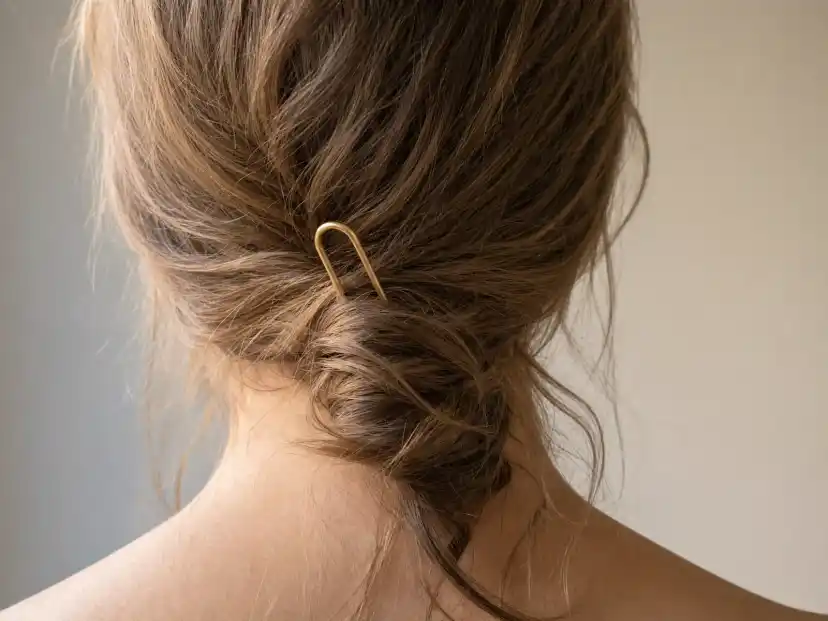
A French hair pin — also sold as a French pin, a hair fork or a U-shaped hair pin — is a single two-pronged pin bent into a long U, in metal or cellulose acetate, used one at a time. PureWow describes it as a large U-shaped accessory, reminiscent of a bobby pin, that can wrap up all of your hair. Not a handful. One.
Here is what it is not:
- Not a bobby pin. Small, sprung, flat-and-wavy, used in numbers to tack down sections. If that is what you wanted, start with the ultimate guide to bobby pins.
- Not a U-pin or hairpin. Thin bent wire, weaker, also used in handfuls. We compare them in bobby pins vs hair pins — go there if thin U-pins are what you wanted.
- Not a hair stick. One straight prong, no fork, a different mechanism.
- Not a claw clip. Hinged, with sprung jaws that clamp shut. Our ultimate guide to claw clips covers that family.
- Not a French barrette. A flat clasp with a snapping bar — see our guide to French barrettes.
The reason it deserves its own category is mechanical. Two prongs plus a rotation is a different holding system from a clamp or a spring. Turning the pin inside the twist wraps a band of hair around the inner prong and traps it between the tines. The hair's own tension holds; the pin only redirects it. Nothing is squeezed shut and nothing is looped — which is both the appeal and the reason the pin drops out if you skip the turn.
How to Choose: Length, Material and Prong Spacing
Four physical properties decide whether a pin works for your head, and none of them is the colourway.
Length. The one people get wrong. PureWow reports French pins span roughly one to four inches, with one-to-two-inch pins suiting short hair and three-to-four-inch pins suiting long, thick or curly hair. Ours run 3.9 to 4.3 inches. The rule: a prong that does not reach past the far edge of your twist has nothing to brace against. HYFEEL lists its acetate forks at 4.3 inches, the long end. According to hisial, its metal pins are 3.9 inches — better matched to a mid-size bun.
Prong gap. The distance between the tines sets how much hair each pass captures. A wide gap takes a fat band of a thick twist; a narrow gap concentrates its grip, which is what low-density hair needs. Nobody prints this number, so judge it from the listing photograph.
Stiffness. A prong that splays under load stops gripping. According to hisial, its alloy pins are lightweight and sturdy and not easy to deform; HYFEEL describes a thicker pin that does not break easily. Both point at the same failure mode.
Surface finish. Slick is safer than textured. Kitsch specifies a smooth anti-rust electroplated finish on its zinc alloy pin, which is why we hand that one to beginners. For the cheapest way to test the format at all, AWAYTR's acetate U-shaped fork was 6.99 dollars as of August 2026.
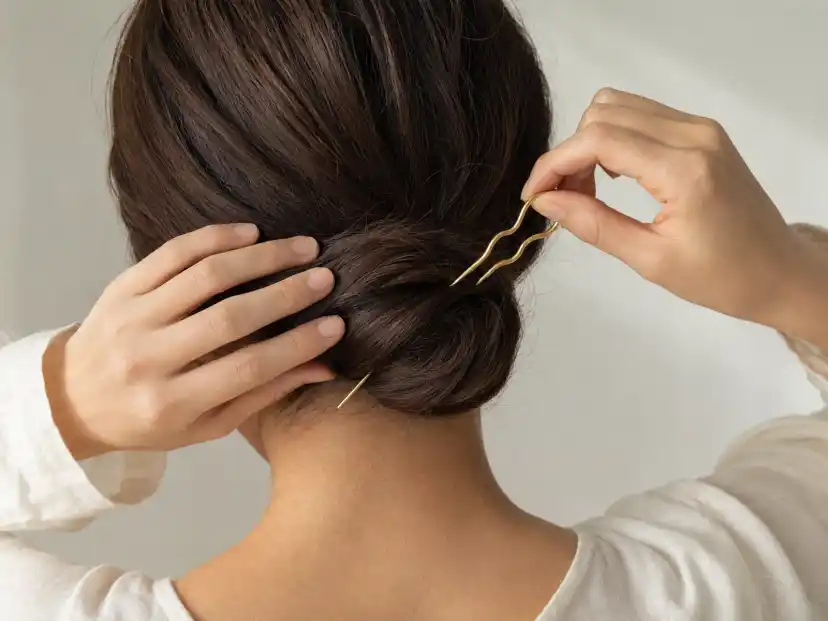
How to Use a French Hair Pin
Here is how to use a French hair pin, in the order we teach it at the basin. It takes most people three attempts.
- Start with grip, not the pin. Glamour South Africa recommends second-day hair, because freshly washed hair is too slippery to hold the pin in place, and suggests building texture first with braids, waves or a texturising spray.
- Build the twist. Gather at the nape, twist upward, tuck the ends inside, hold with one hand.
- Enter shallow, curve outward. Per Glamour South Africa, insert the pin with the curve facing outward and the points facing up, sliding it into the top layer of the twist rather than stabbing straight in.
- Scoop, then rotate 180 degrees. Scoop closer to your scalp, then rotate the pin 180 degrees, or until you feel resistance. Everyone leaves this step out.
- Push it home. Drive the pin back into the twist along the head. PureWow quotes celebrity hairstylist TEMUR: place it inside the twist and push it in a vertical direction to make sure the twist holds firmly.
Two rules from us. The pin should sit flat along the curve of your skull — if you can hook a finger under the outside, it will lever itself out by lunchtime. And Glamour South Africa's line is worth memorising: a French pin should never cause pain. If it does, you took too much hair or entered too deep.
French Hair Pins on Long Hair
Long hair is where this accessory earns its keep, because length gives the pin the one thing it needs: enough coil to wrap around a prong. The French hair pin styles for long hair that hold best all start from a twist rather than a loose coil, for a simple reason — a twist has internal tension, a coil only has weight.
The problem with long hair is not grip but mass. A mid-back-length twist can weigh enough to lever a short pin out, which is why we default to the 4.3-inch class here. If your ends are heavy, fold the tail back on itself before pinning, so you secure a doubled, shorter mass rather than a long pendulum.
The two styles worth practising are the vertical French twist and the low knot. For the twist, sweep everything to one side, roll it upward against the head, tuck the tail inside the roll, and pin through the outer wall into the hair beneath — the shape we build in our French twist with a claw clip tutorial, except the pin lets you place the hold anywhere on the roll rather than only at the seam.
One genuine advantage: Vogue Scandinavia quotes content creator Sanna Jörnvik Déman saying the pin does not ruin a blow-out but rather enhances and protects it. On long hair we agree — no elastic means no dent mid-length.
Best French Hair Pins for Thick Hair
Dense hair is the format's best use case and its harshest test. The best French hair pins for thick hair share three traits: maximum length, a wide prong gap, and prongs stiff enough not to splay under a heavy twist.
Length first. On thick hair a 3.9-inch pin frequently cannot cross the twist, and a prong that stops halfway is just a lever. HYFEEL lists its cellulose acetate forks at 4.3 inches and states they suit thick as well as fine hair; that extra four-tenths of an inch is the difference between bracing and dangling.
Stiffness second. A thick acetate fork resists bending better than a thin plated-metal pin, which is why, in our experience, acetate forks tend to win on genuinely heavy hair — HYFEEL specifies a thicker pin that does not break easily. Kitsch states its zinc alloy pin gives a secure no-slip hold on thick, thin, curly or straight hair; that is a maker claim, but the alloy body is certainly rigid.
Technique third, and it matters more than either. Split the mass. Two smaller twists, each with its own pin, hold far better than one enormous twist with one pin, because grip scales with contact points rather than pin size. If you currently need the largest clips on the market, our roundup of large claw clips for heavy hair is the honest comparison — on coarse hair a claw clip still often wins on speed.
Can You Use a French Hair Pin on Short Hair?
Yes, with conditions, and the conditions are geometric rather than cosmetic. Using a French hair pin on short hair works as soon as you have enough length for one full turn of a twist — in practice, roughly collarbone length or a long bob. Below that, there is nothing for the prongs to wrap around.
The adjustments are these. Buy short, because PureWow's sizing guidance puts one-to-two-inch pins with short hair, and a 4.3-inch fork in a chin-length bob protrudes out the far side. Work in half-up sections rather than whole-head updos — a half-up twist at the crown only asks the pin to hold the top third of your hair, which is achievable on hair that could never make a full chignon. Add grip aggressively, since short hair has less strand-on-strand friction to trade on, which moves Glamour South Africa's texturising-spray step from optional to essential.
Where we will be blunt: on a jaw-length bob, a French pin is fussier and less reliable than a small claw clip or two bobby pins, and no technique changes that. If your hair sits above the collarbone and you want it up in five seconds, use a clip. Keep the pin for the days you want a deliberate half-up twist.
Best French Hair Pins for Fine Hair
Fine and low-density hair is the hardest case, because the holding mechanism runs on friction between strands and there is less fibre to generate it. The best French hair pins for fine hair are light, narrow-gapped and slick — the opposite specification from thick hair.
Weight matters more than you would expect. A heavy metal pin in a small twist becomes its own destabilising load, working loose as you move. According to hisial, its 3.9-inch alloy pins are lightweight and sturdy — a maker claim, and worth knowing that cellulose acetate is the lighter material at equal size — and that shorter length is an advantage here rather than a compromise.
Narrow prong gaps beat wide ones, because a wide gap through a thin twist barely touches anything. Finish matters too: fine hair snags easily, and the smooth electroplated surface Kitsch specifies gives strands something to slide over.
Then build grip artificially. PureWow's expert TEMUR advises those with finer hair to apply texture or hairspray to build grip and prevent the pin slipping out, and Glamour South Africa suggests crimping fine hair at the base. Both describe one fix: raise the friction, then pin.
Be realistic about the ceiling. On very fine hair a single pin may hold a soft twist for an evening but not through a commute and a gym class. If you need sustained security, our best claw clips for fine hair picks are more dependable.
French Hair Pin vs Claw Clip
The honest French hair pin vs claw clip verdict depends on what you are asking the accessory to do, and it splits along four lines.
Speed. The claw clip wins outright. One hand, one second, no technique. A French pin needs a twist built first and a rotation performed correctly, and the learning curve is real.
Finish. The pin wins. It disappears into the style and leaves a smooth, deliberate twist. AWAYTR markets its acetate pin specifically as a creaseless alternative to elastics and claw clips, and the absent dent is a structural difference — nothing is clamped or looped.
Load. The clip wins on very heavy hair, because sprung jaws hold more mass, faster. Two twists with two pins catches up, but that is more work.
Force on the hair. This one goes to the pin. A claw clip stores energy in a spring and applies it continuously to whatever sits in the jaws. A French pin stores nothing — remove the tension and it falls out. There is no sustained clamping force at all. For the claw-clip side of that argument, see are claw clips bad for your hair.
Our working answer behind the chair: claw clip for speed and security, French pin for polish and for anything you want to keep a blow-dry intact through.
Why French Hair Pins Slip (and How to Fix It)
There are five reasons why French hair pins slip out, and four of them are technique rather than product.
- You skipped the rotation. By far the most common. A pin pushed straight into a twist holds nothing but itself. Rotate 180 degrees, or until you feel resistance, as Glamour South Africa specifies, then push it back in.
- Your hair is too clean. Freshly washed hair is too slippery to hold the pin in place, per Glamour South Africa, which is why second-day hair or a texturising spray transforms the hold.
- The pin is too short for your mass. If the prongs do not cross the twist and engage hair on the far side, no technique compensates. Size up.
- You entered too deep. Prongs buried mid-twist have no outer wall of hair to press against. Enter through the top layer.
- The pin sits proud of your head. If the arch stands away from the skull, every head turn levers it outward. Lay it along the curve.
One more, specific to acetate: a very glossy surface can be marginally more slippery to place, so placement has to be exact. We accept that trade, because the same slickness stops it snagging. Fix technique before buying another pin — most slipping complaints resolve with the rotation and a mist of texture spray. Buying a longer pin is the last resort, not the first.
The French Pin Chignon
The chignon is the reference style — a low, soft bun at the nape that looks composed without looking rigid. Building a chignon with a French hair pin takes about forty seconds once the rotation is automatic.
Gather everything at the nape as if for a low ponytail, without an elastic, and twist the length around itself until it coils into a soft bun against the head. Then, following Glamour South Africa's method, hold the pin almost flat against your head and slide it into the outer surface of the bun, scoop a small amount of hair close to the scalp, rotate the pin 180 degrees, and push it back in the direction of the bun to secure. Keep the curve arcing away from your head as you enter.
Three refinements we use constantly:
- Leave the coil slightly loose before pinning. A bun wound drum-tight has no give for the prongs to bite into.
- Aim the pin across the bun, not along it. Crossing the axis of the coil catches two layers rather than one.
- On fine hair, make the bun smaller and steepen the entry angle so the prongs pass through more fibre.
For a heavy chignon we reach for a 4.3-inch acetate fork such as the HYFEEL cellulose acetate set, because the extra length crosses more of the coil. If the bun collapses rather than the pin slipping, the twist is your problem.
Metal vs Acetate French Hair Pins
The metal vs acetate French hair pins question comes down to surface, weight and stiffness, and there is no universal winner.
Metal — typically zinc alloy, electroplated. Kitsch specifies high-quality zinc alloy with a smooth anti-rust finish and states that ergonomic curves distribute tension evenly for all-day wear; hisial lists a durable alloy with a smooth electroplated surface. Metal gives thin prongs at high rigidity: a slim profile that still resists splaying. The risk is in the finish. Plating can wear, and in our experience a worn or seamed edge is the part of a French pin most likely to abrade hair.
Cellulose acetate — the material used for good spectacle frames and the better claw clips. It is polished rather than plated, so there is no coating to wear through, and HYFEEL describes a good gloss surface with a thicker pin that does not break easily. It is lighter than metal at equal size and, in our experience behind the chair, the safer choice on hair that snags. We make the same argument in acetate vs plastic claw clips.
Our split: acetate if your hair is fragile, chemically treated or prone to catching, or if you are buying one pin to keep for years. Metal for the slimmest profile, a jewellery-like finish, or a multipack — hisial's set includes a clear storage box, which stops pins vanishing into a bag lining.
Decorative French Hair Pins for Weddings and Events
Decorative French hair pins for weddings and events do exactly the same structural job as a plain one — the ornament sits on the arch of the U, where it is visible and adds no grip. Worth knowing before you spend: the decoration is jewellery, and the hold still comes from length, prong gap and your rotation.
First consequence: an ornamented pin is heavier at the outer end, which shifts the balance and makes it easier to lever out. If you are wearing one for twelve hours through dancing, hide a couple of bobby pins inside the twist as insurance. Our bobby pin techniques piece covers the crossed-pin anchor we use for this.
Second, mind the setting. Prongs, claws and filigree are the parts that catch hair. A smooth cabochon, a flat pearl cluster or an enamelled arch beats an open crystal claw setting you will be pulling out of a set style at midnight.
The bridal press is consistent about direction. Paperlust's 2026 bridal hair accessories guide and The Knot's bridal accessory guidance both describe pearl and crystal pins scattered through updos, chignons and half-up styles as a mainstream choice, with pearls reading classic and crystals giving higher sparkle. One decorative pin holding a low chignon is the restrained version of that idea.
Are French Hair Pins Bad for Your Hair?
Short answer: a French pin is one of the lower-force ways to put hair up, but it is not risk-free — and the risk is snagging, not pulling.
There is no spring storing energy against your hair and no elastic looping the whole head into one anchor point. The styles dermatologists warn about are the sustained-tension ones: according to the American Academy of Dermatology, hairstyles that pull on your hair can cause hair loss, and the AAD's list is dominated by tightly pulled buns, ponytails and up-dos, cornrows, tight braids, locs, extensions and weaves. A soft twist held by one pin applies far less continuous pull, and it comes out the second it feels tight.
The real risk is friction at the prong. According to the International Journal of Trichology's overview of hair cosmetics, the cuticle is overlapping scales like shingles on a roof, and chemical damage from bleaches, dyes, straighteners and even sunlight can weaken hair and increase inter-fibre friction, leading to breakage. A 2020 cosmetic trichology commentary in the Indian Dermatology Online Journal describes repeated cosmetic treatments as chronic mechanic-chemical strain that weathers and separates the cuticle layers. Every insertion drags two prongs across the same band of fibre. A polished prong glides; a chipped one scrapes.
Four rules:
- Retire any pin whose plating has chipped or whose edge has a burr. Run it across the back of your hand — if you feel it, your cuticle will.
- Never pull a pin out of a tangle. Reverse the rotation to release it, then lift it away.
- Move the placement. The AAD advises changing your hairstyle so hair can recover; the same logic applies to loading one section daily.
- Treat pain as a stop signal, not a break-in period. Glamour South Africa is explicit that a French pin should never hurt.
The Bottom Line
A French hair pin holds a whole twist because you rotate it, not because it clamps. Buy long — 4.3 inches or so — if your hair is long or dense, short if it is fine or above the collarbone. Learn the 180-degree turn before you blame the pin, style on second-day hair, and retire any pin with a chipped edge.
Buying your first one? Get a single good pin rather than a multipack — the Kitsch French hair pin is what we hand to beginners, at 7.94 dollars as of August 2026 — then practise the chignon three times in a mirror. Most people who bounce off this accessory did so after one attempt without the rotation.
Explore the full series
- How to Use a French Hair Pin: A Step-by-Step Guide for Beginners — The insert-and-rotate motion, step by step, plus the three mistakes beginners make.
- French Hair Pin Styles for Long Hair That Actually Hold — Why pin length decides everything on long hair, and eight styles that hold.
- Best French Hair Pins for Thick Hair That Hold All Day — Length, prong gap and stiffness — the three specs that decide whether a pin survives dense hair.
- French Hair Pins on Short Hair: What Works and What Slips — The length threshold a French pin needs, which short styles work, and when to reach for a claw instead.
- Best French Hair Pins for Fine Hair: Light Picks That Grip — Why the fine-hair spec is the exact inverse of the thick-hair one, and pins that grip without weight.
- French Hair Pin vs Claw Clip: Which Holds Better? — Five axes, five verdicts — hold, speed, creasing, comfort, and how each scales with volume.
- Why Does My French Hair Pin Slip Out? 8 Fixes That Work — Eight fixes in the order worth trying them, starting with the half-rotation almost everyone skips.
- How to Do a Chignon with a French Hair Pin in Under a Minute — The scoop-and-rotate sequence, three variations, and an honest answer on how long it really takes.
- Metal vs Acetate French Hair Pins: Which Should You Buy? — Six axes, six verdicts — thickness, weight, grip, warmth, how each material fails, and price.
- Best Decorative French Hair Pins for Weddings and Special Events — Five decorative pins for five different jobs, and why ornament makes a pin harder to keep in.
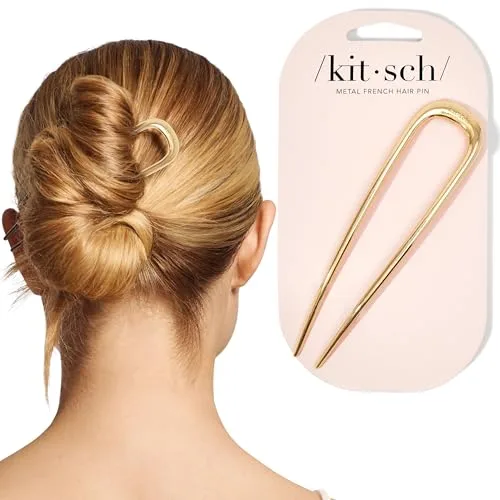
Kitsch French Hair Pin (Gold)
The mainstream pick and the easiest one to learn on. Zinc alloy with a smooth anti-rust electroplated finish, so it slides through a twist without catching.
We tested dozens of claw clips to find the very best options. Below you'll find our complete ranking, with detailed reviews and real customer feedback for each pick.
The Complete Ranking
The mainstream pick and the easiest one to learn on. Zinc alloy with a smooth anti-rust electroplated finish, so it slides through a twist without catching. A single sturdy pin rather than a multipack, which is the right way to buy your first one.
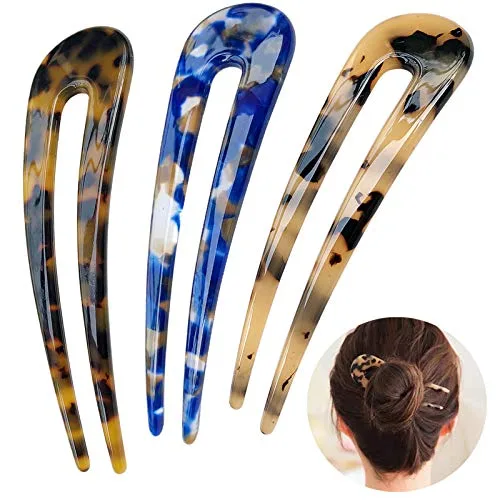
A 4.3-inch acetate fork, which is the long end of the range and the reason this set handles a heavy chignon. Cellulose acetate has a glossier, slicker surface than plated metal, so it is the gentler choice on hair that snags easily.
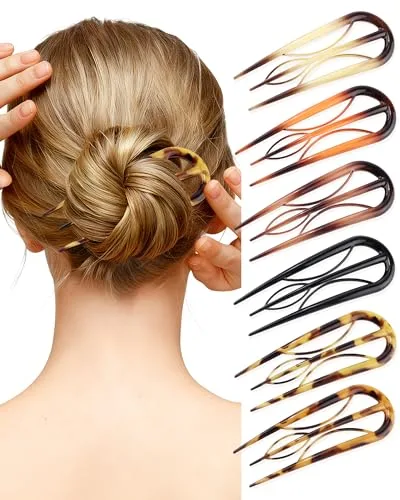
The cheapest sensible way to find out whether the format suits you. Cellulose acetate in tortoise shell, and the seller pitches it specifically as an alternative to elastics and claw clips because it does not leave a crease.
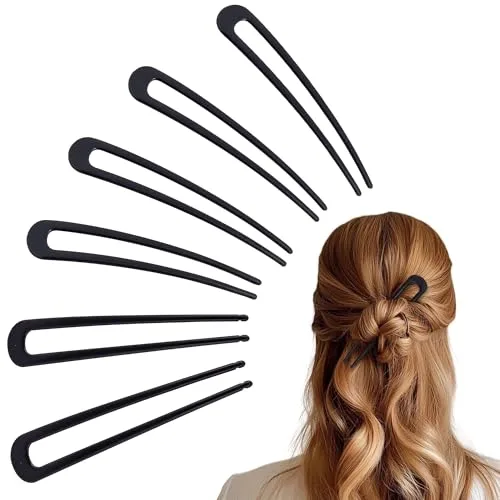
Six alloy pins with a storage box, which is the practical way to keep one in a bag, one on the desk and one at home. At 3.9 inches these are slightly shorter than the acetate forks, so they suit a mid-size bun better than a very heavy one.
Quick Comparison
A side-by-side look at our top picks
Frequently Asked Questions
The 180-degree rotation is the entire trick
Which length to buy for your hair
Why it slips on freshly washed hair

Donna Miller
Enjoyed This Guide?
Get more hair tips and product recommendations delivered weekly.