- What Are Decorative Hair Combs?
- How to Put In a Decorative Hair Comb
- Types of Decorative Hair Combs
- Bridal and Occasion Combs
- Are Decorative Hair Combs Bad for Your Hair?
- Why a Comb Slips Out
- Comb Materials: Metal, Wood and Acetate
- Hairstyles to Wear With a Comb
- Combs for Fine and Thin Hair
- Combs for Thick and Heavy Hair
- Vintage, Antique and Art Deco Combs
- Which Comb Should You Buy First?
- Explore the full series
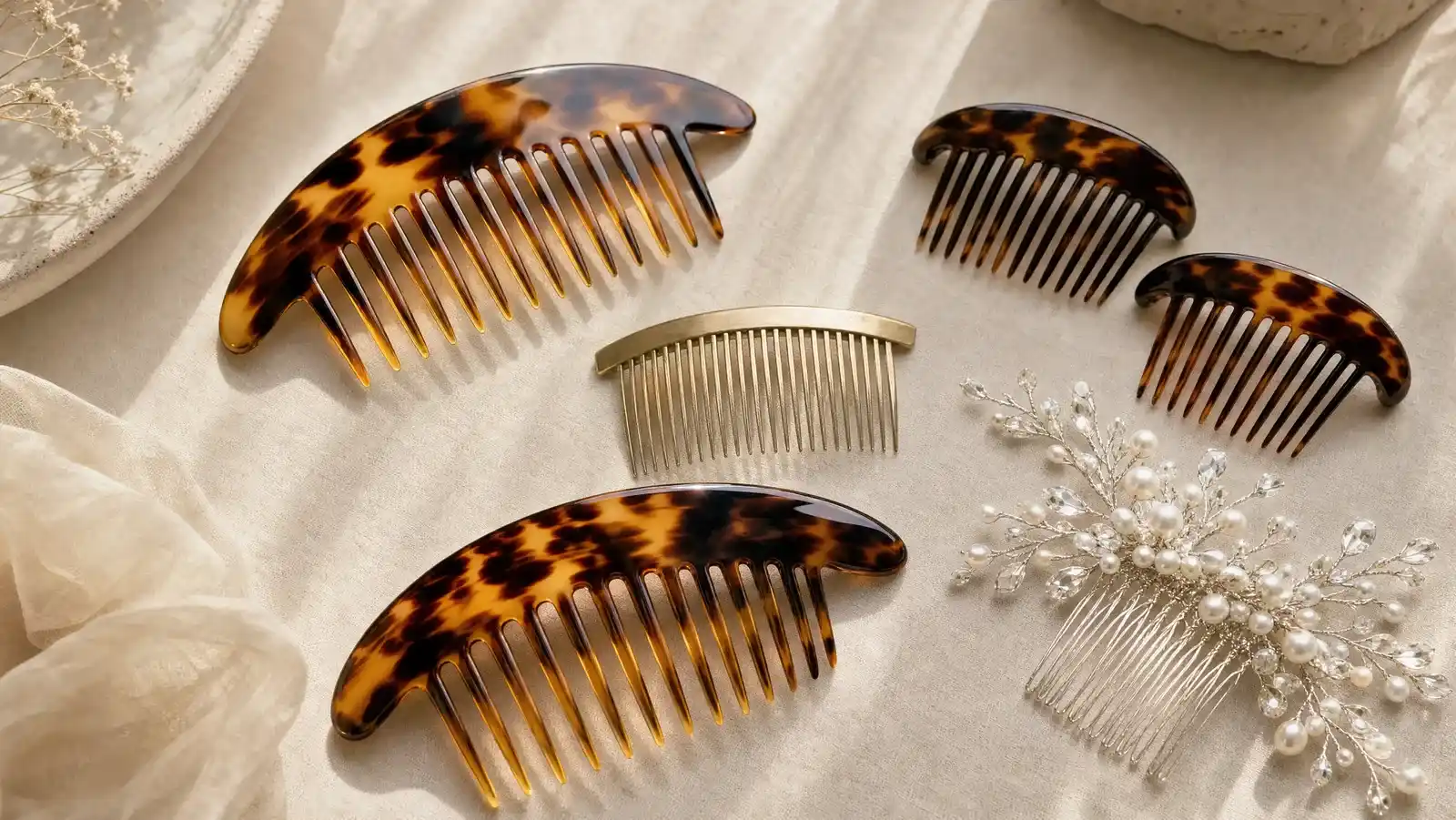
Short answer: a decorative hair comb is a single curved comb, roughly 1.5 to 4 inches across, that you push into gathered hair so its teeth brace against your scalp. Nothing clamps. The hold comes from tension between the comb's spine, a folded band of hair and your head — which is why a comb behaves nothing like the claw clip already in your drawer.
Some links below are affiliate links, which means we may earn a commission at no cost to you.
Combs are having a real moment. Marie Claire ran its coverage under the headline The French Comb Trend is 2026's Most Elegant Hair Accessory, and Who What Wear's roundup of hair accessories about to pop off in 2026 named combs alongside French pins and tassels. Bustle got there earlier, running its January 2025 piece under the line Move over, claw clips — though the article itself says claw clips are not going anywhere, and none of the creators it quotes calls a comb a replacement. Treat all of that as press framing, not evidence. What follows is the mechanical case for and against.
What Are Decorative Hair Combs?
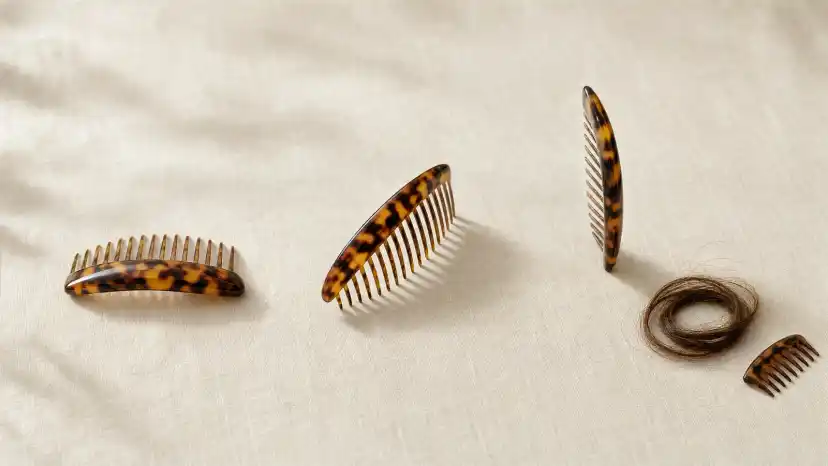
A decorative hair comb is an ornamental comb meant to stay in your hair rather than pass through it. One piece, no hinge, no spring, no clasp. The spine carries the decoration; the teeth do the work.
The category is old enough to be genuinely odd. The Metropolitan Museum of Art holds an ivory comb from Thebes dated to around 1550 to 1458 B.C., excavated from a burial at Asasif — a hair accessory roughly three and a half thousand years older than the plastic one you lost last week.
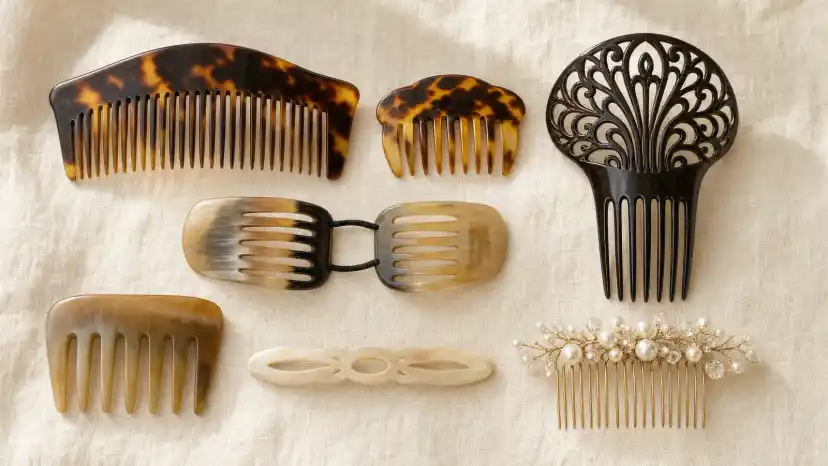
Names are a mess, so here is the sorting:
- Side combs — small curved combs, usually sold in pairs, worn above the ears.
- French combs or decorative side combs — the larger single version, 3 to 4 inches, the one the 2026 trend coverage means.
- Bridal combs and hair vines — decoration on a wire or a short comb base.
- Peinetas — tall arched combs, traditionally worn to hold a lace mantilla.
- Hair forks and picks — two or three long prongs, a different mechanism again.
The honest comparison is with what you already own. A claw clip clamps: two sprung jaws close on a section and the hair is trapped between them. A comb braces: the teeth slide in, the spine rotates down, and the hair's own tension against your scalp is the only thing holding. A French hair pin works by rotation too, but with two prongs and no spine to spread the load. If you want the clamp family instead, start at our ultimate guide to claw clips, and if you are weighing accessories against each other, french hair pin vs claw clip covers that pairing.
What this means practically: a comb has no maximum jaw capacity — you can put as little hair in it as you like — but it also has no mechanical catch, so it fails by sliding rather than by popping open.
How to Put In a Decorative Hair Comb
Most people fail on the first try because they insert a comb the way they would insert a hair slide: teeth down, push forward. That does not hold.
The method the trend coverage keeps describing is a flip. Bustle, reporting in January 2025, quotes creator Emily Elizabeth describing it as taking the comb, flipping it upside down, grabbing the hair you want to pin back and combing it through, then flipping the comb and shoving it in so that it is secure. The same piece notes the comb should sit against the curve of your head, and that pushing the comb forward is what creates height, in the context of a 1960s-style updo.
Broken into four steps:
- Gather less hair than you think. A section about an inch deep is plenty for a side comb.
- Enter upside down. Teeth pointing back toward the crown, spine away from the scalp, and comb through until the teeth are fully seated.
- Rotate the comb down and in. The spine swings toward the scalp, the teeth swing under, and a band of hair folds back on itself inside the comb. This is the lock.
- Push the spine flat against your head. If the spine stands off the scalp, the comb is holding on friction alone and will slide.
Two conditions make or break it. Second-day hair generally holds better than freshly washed hair — grip comes from friction between strands, and clean, slippery hair tends to offer less of it. And the comb's curve has to match your skull. A flat comb on a round head touches at two points instead of ten.
Our step-by-step piece on how to use a decorative hair comb walks through the motion in detail, including where to place the comb for a half-up or a French twist, because the flip is easier to see than to read.
Types of Decorative Hair Combs
There are five formats worth knowing, and the difference between them is width, tooth count and whether they work alone or in pairs.
Small paired side combs. The entry point. The Good Hair Days USA set in our picks is listed at 2 7/8 inches wide by 1.7 inches long, sold as three matching pairs, with a split-tooth design — small gaps between the teeth that generate the holding tension. They pin the sides back. They will not hold an updo.
Large French side combs. The single-comb version. The Camila Paris AD66 is listed at 4 inches in a 2-pack, and that length is the whole point: it is the only comb here long enough to close across a full twist rather than pin its surface. Camila Paris markets it for medium to thick hair, French twists, chignons and buns.
Interlocking or twist combs. Two combs joined by a flexible band or wire, inserted on either side of a twist and pulled together. More secure, fussier to learn.
Decorative combs and hair vines. Where the comb is mostly a mount for the decoration. The Tatibana piece in our picks is listed at 6.7 by 2.7 inches overall — crystals, pearls and silver-plated petals and leaves on a bendable soft alloy wire.
Picks, forks and peinetas. Adjacent families. Long prongs or a tall arch rather than a row of short teeth.
A fuller breakdown of types of decorative hair combs covers all eight shapes on the market and the hold each one is built for. If you want the flat-clasp family instead — anything with a snapping bar — see our guide to barrettes.
Bridal and Occasion Combs
Occasion combs are a separate design problem, because they are asked to hold a style for eight hours under a veil while photographing well from three feet away.
The practical split: bridal hair combs either hold or decorate, and very few do both. A rigid 4-inch comb holds. A pearl-and-crystal branch mostly decorates, and is usually pinned into a style that something else is already holding.
The Tatibana comb is the second kind, and it is honest about it. The listing describes a bendable branch, so the piece can be reshaped to follow the line of an updo instead of fighting it, and describes the piece as handmade. At 6.7 by 2.7 inches it is wide enough to read as a feature rather than a detail. Its marketing also says the finish will not fade; we have no way to verify durability or fade resistance, so treat that as the seller's copy.
What we would actually do for a wedding:
- Build the style first, then add the comb. A decorative comb is the last thing in, not the structure.
- Bend the branch to the head before the day, if the piece is bendable. A flat ornament on a curved updo lifts at the ends.
- Anchor into a braid, a twist seam or a pinned base — somewhere the teeth have something woven to bite.
- Rehearse it once. Occasion pieces are heavier than everyday combs and settle differently after an hour.
For the pin-shaped alternative at the same price point, we have a separate roundup of decorative French hair pins for weddings.
Are Decorative Hair Combs Bad for Your Hair?
The question we get in this exact form — do decorative hair combs damage hair — deserves a straight answer: the comb is not the risk, the tension is.
A comb's advantages are real. Load spreads across many teeth rather than two jaw edges, there is no elastic to compress a single line of hair, and nothing creases. But a comb holds by pressing against the scalp, and scalp tension is the mechanism behind traction damage.
The American Academy of Dermatology's guidance on hairstyles and hair loss gives the warning signs plainly. It states that if your hairstyle feels painful, the style is too tight, and lists broken hairs around your forehead, a receding hairline and patches of hair loss where hair is pulled tightly. It also notes that constant rubbing of a hat, head scarf or other hair covering over the hair can lead to traction alopecia, and advises switching up your hairstyle regularly so hair can recover from tight styles. Its position on frequency is useful here: wearing hair tightly pulled back every once in a while is fine, but you want to avoid doing so often.
Breakage is a separate mechanism from traction. According to a 2015 British Journal of Dermatology study on breakage in curly hair by Camacho-Bragado and colleagues, fracture follows a sequence — cuticle sliding, failure of the cuticle-cortex interface, then intercellular cracks that grow and merge — and mechanical damage from grooming accumulates inside the fibre, so breakage happens at unpredictable sites. The study's conclusion is about continuous care rather than any one accessory, which is the right frame: no single comb breaks your hair, repeated stress in the same place does.
Three habits we would keep: move the comb's position day to day, take it out before sleeping, and stop immediately if the scalp stings. Our pieces on traction alopecia from hair accessories and how to tell a safe clip from a damaging one go further.
Why a Comb Slips Out
Almost every message we get asking why a hair comb keeps falling out describes one of five problems, and four of them are free to fix.
You skipped the flip. A comb inserted teeth-first and pushed forward is held by friction only. Without the rotation there is no folded band of hair and no lock. This is the single most common cause.
Your hair is too clean. Grip is friction between strands. On freshly washed, silky or finely textured hair there is often not enough of it. Work on second-day hair, or add texture first.
The comb is too short for the job. A 2 7/8-inch side comb cannot close across a full French twist. The teeth reach the surface of the section and brace against nothing. This is why the 4-inch Camila Paris comb exists.
The curve is wrong for your head. Combs are moulded to one arc. If the spine lifts off the scalp when you push it flat, the comb is wrong for your skull shape, and no technique fixes that.
You took too much hair. Overfill a comb and the teeth cannot seat to the scalp. Less hair, seated deeper, holds better than more hair held shallow.
One more variable is placement. A comb set high on the crown fights gravity with a short lever; the same comb set at the side, angled slightly up, loads against the skull instead. Placement also decides whether it hurts — the same logic we use in how to position hair clips to avoid headaches.
Comb Materials: Metal, Wood and Acetate
Material changes three things that matter: surface friction, how the teeth fail, and whether the comb can be reshaped.
Cellulose acetate. The quality default. According to TEGEN Accessories, which sells acetate hair accessories and publishes a page on the material, acetate is plant fibre — wood pulp and cotton, treated so it can be formed into sheets, not crude oil — and is technically classed as a bioplastic. The same page says it holds colour with real depth, can be warmed and reshaped to fit the head, and does not go chalky and brittle after a year in a handbag, and contrasts sheet-cut acetate with cheap claws that are injection-moulded in seconds. Camila Paris describes the acetate in its combs as a plant-based resin and states that the brand has operated since 1999.
Be careful with the green claims. TEGEN's own page says acetate does break down more readily than petroleum plastic but that the rate depends on conditions and manufacturing, calls the research on it genuinely mixed, and says the company no longer describes its accessories as biodegradable because it cannot fully substantiate that. We would buy acetate for the surface and the sheet-cut edges, not for the compost bin. Our acetate vs plastic comparison goes into the hair-health side.
Metal. Thin, strong, and the only option for fine decorative work. The Tatibana piece uses a bendable soft alloy wire, which is the trade-off in a sentence: metal that bends to your head will also bend out of shape in a bag. Plated metal may present a higher-friction surface than polished acetate, so it can catch on fragile hair.
Wood. Carved rather than moulded, so teeth are generally thicker and fewer, and the surface is matte enough to add grip. We would treat wood as the decorative and low-tension choice rather than the one you trust with a heavy twist, and we would check the tooth tips for roughness before use.
A dedicated comparison of metal, wooden and acetate hair combs is next up in this series, including which surfaces snag.
Hairstyles to Wear With a Comb
A comb is good at a specific short list of styles and genuinely bad at a few others. Here is the useful version.
Half-up with volume at the crown. Gather the top section, flip the comb in, and push the spine forward before settling it. Bustle's report notes that pushing the comb forward is what creates the height, and that is the one trick that separates a comb half-up from a flat barrette half-up.
Two side combs, sweeping back. The original use for paired combs. One above each ear, both angled slightly up and back, holding the front hair out of your face with nothing at the back of the head.
The French twist. Roll the length up against the back of the head and close a long comb across the seam, teeth biting into the roll on one side and the scalp hair on the other. This is the style that needs the 4-inch comb; Camila Paris markets the AD66 for exactly this plus chignons and buns.
A low chignon with a decorative comb above it. The bun is held by something else; the comb is the ornament. Our chignon walkthrough uses a pin, and the same base takes a comb.
What we would skip: a full high ponytail (a comb has nothing to brace against mid-air) and very short, blunt bobs where sections are too shallow for the teeth to fold anything.
The whole catalogue of decorative hair comb hairstyles, with the angles drawn out, gets its own article. A comb will not cover every job a clip does — it has no grip on a wet-hair pile-up, for instance.
Combs for Fine and Thin Hair
Fine hair fails a comb in a specific way: the section compresses to almost nothing, the teeth close on air, and the comb walks out over twenty minutes.
What makes decorative hair combs for fine hair work is tooth spacing and scale, not grip strength. Three rules:
- Go narrow and short. A small comb filled properly holds better than a large comb half empty. The Good Hair Days set at 2 7/8 by 1.7 inches is the right order of magnitude for a fine-hair side sweep.
- Look for split or doubled teeth. That set's split-tooth design puts small gaps between teeth specifically to create holding tension, and the listing describes the material as flexible with memory and spring-action teeth. On fine hair, teeth that pinch slightly beat teeth that merely pass through.
- Add texture before the comb, not more comb. Dry texture spray or a day-old wash does more for hold than a bigger accessory.
At about $8.99 as of November 2026 for six combs, that set is also the cheapest honest way to find out whether your hair takes combs at all. Three pairs means you can leave one pair in a bag and still have two at home.
One caution specific to fine hair: thinner hair makes scalp tension easier to feel and harder to notice, and the AAD's warning signs include broken hairs around the forehead. Fine hairline hair is exactly where that shows first, so keep front-of-head combs loose and move them.
Combs for Thick and Heavy Hair
Thick hair fails a comb the opposite way: there is plenty for the teeth to grab, but the comb is too short to span the section, so it pins the surface and then levers itself out under the weight behind it.
The fix for decorative hair combs for thick hair is length and leverage:
- Buy 3.5 inches or longer. The Camila Paris AD66 is listed at 4 inches, and at about $9.99 as of November 2026 for two combs it is the cheapest way into that length in acetate. Camila Paris markets it specifically for medium to thick hair and for French twists.
- Use two combs, not one big one. Opposed combs on either side of a twist share the load and halve the tension on each.
- Seat the teeth to the scalp. On dense hair it is easy to stop when the comb meets resistance halfway. That is the position it will slide from.
- Expect pairs to be a decoration, not a hold. Small side combs on thick hair hold the front. They will not hold the mass.
Note on tooth counts: ignore them. Camila Paris lists the same tooth count in the bullets for both its 4-inch and its 3-inch combs, which means the number is boilerplate carried across listings rather than a measured spec. We do not quote tooth counts for this brand, and we would not choose on that basis for any brand.
If a comb will not take your hair's weight at all, a clamping accessory is the more honest answer, and a wide claw clip will do the job a comb cannot.
Vintage, Antique and Art Deco Combs
The collectable end of the category is worth understanding even if you never buy one, because it explains the shapes still being sold.
Two Victoria and Albert Museum records make the point. The V&A holds a set of three tortoiseshell hair combs with their card box, catalogued as England, around 1890 — the largest with three prongs and an open-work mount of asymmetrical foliage around a lyre, the box lined with cotton wool, the lid inscribed in a late nineteenth-century hand "Fine Tortoiseshell Hairpins. M.I.J." Thirty years later the shapes had changed completely: the V&A also holds a tortoiseshell hair comb made in France in 1923 to 1924, circular in shape and decorated with Egyptian-inspired motifs — Art Deco arriving in the middle of a wave of Egyptian revival design.
Three things to carry back to a modern purchase:
- Antique and art deco hair combs were structural accessories first. Three long prongs and a tall decorative mount exist to hold a weight of hair, not to pin a side sweep.
- Those combs were made of shell. The "tortoise shell" in anything you buy today is almost always a pattern that runs through an acetate sheet, which is why TEGEN describes its Ooh La La! pieces as cut by hand from a patterned sheet.
- Vintage teeth are brittle. A hundred-year-old comb is a display piece or a once-a-year piece, not a daily driver.
A longer article on antique and art deco hair combs — dating marks, what the V&A and Met records show, and what to avoid on resale sites — is planned for this series.
Which Comb Should You Buy First?
We have not physically tested these three; what follows is reasoning from listed specs, dimensions and materials.
Start with the Good Hair Days USA 6-pack at about $8.99 as of November 2026. Three pairs, 2 7/8 by 1.7 inches, split-tooth, listed as made in the USA. It is the cheapest way to answer the only question that matters: does your hair hold a comb at all. One note on its marketing — the listing asserts these follow the contour of the scalp and are therefore comfortable and safe to wear while driving, unlike claw clips. That is a manufacturer claim, we cannot verify it, and we would not buy on the strength of it.
Add the Camila Paris AD66 at 4 inches if your hair is medium or thicker, or if a French twist is the style you actually want. About $9.99 as of November 2026 for two, cellulose acetate, made in France, with a drawstring bag. It is the only comb here long enough to close on a full twist.
Buy the Tatibana pearl comb for an occasion, not for Tuesday. About $8.99 as of November 2026, 6.7 by 2.7 inches, bendable wire, pearls and crystals, listed as handmade.
The honest summary of the whole category: a comb is lighter than a claw clip, leaves no crease, and looks more deliberate. It is also fussier to put in, slides on clean hair, and cannot hold a weight that a clamp handles easily. If your claw clips work, a comb is an addition to the drawer rather than a replacement for it.
Explore the full series
- How to Use a Decorative Hair Comb (So It Actually Stays In) — The three-step insert-and-rotate that makes a comb grip, and why the teeth must enter against the direction of the hold.
- Types of Decorative Hair Combs Explained: Side, Tuck, Mantilla and More — A plain-language taxonomy of every comb shape on the market, and which hold each one is built for.
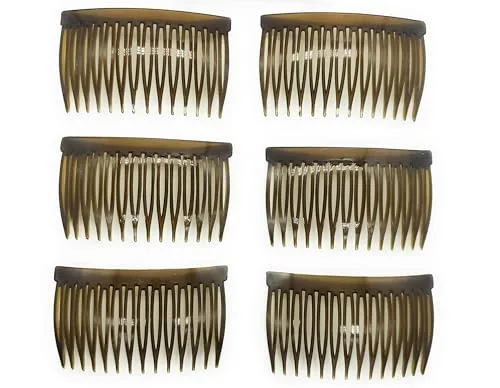
Good Hair Days USA Anti-Slip Side Combs (6 Pack)
Three matching pairs of curved side combs for under ten dollars, which is the cheapest honest way to find out whether combs suit your hair before spending more..
We tested dozens of claw clips to find the very best options. Below you'll find our complete ranking, with detailed reviews and real customer feedback for each pick.
The Complete Ranking
Three matching pairs of curved side combs for under ten dollars, which is the cheapest honest way to find out whether combs suit your hair before spending more.
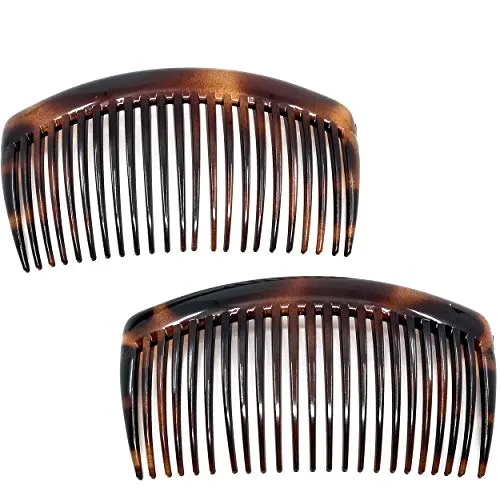
At 4 inches this is the length that actually closes on a full twist rather than just pinning the surface. Cellulose acetate, made in France.
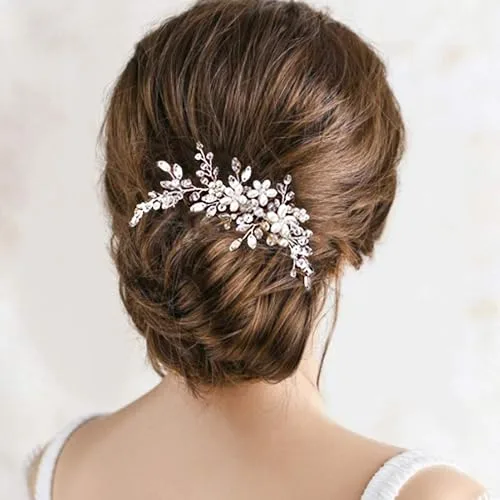
A bendable pearl-and-crystal branch rather than a rigid comb, so it follows an updo instead of fighting it. The decorative end of the category.
Quick Comparison
A side-by-side look at our top picks
Frequently Asked Questions
What are decorative hair combs called?
How do you keep a hair comb from falling out?
Are hair combs better for your hair than claw clips?

Donna Miller
Enjoyed This Guide?
Get more hair tips and product recommendations delivered weekly.