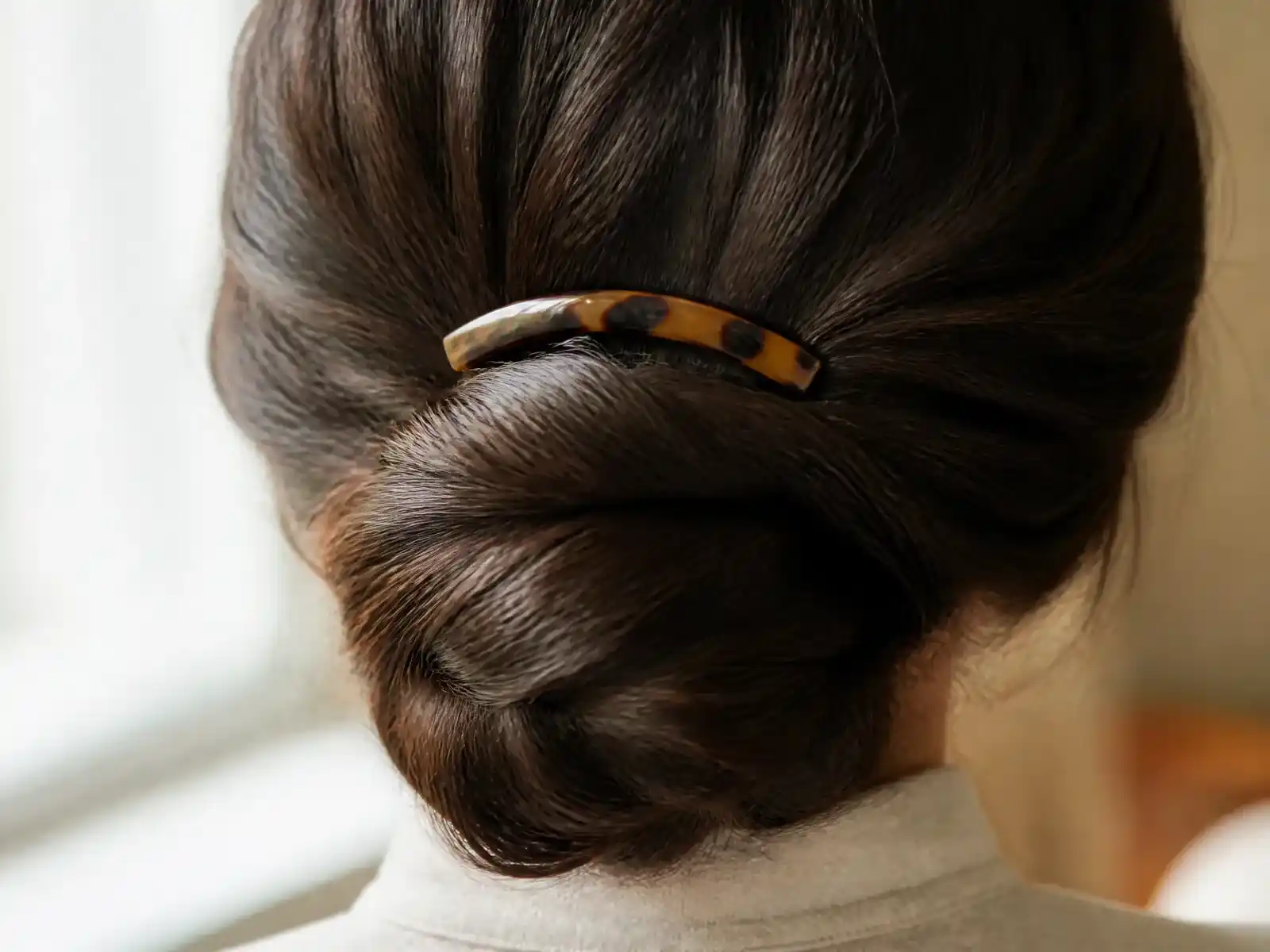
- Why a french pin for thick hair falls out
- How to choose a french hair pin for thick hair
- HYFEEL French Hair Forks: best overall for thick hair
- Tiefebene Prestige French Hair Pins: best value, with a caveat
- hisial Metal French Hair Pins: the stiffest prongs here
- Benefree Cellulose Acetate French Hair Pins: the widest prong gap
- Kitsch French Hair Pin: one pin that reads as jewellery
- Technique: using a french hair pin on long, thick hair
- If it still slips: a five-minute triage
- One note on tension
- The bottom line
A french pin for thick hair needs three specs, in this order: length of at least four inches so the prong can cross the twist and re-enter hair on the far side, a wide prong gap that swallows a dense section instead of squeezing it, and prongs stiff enough not to splay under the weight.
Best Claw Clips is reader-supported. When you buy through links on our site, we may earn an affiliate commission at no extra cost to you.
Get those three right and a budget pin outperforms a designer one. Get them wrong and no technique saves you. Below we rank five pins against length, gap and stiffness in that order, then cover the technique changes dense hair needs — because a correctly specced pin used the old way still ends up on the floor by lunchtime. If you are not sure which shape you are shopping for, our guide to the types of french hair pins covers the format first.
Why a french pin for thick hair falls out
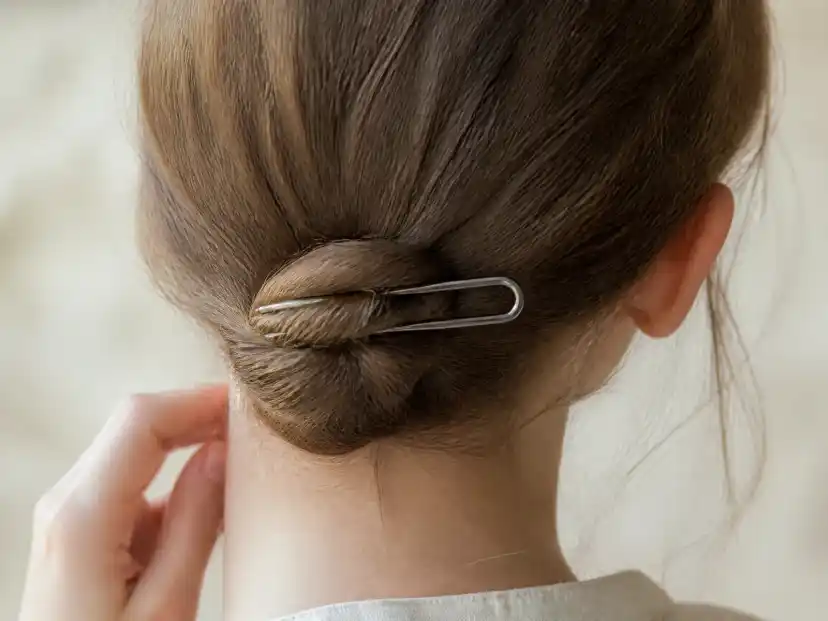
A french pin — sold interchangeably as a hair fork — has no hinge, no spring and nothing that closes. It is a lever: one prong slides into the twist, the pin rotates roughly half a turn, and the second prong drives down through the bun and out into the hair on the far side. All the holding power comes from the hair trapped inside that arc, and dense hair attacks it three ways.
It runs out of pin. A heavy chignon can be well over an inch deep. A short prong enters the mass, spends its whole length inside it and emerges with a quarter inch to spare — not enough to catch anchor hair. Every head turn then walks it further out until gravity finishes the job. The answer is length.
It refuses to be compressed. Thick hair is springy. Force a wide section between two closely set prongs and the hair pushes back, levering the pin outward across an afternoon. That slow creep is not a technique problem. The answer is prong gap.
It bends the pin. Hang enough weight off two thin prongs and they splay. Once the gap widens under load the pin stops gripping and drops out. The answer is stiffness.
Rank any pin on those three, in that order. Length comes first because a short pin fails immediately; the other two decide how long the hold lasts.
How to choose a french hair pin for thick hair
Length: four inches is the floor
Hair fork retailer Long Haired Jewels publishes a rough sizing chart that puts thick hair at shoulder length on a 4-inch fork and thick hair between waist and tailbone on a 5-inch fork — in every row, longer than it recommends for fine hair at the same length. Its own caveat is worth repeating: with hair forks, it says, there is no such thing as one size fits all. The pins here whose listed length we trust run 3.9 to 4.33 inches, covering shoulder-to-mid-back on dense hair.
For a number that fits your own head, the same guide describes a neat test: put your hair up in your usual bun, push a pencil through it like a hairstick, mark where it enters and exits, then measure between the marks and add an inch to an inch and a half. That is your prong length. For what it unlocks, our guide to french hair pin styles for long hair works through the styles that hold and the ones that quietly do not.
Prong gap: wide enough to swallow the section
Almost nobody prints prong gap, which is why buyers skip it. Judge it from the listing photograph: you want prongs that look parallel and generously spaced, not pinched at the tips. Beautiful Life by Paula puts it plainly, advising that if you are shopping for the best hair forks for thick hair or long hair, you want large hair prongs. One pin below does print the number, which is why it earns a slot.
Stiffness: prongs that hold their shape
Stiffness is the tiebreaker rather than the headline, because a stiff pin that is too short still fails. Sellers do talk about it: hisial says its alloy pins are lightweight and sturdy and not easy to deform, and HYFEEL describes a thicker pin that does not break easily. Both are listing claims, not measured figures. The practical test, in our experience: hold a pin by its bridge and press the prong tips together. If they meet without protest, they will splay inside a heavy twist too.
Where the thick-hair spec inverts
All three specs run backwards for low-density hair. Kov Essentials, which publishes its own french pin guide, tells fine-haired readers to use a smaller bun and push the pin in at a steeper angle so the prongs grab more hair — the opposite of the wide, shallow bite dense hair needs. If that describes you, read our picks for the best french hair pins for fine hair instead, or you will end up with a long fork rattling around in a bun too small to fill it.
HYFEEL French Hair Forks: best overall for thick hair
The HYFEEL French Hair Forks win on the spec that matters most. HYFEEL lists them at 4.3 inches, and on shoulder-to-mid-back hair that is enough prong to cross a dense twist and still re-enter hair on the far side. They are cellulose acetate rather than plated metal, which keeps a 4.3-inch pin light enough that it does not add to the load it holds, and HYFEEL specifies a glossy surface and a thicker pin that does not break easily. Three to a pack in blue and tortoise shell, $12.99 as of August 2026 — the priciest pick here, and the one to buy if you are only buying one. One honesty note: HYFEEL's own copy calls this a medium large hairpin suitable for thick or fine, long and shorter hair. That is marketing breadth, not a fit statement.
Tiefebene Prestige French Hair Pins: best value, with a caveat
The Tiefebene Prestige French Hair Pins carry the longest length we are willing to quote on this page: the listing title states 4.33 inch, large tortoise shell, and hair styling for thick hair, and four acetate pins in four shades cost $6.69 as of August 2026. Four to a pack matters more for dense hair than for anyone else, because the crossed-pin technique below uses two at a time. Tiefebene also claims an inner dual tooth structure that locks hair and prevents slippage; treat that as a design description rather than a proven result.
The caveat: the same listing also pitches these as ideal for fine hair in its bullets. That is a seller marketing both ways, not a spec. Act on the 4.33-inch measurement and ignore the hair-type language.
hisial Metal French Hair Pins: the stiffest prongs here
The hisial Metal French Hair Pins answer splay rather than length. These are U-shaped alloy pins, and hisial describes them as a durable alloy with a smooth electroplated surface, lightweight and sturdy, and not easy to deform. Six come in a clear storage box for $7.99 as of August 2026, the lowest cost per pin here.
They rank third for one reason: at 3.9 inches, per hisial's listing, they are the shortest pins here, and our order puts length above stiffness. That is fine for a mid-size bun, marginal for a full chignon on long, heavy hair. Buy these if your twist is modest but your hair is coarse enough to force acetate prongs open.
Benefree Cellulose Acetate French Hair Pins: the widest prong gap
The Benefree Cellulose Acetate French Hair Pins are here for one number: the package bullet lists a 1.2-inch width, the widest documented prong gap in this set. Gap decides whether the pin swallows your section or squashes it, and squashing produces the slow afternoon creep. Two tortoise-shell pins in two colours, $6.99 as of August 2026.
Benefree describes the acetate as having a smooth edge that slides into a bun without hair damage. The honesty note here is bigger than usual: the listing contradicts itself on length, the title and the package bullet giving different figures, so we will not quote a length for it at all. Buy it for the width, and pair it with a pin whose length you trust.
Kitsch French Hair Pin: one pin that reads as jewellery
The Kitsch French Hair Pin is the odd one out: a single zinc alloy pin at $9.93 as of August 2026, more than every multipack here except the HYFEEL three-pack. You are paying for finish. Kitsch specifies a smooth anti-rust surface, says the pin glides through hair without snagging, and describes ergonomic curves that distribute tension evenly. On dense hair the rigid alloy body is a real advantage over thin acetate, and the plating matters because a rough prong dragged through a lot of hair is how snagging starts. The limitation is arithmetic: it is one pin, and the technique below wants two.
Technique: using a french hair pin on long, thick hair
A correctly specced pin used the old way still falls out. Five adjustments:
- Start on second-day hair. Kov Essentials is blunt: a french pin works best on second-day hair or hair with a little texture, because freshly washed, slippery hair is harder to grip. L'Oréal Paris says the same of the French twist — it works best with some stick in your hair, and if your hair is too clean, pieces can easily fall loose. Dry shampoo through the roots fixes it in thirty seconds.
- Halve the mass. Birchbox's thick-hair advice is to split the weight of your hair by sectioning off a top portion to create a second twist. Kov Essentials gives the chignon version: divide your hair into two sections before twisting, layer them into the bun shape, then pin through both layers. Two anchored twists beat one enormous one, because grip scales with contact points rather than pin size.
- Take a smaller bite than feels right. The prong has to complete its rotation. Overload it and the pin jams halfway, which feels like the pin will not go in but is really the pin failing to lock.
- Anchor into the underside. Catch hair close to the scalp underneath the twist, not the loose surface of the bun, which has nothing behind it to brace against.
- Cross two pins. For extra hold on thick hair, Kov Essentials advises using two pins crossing at a slight angle through the bun. Set at opposing angles they brace against each other, so neither can rotate its way out alone.
If it still slips: a five-minute triage
Stop at the first item that is true.
- The twist is too loose. Kov Essentials names this as the usual culprit when a pin keeps slipping: the hair is too smooth or the twist is too loose. Retwist with real tension before you reach for the pin.
- Too much hair on the prong. If the half-turn feels jammed rather than progressively tighter, back the pin out and take a thinner section.
- The pin is standing proud. After the rotation, push it flat against the head. A pin left sticking out gets unseated by the first shoulder check.
- The pin is too short. Run the pencil test above; if your measurement plus an inch exceeds your pin, no technique will save it.
- It is the wrong tool for the day. L'Oréal Paris advises that if your hair is thick or extremely long, you should consider larger clips rather than bobby pins, because they give the stronger hold a heavy head of hair needs. On a rushed morning we agree: our roundup of large claw clips for heavy hair covers the faster option.
One note on tension
Thick hair tempts you to pull everything back as hard as it will go, and that is the habit worth breaking. The American Academy of Dermatology warns that a tightly pulled updo constantly pulls at and damages the health of your hair, that the resulting condition is called traction alopecia, and that if your hairstyle feels painful, the style is too tight. It advises loosening the style so it does not pull and switching styles regularly so hair can recover. Conveniently, the two-twist method is gentler as well as more secure.
The bottom line
Buy on length first. On dense, shoulder-to-mid-back hair four inches is the working floor, which makes the HYFEEL forks at a listed 4.3 inches the safest single purchase. The Tiefebene four-pack is the cheapest route to real length plus a second pin for the crossed hold, hisial is the stiffest if splay is your failure mode, Benefree brings the widest documented gap, and Kitsch is the one you wear when the pin is meant to be seen.
Then change the technique: two twists instead of one, a smaller bite of hair, an anchor on the underside, two pins crossed. That is what turns french hair pins from a pretty accessory into something that survives a working day on heavy hair.
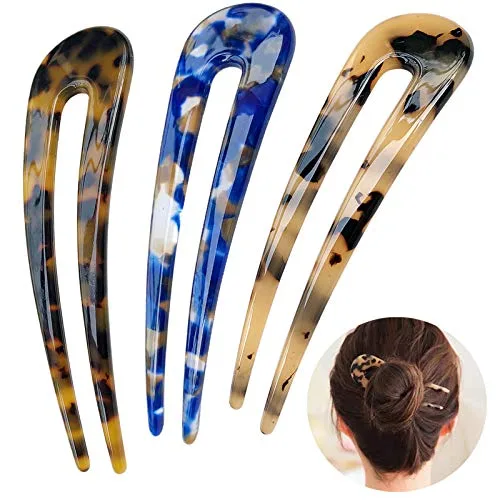
HYFEEL French Hair Forks, Cellulose Acetate (3 Pack)
At 4.3 inches this is long enough to cross a dense twist and re-enter the hair on the far side, which is the whole problem with thick hair — a short pin pivots straight back out.
We tested dozens of claw clips to find the very best options. Below you'll find our complete ranking, with detailed reviews and real customer feedback for each pick.
The Complete Ranking
At 4.3 inches this is long enough to cross a dense twist and re-enter the hair on the far side, which is the whole problem with thick hair — a short pin pivots straight back out. Acetate keeps it light despite the size.
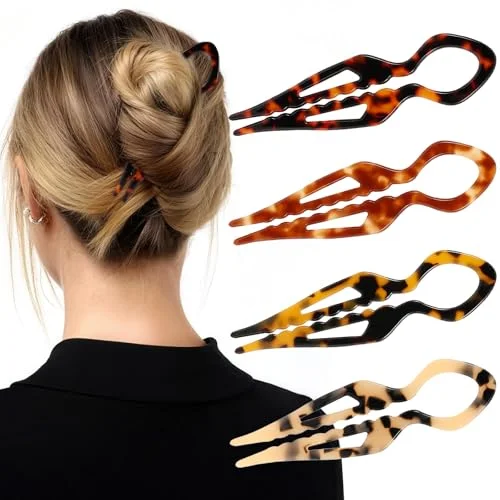
The cheapest way to get real length: 4.33 inches, four to a pack, so you can run two pins through a heavy chignon without buying twice. Tortoise acetate rather than plated metal.
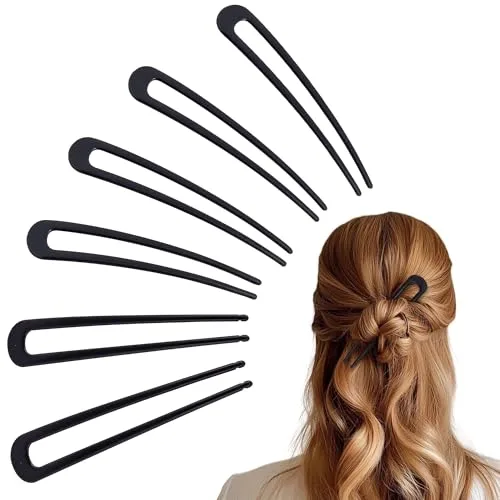
Alloy rather than acetate, so the prongs resist splaying under a heavy twist — the failure mode that ends thick-hair updos. Six to a box at 3.9 inches, the shortest here but the stiffest.
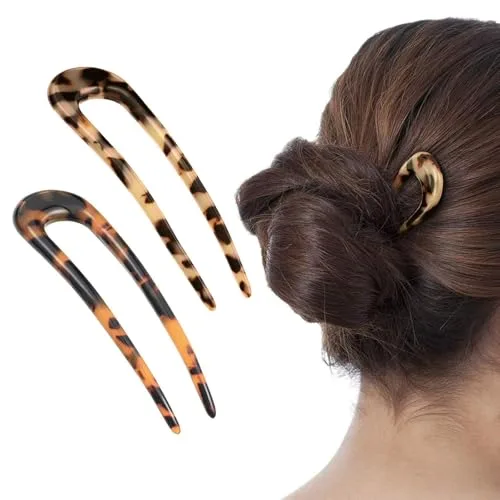
The widest prong gap in this set at a listed 1.2 inches. Gap is what lets the pin swallow a thick section instead of compressing it, and compression is what makes a pin creep out over an afternoon.
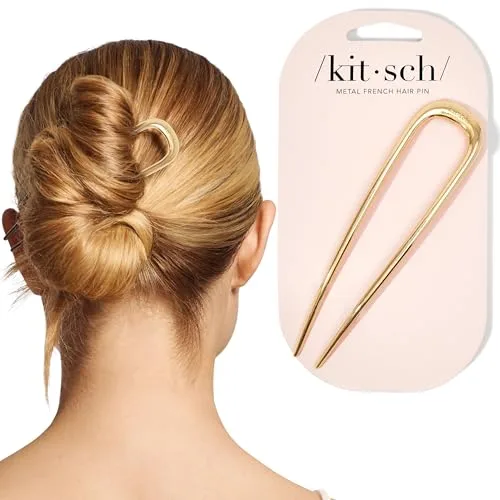
One pin, zinc alloy, smooth enough to pass through dense hair without snagging. Buy it when you want a single pin that looks like jewellery rather than hardware.
Quick Comparison
A side-by-side look at our top picks
Frequently Asked Questions
What length french pin do I actually need?
Why does my pin hold for an hour and then creep out?
Can a french pin damage thick hair?

Donna Miller
Enjoyed This Guide?
Get more hair tips and product recommendations delivered weekly.