- Why a french pin slips out of fine hair
- How to choose the best french hair pins for fine hair: invert the thick-hair spec
- Twoheadpig Prestige Curved French Hair Pins: our pick for fine hair
- Kitsch French Hair Pin in Hematite: the slim metal option
- BEoffer French Hair Pin: the multipack that lets you use two
- AWAYTR U-Shaped Acetate Forks: the lightest set here
- Technique: how to make a french hair pin for fine hair hold
- Two small pins beat one large pin
- When a french pin is the wrong tool
- A note on tension and your hairline
- What we would buy
The best french hair pins for fine hair are short, light and narrow-gapped — roughly 3 to 3.5 inches at shoulder length, longer only if your hair is, with prongs set close enough to compress a small section, and a surface with some texture to it. Fine hair supplies less friction than thick hair does, so a bigger pin does not grip harder. It just sinks.
Best Claw Clips is reader-supported. When you buy through links on our site, we may earn an affiliate commission at no extra cost to you.
That is the part most buying guides get backwards. Faced with a pin that keeps sliding out, the obvious move is to buy a longer, sturdier one — and it makes things worse. If the format is new to you, start with our overview of french hair pins. Below we rank four french pins for fine hair on weight, gap and surface, then spend the second half on technique, which here matters more than the product.
Why a french pin slips out of fine hair
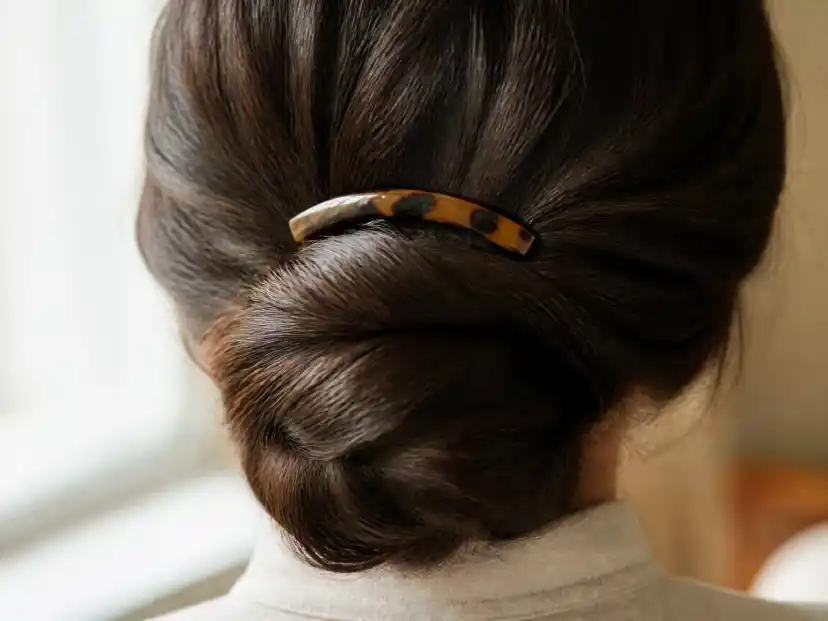
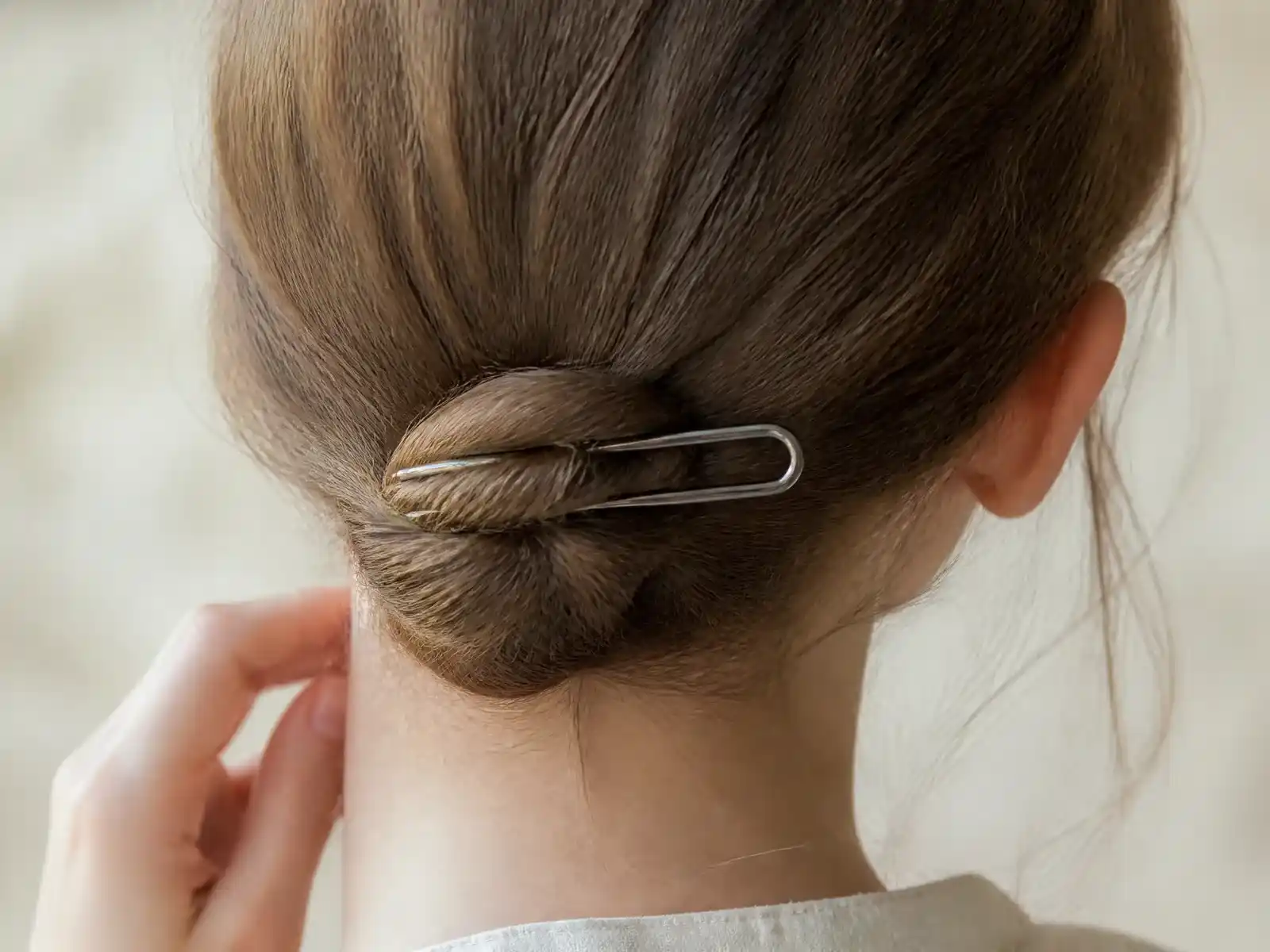
A french pin, sold interchangeably as a hair fork, has no hinge and nothing that closes. One prong enters the twist, the pin rotates roughly half a turn, and the second prong drives down through the bun and out into the hair on the far side. Everything holding your style up is the hair trapped inside that arc, pressing against itself. That is a friction machine, and fine hair is a poor supplier of friction. As RevAir explains, fine hair refers to the diameter of each individual strand, and a fine strand is narrow, which means it has less cortex — the protein-rich inner structure that gives hair strength and elasticity. Narrow strands catch on each other less, so they slide. Two effects follow:
- The twist is thinner than the pin expects. A section an inch deep on dense hair might be a third of that. A long prong passes clean through and out the other side with nothing gripped.
- Weight works against you. On thick hair the mass of the bun presses down onto the prongs and helps seat the pin. Fine hair cannot do that, so a heavy pin becomes the heaviest thing in the style and levers itself out.
One clarification: fine is strand diameter, thin is density. RevAir defines thin, or low-density, hair as the number of strands on your head rather than the size of those strands. Anyone shopping for french hair pins for thin hair usually has both, and everything below covers either.
How to choose the best french hair pins for fine hair: invert the thick-hair spec
If you have read our picks for the best french hair pins for thick hair, everything here runs the other way. That guide ranks on length first, then a wide prong gap, then stiffness. For fine hair, reverse all three.
Shorter, not longer. Long Haired Jewels publishes a rough hair fork sizing chart whose fine-hair column runs shorter than its thick-hair column at every hair length: 3.5 inches for fine hair at shoulder length, and 4 inches at waist to tailbone where thick hair gets 5. Keep its own caveat in mind — with hair forks, it says, there is no such thing as one size fits all. Our rule of thumb: start around 3.2 to 3.5 inches and size up only if the prongs emerge from the far side of the twist with room to spare.
Narrow gap, not wide. Thick hair needs a gap wide enough to swallow a dense section without squeezing it. Fine hair needs the opposite: prongs close enough that the little hair between them is genuinely compressed. A wide fork in a slim twist leaves the section rattling loose.
Textured or small, not big and slick. Grip has to come from somewhere. On a thick twist the hair supplies it. On fine hair you want either a textured prong surface or a pin small enough that the friction available is enough. A large, highly polished pin is a slide waiting to happen.
Light, always. A heavier pin only adds load to an anchor that is already weak.
Twoheadpig Prestige Curved French Hair Pins: our pick for fine hair
The Twoheadpig Prestige Curved French Hair Pins are the only pins in this set with published dimensions, and the numbers land where fine hair wants them: Twoheadpig lists 3.2 by 1.1 by 0.2 inches. That is 3.2 inches of pin overall — a listed length, not a measured prong — and 1.1 inches across the widest point, which puts the gap between the prongs narrower still. Long Haired Jewels puts fine hair at shoulder length on 3.5 inches, its shortest fine-hair row, so this sits just under even that.
More usefully, this is the one pin here whose seller claims a textured working surface. Twoheadpig describes a Serrated Anti-Slip Design on an acetate board, plus a curved angle for a better head fit. Serration is a design description rather than a measured result, but it is the right idea: on fine hair, texture on the pin substitutes for the friction the hair is not producing. Four pins at $9.99 as of August 2026, which also gives you the pairs the technique below wants.
One honesty note: the same listing markets this both as a prestige pin for fine hair and as suitable for thin or thick hair. That is marketing breadth. Buy it for the 3.2 inches and the serration.
Kitsch French Hair Pin in Hematite: the slim metal option
Acetate has a floor. Below a certain thickness an acetate prong flexes, and a flexing prong cannot complete the rotation that locks the pin. Metal has no such floor, which is the argument for the Kitsch French Hair Pin in hematite — a single zinc alloy pin with a thin cross-section that does not go floppy. Kitsch markets it as lightweight and travel friendly.
The dark hematite finish is the other reason it is here: on a small twist there is little hair to hide hardware behind, and this one disappears in brown or black hair.
Two limits. Kitsch publishes no prong length we will quote, so you buy on shape rather than measurement. And it is one pin at $9.99 as of August 2026, more than either multipack below — awkward when the fine-hair technique wants two. Kitsch's claim of a no-slip hold on thick, thin, curly or straight hair covers every base at once; judge the pin on its slim profile instead.
BEoffer French Hair Pin: the multipack that lets you use two
The BEoffer French Hair Pin 3-pack is the cheapest route to two matching pins, at $6.29 as of August 2026, discounted from a $6.99 list price as of the same date. You get gold, silver and black: one colourway you wear constantly and two spares, which matter because a small pin in a small twist is easy to lose.
BEoffer describes nicely rounded tips and a smooth rubbed finish that glides without pulling, plus a U-shaped curved profile said to sit against the head. Those are seller descriptions, and rounded-and-smooth cuts both ways on fine hair: kinder going in, less grippy once in. If you buy these, lean harder on the texture step below.
BEoffer also claims these do not leave the dents or creases a claw clip does — the brand's claim, not our finding. No published dimensions, so we will not quote a length.
AWAYTR U-Shaped Acetate Forks: the lightest set here
Six cellulose acetate pins for $6.99 as of August 2026 makes the AWAYTR U-shaped acetate forks the lowest cost per pin here, and acetate is the material that keeps mass down. A light pin should never outweigh the section it is holding.
AWAYTR says these are lightweight and will not pull or damage hair, unlike elastics or claw clips, and markets them for thick, thin, curly or straight hair. Both are listing claims and the second is broad enough to be meaningless. What we would buy them for is quantity: enough pins to keep a pair in every bag. No published dimensions here either, so treat length as unknown.
Technique: how to make a french hair pin for fine hair hold
On thick hair a well-specced pin covers for sloppy technique. On fine hair it does not. Five changes, in the order we would make them:
- Build a tighter base. This is the whole game. TELETIES advises creating tighter twists and using smaller sections so the pin has more grip, and its FAQ answer for a pin that will not stay is to try twisting your hair more to create extra tension. A loose twist gives the prongs nothing to lever against.
- Style on day-two hair. Kov Essentials, which publishes a french pin guide, says a french pin works best on second-day hair or hair with a little texture, and that freshly washed, slippery hair is harder to grip. On wash day, its suggestion is to run a small amount of dry shampoo through before you start.
- Add texture on purpose. TELETIES also suggests teasing, a texturizing spray or a texturizing powder to create a grippier surface that will help keep the pin in place. Living Proof makes the same connection, noting that texture can give your hair grip, volume and definition. Spray the mid-lengths, not the roots, then twist.
- Take a smaller bite. TELETIES advises anchoring close to the scalp and catching a small section of hair underneath. On fine hair, smaller still — a prong that swallows half the twist cannot rotate, and a pin that cannot rotate cannot lock. Kov Essentials arrives at the same place from the other direction, recommending a smaller bun and pushing the pin in at a slightly steeper angle so the prongs grab more hair.
- Push it flat. Finish the rotation and press the pin down against the head. A pin left standing proud gets unseated by the first head turn.
Two small pins beat one large pin
The most useful habit we have on fine hair: stop asking one pin to hold everything. Two short pins entering the twist from different angles — one low near the nape, one higher in the roll — split the load, so when one loosens the style does not collapse. Each pin then holds half a section, which is exactly the amount of hair a short, narrow pin is good at. That is our judgement rather than a manufacturer instruction, and it is why we weighted multipacks so heavily above.
If two pins still leave a section drifting loose, the fix is a smaller anchor rather than a bigger pin. A couple of bobby pins tucked under the roll will hold the wisps a fork cannot reach, and our picks for the best bobby pins for fine hair cover which ones do that without sliding straight back out.
When a french pin is the wrong tool
We would rather say this than sell you a pin that will not work. A french pin needs a twist deep enough for the prongs to pass through and re-enter hair. If your hair is both very fine and shorter than about chin length, there may not be enough material to build that twist, and no texturising product creates hair that is not there. Same answer if you want something you can take in and out one-handed all day.
A clip is the more honest tool in both cases, because it supplies its own grip mechanically instead of borrowing yours. Our guide to the best claw clips for fine hair covers what matters there — closely spaced teeth, matte surfaces, and sizing down rather than up, the one rule that carries across both formats.
A note on tension and your hairline
A pin holds by leverage rather than by squeezing, so a secure style need not be a tight one. Do not give that away by cranking the twist to compensate for a slippery base.
The American Academy of Dermatology's guidance on hairstyles that pull is a useful line to keep: if your hairstyle feels painful, the style is too tight. It also advises switching up your hairstyle regularly so your hair can recover from tight styles, and lists warning signs including broken hairs around your forehead, a receding hairline and patches of hair loss where hair is pulled tightly. Fine hair gets no pass on any of that. Move where you anchor the pin from one day to the next.
What we would buy
Start with the Twoheadpig four-pack: the shortest and narrowest pin here, the only one with a published measurement, and the only one whose seller claims a textured anti-slip surface — $9.99 as of August 2026 for four. For a dark, slim metal pin that vanishes in brown hair, add the Kitsch hematite. If you mainly want quantity so you can practise the two-pin habit, the AWAYTR six-pack at $6.99 as of August 2026 is the cheapest route in.
Whichever you buy, spend your effort on the base rather than the hardware. Tighter twist, day-two texture, smaller bite, two pins instead of one. For the format itself — the shapes, the insert-and-rotate motion and how a fork differs from a hairstick — our french hair pin guide is where to go next.
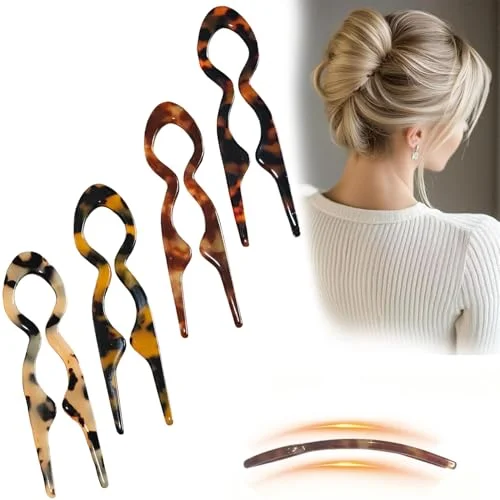
Twoheadpig Prestige Curved French Hair Pins, 3.2 Inch (4 Pack)
The narrowest, lightest pin here at 3.2 by 1.
We tested dozens of claw clips to find the very best options. Below you'll find our complete ranking, with detailed reviews and real customer feedback for each pick.
The Complete Ranking
The narrowest, lightest pin here at 3.2 by 1.1 by 0.2 inches, and the only one whose seller specifically claims a serrated anti-slip edge — texture is how you replace the friction fine hair does not supply on its own.
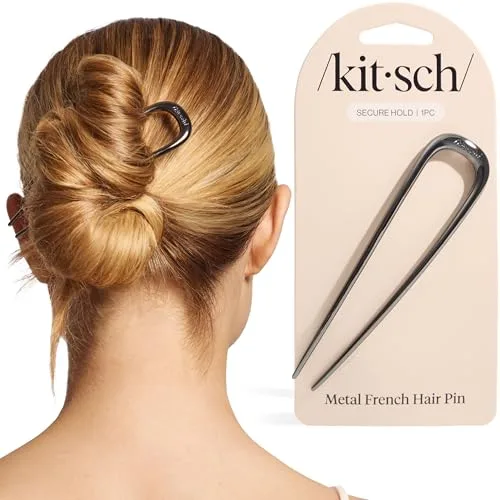
A single slim alloy pin. Metal lets you get a thin cross-section without a floppy prong, which is the trade acetate cannot quite make at this size.
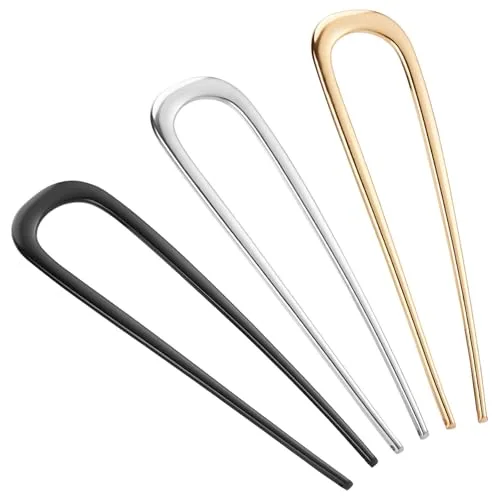
Rounded tips and a rubbed finish, three to a pack. On fine hair the useful move is two small pins in different places rather than one big pin doing all the work.
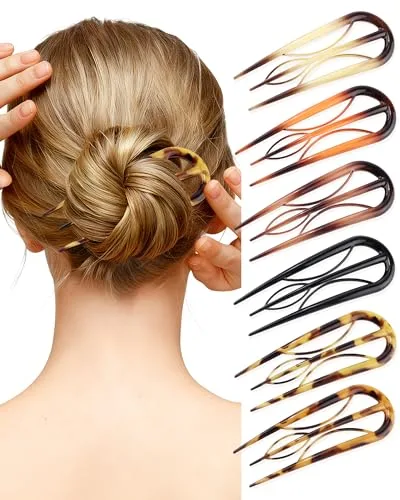
Acetate, six to a pack, light enough that the pin does not outweigh the section it is holding. The seller pitches them against elastics and claw clips on comfort.
Quick Comparison
A side-by-side look at our top picks
Frequently Asked Questions
Will a french pin actually stay in fine hair?
Should I size up or size down for fine hair?
Why does my french pin slip out after ten minutes?

Donna Miller
Enjoyed This Guide?
Get more hair tips and product recommendations delivered weekly.