- What Are Bobby Pins?
- Types of Bobby Pins by Size
- Types of Bobby Pins by Material
- Types of Bobby Pins by Style
- Best Bobby Pins by Hair Type
- How to Use Bobby Pins Correctly
- Bobby Pin Hairstyles
- Hair Health and Bobby Pins
- Bobby Pins vs Similar Accessories
- Care and Storage
- Where to Buy Bobby Pins
- Premium Bobby Pin Brands
- FAQs
- The Bottom Line
You've been using bobby pins upside down your whole life. The wavy side should face your scalp, not outward—and flipping them over can improve your grip by 50% or more.
This one mistake is why your pins keep falling out. It's not the pins. It's not your hair. It's technique—and once you learn the basics, those frustrating slips become a thing of the past.
Bobby pins are the most essential hair accessory most people never learned to use correctly. These small, bent pieces of metal have been securing hairstyles since the 1920s, yet the same mistakes persist a century later.
This guide covers everything: how bobby pins actually work, which types exist, how to choose the right ones for your hair, and—most importantly—how to use them so they stay put. Whether you're securing a simple half-up style or building an elaborate updo, understanding bobby pins unlocks styling options you never knew you had.
For other hair accessory guides, see our ultimate guide to claw clips or compare bobby pins vs claw clips.
What Are Bobby Pins?
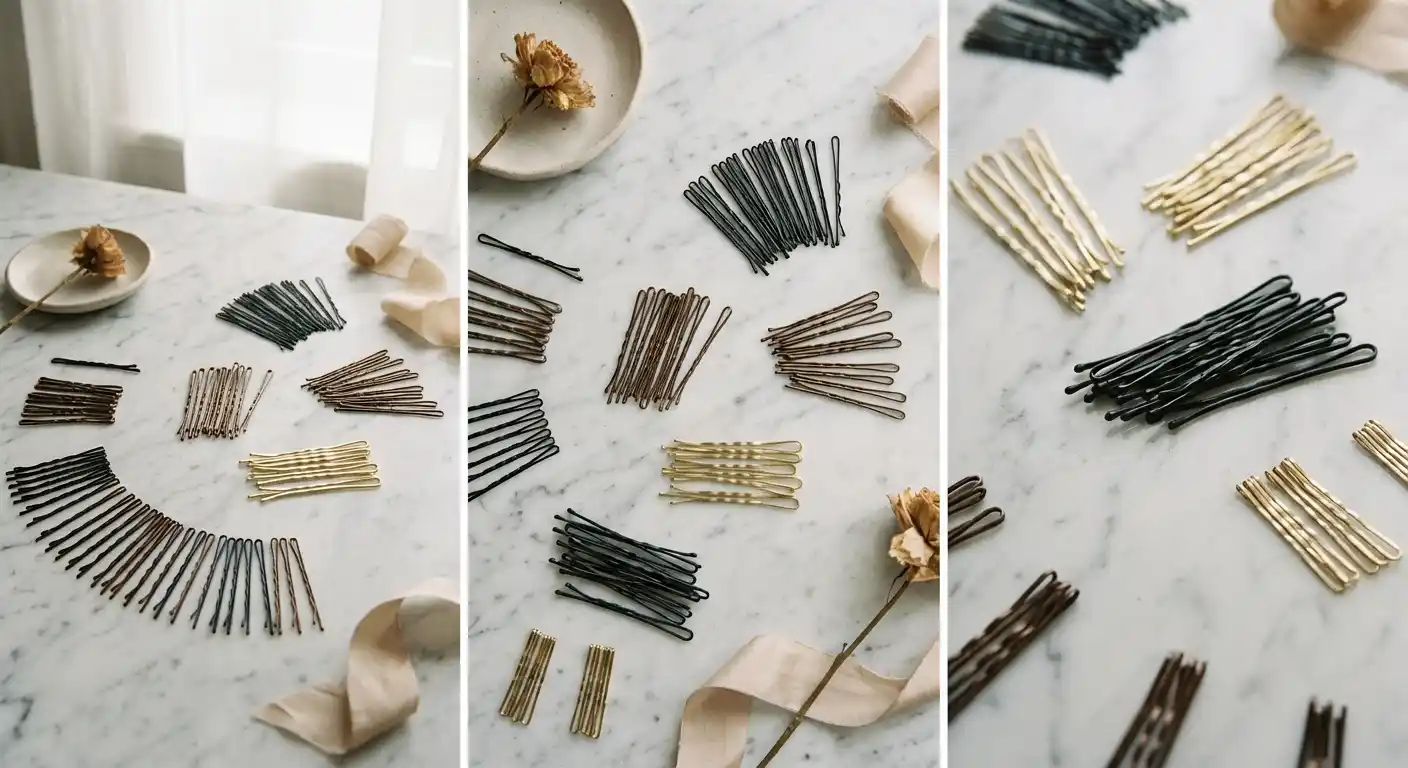
Bobby pins are small, thin hairpins made from two prongs connected at one end. One prong is straight, and the other has a wavy or crimped pattern. When squeezed together and released into hair, the prongs grip strands between them.
Basic Anatomy
| Part | Description | Function |
|---|---|---|
| Flat side | Straight, smooth prong | Sits against scalp |
| Wavy side | Crimped, textured prong | Grips and holds hair |
| Tip | Rounded or ball ends | Protects scalp from scratching |
| Bend | Curved closed end | Creates spring tension |
| Opening | Space between prongs | Determines hair capacity |
Brief History
The bobby pin was invented in the 1920s to secure the popular "bobbed" hairstyles of the flapper era. The name comes from "bob," the short haircut that required small pins to hold waves and curls in place. Before bobby pins, women used straight hairpins that provided less grip and frequently slipped out.
Luis Marcus, a San Francisco-based cosmetics manufacturer, developed the bobby pin around 1922 shortly after World War I. According to his daughter, he considered naming it the "Marcus Pin" but settled on "bobby pin" based on the bobbed hair style. He originally sold two handmade bobby pins for 35 cents—and remarkably, the basic design has remained nearly identical for over a century. Marcus lived to 102, passing away in 1990, having watched his simple invention become a staple in households worldwide.
Types of Bobby Pins by Size
Bobby pins come in three main sizes, each designed for different hair types and styling needs.
Mini Bobby Pins (1.5 inches)
Best for: Fine hair, baby hairs, delicate styling, bangs, small sections
Mini pins are shorter and often have a finer gauge wire. They're less visible in finished styles and work well for:
- Securing wispy pieces around the face
- Pinning down baby hairs
- Creating intricate styles where visibility matters
- Fine hair that gets overwhelmed by standard pins
See our complete guide: best mini bobby pins for delicate styles.
Standard Bobby Pins (2 inches)
Best for: Average hair thickness, everyday styling, most updos
The classic size that works for most people and most styles. Standard pins balance grip strength with versatility:
- General-purpose styling
- Half-up styles
- Basic buns and twists
- Securing braids
Jumbo Bobby Pins (2.5-3.4 inches)
Best for: Thick hair, heavy updos, maximum hold, long hair
Jumbo pins have longer prongs and often a stronger spring. They're essential for:
- Thick or coarse hair that overwhelms standard pins
- Elaborate updos with lots of hair
- Securing heavy buns
- Long hair that needs extra grip length
See our detailed guide: best jumbo bobby pins for thick updos.
Size Comparison
| Size | Length | Best Hair Type | Visibility | Grip Strength |
|---|---|---|---|---|
| Mini | 1.5" | Fine, thin | Low | Light |
| Standard | 2" | Average | Medium | Medium |
| Jumbo | 2.5-3.4" | Thick, long | Higher | Strong |
Types of Bobby Pins by Material
The material and coating affect durability, grip, and how gentle pins are on hair.
Steel (Most Common)
Standard bobby pins are made from carbon steel wire, bent and shaped, then coated for protection. Steel provides good spring tension and durability at low cost.
Pros: Affordable, widely available, reliable grip Cons: Can rust if coating chips, may snag hair if damaged
Stainless Steel
Higher-quality pins use stainless steel, which resists rust and corrosion even without coating.
Pros: Rust-resistant, durable, maintains spring longer Cons: More expensive, less common
Coated Finishes
Most bobby pins have a coating that affects performance:
| Coating | Benefits | Drawbacks |
|---|---|---|
| Enamel | Smooth, color options | Can chip over time |
| Rubber-tipped | Gentle on scalp | Tips can wear off |
| Matte | Extra grip, less visible | May feel rougher |
| Powder-coated | Durable, good grip | Limited colors |
Decorative Materials
Fashion bobby pins incorporate additional materials:
- Pearl or rhinestone accents: For special occasions
- Enamel designs: Colored patterns and shapes
- Gold or silver plating: Elevated everyday styling
- Fabric-wrapped: Softer look, gentler grip
Types of Bobby Pins by Style
Beyond the classic bobby pin, several variations exist for specific purposes.
Standard Bobby Pins
The classic U-shaped pin with one straight and one wavy prong. Works for general styling and is what most people picture when they think "bobby pin."
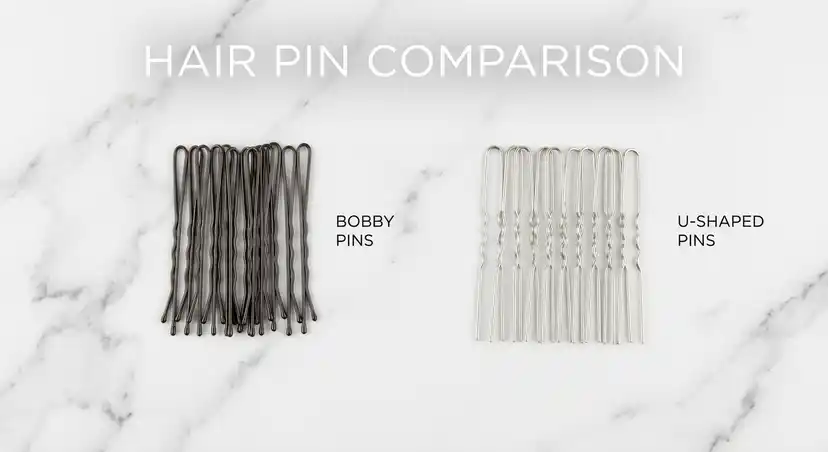
U-Pins (Hairpins)
U-pins have two straight prongs of equal length with no wavy side. They're designed for buns and updos, sliding into twisted hair to anchor it in place. Unlike bobby pins, they don't grip by squeezing; they anchor by weaving through hair. The Conair Curved Bobby Pins/U-Pins are excellent for this purpose.
Learn more: bobby pins vs hair pins: what's the difference.
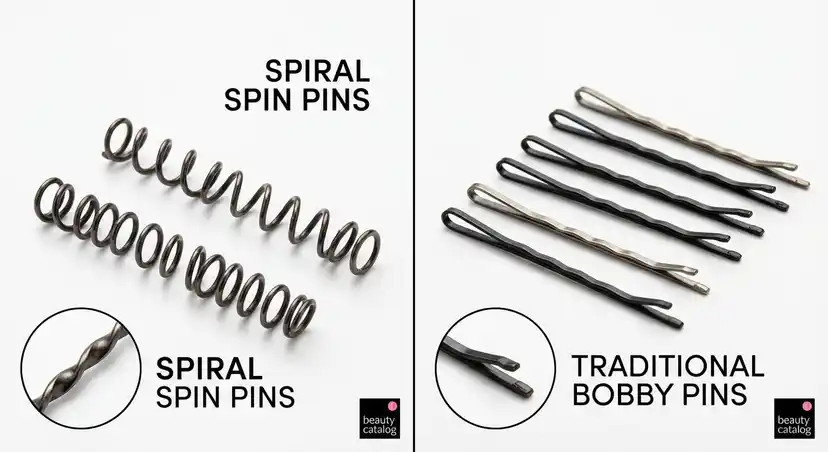
Spin Pins (Spiral Pins)
Corkscrew-shaped pins that twist into buns instead of sliding in. They hold more hair with fewer pins and work especially well for thick hair.
Compare options: spin pins vs bobby pins: which holds better.
Crinkle Pins
Both prongs have a wavy texture for extra grip. These are particularly good for slippery hair that slides out of standard pins.
Fringe Pins
Extra-short pins designed specifically for bangs and fringe styling. They stay hidden while keeping face-framing pieces in place.
Best Bobby Pins by Hair Type
Different hair types need different pin characteristics for optimal hold.
For Thick Hair
Thick hair overwhelms standard bobby pins. You need:
- Jumbo size (2.5"+ length)
- Strong spring tension
- Textured grip surface
Top features: Extra-long prongs, reinforced bend, matte or textured coating
The MORGLES 3.15 Inch Jumbo Bobby Pins are specifically designed for thick hair, gripping twice as much hair as standard pins.
See our full guide: best bobby pins for thick hair.
For Thin Hair
Thin hair shows pins easily and can be weighed down by heavy pins:
- Mini or standard size
- Lightweight construction
- Color-matched to hair
Top features: Fine gauge wire, subtle finish, secure-grip coating
See our full guide: best bobby pins for thin hair.
For Fine Hair
Fine hair (small strand diameter) needs pins that won't slip:
- Textured or matte finish for grip
- Standard or mini size
- Tight spring tension
Top features: Extra-grip coating, crinkle texture, tight closure
For fine, slippery hair, the Frenchies Ultra Flocked Bobby Pins feature a velvet-like texture that creates exceptional friction.
See our full guide: best bobby pins for fine hair.
For Curly Hair
Curly hair needs pins that work with texture, not against it:
- Smooth tips to prevent snagging
- Flexible enough to navigate curls
- Open enough to accommodate curl width
Top features: Ball tips, smooth coating, slight flexibility
See our full guide: best bobby pins for curly hair.
For Long Hair
Long hair often means more weight to secure:
- Jumbo pins for updos
- Standard pins for detail work
- Multiple pins for secure styles
See our full guide: best bobby pins for long hair.
For Short Hair
Short hair (pixies, bobs) needs discreet pins that hold small sections:
- Mini pins for invisibility
- Standard pins for accent styling
- Strong grip for shorter lengths
See our full guide: best bobby pins for short hair.
Quick Reference by Hair Type
| Hair Type | Recommended Size | Key Feature | Common Issue |
|---|---|---|---|
| Thick | Jumbo | Strong spring | Pins too weak |
| Thin | Mini/Standard | Lightweight | Pins too visible |
| Fine | Standard | Extra grip | Pins slip out |
| Curly | Standard | Smooth tips | Pins snag curls |
| Long | Jumbo + Standard | Length variety | Not enough pins |
| Short | Mini | Invisibility | Hard to hide |
How to Use Bobby Pins Correctly
The difference between bobby pins that hold and bobby pins that fall out is technique, not the pins themselves.
The Right Way to Insert
Step 1: Position the pin with the wavy side facing your scalp. This is the most common mistake. The waves grip hair better when they press against your head.
Step 2: Don't open the pin wide before inserting. This weakens the spring. Instead, slide the pin into hair while keeping prongs close together.
Step 3: Point the pin in the direction of the style you're securing. If hair is going up, point the pin up. If it's going to the side, angle the pin that way.
Step 4: Push until the bend of the pin sits flush against your head. The entire length of the prongs should be in your hair, not sticking out.
Pro Tip: Think of it this way—if you can see the bend of the pin from the front, you haven't pushed it in far enough. The pin should essentially disappear into your hair.
Essential Techniques
The X-Pattern: Cross two pins over each other in an X shape for extra security at stress points. This prevents both pins from sliding in the same direction.
The Lock Method: Insert a pin, then insert a second pin in the opposite direction, catching the first pin. This locks both in place.
The Weave: For updos, weave the pin through multiple sections of hair instead of just pinning one section to your head.
Hairspray First: Spray the section with hairspray before pinning. The texture helps pins grip better, especially on clean, slippery hair.
Using quality pins makes a significant difference. The MetaGrip Premium Bobby Pins have a Japanese grip coating that holds even slippery hair all day.
For 15 detailed techniques with step-by-step instructions, see how to use bobby pins: 15 essential techniques.
Common Mistakes
| Mistake | Why It's Wrong | The Fix |
|---|---|---|
| Wavy side facing out | Reduces grip by 50%+ | Flip the pin over |
| Opening too wide | Weakens spring tension | Keep prongs close when inserting |
| Using too few pins | Causes strain on each pin | Use more pins, less tension each |
| Wrong size for hair | Can't grip properly | Match pin size to hair type |
| Pins sticking out | Visible and less secure | Push in until bend is flush |
Troubleshooting
If your bobby pins constantly fall out, see our complete troubleshooting guide: why do my bobby pins fall out: 10 fixes that work.
Bobby Pin Hairstyles
Bobby pins enable hundreds of hairstyles, from simple daily looks to elaborate updos.
Everyday Styles
- Half-up twist: Twist back the sides and pin at the crown
- Side sweep: Pin hair behind one ear for an asymmetrical look
- Pinned bangs: Keep growing-out bangs off your face
- Low twist: Twist the bottom section and pin at the nape
Professional Styles
For work-appropriate looks that stay polished all day:
- Classic French twist
- Low chignon
- Sleek pinned ponytail
- Tucked bun
See our guide: professional bobby pin hairstyles for work.
Special Occasion Styles
For weddings, galas, and formal events:
- Elaborate updos
- Vintage finger waves
- Romantic loose curls with pinned sections
- Braided crowns
See our guide: elegant bobby pin hairstyles for weddings.
Making Pins Invisible
For styles where you don't want pins to show:
- Match pin color to hair color
- Insert pins under top layers of hair
- Use the smallest pins that will hold
- Angle pins so the bend points inward
See our techniques guide: how to hide bobby pins: invisible placement techniques.
Hair Health and Bobby Pins
When used correctly, bobby pins are gentle on hair. When misused, they can cause damage.
Potential Issues
Breakage: Forcing pins into tangled hair, using damaged pins with sharp edges, or pulling pins out roughly can break strands.
Tension: Styles that pull tightly on the same spots daily can cause traction stress over time.
Scalp irritation: Pins pressing into the scalp or scratching from bare metal tips can cause discomfort.
How to Minimize Damage
- Use quality pins with smooth coatings and protected tips
- Don't reuse bent pins that have lost their shape
- Remove pins gently by sliding, not pulling
- Vary your styles so tension isn't always on the same spots
- Don't sleep in pins unless they're specifically designed for it
For complete information, see are bobby pins bad for your hair?.
Bobby Pins vs Other Accessories
| Accessory | Damage Risk | Hold Strength | Versatility |
|---|---|---|---|
| Bobby pins | Low (with proper use) | High | Very high |
| Claw clips | Very low | Medium-high | Medium |
| Elastic hair ties | Medium-high | Very high | Low |
| Scrunchies | Low | Medium | Low |
| Spin pins | Low | High | Medium |
Compare in detail: bobby pins vs claw clips: which is better.
Bobby Pins vs Similar Accessories
Bobby Pins vs Hair Pins (U-Pins)
| Feature | Bobby Pins | Hair Pins |
|---|---|---|
| Shape | Bent U with wavy prong | Open U, straight prongs |
| Grip method | Squeezing | Anchoring/weaving |
| Best for | Securing sections | Anchoring buns |
| Visibility | Can be hidden | Usually hidden in buns |
| Hold type | Friction grip | Structural anchor |
See our detailed comparison: bobby pins vs hair pins: what's the difference.
Bobby Pins vs Spin Pins
| Feature | Bobby Pins | Spin Pins |
|---|---|---|
| Quantity needed | Multiple (5-20+) | Few (1-3) |
| Best for | Any style | Buns specifically |
| Learning curve | Some technique required | Twist and done |
| Hair type | All types | Best for thick hair |
| Visibility | Can show | Usually hidden |
See our detailed comparison: spin pins vs bobby pins: which holds better.
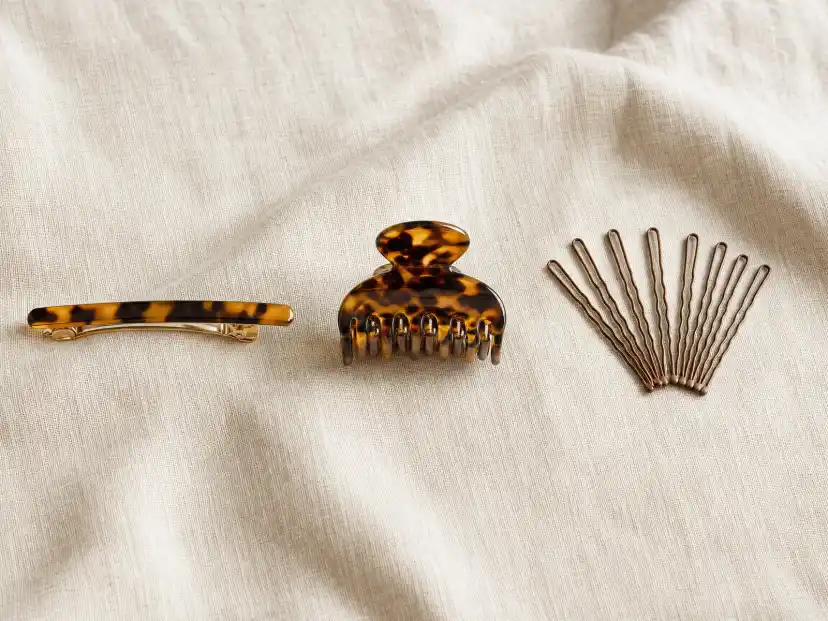
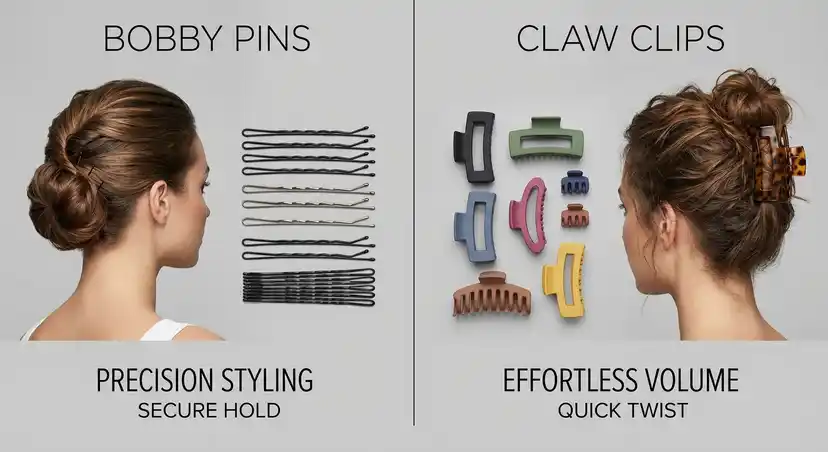
Bobby Pins vs Claw Clips
| Feature | Bobby Pins | Claw Clips |
|---|---|---|
| Speed | Slower (multiple pins) | Faster (one clip) |
| Precision | High | Low |
| Style options | Unlimited | Limited |
| Damage risk | Low | Very low |
| Best for | Intricate styles | Quick everyday |
See our detailed comparison: bobby pins vs claw clips: which is better.
Care and Storage
Proper care extends the life of bobby pins and maintains their grip.
Preventing Rust
Bobby pins can rust if the coating chips or they're stored wet:
- Dry completely before storing
- Replace damaged pins with chipped coating
- Store in dry location away from bathroom humidity
- Consider stainless steel pins for humid environments
Storage Options
| Method | Pros | Cons |
|---|---|---|
| Magnetic holder | Easy access, visible | Takes counter space |
| Tic-tac container | Portable, sealed | Hard to grab individual pins |
| Pin cushion | Cute, accessible | Pins can fall out |
| Drawer organizer | Out of sight, organized | Less convenient |
| Mint tin | Portable, protected | Small capacity |
When to Replace
Replace bobby pins when:
- The coating is chipped or peeling
- The spring feels weak (pins don't close tightly)
- Tips are missing or sharp
- Pins are bent or misshapen
- Rust spots appear
Where to Buy Bobby Pins
Drugstore Options
Pros: Affordable, convenient, available everywhere Cons: Lower quality, weaker grip, shorter lifespan Best brands: Goody, Scunci, Conair
For everyday value with decent quality, the Diane Bobby Pins 300 Pack offer smooth tips and reliable hold at an excellent price point.
Professional/Salon Brands
Pros: Better quality, stronger grip, longer lasting Cons: Higher price, less widely available Best brands: Fromm, Marianna, Diane
Premium Brands
Pros: Best quality, exceptional grip, years of use Cons: Highest price point Best brands: MetaGrip, Frenchies, Hawwwy
See our premium brand guide: best premium bobby pin brands.
Price Comparison
| Category | Price Range | Count | Cost per Pin |
|---|---|---|---|
| Drugstore | $3-8 | 100-200 | $0.02-0.04 |
| Professional | $8-15 | 50-100 | $0.08-0.15 |
| Premium | $10-25 | 20-50 | $0.20-0.50 |
What to Look For
When shopping for bobby pins:
- Match size to your hair type (mini, standard, or jumbo)
- Check the coating quality (should be smooth, even)
- Test spring tension if possible (should close firmly)
- Verify tip protection (ball tips or coated ends)
- Consider your use case (everyday vs special occasion)
Premium Bobby Pin Brands
For those who want the best performance, premium brands offer significant upgrades over drugstore options.
MetaGrip
Japanese-made pins known for exceptional grip. The coating includes grip-enhancing technology that prevents slipping even in fine or oily hair.
Frenchies
Specializes in pins for thick hair. Their flocked (textured) coating provides grip that standard pins can't match.
Fromm Pro
Salon-professional pins with matte finish for extra grip. Popular with professional stylists for updo work.
Hawwwy
Known for their spin pins, but their traditional bobby pins also offer strong grip with smooth insertion.
For complete brand comparisons and recommendations, see best premium bobby pin brands.
FAQs
Which way do bobby pins go in?
The wavy, crimped side should face your scalp. Most people use them upside down, which reduces grip significantly. The waves catch and hold hair against your head.
Why won't my bobby pins stay in?
Common causes: using them upside down, opening them too wide before insertion, using the wrong size for your hair type, or having very clean/slippery hair. See why do my bobby pins fall out: 10 fixes for solutions.
How many bobby pins do I need for an updo?
It varies by hair thickness and style complexity:
- Simple twist: 4-6 pins
- Basic bun: 6-10 pins
- French twist: 10-15 pins
- Elaborate updo: 15-30+ pins
Are bobby pins bad for your hair?
When used correctly with quality pins, bobby pins are gentle on hair. Damage occurs from using damaged pins with sharp edges, pulling pins out roughly, or wearing tight styles daily in the same spot. See are bobby pins bad for your hair?.
What's the difference between bobby pins and hair pins?
Bobby pins have one straight and one wavy prong that grip by squeezing. Hair pins (U-pins) have two straight prongs and anchor by weaving through twisted hair. They serve different purposes. See bobby pins vs hair pins.
Do bobby pins work for curly hair?
Yes, but you need pins with smooth tips that won't snag curls. Look for ball-tipped pins and use gentle technique. See best bobby pins for curly hair.
How do I make bobby pins invisible?
Match pin color to your hair, insert under the top layer, use the smallest pins that will hold, and angle pins so the bend points inward. See invisible bobby pin techniques.
What size bobby pins do I need?
- Fine/thin hair: Mini (1.5")
- Average hair: Standard (2")
- Thick/long hair: Jumbo (2.5-3.4")
See size guides for thick hair, thin hair, and fine hair.
Why do cheap bobby pins not work?
Inexpensive pins often have weak springs, poor coatings that don't grip well, and tips that scratch. They also lose tension quickly. Professional-grade pins cost more but perform dramatically better and last longer.
Can I sleep with bobby pins in?
Not recommended. Bobby pins can poke your scalp, cause discomfort, and create pressure points. For overnight styling, consider silk scrunchies or bonnets instead. See how to sleep with a claw clip for overnight hair protection options.
The Bottom Line
Bobby pins are simple tools with profound impact on what hairstyles you can achieve. Here's everything you need to remember:
- Use them right side up (wavy side toward scalp)—this single fix transforms your grip
- Match size to your hair type (mini, standard, or jumbo)
- Invest in quality for daily use (professional or premium brands pay for themselves)
- Learn proper technique (don't open wide, point in direction of style)
- Use enough pins (underpinning causes failure—when in doubt, add more)
Find Your Perfect Bobby Pin
By hair type:
- Thick hair | Thin hair | Fine hair | Curly hair | Long hair | Short hair
For technique mastery:
Considering alternatives?
The right bobby pins used correctly can secure any hairstyle you can imagine. Now you have everything you need to make them work.
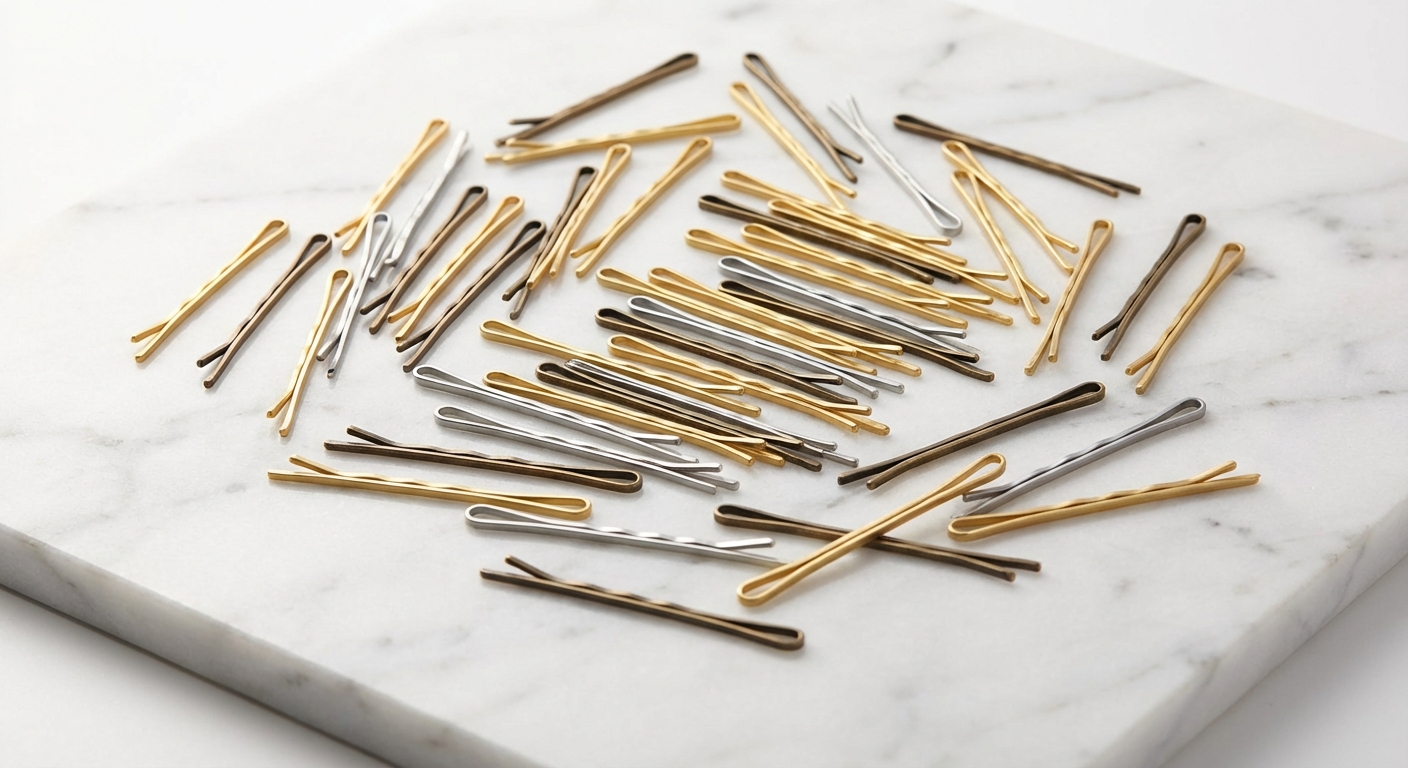
MetaGrip Premium Bobby Pins (100 Pack)
Professional-grade pins with Japanese grip coating. The benchmark for quality bobby pins—strong spring, excellent hold, and durable coating that won't chip.
“These actually grip! The coating makes such a difference compared to drugstore pins....”
We tested dozens of claw clips to find the very best options. Below you'll find our complete ranking, with detailed reviews and real customer feedback for each pick.
The Complete Ranking
MetaGrip Premium Bobby Pins (100 Pack)
“These actually grip! The coating makes such a difference com...” — Verified Buyer
Professional-grade pins with Japanese grip coating. The benchmark for quality bobby pins—strong spring, excellent hold, and durable coating that won't chip. What professionals use.
“These actually grip! The coating makes such a difference compared to drugstore pins.”
— Verified Buyer
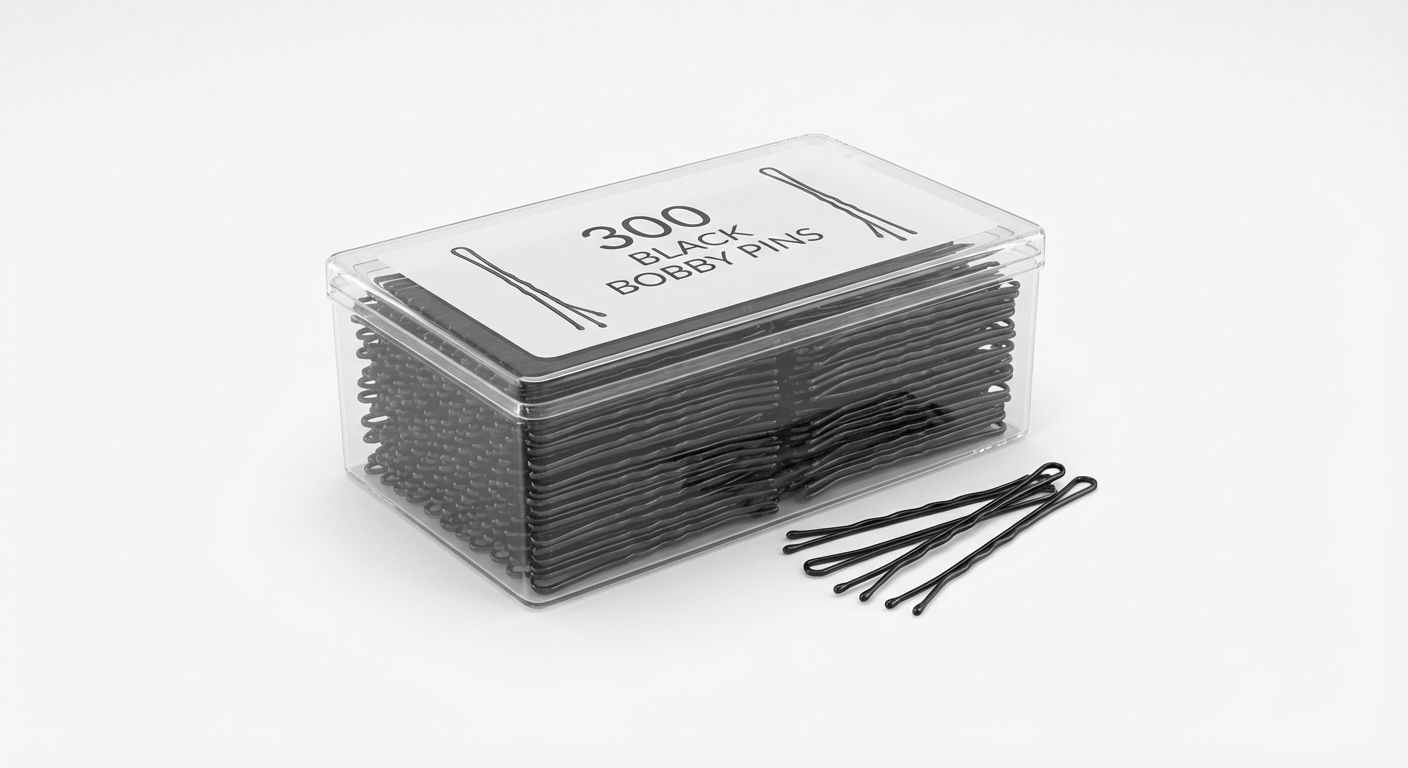
Diane Bobby Pins 1.75" (300 Pack)
“Great value and quality. My go-to everyday pins....” — Verified Buyer
Quality bobby pins at an excellent value. 300 pins means you'll always have extras, and the smooth tips protect hair from snagging. Great for everyday use.
“Great value and quality. My go-to everyday pins.”
— Verified Buyer
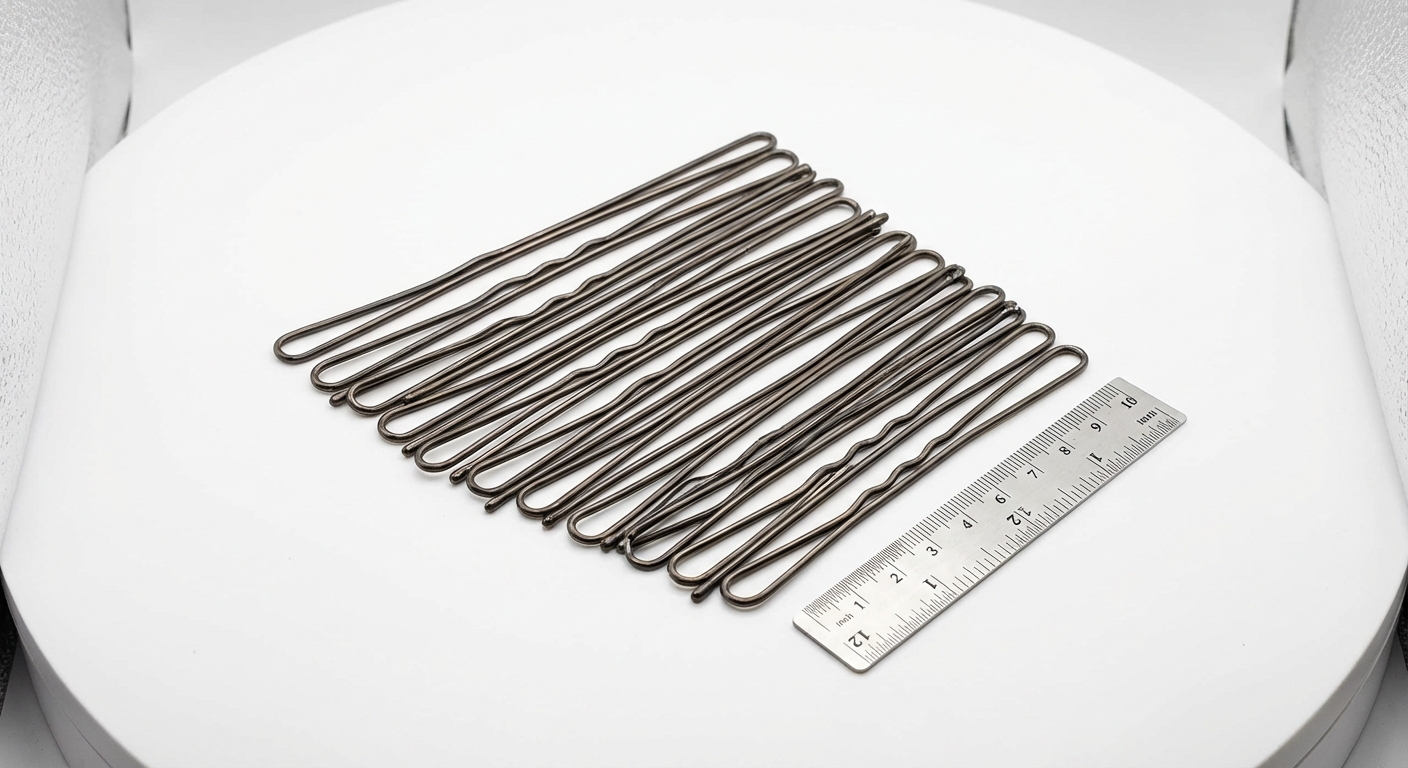
MORGLES 3.15 Inch Jumbo Bobby Pins (100 Pack)
“Finally pins that hold my thick hair! Standard pins never wo...” — Verified Buyer
Extra-large pins for thick hair and elaborate updos. At 3.15 inches, they grip twice as much hair as standard pins. Essential for anyone with thick hair.
“Finally pins that hold my thick hair! Standard pins never worked.”
— Verified Buyer
Conair Curved Bobby Pins/U-Pins (100 Pack)
“Perfect for anchoring buns. Bobby pins can't do this....” — Verified Buyer
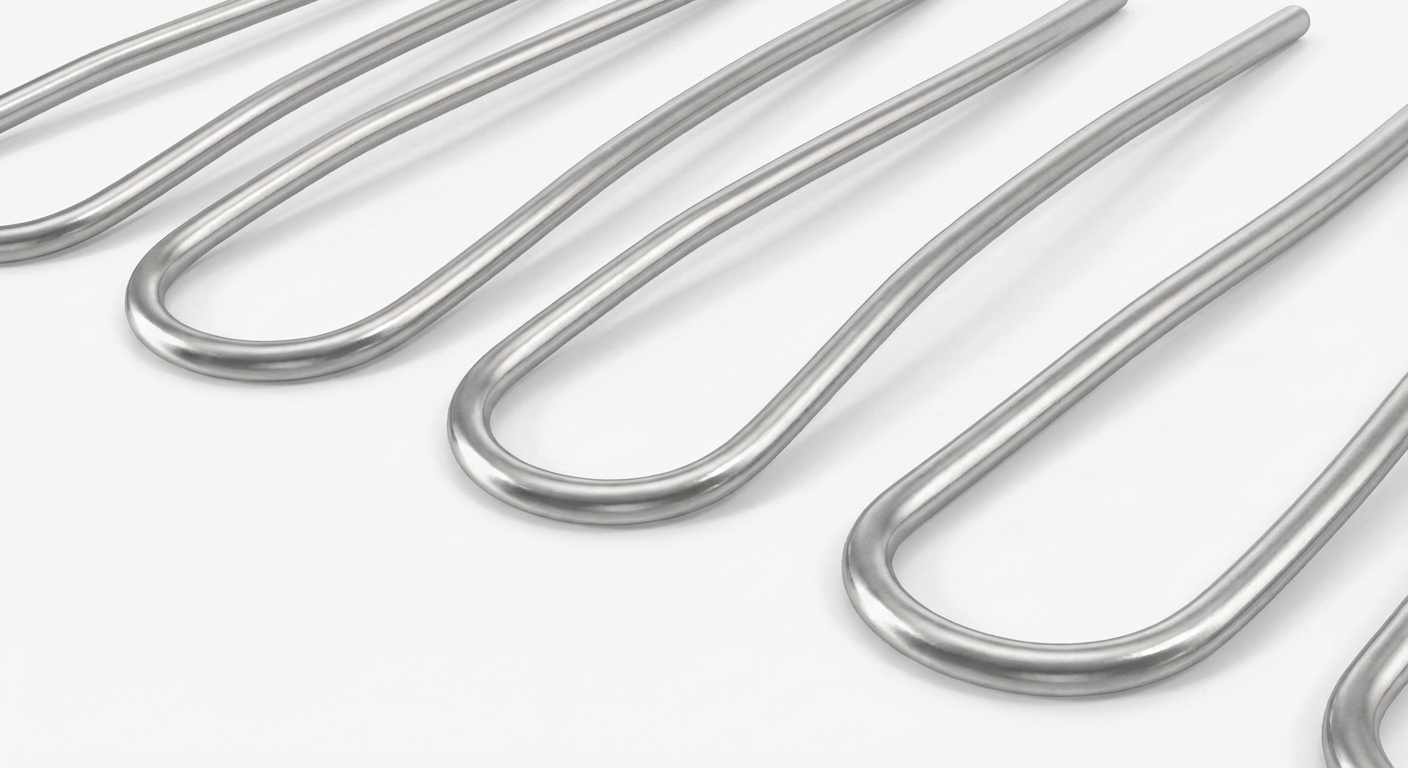
U-pins for anchoring buns—different from bobby pins. These stay open to weave through hair, then anchor when positioned. Essential for bun styles.
“Perfect for anchoring buns. Bobby pins can't do this.”
— Verified Buyer
These actually grip! The coating makes such a difference compared to drugstore pins.
Quick Comparison
A side-by-side look at our top picks
Frequently Asked Questions
The Wavy Side Secret
Why Pins Fall Out
The Quality Difference

Donna Miller
Enjoyed This Guide?
Get more hair tips and product recommendations delivered weekly.