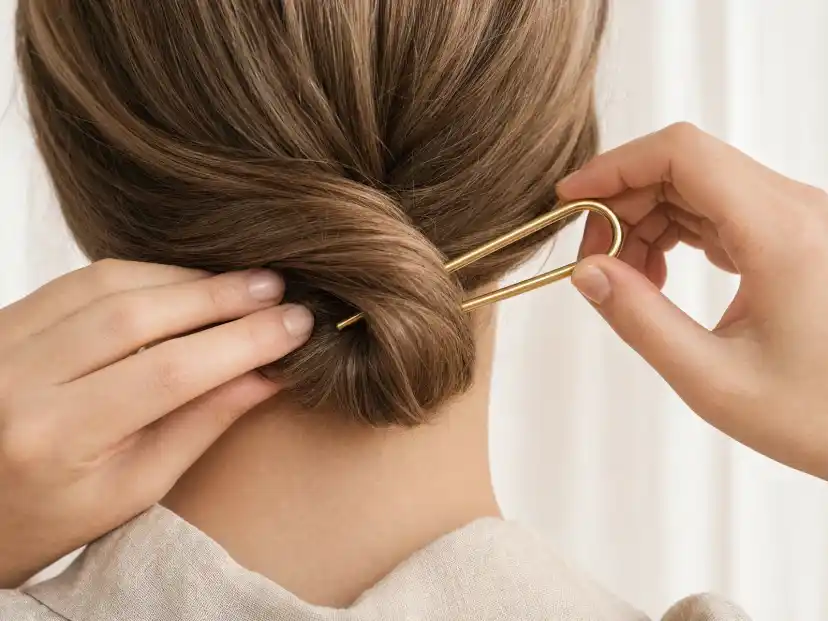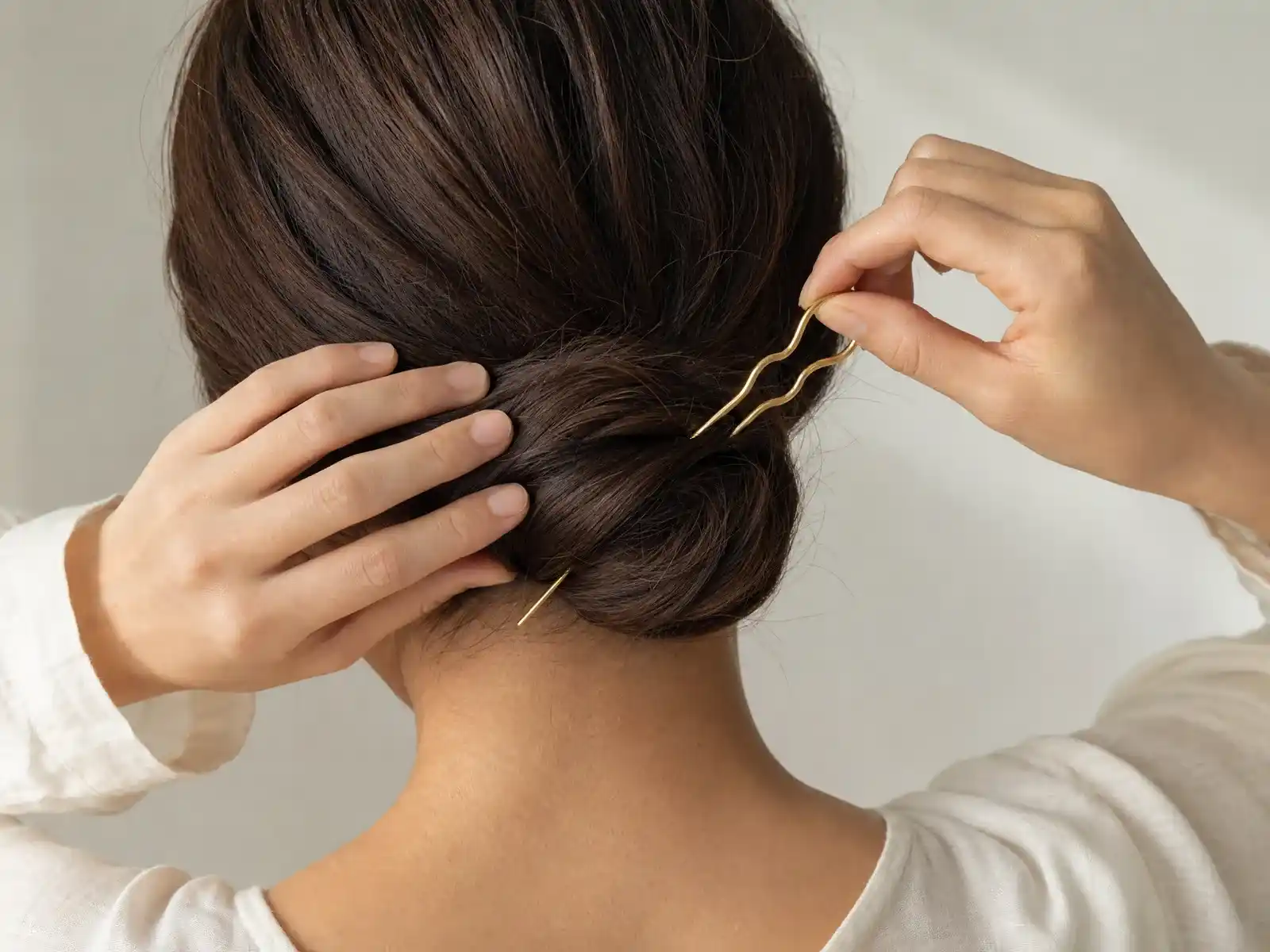
Short answer: a french hair pin bun needs one pin and five moves. Twist your hair into a rope at the nape, coil it into a bun, then push the pin down through the outer edge, rotate it a half turn so it scoops under the base, and drive it back down through the far side. Under a minute, once your wrist knows it.
Best Claw Clips is reader-supported. When you buy through links on our site, we may earn an affiliate commission at no extra cost to you.
That "under a minute" is honest and slightly unfair at once. The motion really is quick, but nobody lands it first try — expect three or four collapsed buns before one locks. Of all the french hair pin techniques worth learning, the low chignon has the best effort-to-payoff ratio, because a coiled bun gives the prongs more to bite into than any other style.
What a french hair pin bun actually is
A chignon is a folded knot, not a wound-up topknot. L'Oréal Paris defines it as a twisted updo that resembles a sleek, knotted bun, traditionally worn low at the nape of the neck. The word "twisted" carries structural weight there, because the twist is what your pin grips.
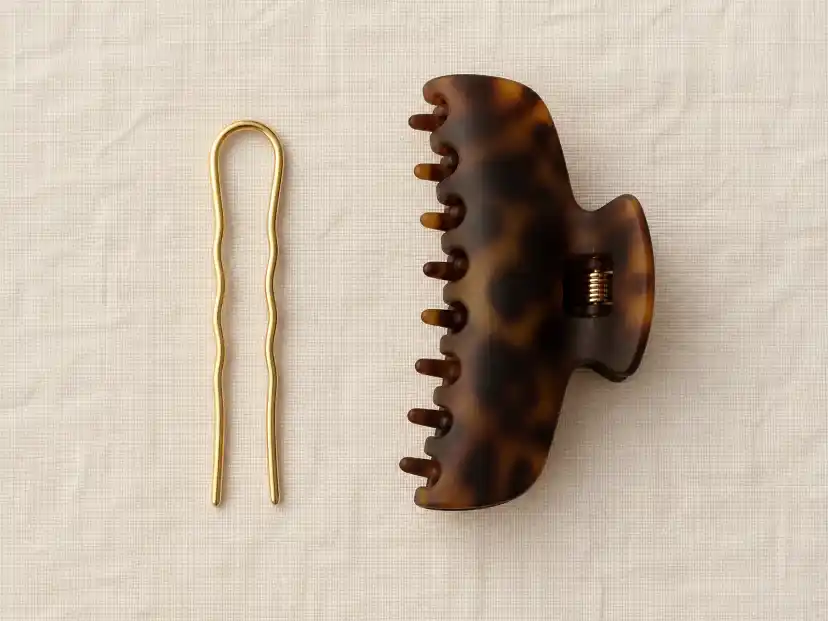
A french hair pin is an open U whose prongs are not sprung against each other, so it cannot clamp — it holds by leverage against hair already under tension. Rotate it inside the bun and a little hair wraps around the near prong while the far prong levers down through the coil, trapping the pin: the straight path it entered by no longer exists.
Which is why a loose bun cannot be pinned at all. It also marks the difference from the other classic updo: a chignon is horizontal, a knot at the nape; a french twist is a vertical roll up the back of the head. For that vertical version with a more forgiving tool, a french twist with a claw clip is the easier cousin.
The french hair pin bun tutorial, step by step
Work on dry hair with the pin already in your dominant hand. Putting it down mid-twist is the commonest way to lose a bun.
- Gather at the nape. Collect your hair as if starting a low ponytail, just above the hairline at the back, and smooth it with your palms, not a brush.
- Twist until it coils on itself. Rotate the length around two fingers, keeping tension, until the rope starts turning in on itself against your head. If a finger pushes through the middle, it is too loose to pin.
- Fold the coil into a bun. Wrap the rope around its own base into a flat disc at your neck and tuck the ends under. Hold it with your non-dominant thumb pressed to the centre; it should feel like one dense object.
- Insert the pin downward through the outer edge. Enter the outside face of the bun about an inch in, curve facing away from your head. Glamour South Africa, quoting stylist and Mint Tools cofounder Van Hong, advises holding the pin almost flat against your head and warns against going too close to the scalp on that first pass, which creates tension when you rotate.
- Scoop, rotate, push down. Catch a thin section from underneath the bun's base, turn the pin roughly half a circle, then drive it back down through the far side so it exits pointing at the floor.
Then nod twice, shake your head once and look at your shoes. Survive that and you survive a day.
The half-turn that makes a french hair pin chignon hold
This is the step beginners skip, and skipping it is why most people decide these pins do not work.
Once most of the prong is buried in the outer edge, tip the point toward your scalp and pick up a small amount of hair from the underside — Teleties advises anchoring close to the scalp and catching a small section of hair underneath. Then rotate. Van Hong's instruction, via Glamour South Africa, is to rotate the pin 180 degrees and push it back in the direction of the bun; Glamour is blunt that this rotation creates the tension the style needs, whereas simply sticking the pin into the twist would cause it to fall. Teleties calls the sequence stab, hook and flip.
You are feeling for resistance that builds smoothly. If the turn jams halfway you have loaded too much hair onto the prong, so back out an inch and take a thinner bite. If it turns with no resistance at all, you caught nothing. Finish by pushing until the pin lies flat along the skull; a pin standing proud of the head is one waiting for the first doorway you walk through.
Prep: why day-two hair holds better
Friction is the mechanism and conditioner is its enemy. L'Oréal Paris says the chignon works best on second or third-day hair, and advises that if you have just washed and your hair is too slippery to get a hold on, you should mist it with dry shampoo to absorb excess oil and provide grip. Teleties says the same: start with slightly textured hair for better grip.
In our experience the difference is not subtle: the bun that holds all day on Tuesday unwinds by lunchtime on freshly washed hair. Texturising spray through the mid-lengths costs ten seconds and fixes it.
Three french hair pin updo variations
The classic low chignon
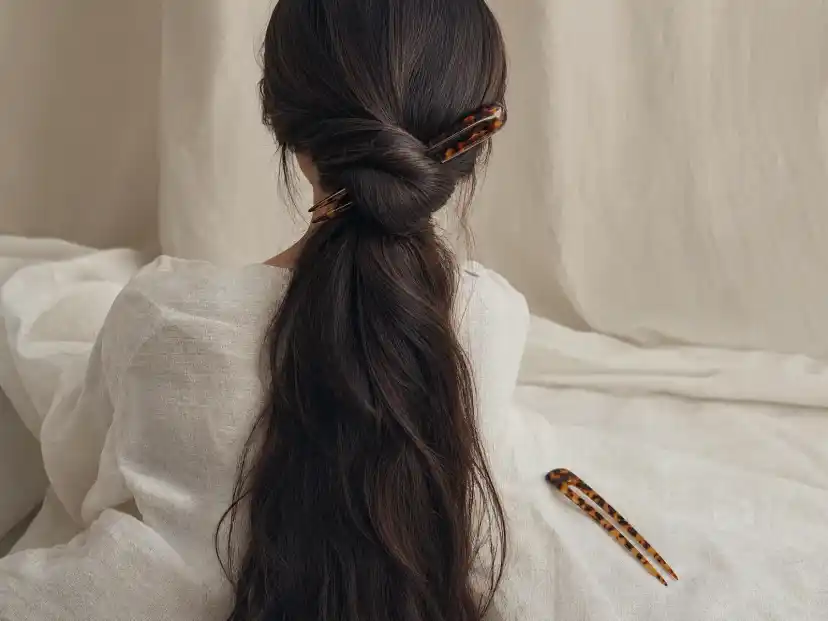
The version above: smooth, compact, sitting at the nape, ends tucked so nothing pokes out sideways. Practise this one first, because a dense coil is the most forgiving base a prong can find and every other variation is a modification of it.
On very long or heavy hair a single coil grows too fat for a short pin to cross, and the bun then hinges away from the head under its own weight. Two fixes work. Split the length into two ropes, coil them into a figure of eight and pin through the crossing point. Or buy length: the HYFEEL forks are listed at 4.3 inches, enough to span a bigger knot and re-enter hair on the far side. We cover both, and the braided bases that suit waist-length hair, in our guide to french hair pin styles for long hair.
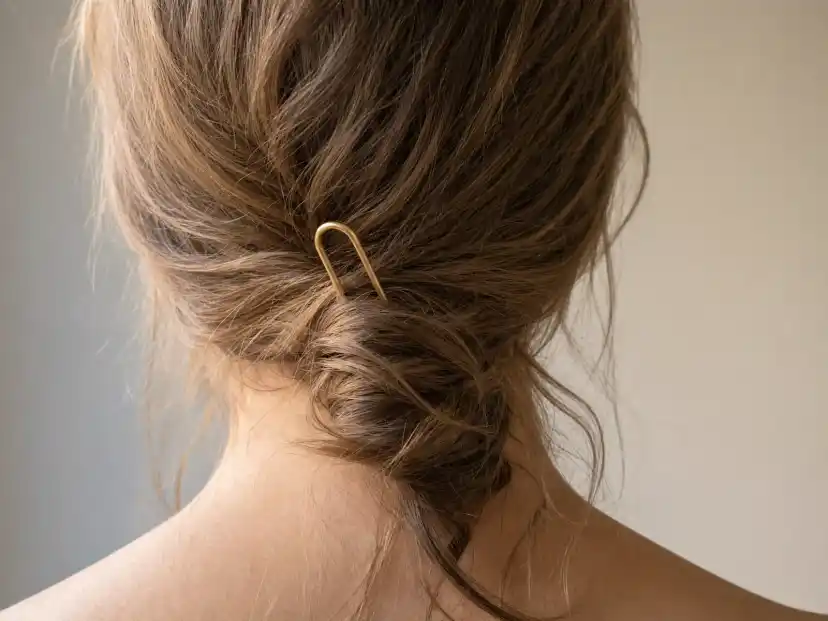
The undone french hair pin messy bun
Build it exactly the same way, then break it on purpose. The order matters: a bun that was messy before pinning has no tension for the prongs to use, so pin first and loosen second.
Makeup.com by L'Oréal describes the finishing move for a messy chignon as loosening random pieces of the bun and tugging hair at the crown for an unkempt look. We would keep that to four or five deliberate tugs: two face-framing pieces at the temples, one at the nape, and a lift from the crown so the top of the head is not flat. Pull from the outer surface of the bun, not from beside the pin, and stop while the coil still holds its shape. The line between undone and unravelling is about three tugs wide.
The half-up mini chignon
The easiest of the three, and the one that works on the least hair. Take the top third, temple to temple, twist it two or three turns into a short rope, then fold that rope up on itself into a small loop against the back of the head. Pin through the loop and into the hair behind it with the same scoop-and-rotate, letting the loose length underneath hide the exit point.
Because the loop is small, the pin crosses only an inch or so of hair, which is usually where a beginner first feels the lock happen. It also suits heavy layers: the short pieces that escape a full chignon are left down here instead of fighting the twist. Start with it if the low chignon keeps collapsing — the muscle memory transfers straight across.
Troubleshooting: when it slips, sags or pinches
- It slid straight out. You under-rotated, or the twist was too loose. Teleties is direct about this: fail to create enough tension and the pin will not have anything to grip onto.
- It held, then sagged after an hour. The bun is too big or sits too low. Rebuild it smaller and half an inch higher, so its weight presses against the head rather than hanging off it.
- The rotation jams. Too much hair on the prong. Halve the bite, every time.
- It hurts. Take it out. Glamour South Africa says a french pin should never cause pain, on insertion or in the finished style, and that hair being pulled too tightly means taking the pin out and reinserting closer to the surface of the style on the first pass. The American Academy of Dermatology is firmer still: if your hairstyle feels painful, the style is too tight, and it lists stinging, crusts and scalp tenting alongside pain as warning signs. The AAD also advises switching up your hairstyle regularly so hair can recover from tight styles.
For the longer diagnostic version of this list, see why your french hair pin slips out.
Which pin to reach for
Almost any single pin will do a chignon; what matters is length relative to your bun.
For most people we would start with one slim metal pin, such as the Kitsch French Hair Pin at 9.93 dollars as of September 2026. Kitsch describes it as zinc alloy with a smooth anti-rust finish that glides through hair without snagging. No length is published on the listing, so treat it as a standard mid-size pin.
If your hair is thick or past the shoulder blades, buy on length instead. HYFEEL lists its acetate hair forks at 4.3 inches in a three-pack, 12.99 dollars as of September 2026, and calls them a thicker pin that does not break easily.
If you are only finding out whether the technique suits you, the BEoffer three-pack is 6.99 dollars as of September 2026 in gold, silver and black. BEoffer claims its pins do not leave the dents a claw clip can — a seller claim, not our finding.
The bottom line
A chignon is the fastest thing a french pin does, and the skill fits in one sentence: twist tight, then rotate the pin instead of pushing it. Give yourself ten minutes with a mirror and day-two hair, accept that the first few will fall apart, and it becomes a four-second reflex. For the full background on pin shapes, lengths, materials and the hair types this tool struggles with, start with our guide to french hair pins.
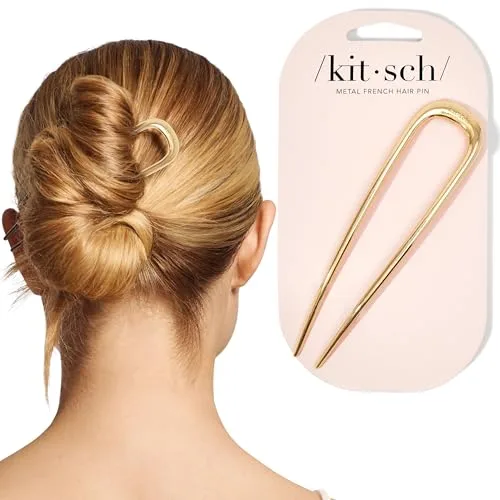
Kitsch French Hair Pin (Gold)
One slim alloy pin, which is all a chignon actually needs. Thin enough to pass through a tight twist without forcing the bun open.
We tested dozens of claw clips to find the very best options. Below you'll find our complete ranking, with detailed reviews and real customer feedback for each pick.
The Complete Ranking
One slim alloy pin, which is all a chignon actually needs. Thin enough to pass through a tight twist without forcing the bun open.
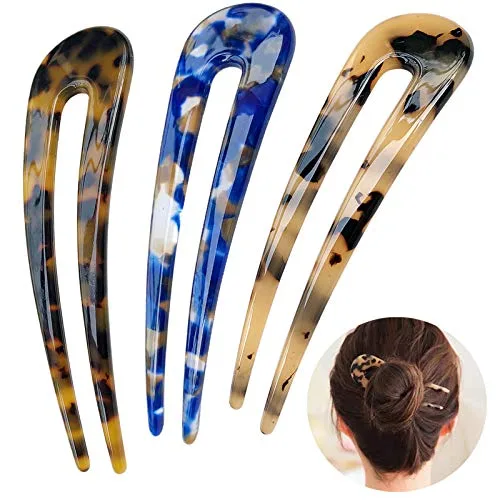
At 4.3 inches this is the longer option, and length is what lets a pin span a bigger bun. The 3-pack also means a spare in the bag.
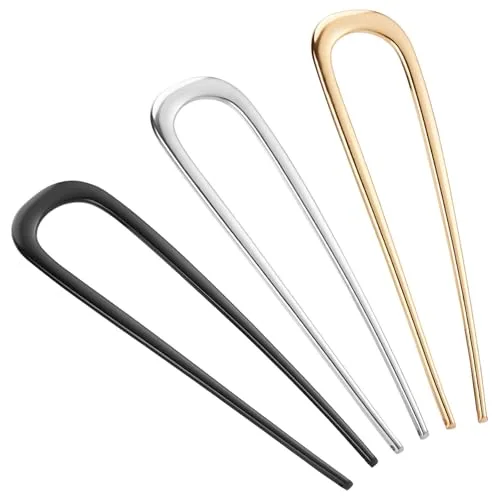
Three pins in gold, silver and black for under seven dollars — the cheapest way to find out whether the technique suits you before spending more.
Quick Comparison
A side-by-side look at our top picks
Frequently Asked Questions
How long does a french hair pin bun really take?
Why does my chignon slip out after ten minutes?
Does a chignon hold on fine hair?

Donna Miller
Enjoyed This Guide?
Get more hair tips and product recommendations delivered weekly.