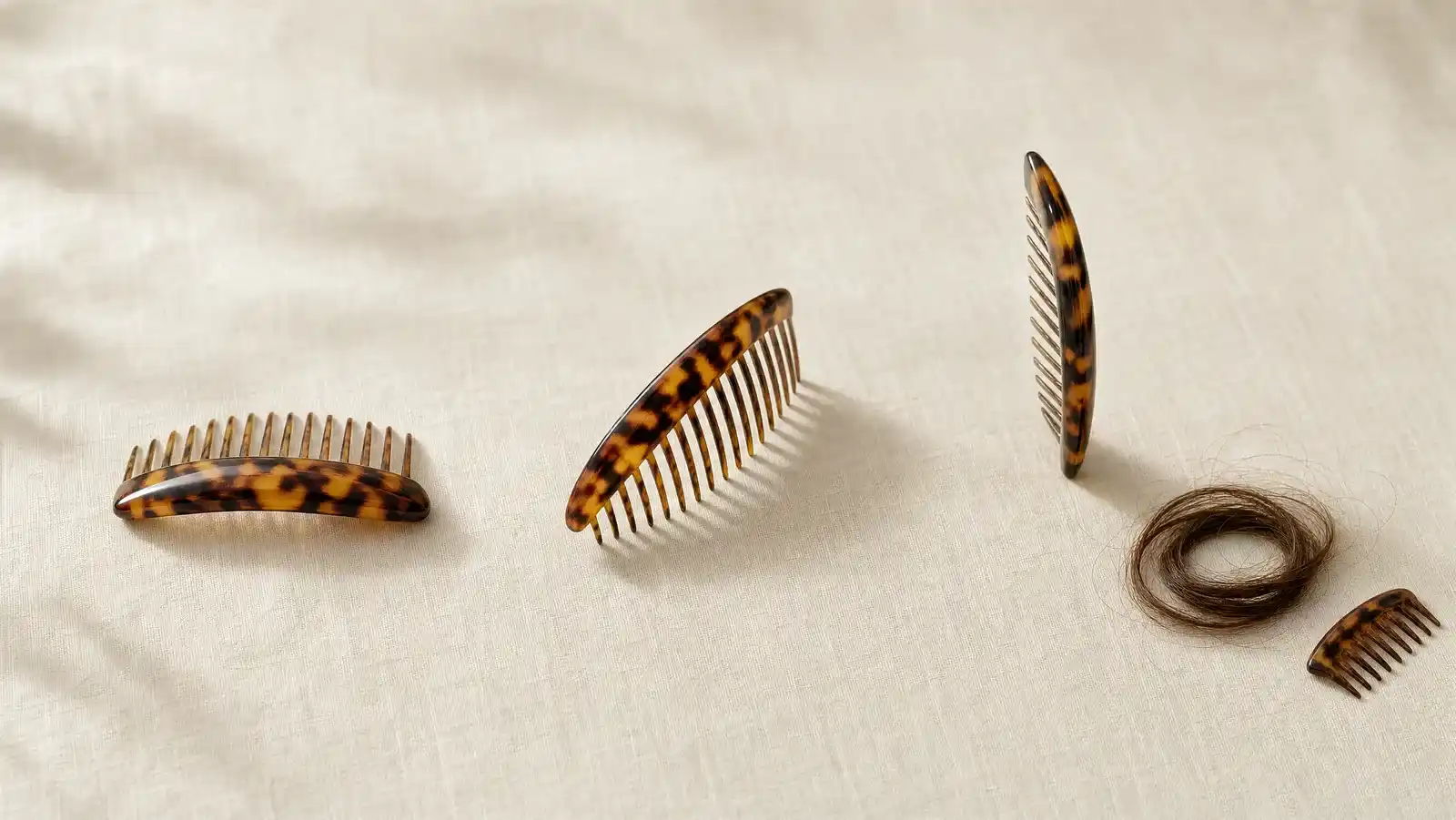
- How to Use a Decorative Hair Comb: The Insert-Push-Rotate Motion
- Which Direction Do the Teeth Face?
- Clean, Slippery Hair Is the Main Failure Mode
- Left, Right, or Both: Placement That Holds
- How to Anchor a French Twist With a Comb
- How to Tell the Comb Is Too Short
- Why Combs Are Having a Moment Again
- Comfort and Scalp Tension
- Troubleshooting Checklist
- What to Do Next
A decorative hair comb holds by leverage, not force. Insert it at a shallow angle with the teeth aimed at the hair you want to trap, push it along the scalp about half an inch, then rotate the spine upright until it lies flush. That insert-push-rotate sequence is the whole technique.
Some links below are affiliate links, which means we may earn a commission at no cost to you.
Many people push a comb straight in the way you would push in a hair slide, and it backs out within the hour. If you are new to decorative hair combs, that single correction fixes most of what goes wrong. Below is the motion in detail, where to place the comb, how to anchor a French twist with one, and how to tell when the comb in your hand is simply too short for the section you are holding.
How to Use a Decorative Hair Comb: The Insert-Push-Rotate Motion
Stand in front of a mirror with the comb in your dominant hand, spine toward you, teeth pointing at the hair you want to gather.
- Gather the section first. Sweep the hair back with your free hand and hold it where you want it to end up. Do not let go. The comb's job is to take over from your hand, not to create the shape.
- Enter at a shallow angle. Set the tooth tips against the scalp roughly 20 to 30 degrees off flat, pointing in the same direction the hair is travelling. Steeper than that and the teeth skate over the surface instead of picking up hair from the roots.
- Push along the scalp, not into it. Slide the comb half an inch to an inch, staying in contact with the scalp the whole way. You should feel the teeth loading up with hair. This is the step people shorten.
- Rotate the spine upright. Keeping the tips where they are, lift the spine until the comb sits flat against the head. The teeth now bend the gathered hair into a shallow S shape and lock it in place. You will often hear a faint crackle as it seats.
- Push home the last few millimetres. Once upright, nudge the comb forward until the spine is flush. Check the mirror: no tooth tips should be visible above the hair.
That rotation is doing real mechanical work. Pushed in flat, a comb is a passive ornament resting in the hair. Rotated, it becomes a lever, and the hair itself supplies the counter-tension that keeps it there.
Which Direction Do the Teeth Face?
Teeth toward the hair, decorative edge out. That sounds obvious until you are reaching behind your own head.
For a side comb sweeping hair back from the temple, the teeth travel toward the back of your skull on the way in. For a comb finishing a bun, the teeth travel up into the base of the bun and the spine ends up pointing down, so gravity pushes the comb into the bun rather than out of it. For a comb holding a half-up section, the teeth go in from underneath, pointing up toward the crown.
The general rule: the teeth should always point into the thickest part of the hair, so they have mass to lever against. Point them into thin air at the edge of a section and the comb has nothing to grip.
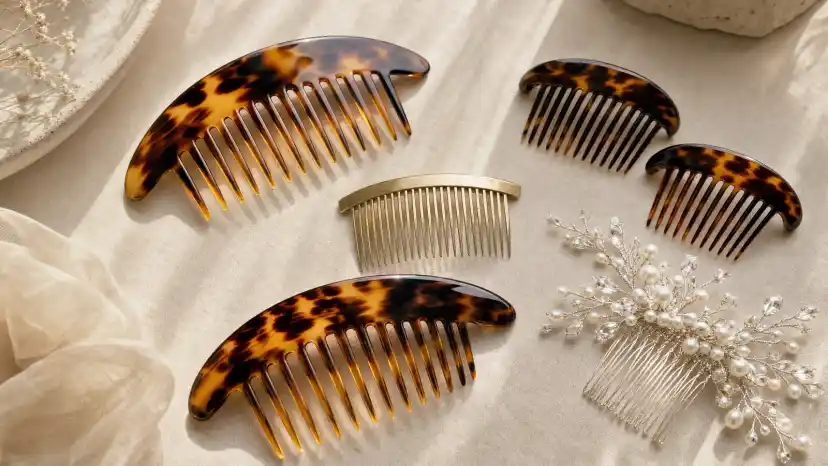
Curved combs add a wrinkle, because the curve has to match the curve of your head at that spot. A set like the MEZYKAP four-pack is useful here precisely because you get four combs with the same curve — glossy black, dark tortoise, light tortoise and cream — to experiment with across the temple, the nape and the side of a bun until you find where that particular arc sits flush.
Clean, Slippery Hair Is the Main Failure Mode
If the motion is right and the comb still slides out, the problem is usually your hair, not the comb.
A comb holds through friction between hair fibres and between hair and the comb. That friction is measurable and it is not constant. In a 2025 study published in Tribology in Industry, researchers Dewri and Gnanamoorthy measured the friction coefficient of human hair with a capstan tribometer and found a greater friction coefficient in wet conditions than dry, and that the friction coefficient decreased as the applied load increased. Their introduction also notes that hair care products such as shampoo, conditioner and serum change the coefficient of friction.
Two practical takeaways, neither of which the study measured directly:
- Freshly washed and conditioned hair may be the hardest surface to hold. The study used sprayed water rather than styling products, so take this as practical experience, not a finding: give slippery hair a mist of texture spray or a little dry shampoo at the roots of the section you are combing, or style on day-two hair. Many wearers report this is the single biggest difference.
- Pushing harder is probably not the fix. The measured coefficient of friction fell as load rose, which at least suggests extra pressure gives diminishing returns, and in practice leaning on the comb mostly buys you scalp discomfort. The lever does the work; your thumb does not.
A light backcomb at the root of the section, two or three gentle strokes with a fine comb, also works and is less sticky than product. If you are weighing finishes and materials, our notes on acetate versus plastic apply to combs as well as clips: a high-polish surface looks better and snags less, but it is also slicker.
Left, Right, or Both: Placement That Holds
Placement is a geometry question, and the answer depends on which way your hair naturally falls.
- Single comb, opposite side to your part. If you part on the left, the comb goes on the right, where the hair is being swept across and is already under slight tension. A comb set on the same side as the part has loose hair to hold and tends to loosen.
- Pair of combs, mirrored. Set them symmetrically, roughly level with the top of each ear, teeth travelling back. This is the classic side-comb look and the most forgiving arrangement for fine hair, because each comb only has to hold half the weight.
- Height matters more than people expect. Too high and the comb sits where the skull curves hardest, so a straight comb cannot lie flush. Too low, at the hairline, and you are pulling on the most fragile hairs. Just above the ear is the usual sweet spot.
- Behind the crown for a half-up. Insert from below, teeth up, and let the loose length fall over the spine to hide it.
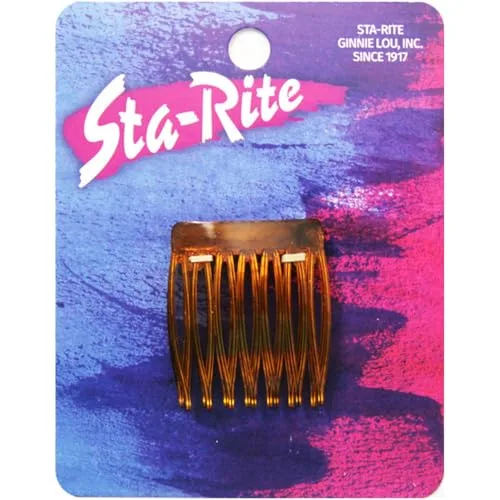
A small 1.5-inch pair like the Sta-Rite combs is the right size to learn placement with, because a short comb only commits a small section of hair. Get the angle wrong and you lose nothing but thirty seconds. The Good Hair Days six-pack is the same idea at scale: the listing gives the dimensions as 2 7/8 inches wide by 1.7 inches long with a split-tooth design, and three matching pairs means you can keep combs in a bag, a desk and a bathroom while the motion is still new. The brand also markets these as following the contour of the scalp; treat that, and its comparisons to other accessories, as the brand's own claim.
How to Anchor a French Twist With a Comb
This is where comb length stops being cosmetic.
- Gather all your hair at the nape as if for a low ponytail, but do not fasten it.
- Twist the tail once or twice in one direction, then fold it upward against the back of your head so the twist runs vertically.
- Hold the fold closed with one hand and tuck the loose ends down into the roll with the other.
- Insert the comb horizontally across the seam of the roll, teeth pointing into the twist, about two-thirds of the way up.
- Push along the scalp, then rotate the spine upright so the teeth cross the seam and pin both sides of the roll together.
The comb has to be long enough to cross that seam and land in hair on both sides. A 4-inch comb such as the Camila Paris AD66/2 is the shortest length we would attempt a full twist with on medium or thick hair; the listing describes it as a curved cellulose acetate comb made in France and sold as a 2-pack at about $9.99 as of November 2026. Camila Paris describes cellulose acetate as a plant-based resin and states the brand has operated since 1999. We cannot tell you how many teeth these have, incidentally: the brand's bullets repeat the same tooth count across combs of different lengths, which cannot be right for both.
For a softer, lower version of the same shape, a long pin is often easier than a comb, and the sequence is different enough that we wrote it up separately in how to use a French hair pin and how to do a chignon with a French hair pin.
How to Tell the Comb Is Too Short
Three tests, all of which you can run in the mirror in about five seconds.
- The span test. Lay the comb flat against the section before you insert anything. If its teeth do not reach across the full width of hair you are trying to hold, plus a little hair on the far side to land in, it is too short. This is the test the French twist fails most often.
- The rotation test. Insert and rotate. If the spine will not come upright because the teeth have bottomed out in the hair, the comb is too short to clear the mass.
- The pop test. Seat the comb, then nod forward and back twice. A comb that lifts at one end on the second nod is holding with only two or three teeth, which means either the comb is short or you entered too steeply.
The failure the other way round is rarer but real: a comb much longer than the section leaves teeth sitting in no hair at all, and those free tips catch on collars and scarves.
Why Combs Are Having a Moment Again
Ornamental combs are not a new idea. According to the Metropolitan Museum of Art's catalogue entry for an Egyptian hair comb dated to roughly 3200 to 3100 B.C., its detailed decoration suggests that it was a ceremonial object, not just an instrument for arranging the hair. The Spanish peineta is a later and taller variation: per Wikipedia's entry on the object, the name comes from the Spanish verb for combing, the form dates to the 19th century, examples were historically made of tortoiseshell and are now usually synthetic, and it is worn to support a mantilla veil.
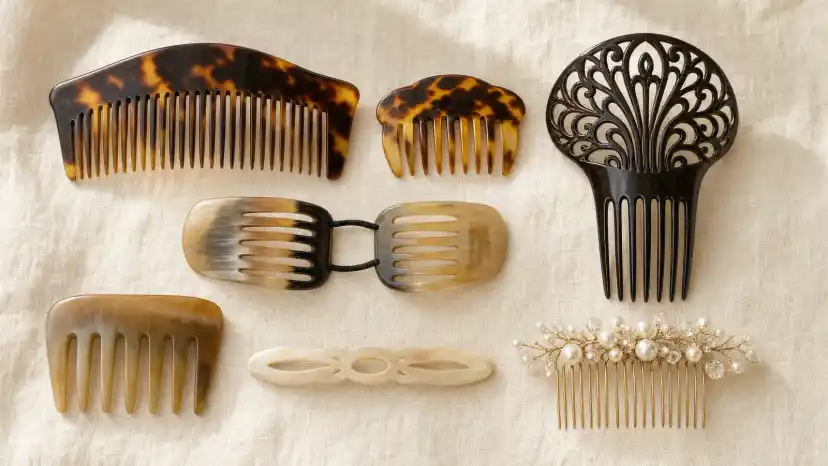
The current revival is well documented in the fashion press. Who What Wear named combs, alongside tassels and French pins, among the eight hair accessories it expects to take off in 2026. If you want the full taxonomy before you buy, we break it down in types of decorative hair combs.
Comfort and Scalp Tension
A correctly rotated comb spreads its load over several teeth, which is part of why some wearers find combs milder than a single clamping accessory; we have found no dermatology source that ranks one accessory as safer than another. But the tension you build into the style still matters.
The American Academy of Dermatology lists tightly pulled buns, ponytails and up-dos among the hairstyles that can cause traction alopecia, and states that if your hairstyle feels painful, the style is too tight. It names pain from tightly pulled hair, stinging on the scalp, crusts, tenting of the scalp and broken hairs around the forehead as signs to watch, and advises avoiding frequently wearing hairstyles that pull on your hair. Its general prevention advice is to switch hairstyles regularly so the hair can recover, which for combs means not wearing the same one in the same spot every day.
Practically: move your combs a centimetre or two each day, loosen the gather before you insert rather than after, and take the comb out if the spot aches. More on the mechanics of placement in how to position hair clips to avoid headaches and on spotting a badly made accessory in traction alopecia from hair accessories.
Troubleshooting Checklist
- Slides out within minutes. You pushed instead of rotating. Redo step four.
- Slides out after an hour. Hair too slippery. Add texture at the root or wait a day after washing.
- Hurts at the insertion point. You entered too steeply and the tips are against the scalp rather than along it.
- Spine will not sit flush. Wrong curve for that part of your head, or the comb is too short. Try a different placement before blaming the comb.
- Teeth visible above the hair. The comb is only half rotated. Push it home.
- Holds, but the style collapses. The comb is doing the shape's job. Build the shape with your hands first, then commit the comb.
What to Do Next
Pick the shortest comb you own, stand at a mirror, and run the motion ten times on a small side section until the rotation stops feeling like a separate step. Then move up in length: a 1.5-inch pair for half-ups and side sweeps, something around 4 inches once you want to hold a twist. Nothing else about combs is difficult once the lever is automatic.
From there, the useful next reads are our complete guide to decorative hair combs for materials, sizing and shopping, and how to wear barrettes if you want a flat accessory that holds without needing the rotation at all.
We tested dozens of claw clips to find the very best options. Below you'll find our complete ranking, with detailed reviews and real customer feedback for each pick.
The Complete Ranking
Short, cheap and forgiving. A 1.5-inch pair is the easiest size to practise the insert-and-rotate motion on without wasting a section of hair.
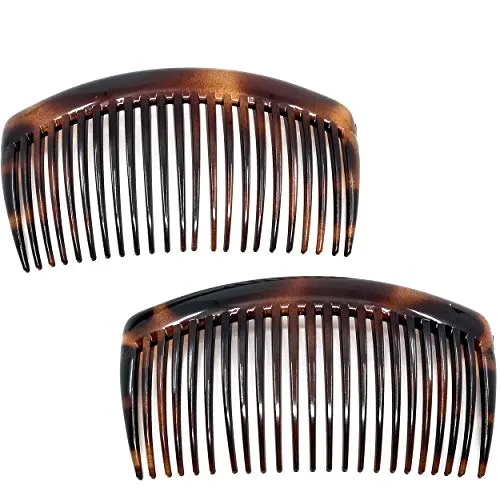
The 4-inch length is what the twist section in this guide is built around; a shorter comb cannot span the roll.
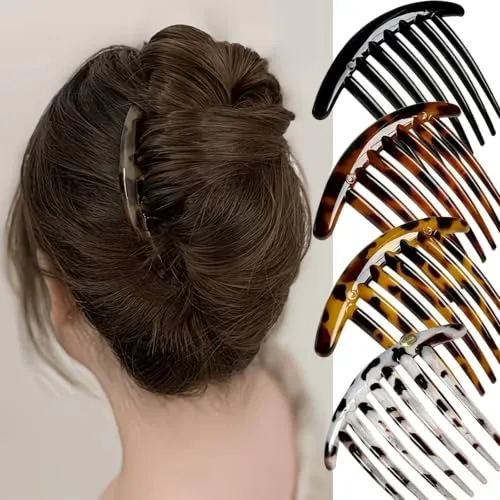
A curved 7-tooth profile in four colours, useful while you work out which angle your own head shape needs.
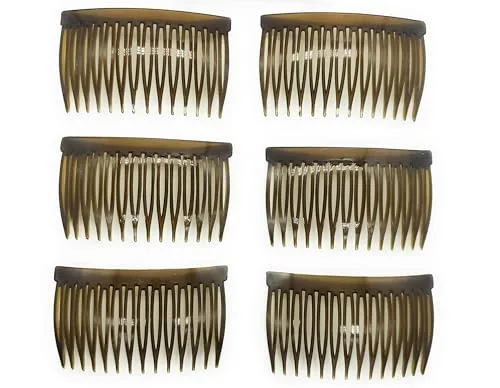
Six combs means you can leave pairs in a bag, a desk and a bathroom while the technique is still new.
Quick Comparison
A side-by-side look at our top picks
Frequently Asked Questions
Why does my decorative hair comb keep falling out?
Which way should the teeth of a hair comb face?
Are decorative hair combs bad for your hair?

Donna Miller
Enjoyed This Guide?
Get more hair tips and product recommendations delivered weekly.