- What Are Snap Hair Clips?
- How the Snap Mechanism Actually Grips
- Snap Clip Sizes: Mini, Standard and Jumbo
- How to Use a Snap Clip
- Metal vs Plastic Snap Clips
- Do Snap Clips Damage Hair?
- Snap Clips for Bangs and Fringe
- Drugstore Snap Clip Brands Compared
- Snap Clip Barrettes as a Finished Style
- How Many Snap Clips You Actually Need
- The Bottom Line
- Explore the full series
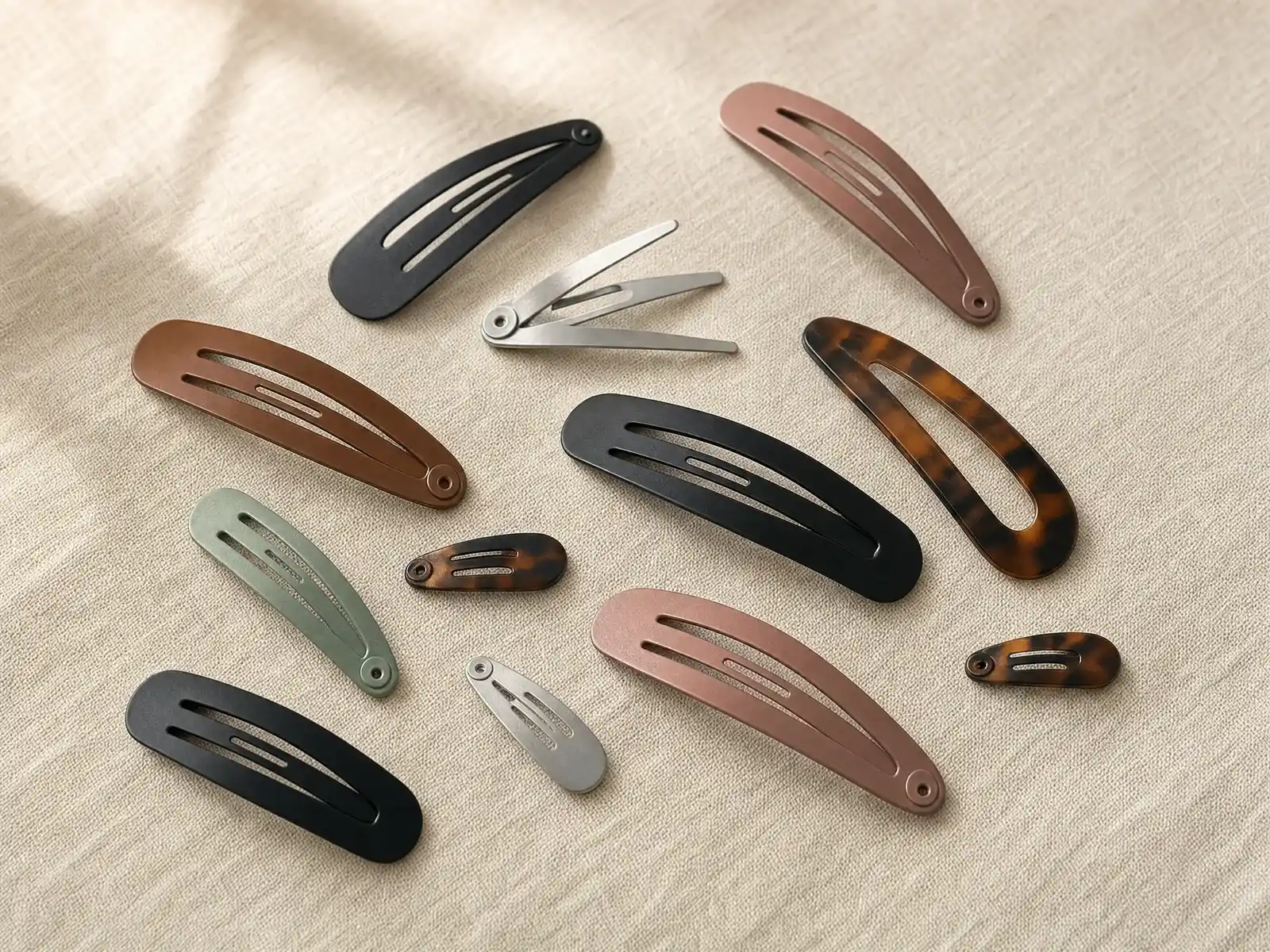
Snap hair clips are one piece of springy metal that flips from curved-up to curved-down when you press the middle, trapping a small section of hair under the plate — which makes them the cheapest clip that genuinely holds, and the wrong clip for anything heavy.
Every other property of the category falls out of that single moving part. We earn a commission from Amazon links on this page, at no cost to you.
They are also the most mislabeled clip in the drawer. Sellers list the identical object as a snap clip, a double grip hair clip, a tic-tac clip and a snap clip barrette. This guide sorts it out: the mechanism, the three real sizes, how to set one so it stops sliding out, what the material changes, and where the honest limits sit.
What Are Snap Hair Clips?
A snap hair clip is a flat metal plate, usually between 1 and 3 inches long, with a row of short prongs along its underside and a narrow base plate fixed beneath it. Press the raised center and the plate inverts with an audible click, closing the prongs down against the base and pinning whatever hair sits between them. Press again from the other side and it pops back open.
That is the whole machine. No screw, no hinge pin under load, no separate clasp. The plate is the spring.
Retailers sell the same object as a "double grip" clip, which may be a nod to that two-layer build: you are not clamping hair between two jaws of equal size, you are pressing a toothed upper plate down onto a thin lower rail, so the hair is gripped from above and below along a strip barely over a centimeter wide. The PIDOUDOU clips measure 2 inches long and 0.55 inches wide, which is about 4.9 cm by 1.4 cm — a useful reminder of how small the working surface really is.
Snap clips sit inside the much larger barrette family, and they are its branch with the fewest parts and the lowest profile. For the full taxonomy of closures — French bars, automatic clasps, banana clips, stick barrettes — our breakdown of the types of barrettes covers each mechanism and the hair it suits.
They also carry more cultural baggage than any other clip. According to Hello magazine's roundup of '90s hair accessory trends, "these old-school clips are moving out of the playground and back onto grown-ups" — a fair description of a product that spent years sold mainly as a children's accessory.
How the Snap Mechanism Actually Grips
This is the part most guides skip, and the only part that predicts whether a clip will hold your hair.
A snap clip plate is bistable. It is stable curved one way, stable curved the other way, and unstable in between. Pressing it pushes the metal through that unstable middle, and past the tipping point the stored elastic energy releases at once — which is the snap you hear. The grip you get afterwards is whatever residual force the plate exerts trying to stay closed.
Two consequences follow, and they explain nearly every snap clip complaint.
The closing force is fixed. A claw clip's spring force varies with how far you open it; a snap clip has exactly one closed position. You cannot squeeze it harder for more hold. Friction on the hair is the product of that fixed normal force and the contact area, so the only variable you control is how much hair you put in. Grip is tuned by section size, not by effort.
It fails in both directions. Overload the clip and the plate cannot complete its travel, so it parks near the unstable middle and pops open at the first head movement. Underload it and the prongs bottom out on the base rail with nothing between them, so the plate is fully closed but exerting almost no pressure on the few strands present — and the clip slides down the hair under its own weight. A snap clip that keeps creeping toward your ear is usually holding too little hair, not too much.
The practical target is a section that just fills the gap: enough bulk that the plate has to work to close, not so much that it hesitates. For a 2 inch clip that is roughly a pencil-thick strand.
Prong count matters less than people assume. Three short prongs biting into a filled section can hold about as well as a dozen, because the limiting factor is the plate's force rather than the number of points dividing it up.
Snap Clip Sizes: Mini, Standard and Jumbo
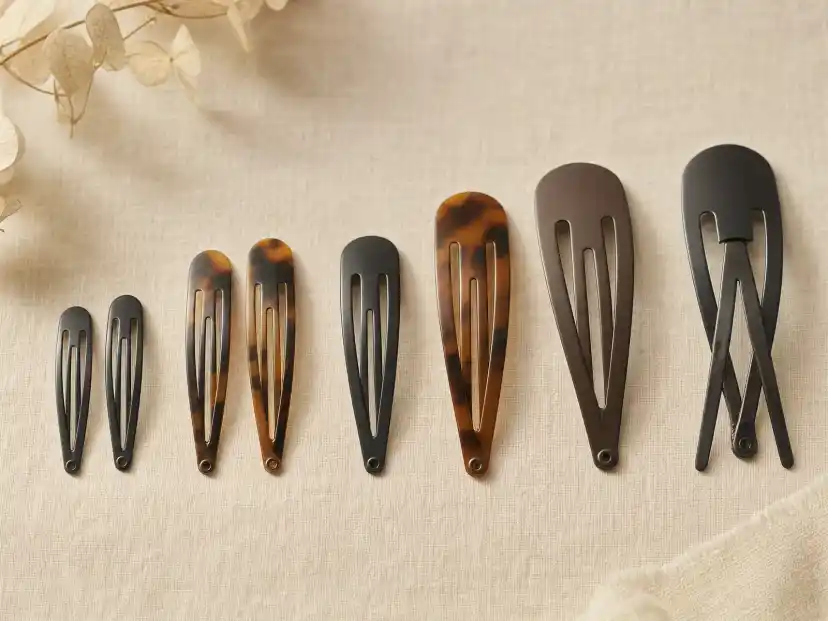
Compared with the rest of the accessory aisle, snap hair clip sizes are refreshingly simple. There are three that matter, and they sort by the volume of hair they close on rather than by your hair length.
| Size | Length | Section it holds | Best for |
|---|---|---|---|
| Mini | About 1.2 in | A pencil-lead wisp | Flyaways, baby hair, one pinned strand |
| Standard | About 2 in (4.9 cm) | A pencil-thick strand | Bangs, side hair, everyday pinning |
| Large | About 3.1 in (7.8 cm) | A thumb-thick section | Thick hair, half-up sections, ponytail work |
Start with standard. The 2 inch clip is the size the category is built around, and the listing language reflects it: PIDOUDOU describes its 2 inch clip as the ideal size for securing bangs, side hair, or everyday hairstyles. The PIDOUDOU 40 Pack Black 2 Inch Metal Snap Hair Clips are the plainest version of that default — smooth black coating, sturdy snap, nothing clever — at about $5 as of October 2026 for forty of them, which is as close to free as hardware gets. If you only buy one pack, buy this one.
Size up when the clip hesitates on close. A 3.1 inch plate stores more energy and spans a wider section, which is why the yuntop set is the one to reach for with dense or coarse hair; its listing claims it holds hair well, does not slip off, and will not let hair get stuck, and the extra 1.1 inches of plate is the reason that claim is plausible on thick hair where a 2 inch clip would skate.
Size down when the clip is visible or overkill. At 1.2 inches the MJIYA minis disappear into the hairline, which is the point.
The logic mirrors the one we use for bigger hardware: match the clip to the mass of hair it must close around, not to an idea of your hair type. Our claw clip size guide works through the same reasoning at the other end of the scale.
How to Use a Snap Clip
Most slipping problems are placement problems. Learning how to use snap clips properly takes about thirty seconds and then never needs revisiting.
- Open the clip first. Press the plate from underneath until it pops up. Fighting a half-open clip with hair already in your other hand is how you lose sections.
- Comb the section you want with your fingers. Snap clips grip a tidy strand far better than a fluffy one, because a tidy strand actually fills the gap.
- Set the base rail against the head, not the plate. The thin lower rail goes flat to the scalp side; the toothed plate closes down on top. Doing it the other way round puts the prongs against your scalp, which is both uncomfortable and a weaker hold.
- Slide it in along the hair's direction of travel, about a quarter inch deeper than looks right. The plate shortens the hair's path slightly as it closes, so a clip set at the exact edge of a section will end up with less hair in it than you intended.
- Press until it clicks. One decisive press. If it does not click, you have too much hair — drop some rather than forcing it, because a plate held near its tipping point will release on its own.
- Check it feels secure and not tight. A correctly loaded snap clip is noticeable but not pulling.
To remove it, press the plate up from the base end rather than yanking the clip out sideways. Pulling a closed clip through hair drags the prongs along the strands, and that is where the small snags come from.
One habit worth building: when you are pinning two clips near each other, point them in opposite directions. Two clips angled the same way shear the hair the same way and tend to migrate together. Crossed clips lock each other in place.
Metal vs Plastic Snap Clips
The choice between metal and plastic snap clips comes down to how the plate stores energy, and metal simply does it better.
Spring metal returns to its shape after repeated inversions. That is a large part of why the snap clip survived as a design: a thin steel or alloy plate can be flipped back and forth many times over and still produce much the same closing force. The listings for all three sets above are metal for exactly this reason — PIDOUDOU uses a coated metal, MJIYA specifies a wear-resistant metal alloy described as colorfast and corrosion-resistant, and yuntop uses painted metal.
A polymer plate has a much lower elastic modulus, so to store the same energy it has to be thicker. That makes plastic snap clips bulkier, taller off the head and more visible — and polymers creep under sustained load in a way spring steel does not, so a plastic plate held closed for hours tends to relax. In practice, plastic appears in this category mostly as a decorative shell over metal hardware, or in children's clips where hold matters less than color.
Where metal loses is the coating and the skin. The finish is doing real work: a smooth coating is what keeps the plate's cut edges from catching strands, which is why PIDOUDOU markets its sleek black coating and smooth surface as reducing snagging and pulling. Once that coating chips, the clip is a bare metal edge working against your hair, and it should be retired.
Metal content is also the one genuine health consideration here, and the next section covers it. The buying rule stays simple: choose metal with an intact smooth finish, and treat a chipped or rusted plate as consumable rather than repairable. At roughly twelve cents a clip, replacement is the rational move.
Do Snap Clips Damage Hair?
Asking do snap clips damage hair is really asking two separate questions — one mechanical, one about tension — and they have different answers.
The mechanical risk is low but real. A snap clip's contact strip is narrow, its force is fixed and modest, and it is designed for small sections, so it does not generate the sustained pull that heavy updos do. What it can do is crease. A toothed plate pressed on a pliable fiber leaves a defined line, and on damp or fine hair that line can still be visible hours later. Take clips out before the hair fully dries if you plan to wear it down, and take them out at night: Philip Kingsley's trichologists advise against going to sleep with pins or clips in your hair, because the metal can cut into and break the hair shaft and can also harm the scalp.
Tension is the variable that actually matters. The American Academy of Dermatology lists "buns, ponytails, and up-dos that are tightly pulled" among the styles that can cause traction alopecia when they are too tight, and notes that "your hairline is one of the first places you can see traction alopecia." Its rule is the most useful sentence in the whole literature for clip wearers: "If your hairstyle feels painful, the style is too tight." Snap clips live at the hairline more than any other clip, so that advice applies with particular force. If a clip pulls, reset it looser and further back rather than pressing it harder.
There is a second, less-discussed issue with metal clips: nickel. According to a 2022 review in Allergologie Select by Symanzik, Skudlik and John, testing of metallic hairdressing tools found that "tweezers, sectioning clips, hair clips, and straight razors were identified as nickel as well as cobalt releasing tools." The same review reports nickel release from 9.2% of 229 tools in a 2019 study, and from 27.6% of 475 tools in a 2021 study. That is professional salon equipment rather than drugstore packs, but the material story is the same.
It matters because the scalp is a common site for metal reactions. A 2017 study in Skin Appendage Disorders, "Common Allergens Identified Based on Patch Test Results in Patients with Suspected Contact Dermatitis of the Scalp," reports that "the most common allergens in our study population were nickel (23.8%)." If you get itching, redness or scaling where clips sit, the clips are worth suspecting, and patch testing with a dermatologist is how that question gets answered rather than guessed. A coated plate puts a barrier between the alloy and your skin, which is one more argument for retiring chipped clips.
For a wider checklist on separating a safe clip from a damaging one — edges, springs, weight, closure — our guide to safe vs damaging hair clips runs through the specific things to look for before you wear something.
Snap Clips for Bangs and Fringe
This is the job the clip was designed for, and the reason the 2 inch size became the default.
The case for snap clips for bangs is mechanical: a fringe is a small, awkward, low-mass section that most hardware cannot grip. A claw clip needs volume to close around and has none here. A bobby pin relies on friction from two thin arms and slides on freshly washed hair. A snap clip's fixed-force plate does not care how slippery the hair is as long as the section fills the gap, so it holds a clean fringe that other clips release.
Three placements, in rising order of commitment:
- Straight back, one clip. Comb the fringe up and back, set the clip about an inch behind the hairline so the plate lies flat against the skull's curve, and snap. Set it too close to the forehead and the plate has to bend against the steepest part of the curve, which pops it open.
- Swept to one side, one clip. Brush the fringe diagonally across the forehead and pin it behind the opposite temple. This is the version that hides growing-out bangs, because the clip sits in the denser hair at the side where it has more to bite.
- Split and double-pinned. Part the fringe down the middle and take each half back with its own clip. Visually symmetrical, and mechanically the safest option on fine hair, because two small sections each get their own fixed force instead of one overloaded clip.
For the smallest version of this job — baby hair at the temples, the single strand that escapes a bun, a cowlick you are trying to train flat — a 2 inch clip is both too strong and too visible. The MJIYA 50 Pack 1.2 Inch Black Metal Snap Hair Clips are the right scale for it, about $5 as of October 2026 for fifty, and the listing's anti-slip framing describes the intended use well: a secure hold without constant readjustments. Check the current price if the mini size is the gap in your drawer.
One limitation worth stating plainly: snap clips are poor at holding hair that has to survive exercise. The fixed closing force has no reserve, and a repeated impact loads the plate past its tipping point. For a workout, use something with a variable spring.
Drugstore Snap Clip Brands Compared
The shortest version of this comparison is that the hardware is close to identical and the differences are coating, pack count and price per clip.
What you can read off a pack before buying:
- Pack economics. Multipacks are the honest way to own snap clips, because you will lose them. Forty 2 inch clips for about $5 as of October 2026 works out near twelve cents each; a 4-count drugstore blister pack of the same thing rarely beats that per clip.
- Stated length. If a pack does not print a length in inches or centimeters, you are guessing at the only spec that matters.
- Finish. Smooth coated metal over bare stamped metal, every time.
- Color matching. Black clips disappear in dark hair; on light hair, the mini sizes matter more than color because they are less visible at any shade.
On the mainstream shelf, Conair's Scunci line is the one most people meet first. A Stop and Shop listing for Scunci No Slip Grip Snap Clips lists a 4-count pack from manufacturer Conair LLC with the product description "No-slip grip. All hair. All day hold." That is marketing language rather than a spec, and it is a reasonable description of what any correctly sized snap clip does — which is the point. The category does not have much room for a premium tier, because there is no feature to add to a bistable plate.
So the hunt for the best drugstore snap clips is less about brand and more about arithmetic. Decide which of the three sizes you are short of, find the lowest price per clip in a coated metal finish with a printed length, and buy the bigger pack. The failure modes we described above are set by geometry, not by logo.
Snap Clip Barrettes as a Finished Style
Snap clips crossed over from utility to decoration because they are flat, cheap and symmetrical — three properties that make repetition look deliberate. Worn as a style the clip is meant to be seen, so placement answers to sightlines rather than to hold. Two rules carry most of it.
Odd numbers, parallel lines. Three or five clips stacked in a row above one ear read as intentional; two read as an accident. Keep the gaps even and the plates aligned along the same axis, because the eye catches a broken line faster than it catches a crooked single clip.
Pin into the part, not the mass. A clip set along a part line has a defined edge to follow and sits flat. A clip pushed into loose hair in the middle of the head has no reference line and tilts.
This is also the look that drove the revival, and the half-up variants are worth copying properly. Our walkthrough of a '90s snap clip look covers the stacked-clip and half-up versions step by step, including which sections to take first so the clips end up level.
One honest caveat: a row of snap clips is a daytime style. Each clip is holding its own small section, and every added clip adds another point of fixed tension at the hairline, so this is the use case where the AAD's pain rule is most worth checking as you go.
How Many Snap Clips You Actually Need
More than you think, for a reason that has nothing to do with styling: snap clips are small, black and flat, which makes them the single most losable object in a bathroom. A workable baseline is about ten minis in circulation, twenty or more 2 inch clips as the working size, and six to ten larges if your sections are thick.
That is why the pack math favors the big sets. The yuntop 30 Pcs 3.1 Inch Large Black Snap Hair Clips cost about $8 as of October 2026 and include a storage box, which sounds like a trivial inclusion until you own thirty identical black clips and have nowhere to put them — the box is the feature as much as the clips are. A shallow tin, a magnetic strip inside a cabinet door or a jar by the mirror will cut your losses more than another pack will.
Beyond that, care comes down to the coating. Store them closed and dry: an open plate catches on everything in a drawer, and coated metal resists corrosion rather than being immune to it, which is why MJIYA sells on being wear-resistant and corrosion-resistant. Wipe the hairspray film off the prongs, because grit is what drags on strands.
Retire a clip on three signals: a chip that exposes bare metal, a prong bent out of line with the others, or a plate that no longer clicks decisively. That last one gets ignored. A clip that closes softly instead of snapping has lost some of its fixed force, so it will slide, and no technique fixes it.
The Bottom Line
Snap hair clips are the most honest clip you can buy: one piece of metal, one closed position, one job done well.
Because the closing force is fixed, using them reduces to matching the section to the clip. Too much hair and the plate never commits; too little and it closes on nothing and slides. Get that right and a twelve-cent clip outperforms hardware costing twenty times as much at the one task it was built for — pinning a small, flat, low-volume section close to the head.
Buy standard 2 inch clips first, add minis for hairline work and larges if your sections are thick, choose coated metal with a printed length, and replace them when the coating chips or the snap goes soft. Then check the AAD's rule as you wear them: if it hurts, it is too tight.
Explore the full series
- Snap Hair Clip Sizes Explained: Mini, 2-Inch, and Jumbo — What each size from 1.2 to 3.5 inches actually holds, and how many of each to own.
- How to Use Snap Clips: 10 Easy Hairstyles That Hold — Which way the clip faces, why it needs a flat section, and ten styles that stay put.
- Metal vs Plastic Snap Clips: Which Holds Better? — Spring force, coating and dent risk compared across metal, plastic and acrylic snap clips.
- Do Snap Clips Damage Hair? What to Watch For — Where snap clips actually stress hair, the warning signs, and how to wear them safely.
- Best Snap Clips for Bangs and Fringe That Stay Put — The clips that hold a fringe without denting it, including picks for growing-out bangs.
- Best Drugstore Snap Clip Brands: Goody vs Scunci vs Kitsch — Goody, Scunci, Kitsch and Revlon compared on grip, coating and price per clip.

PIDOUDOU 40 Pack Black 2 Inch Metal Snap Hair Clips
The 2-inch black metal clip is the default size the whole category is built around, and this 40-pack is the cheapest honest way to own enough of them. Smooth black coating, sturdy snap, nothing clever.
We tested dozens of claw clips to find the very best options. Below you'll find our complete ranking, with detailed reviews and real customer feedback for each pick.
The Complete Ranking
The 2-inch black metal clip is the default size the whole category is built around, and this 40-pack is the cheapest honest way to own enough of them. Smooth black coating, sturdy snap, nothing clever.
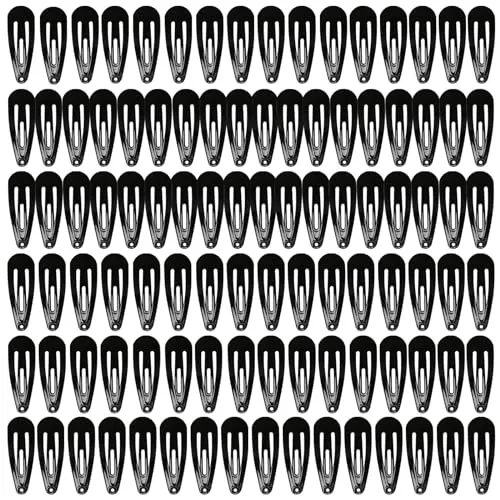
At 1.2 inches this is the size for flyaways, a single pinned-back strand and baby-hair control, where a 2-inch clip would be overkill and visible.
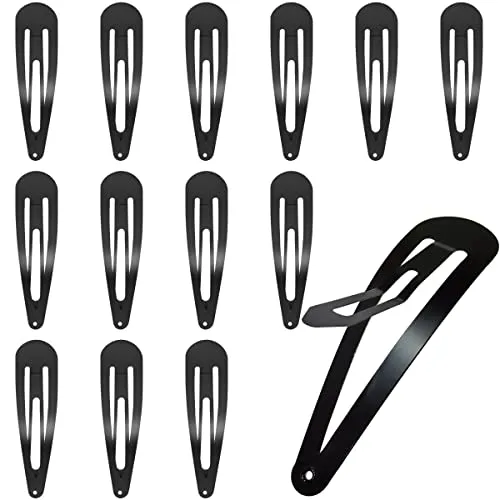
3.1 inches of jaw, so it takes a genuinely thick section instead of skating off it. Comes with a storage box, which matters once you own thirty identical black clips.
Quick Comparison
A side-by-side look at our top picks
Frequently Asked Questions
What is the difference between a snap clip and a barrette?
What size snap hair clip should I buy?
Do snap clips damage fine hair?

Donna Miller
Enjoyed This Guide?
Get more hair tips and product recommendations delivered weekly.