- Why do headbands give me a headache? Pressure, not weight
- A headband headache is a recognized diagnosis
- Fix 1: Take it off and start a timer
- Fix 2: Move the pressure line
- Fix 3: Go wider, and go wider than you think
- Fix 4: Get rid of the teeth
- Fix 5: Grip with friction, not tension
- Fix 6: If the headband is too tight, stretch it or reshape it
- Fix 7: Rotate your bands, and watch your hairline
- Three headbands that don't hurt, and why
- When it is not the headband
- The short version
A headband gives you a headache because it holds on by squeezing, and a narrow band concentrates that squeeze onto a couple of square inches of scalp instead of spreading it out. Pressure is force divided by area. Shrink the area and the same grip presses harder, right onto the nerves sitting just under the skin. So the real question — why do headbands give me a headache when other people wear one all day — has a mechanical answer, and a fixable one. We may earn a commission from links on this page, at no cost to you.
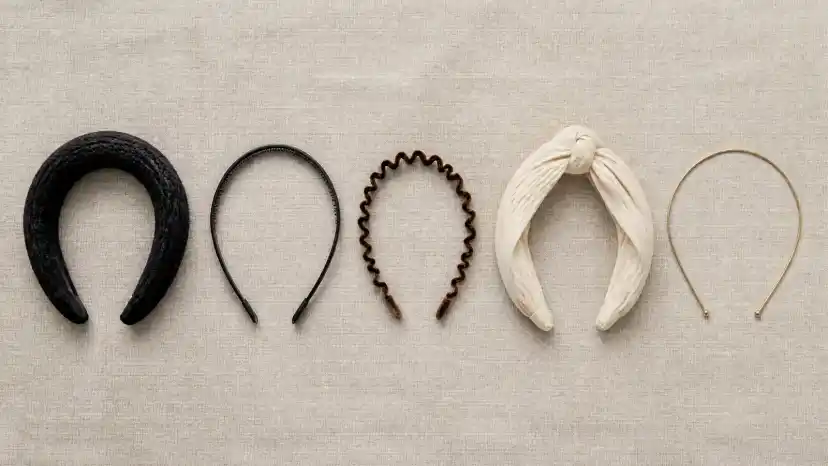
Below: what is actually happening on your scalp, what headache medicine calls it, and seven fixes in the order we would try them. If you want the wider view of widths, shapes and materials first, our guide to what makes a headband comfortable covers the whole category. This page is only about the pain.
Why do headbands give me a headache? Pressure, not weight
A headband weighs almost nothing. Get that out of the way first, because the instinct is to blame heaviness when the real variable is grip.
A band stays on your head by pressing inward. How much that hurts depends less on how hard it presses than on how little of your head it presses against. Double the width of a band and the same holding force lands half as hard on any given patch of scalp. A 0.6-inch band and a 1.2-inch band can grip identically and feel completely different, because one of them is spreading its load over twice the skin.
What sits under that skin matters too. According to the narrative review of external-pressure headaches by Ole Hensel and Torsten Kraya in the journal Brain and Behavior, the proposed mechanism is that sustained mechanical force on the tissues around the skull activates the superficial cutaneous nerves of the face and scalp, with peripheral or central sensitization and the trigeminocervical complex possibly involved. In plain terms: you are not bruising your skull. You are irritating shallow nerves that were never designed to be leaned on for four hours.
Three pieces of geometry do most of the damage — a narrow band, hard plastic teeth, and the two ends where the band crosses behind your ears. The same three failures show up in rigid clips, which is why the pain pattern feels so familiar if you have ever worn a claw clip all afternoon. We took that apart in why hair clips cause headaches.
A headband headache is a recognized diagnosis
If anyone has suggested you are being dramatic, headache medicine disagrees.
Under the International Classification of Headache Disorders, code 4.6.1, external-compression headache is defined as headache resulting from sustained compression of the soft tissues around the skull — and the classification names a tight band around the head, a hat or helmet, and goggles worn for swimming or diving as its examples, all without any damage to the scalp. The diagnostic criteria require at least two episodes brought on by, and occurring within one hour during, sustained external compression of the forehead or scalp. In their review of the literature, Hensel and Kraya list headbands and hairbands explicitly among the triggers, alongside helmets, hijabs, hearing protection, headphones and wigs.
Hensel and Kraya's review puts numbers on it. They report a lifetime prevalence of about 4 percent in adults aged 25 to 64 — roughly one person in twenty-five. The pain is most often described as pressing rather than throbbing, it is worst exactly where the object sits, typically across the front of the head, and average reported intensity is around 4 out of 10. Most episodes clear within an hour once the compression is relieved, though the review notes rare cases lasting up to five days.
The same review is blunt about treatment: resolution and prevention come from avoiding the precipitating cause, and it found no evidence that alternative therapeutic measures are effective. There is no pill for this. There is only geometry. For the fuller clinical picture, see our piece on external compression headaches from hair clips.
Fix 1: Take it off and start a timer
The first fix doubles as a diagnosis. Take the band off and note the time. If your head clears inside the hour, the band was the cause and everything below applies to you. If it does not, skip to the last section.
Do this early rather than heroically late. The pain builds while the pressure is sustained, so the band you tolerate at 11am is the band you cannot think through by 3pm.
Fix 2: Move the pressure line
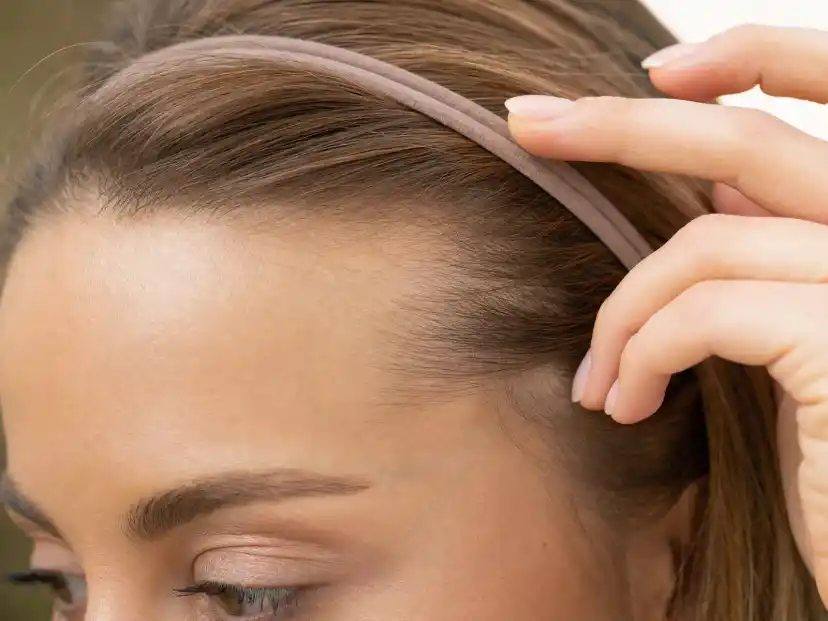
Hensel and Kraya report that the pain of a compression headache is maximal at the site of the compression. That is unusually actionable: if the pain has an address, change the address.
Slide the band half an inch forward or back and the load lands on fresh tissue. Two spots are worth auditing specifically — your temples, and the point behind each ear where the band crosses. Those ends carry the most concentrated pressure, because the skull is narrowing there and the band is not. If moving the band back makes it slip, that is a separate and solvable problem: see how to wear a headband without it slipping back.
Fix 3: Go wider, and go wider than you think
If you change exactly one spec, change width. This is the fix with the most leverage, because area is the denominator in the pressure equation and nothing else in the design moves it as much.
Our floor is about an inch, and we would rather be nearer two. Below an inch, a band has to work as a tourniquet to stay on. Around two inches, it can be genuinely loose and still hold, because there is enough surface in contact with your head to do the job by contact rather than by clamping.
Fix 4: Get rid of the teeth
Teeth are the opposite of width. A toothed band takes whatever force it is applying and funnels it into a line of hard points, each pressing on a patch of scalp a millimeter or two across. That is a very efficient way to grip hair and a very efficient way to generate a headache.
If your headache has distinct sore spots rather than a general band of pressure, teeth are the likeliest culprit. Switch to a smooth padded band and some wearers report the pain becoming diffuse before it fades. Teeth also drag on the hairline, which matters for more than comfort — we cover that in are headbands bad for your hair.
Fix 5: Grip with friction, not tension
This is the principle behind no pressure headbands, and it is worth understanding rather than just buying.
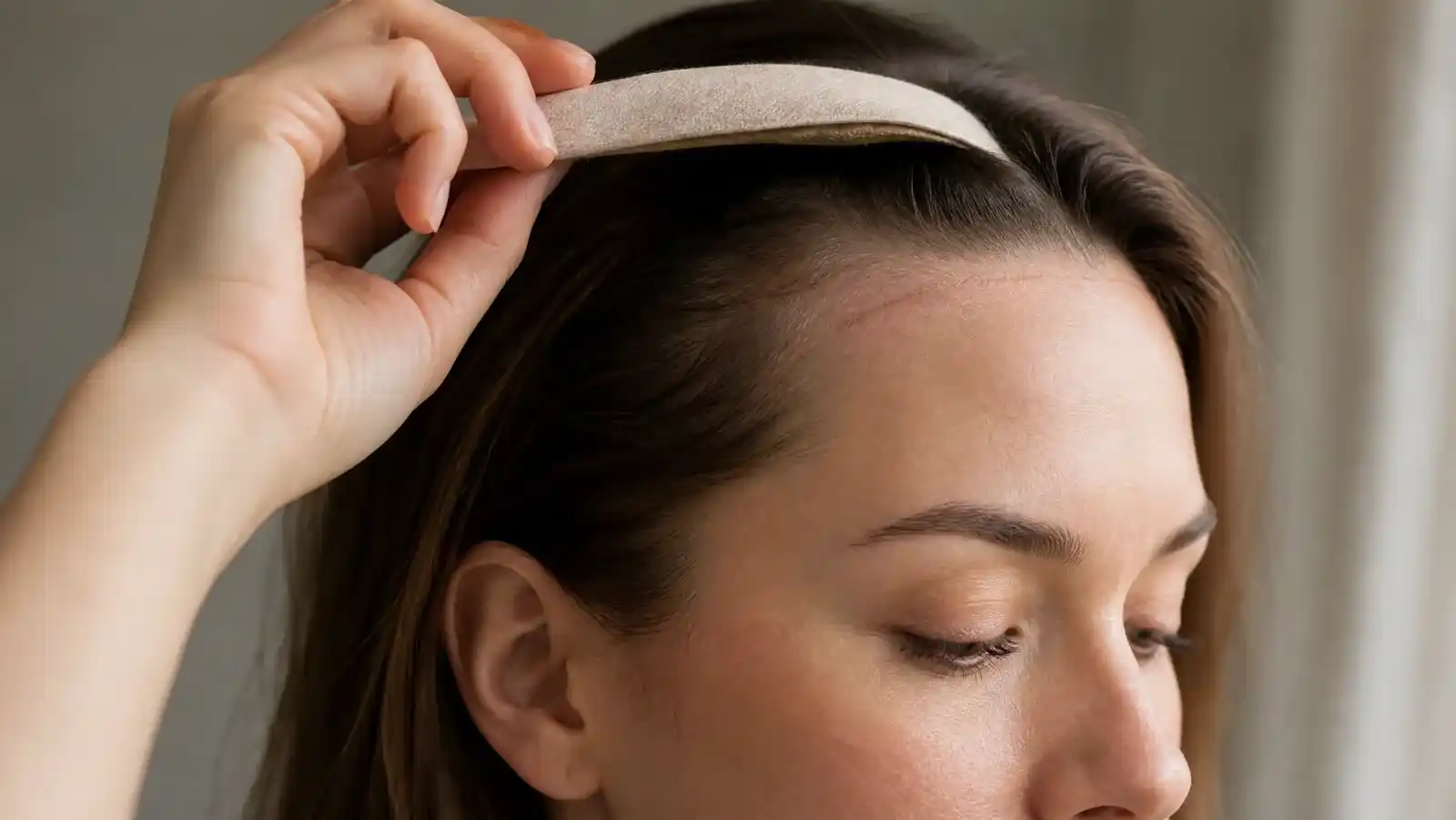
A band can stay in place two ways. It can squeeze, or it can be grippy enough that it does not need to. Velvet, ribbed knit and sueded linings all hold through friction against the hair, which means the band can sit at a tension that would let a satin band slide straight off. Smooth surfaces look better in photographs and perform worse on your head. Check the underside material before anything else on the listing.
Fix 6: If the headband is too tight, stretch it or reshape it
You may not need to replace anything. A rigid hoop can usually be stretched: rest it over something a little wider than your head — a stack of books, a large jar — and leave it overnight. It will not be permanent, but neither is the headache.
Fabric-over-elastic bands tend to loosen with wear, so a band that hurts when it is new may stop hurting after a few months. Bendable frames skip the waiting entirely: you reshape the arc to your own head contour, which usually means opening out the section that crosses behind the ears.
Fix 7: Rotate your bands, and watch your hairline
Hensel and Kraya note that regular breaks, meaning loosening or removing whatever is doing the compressing, reduce the incidence of external-compression headaches. Wearing the same band, in the same position, every day is the single worst pattern, because the same nerves get the same load with no recovery in between.
There is a hair-health reason for the same habit. The American Academy of Dermatology lists pain from tightly pulled hair, stinging on the scalp, crusts and tenting of the scalp as signs a style is too tight, and its guidance is unambiguous: if your hairstyle feels painful, the style is too tight. The AAD also recommends switching up your hairstyle regularly so your hair can recover. Two or three bands in rotation, worn at slightly different heights, is not fussiness. It is the cheapest fix on this list.
Three headbands that don't hurt, and why
Products are the last resort here, not the first. If the fixes above have not worked, these three match the mechanics, and each solves a different failure.
The AUDTOPE Velvet Padded No-Teeth Headbands are our pick because of what they leave out. No teeth means no concentrated contact points, and the pack covers 0.6, 0.8 and 1.2 inches so you can work out which width your head actually tolerates. AUDTOPE states the padded cushion reduces scalp pressure and eases temple soreness; treat that as maker copy, but the no-teeth velvet construction is the right shape for the claim. Three bands cost $7.99 as of September 2026.
The Scunci No-Slip Grip Bendable Headband is the answer to fix six. It has a bendable frame you reshape to your own head, and Scunci states it is engineered to reduce pressure behind the ears — the exact spot most rigid hoops get wrong. It is $5.99 as of September 2026.
The Yazon Ribbed Knit Padded Headbands are the width play. Yazon lists them at 50mm with a padded lining and says that width is what lets the band follow the curve of the head without pinching or leaving deep indentations. The ribbed texture supplies friction grip, so the band does not need tension. Three bands, $12.99 as of September 2026.
When it is not the headband
Sometimes the band is the trigger, not the cause. Hensel and Kraya report that external-compression headaches are markedly more prevalent among people with migraine than among people without, and that in studies of helmet wearers, roughly one in seven had episodes with migraine-like features such as nausea and light sensitivity.
There is a plausible reason for the overlap. According to the American Migraine Prevalence and Prevention study, reported by Richard Lipton and colleagues in Annals of Neurology, 63.2 percent of people with migraine experience cutaneous allodynia — pain from touch that should not hurt — and 20.4 percent have it severely. If that is you, a band that other people find unremarkable may be genuinely painful, and the fixes above matter more, not less.
Two signals say stop tinkering and see a clinician: a headache that does not resolve within about an hour of removing the band, and one that arrives with nausea, visual changes or light sensitivity. We write about hair accessories. Neither we nor a wider headband is a substitute for a doctor.
The short version
Width, then teeth, then position. Almost every headband headache traces back to a band that is too narrow, too toothed, or worn in the same spot for too long, and all three are cheap to fix. Take the band off, note the hour, and change the geometry rather than the tension.
If you are replacing rather than adjusting, start from the specs instead of the photographs — our headband buying guide sets out the widths, materials and shapes worth paying for.
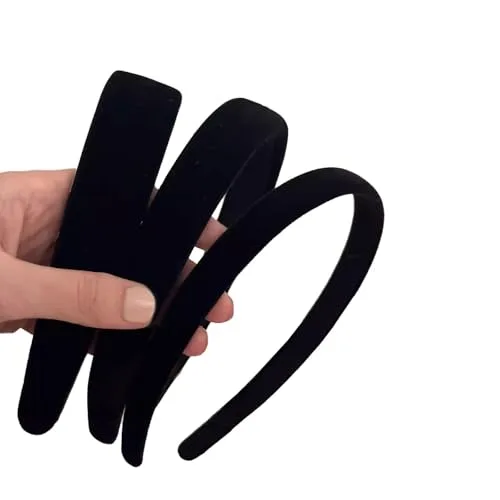
AUDTOPE Velvet Padded No-Teeth Headbands (3 Pack)
The no-teeth build is the whole point: there is no row of plastic points narrowing the contact patch down to a few millimeters. AUDTOPE says the padded cushion is there to reduce scalp pressure and ease temple soreness, which is maker copy rather than evidence, though the construction does match the claim.
“Removes the teeth entirely, which is the single most common concentrated pressure point on a headban...”
We tested dozens of claw clips to find the very best options. Below you'll find our complete ranking, with detailed reviews and real customer feedback for each pick.
The Complete Ranking
AUDTOPE Velvet Padded No-Teeth Headbands (3 Pack)
“Removes the teeth entirely, which is the single most common ...” — Verified Buyer
The no-teeth build is the whole point: there is no row of plastic points narrowing the contact patch down to a few millimeters. AUDTOPE says the padded cushion is there to reduce scalp pressure and ease temple soreness, which is maker copy rather than evidence, though the construction does match the claim. The three-pack spans 0.6, 0.8 and 1.2 inches, so you can find the width your head tolerates without buying three separate bands.
“Removes the teeth entirely, which is the single most common concentrated pressure point on a headband.”
— Verified Buyer
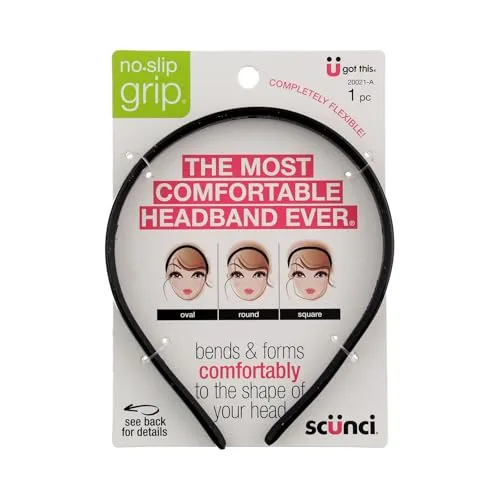
Scunci No-Slip Grip Bendable Headband
“A frame you can bend to your own head contour instead of ada...” — Verified Buyer
A bendable frame you reshape to your own head, rather than hoping your head matches the mold the factory used. Scunci states it is engineered to reduce pressure behind the ears, which is exactly where rigid hoops usually go wrong, and describes it as intended to avoid the discomfort of stiff headbands. This is the one to try when the band you already own fits everywhere except the two places it hurts.
“A frame you can bend to your own head contour instead of adapting to a fixed shape.”
— Verified Buyer
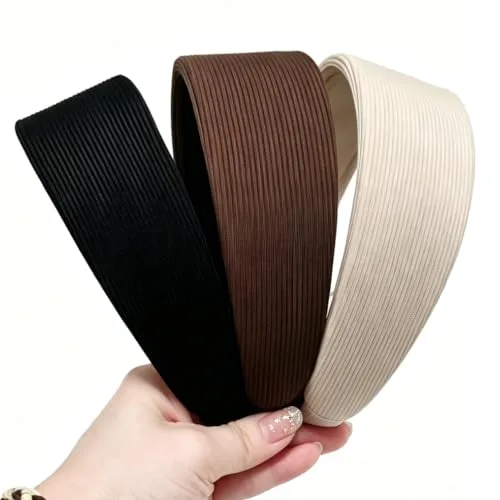
Yazon Ribbed Knit Padded Headbands (3 Pack)
“At a listed 50mm it spreads its holding force over roughly t...” — Verified Buyer
The widest band in this group at a listed 50mm with a padded lining, and width is the single spec that does the most work on pressure. Yazon says that width is what lets the band follow the curve of the head without pinching or leaving deep indentations. The ribbed surface adds friction grip, which means the band does not need to be tight to stay where you put it.
“At a listed 50mm it spreads its holding force over roughly twice the scalp of a typical band.”
— Verified Buyer
Removes the teeth entirely, which is the single most common concentrated pressure point on a headband.
Quick Comparison
A side-by-side look at our top picks
Frequently Asked Questions
How long should a headband headache last after I take the band off?
Will wearing my headband looser stop the headache?
Can headbands cause hair loss as well as headaches?

Donna Miller
Enjoyed This Guide?
Get more hair tips and product recommendations delivered weekly.