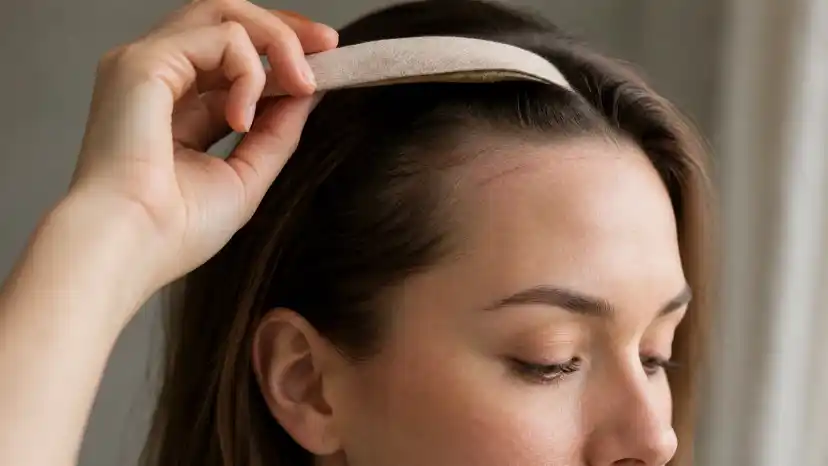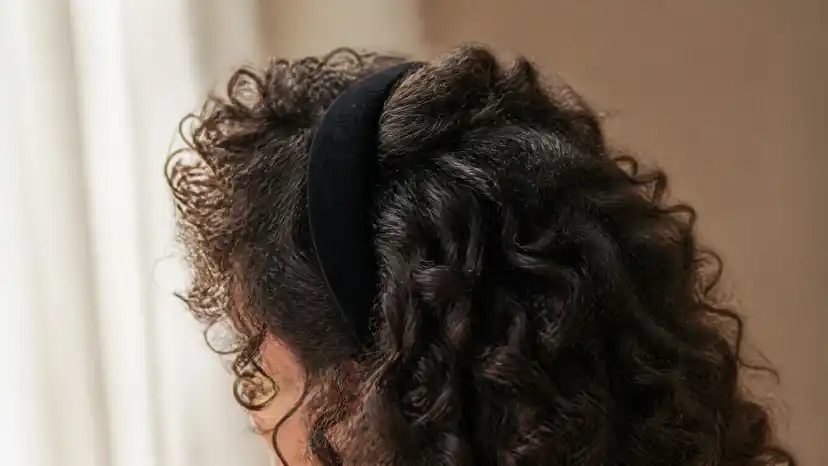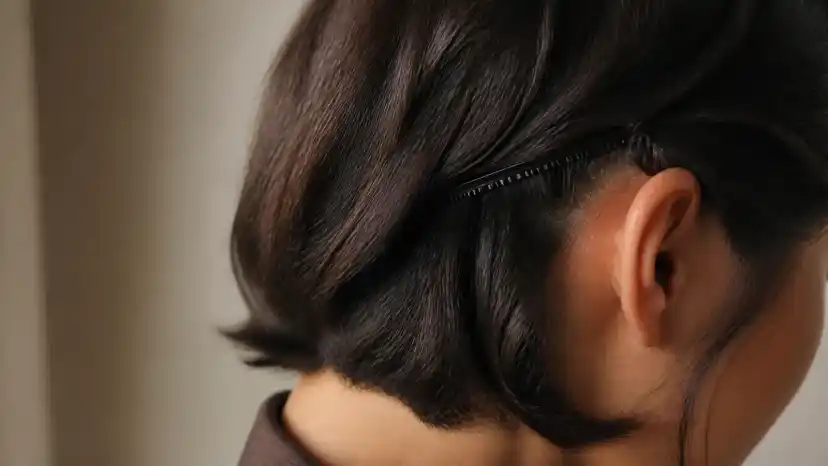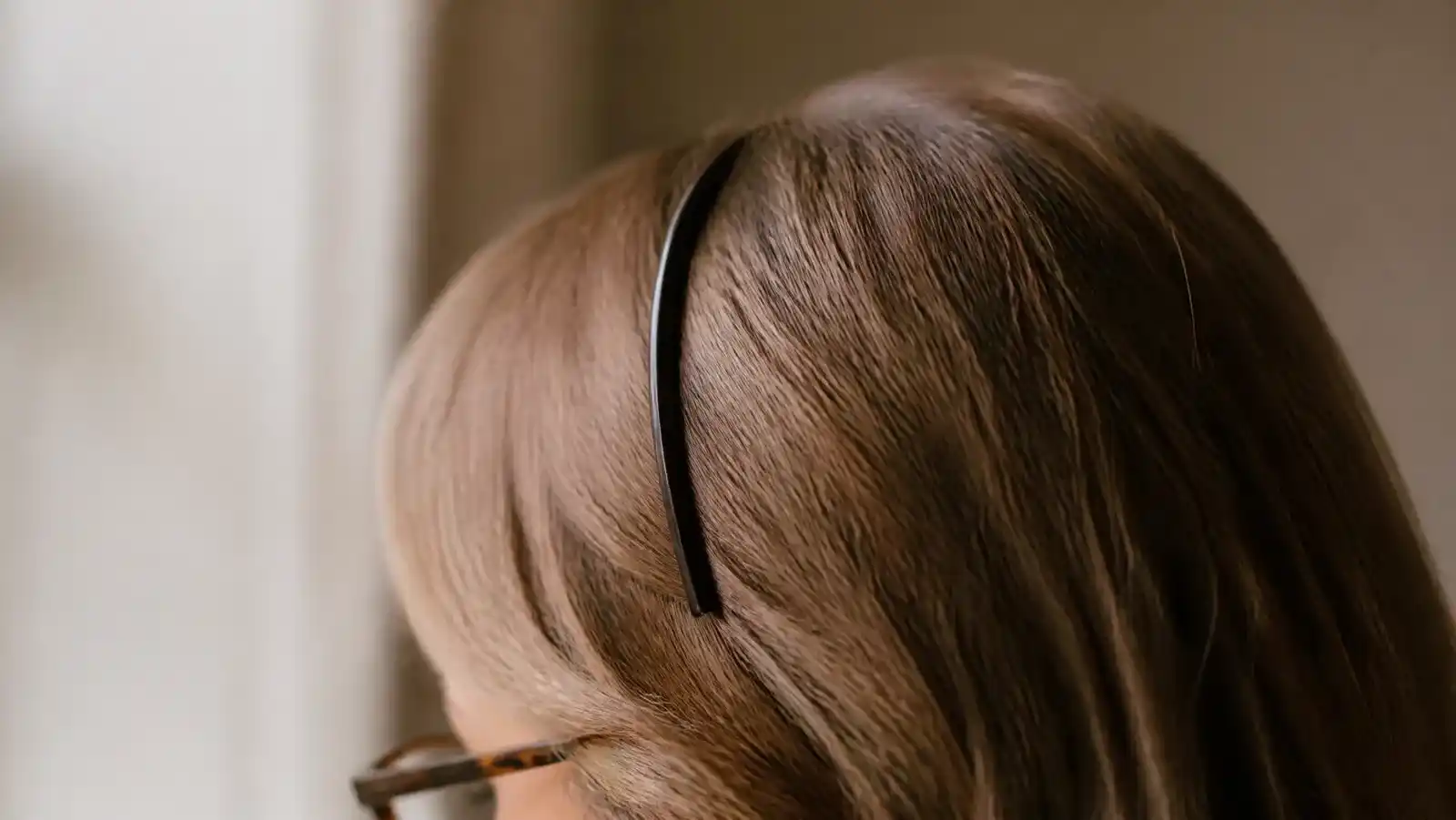
- The collision: two objects, one hollow behind the ear
- Why glasses make it worse than a band alone
- Flat headbands for glasses: four profiles that clear the arms
- Headbands that don't hurt behind ears: put them on in the right order
- The twenty-minute red-mark test
- A tighter band is never the fix, and teeth can help
- Thin headband for glasses, or fabric with no hard edge
- Adjust the glasses, not only the band
- The short version
The best headbands for women who wear glasses are the ones whose ends never reach the ear. The arm of your glasses and the end of your band both finish in the same soft hollow just above and behind the ear, and the band stacks on top of the arm — two rigid objects loading one pressure point. No amount of extra tension fixes that. Curve, width and flex do.
We earn a commission from links on this page, at no cost to you.
This guide is only about that collision: which band profiles clear the arms of your glasses, where the ends should land, and which of the two things to put on first. For the wider view of widths, materials and grip mechanisms, our guide to how to choose a headband covers the whole category.
The collision: two objects, one hollow behind the ear
Look at the geometry rather than the products. A rigid headband is an arc sized for an average skull, and the two places it presses hardest are the ends, because the head narrows behind the ears and the band does not. That is the sorest part of wearing any band, before eyewear enters it.
Now add eyewear, which is engineered to land in exactly the same place. According to Warby Parker's fit guide, the temples of your glasses should sit on the tops of your ears without much notable pressure, and if there is a bend in the temple it should begin right about where the temple meets the ear. Read that as a budget: the frame is designed to use up nearly all the tolerance that spot has.
Stack a band end on top and you are not adding a second mild pressure — you are concentrating both loads onto a few millimetres of skin over bone, with the plastic arm sandwiched between them acting as a ridge. Pressure is force divided by area, and this is one of the smallest contact areas on your head. The general version of that arithmetic is in our piece on why a headband turns into a headache.
Why glasses make it worse than a band alone
The cruel part is that the glasses arm cannot move. Its position sets where the lens sits in front of your eye, and Warby Parker's guidance is that your pupils should be near the horizontal and vertical centre of each lens. Slide your frames up an inch to dodge the band and you are looking through the wrong part of your prescription. The glasses are fixed. The band is the only variable you have.
There is a clinical frame for the discomfort too. Under the International Classification of Headache Disorders, external-compression headache is defined as headache resulting from sustained compression of the pericranial soft tissues — its own examples include a tight band around the head, a hat or helmet, and goggles worn for swimming or diving — with no damage to the scalp. Its criteria require at least two episodes brought on by, and occurring within one hour during, sustained external compression of the forehead or scalp.
The narrative review of external compression and traction headaches by Ole Hensel and Torsten Kraya in Brain and Behavior lists the triggers, and the list is worth reading slowly if you wear glasses: eye or virtual reality goggles, tight hats, helmets, headbands, hairbands, hijabs, hearing protection, in-ear and over-ear headphones and wigs. Headbands and hairbands are named on that list in their own right — prescription frames are not — but a band worn with glasses still puts two objects on one spot. The same review reports a lifetime prevalence of about 4 percent for external-compression headache, citing Rasmussen and Olesen, and notes that the most severe pain was localised in the area where pressure was applied. We go further into that literature in the clinical picture behind compression headaches.
Flat headbands for glasses: four profiles that clear the arms
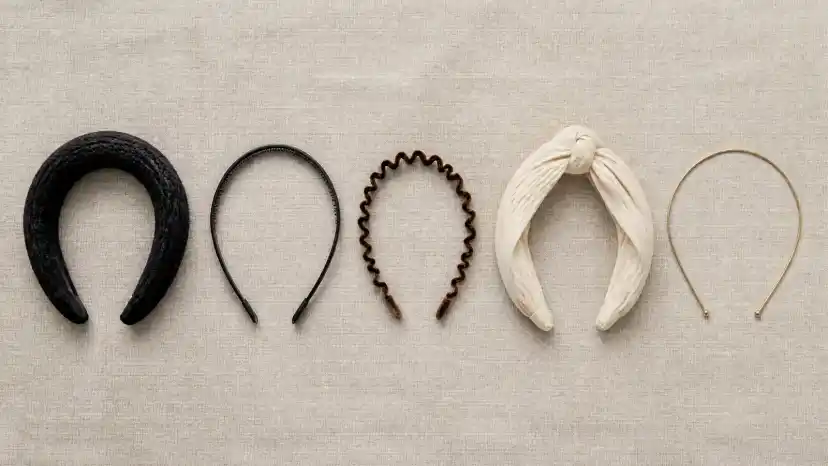
Four shapes get the band out of the way, and every band worth trying is one of them:
- Ends that curve away before the ear. The band turns outward or upward early, so it finishes above the arm instead of on it.
- A skinny, low-profile frame that sits higher up the skull and clears the arm rather than sharing its line.
- A flexible frame you can splay open at the tips, so the last inch of the band stops gripping where the arm already does.
- Fabric with no hard edge at all, which cannot form a ridge because there is nothing rigid in it.
Our pick is the first of those. The KOVOLITU Flex Eyewear Headbands are a two-pack of matte toothed plastic, listed at 4.72 x 5.51 x 0.47 inches, and KOVOLITU says the curved design is intended to avoid contact with the arms of your glasses and describes the plastic as having good elasticity. That is maker copy rather than evidence, but it is the only design here aimed at the collision rather than at general comfort. Two bands are $7.99 as of September 2026.
Headbands that don't hurt behind ears: put them on in the right order
Where the ends land matters more than what the band is made of, and the sequence decides where they land.
Band first, then glasses, seated higher and further forward than feels natural. With the band already in place you can slide each arm in underneath its end and feel whether the two touch before you commit to four hours. Put the glasses on first and you drag the end of the band down across the arm as you push it back into position, which assembles the stack by hand.
Aim the ends at the flat of the skull above the ear rather than the hollow behind it. In our experience a finger's width of clearance above where the arm crosses is enough, and the tell is that you can wiggle an arm slightly without the band moving with it. If the two move together, they are touching.
Forward placement has a second benefit: the band has further to travel before it falls off. The risk is that a band set forward on clean hair slides, and the answer is grip rather than tension — the logic behind stopping a band sliding back without cranking it tighter. Mapping your own sore spots helps too, which is how we approach finding the zones on your head that tolerate pressure.
The twenty-minute red-mark test
Twenty minutes is long enough to diagnose a band and short enough that you have not lost the afternoon to it.
Put the band and glasses on together, wear them for twenty minutes, then take both off and look at the hollow above and behind each ear. A dent, a red line or a warm patch means the band is loading a spot that already has a tenant. Hensel and Kraya note that the most severe pain sits where the pressure is applied, so the mark and the ache should agree with each other.
Check both sides, because most heads are not symmetrical and frames often get bent by one-handed removal. And test on a normal day rather than a quiet one: talking, chewing and pushing your glasses back up your nose all move the arm against the skin.
The American Academy of Dermatology's guidance on hairstyles that pull is worth borrowing here: if your hairstyle feels painful, the style is too tight, and its warning signs are pain from tightly pulled hair, stinging on the scalp, crusts and tenting of the scalp. It also names broken hairs around the forehead and a receding hairline as tell-tale signs. That page is about braids and ponytails rather than headbands, but a tight band worn in the same line daily applies the same kind of load, which we unpack in whether a daily headband habit damages hair.
A tighter band is never the fix, and teeth can help
Tension is the thing to stop adjusting. Tightening a band increases the force at the ends, and the ends are the problem. It also does nothing about the ridge formed by the glasses arm, which is the reason the pain has a sharp edge rather than a broad one.
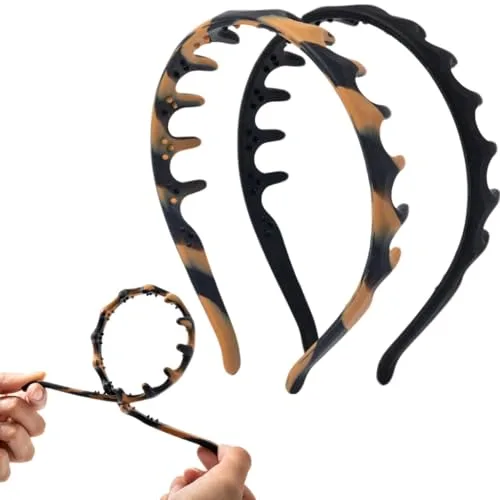
Teeth, counter-intuitively, are on your side here. A toothed band holds by biting into hair rather than by squeezing the skull, so it can stay put at a tension that would let a smooth plastic hoop slide straight off. Grip from teeth is grip you do not have to pay for in pressure. The trade-off is real: teeth are hard on fine hair and on the hairline, so they are not the pick if snagging is your main complaint.
Two toothed multipacks cover that approach. The TOBATOBA Flex Glasses Headbands are six skinny resin bands with two rows of teeth and a listed 5.36 inch diameter, marketed by TOBATOBA as flex, no-pressure bands for women who wear glasses; six are $9.99 as of September 2026. The TOBATOBA Square Glasses Headbands take the same idea in a square profile with a frame the maker describes as adjustable to fit your head, which is what lets you open out the last inch. Six are $14.99 as of September 2026.
Thin headband for glasses, or fabric with no hard edge
If rigid bands have all failed, the next move is to remove the rigid part rather than shop for a better arc.
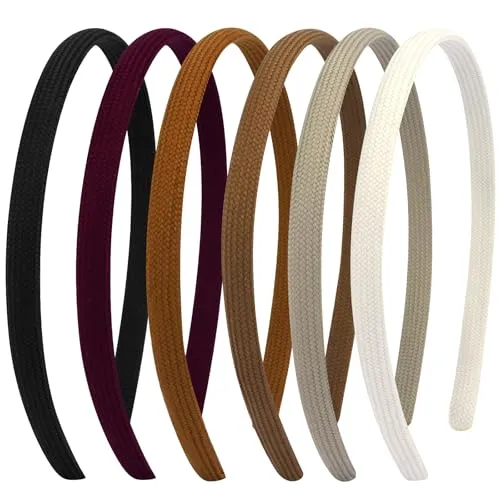
The Vovii Thin Fabric Headbands are a 1cm fabric-wrapped band with no plastic frame, and Vovii describes them as engineered to distribute pressure evenly, breathable and non-abrasive, and says they leave no mark. Take the no-mark line as marketing, but the construction is right: nothing rigid means no edge to press down onto the arm of your glasses. Six are $7.99 as of September 2026. The honest limitation is grip — a soft 1cm band holds by friction, so it is the format most likely to creep back on freshly washed hair.
For all-day wear the lumitrail Silicone Comb Headbands are the adjustable option. lumitrail describes them as silicone over a memory metal wire core that holds its shape without cracking, with micro-fold ends it says have no pressure points during extended wear and tightness that can be adjusted to different head shapes. That last feature is the one that matters for glasses: you can open the band out slightly at the exact point the arms sit. Two are $13.99 as of September 2026.
Adjust the glasses, not only the band
Half of this problem belongs to your frames, and a band is the wrong tool for fixing eyewear that was already too tight. All About Vision's home-adjustment guide suggests very gentle outward pressure on the corner of the frame between the arm hinge and the lens for temples that pinch — but it gives that method for metal frames only, and warns that adjusting the temples of rimless, semi-rimless or plastic frames could break them, recommending an optician for those. For plastic frames it says to soak the arms in warm water for 30 to 60 seconds before working on them at all, and it advises taking frames made of aluminium alloy, titanium or memory titanium, and memory plastic to a professional rather than adjusting them yourself. Warby Parker's advice for frames that do not fit is simpler: take them to an optician for a professional adjustment.
That is where our expertise stops. Persistent pain, numbness or headaches behind the ears are worth raising with an optometrist or a doctor rather than solving with another band. If soreness lingers after the accessories come off, our piece on scalp tenderness that outlasts the accessory covers what that pattern usually means.
The short version
Stop adjusting tension and start adjusting geometry. Pick a band whose ends curve away, sit clear of, or flex open at the spot where your glasses arms cross; put the band on first and higher than feels natural; and use the twenty-minute mark behind your ear as your only real test. Teeth are allies, not enemies, because they buy grip without squeeze.
If you are replacing rather than repositioning, start from the profile of the ends rather than the look of the band — and our guide to the best headbands for women sets out the widths, materials and shapes worth paying for.
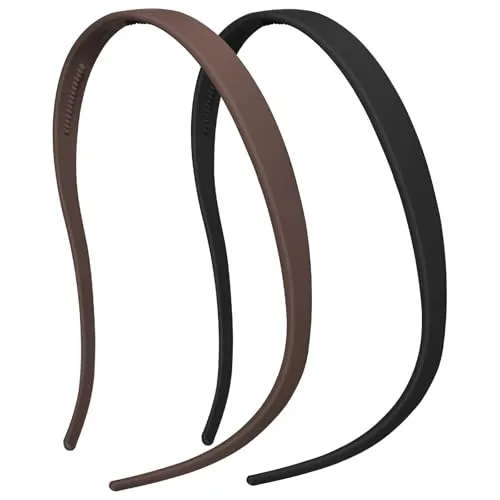
KOVOLITU Flex Eyewear Headbands (2 Pack)
The only mechanism here that addresses the actual problem: KOVOLITU curves the band so it clears the arms of your glasses instead of stacking on top of them. Toothed plastic with some give, 4.
“According to KOVOLITU, the band is curved specifically to avoid contact with the arms of your glasse...”
We tested dozens of claw clips to find the very best options. Below you'll find our complete ranking, with detailed reviews and real customer feedback for each pick.
The Complete Ranking
KOVOLITU Flex Eyewear Headbands (2 Pack)
“According to KOVOLITU, the band is curved specifically to av...” — Verified Buyer
The only mechanism here that addresses the actual problem: KOVOLITU curves the band so it clears the arms of your glasses instead of stacking on top of them. Toothed plastic with some give, 4.72 x 5.51 x 0.47 inches, two to a pack.
“According to KOVOLITU, the band is curved specifically to avoid contact with the arms of your glasses — the only pick here designed around that collision.”
— Verified Buyer
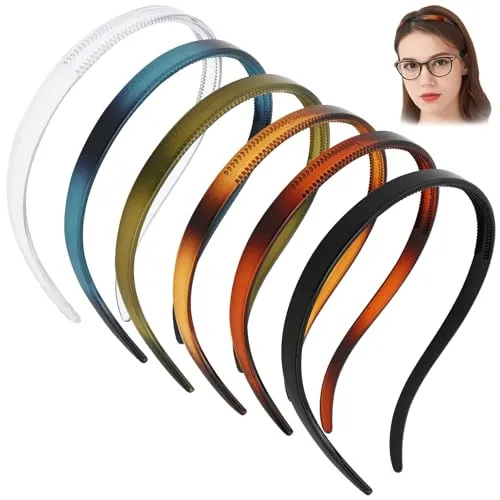
TOBATOBA Flex Glasses Headbands (6 Pack)
“Six bands to a pack at a listed 5.36 inch diameter, which is...” — Verified Buyer
Six skinny resin bands built on the same flex idea, with two rows of teeth for hold and a 5.36 inch diameter. The pack is the cheap way to find out which colour and tension you actually reach for.
“Six bands to a pack at a listed 5.36 inch diameter, which is the cheap way to find the one tension your head tolerates.”
— Verified Buyer
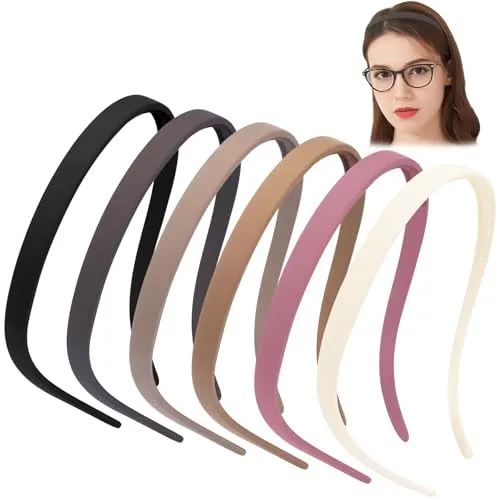
TOBATOBA Square Glasses Headbands (6 Pack)
“TOBATOBA describes the frame as flexible and adjustable to f...” — Verified Buyer
A square-profile take, also matte plastic with two rows of teeth and a flexible frame you can adjust. TOBATOBA sells it specifically as a no-pressure band for glasses wearers; six pieces.
“TOBATOBA describes the frame as flexible and adjustable to fit the head, with two rows of teeth doing the holding instead of tension.”
— Verified Buyer
Vovii Thin Fabric Headbands (6 Pack)
“No rigid frame anywhere on it — a listed 1cm fabric band tha...” — Verified Buyer
No plastic frame at all. A 1cm fabric-wrapped band that Vovii says spreads pressure evenly and leaves no mark — worth trying if every rigid band has failed you, since there is no hard edge to meet the glasses arm.
“No rigid frame anywhere on it — a listed 1cm fabric band that Vovii says spreads pressure evenly and leaves no mark.”
— Verified Buyer
lumitrail Silicone Comb Headbands (2 Pack)
“According to lumitrail, the tightness is adjustable to diffe...” — Verified Buyer
Silicone over memory wire with micro-fold ends and adjustable tightness. The adjustability is the reason it earns a place here: you can open it out slightly where the glasses arms sit.
“According to lumitrail, the tightness is adjustable to different head shapes, which is what lets you open out the section where the glasses arms sit.”
— Verified Buyer
According to KOVOLITU, the band is curved specifically to avoid contact with the arms of your glasses — the only pick here designed around that collision.
Quick Comparison
A side-by-side look at our top picks
Frequently Asked Questions
Band first, then glasses
The red mark behind your ear is the test
Tighter is the wrong lever

Donna Miller
Enjoyed This Guide?
Get more hair tips and product recommendations delivered weekly.