- Why headbands slip back in the first place
- How to wear headbands so they stay put: the six-step seat
- Headband placement: the two spots that actually decide the outcome
- How to keep a headband from slipping: grip instead of squeeze
- Ways to wear headbands for your hair type
- Three headbands that hold without squeezing
- How to wear a headband correctly without triggering a headache
- The short version
Seat the band at your hairline, not on top of your head, and let friction hold it instead of tension. Headbands slip because a stretched loop always travels toward the smallest circumference it can find, and the top of your head is smaller around than the bottom. Learning how to wear headbands is mostly learning where to put them. We may earn a commission from links on this page, at no cost to you.
The rest is grip, ear placement, and a tension level that stops well short of pain. Below is the full method, the fit specs worth checking before you buy, and what to do when a band still creeps. If you are still deciding which style suits you, our guide to headbands for women covers the broader picks.
Why headbands slip back in the first place
Your head is not a cylinder. The standard tape-measure path for head circumference runs just above the brows and around the back of the skull, and that loop is close to the widest circuit your head offers. Move upward from there, over the curve toward the crown, and the circumference shrinks.
A band under tension will always migrate toward the smaller circumference, because that is where its tension drops. That is not a fault in the band. It is a stretched loop doing what stretched loops do, and it will keep doing it until something stops it.
Two things can stop it: friction against the surface it is resting on, and a mechanical edge it can brace against. Most slipping headbands have neither.
They fail on friction because they are resting on hair rather than skin, and hair is a slippery surface. According to a 2025 review in Advances in Colloid and Interface Science by Erik Weiand and colleagues, hair friction is anisotropic — the protruding cuticle edges interlock when sliding one way and glide the other — and it rises as the protective 18-methyleicosanoic acid layer on the fiber surface is lost through weathering and processing, while conditioners bring friction back down toward virgin levels. The same review lists humidity and cleanliness among the factors that change how hair slides. In plain terms: smooth, clean, well-conditioned hair gives a smooth plastic band almost nothing to hold.
They fail on bracing because a band parked halfway back has open skull in every direction. Seated properly, it has the widest part of your head below it and your ears beside it, and it would have to stretch to escape.
How to wear headbands so they stay put: the six-step seat
This takes under a minute and is the whole game.
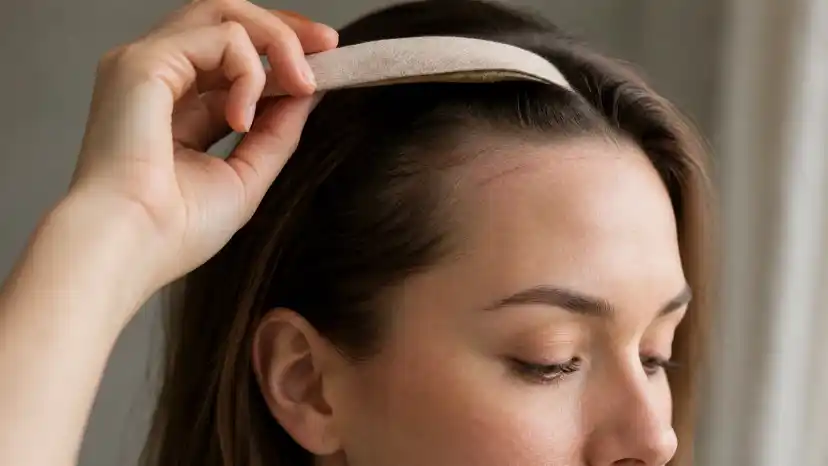
- Go in from the back, not the front. Set the back edge at your nape first, then roll the band forward over your head. Pushing a band back from the forehead drags it along the hair shaft and leaves it sitting wherever the friction ran out — usually the crown.
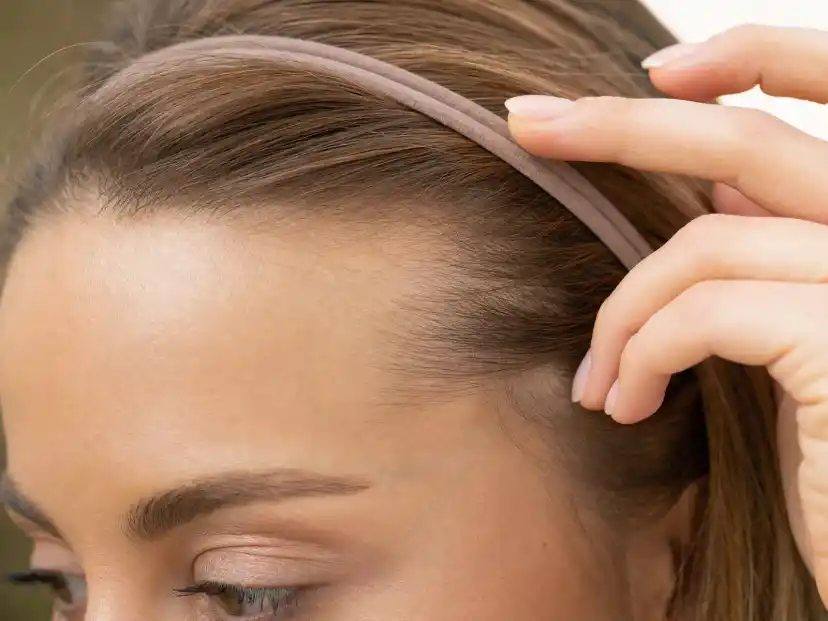
- Land the front edge on skin. The band should touch the hairline or sit a finger-width behind it, with at least some contact on bare skin. Skin grips. Hair does not.
- Take the ends behind your ears. Your ears are the only mechanical stop on the side of your head. A band routed behind them cannot ride up without deforming, and the tops of the ears carry some of the load that would otherwise sit on your temples.
- Check the back edge is low. Run a finger along the rear of the band. If it has already ridden up onto the round of your skull, the front will follow within the hour. Pull it down toward the occipital bone, the bump at the base of the skull.
- Press the teeth or grip surface in. If your band has teeth, wiggle them into the hair rather than skating them over the top. Teeth work by anchoring into hair, and that only happens if they are seated.
- Do the one-finger check. You should be able to slide a finger under the band at the temple with mild resistance. If you cannot get a finger in, it is too tight. If it flops, it is too loose and will travel.
Headband placement: the two spots that actually decide the outcome
Everything above collapses into two contact points.
The front edge. This is the one people get wrong. There is a strong instinct to push a band backward for a softer, less severe look, but every centimeter back is a smaller circumference and less skin contact. If you want the band further back for styling reasons, accept that you now need real grip to compensate — teeth, silicone, velvet, or pins.
Behind the ears. A band whose ends sit on the ears rather than behind them is balanced on two rounded, moving surfaces. Talking and chewing then nudge it loose all day. Behind the ears, the same band is tucked into a natural hollow and braced.
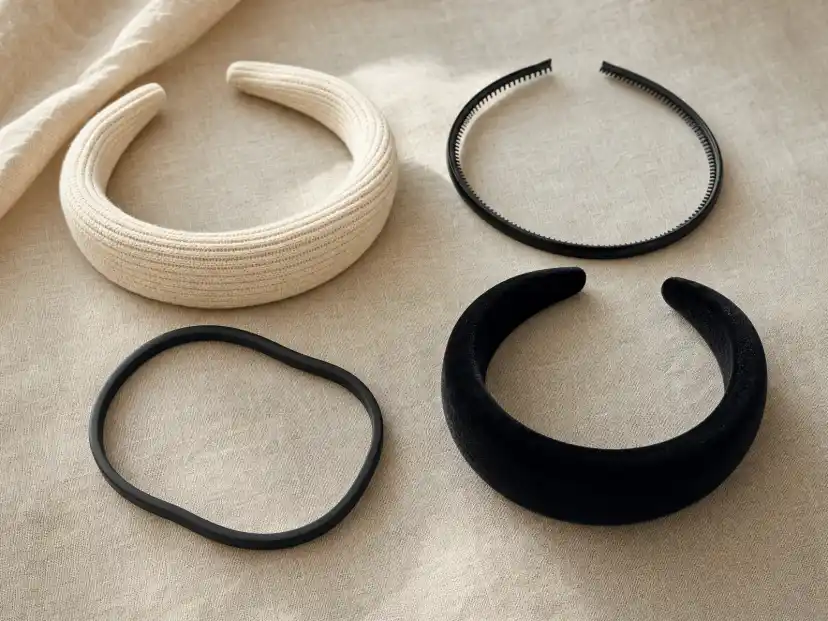
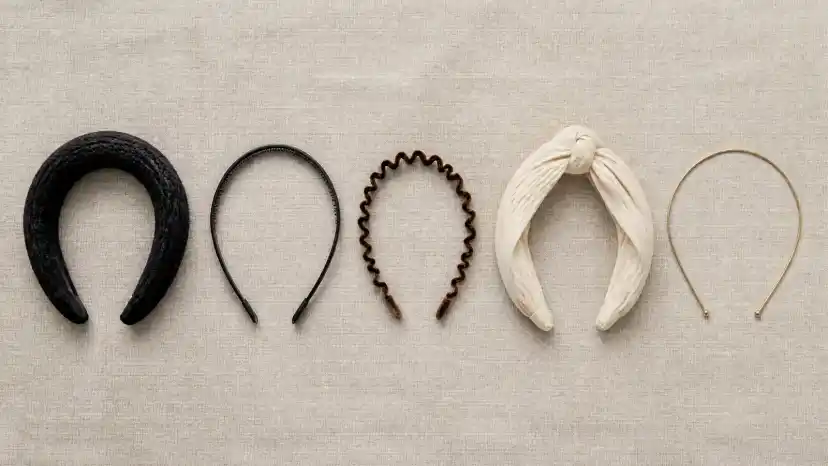
There is a third, optional contact point worth knowing: the nape. Wide bands and knotted turban styles that reach down to the hairline at the back get a long, low band of contact that resists creep almost entirely. Different shapes handle these contact points differently, which is the practical reason to know the formats — our breakdown of the Types of Headbands Explained: 12 Styles and What Each Does maps which shapes brace and which ones simply squeeze.
How to keep a headband from slipping: grip instead of squeeze
The instinct when a band slides is to buy a tighter one. That trades one problem for a worse one. Better levers, in the order we would try them:
- Wear it on day-two hair. The sebum and residual product that make hair look less fresh are exactly what make it grippy. This is free and it works better than most of the rest.
- Add texture at the contact points only. A little dry shampoo, texture spray, or hairspray where the band will sit. Headbands of Hope suggests applying hairspray, pomade, gel, or texturizing spray to the spots where the headband will sit, and that targeted approach is right: you want grip at the interface, not a stiff head of hair.
- Choose a gripping underside. Velvet, suede, ribbed knit, and silicone strips all raise friction without adding tension. This is the single most effective purchase-side change.
- Pick teeth over smooth plastic. Teeth convert a friction problem into an anchoring problem, and anchoring is easier to win.
- Pin it, discreetly. Headbands of Hope recommends applying bobby pins in a criss-cross fashion through the hair and down onto the band with the pin openings pointing downwards. Two pins at the back, hidden under the top layer, will hold almost any band. The same logic applies to flat clips, and the placement principles in our guide to How to Wear Barrettes: 12 Easy Ways to Style Any Hair transfer directly.
- Tease a quarter-inch at the crown. A small amount of backcombing where the band crosses gives it a textured shelf to sit against.
Ways to wear headbands for your hair type
Fine or thin hair offers the least friction and the least bulk, so anchoring beats padding. Teeth, a velvet underside, or a pin at each side. Skip heavy rigid hoops, which have too much mass for too little grip.
Thick hair has the opposite problem: the band never reaches the scalp at all, so it rests on a springy cushion of hair that pushes back. Width is the fix, because pressure is force divided by area. We go into the specs in our roundup of the best headbands for thick hair.
Curly and coily hair usually grips well but resents compression at the hairline, where the hairs are often finest. Sit the band behind the front row of curls rather than crushing it.
Short hair and bobs lose the bracing that long hair provides at the nape. Route the ends behind the ears and expect to use a pin.
Three headbands that hold without squeezing
Because the fix is grip rather than tension, the specs worth paying for are the underside and the teeth. All prices are as of September 2026.
The Thin Velvet Headbands with Teeth set at $7.99 for three is the format we would try first, because it stacks both grip mechanisms — teeth to anchor, velvet to resist sliding on skin — onto a frame the listing describes as thin and lightweight. Less mass perched high on the head means less to pull the band backward in the first place.
If your problem is a hoop that only touches your head in two places, the Scunci No-Slip Grip Bendable Headband at $5.99 lets you reshape the frame to your own head. Scunci describes it as shaped to the natural contours of the head, with a bendable build the brand says reduces pressure behind the ears. That is maker copy, not independent testing, but the principle holds: more contact length spreads the same load over more scalp.
For practising the seating technique on something you do not mind bending, the JJUNW Toothed Plastic Headbands four-pack at $5.49 is the cheap route in, with what JJUNW describes as precision-placed teeth on a lightweight plastic frame.
How to wear a headband correctly without triggering a headache
Tightening a band until it cannot slip is the failure mode we would most like to talk you out of, because the pain it causes is a recognized diagnosis.
The ICHD-3 entry for external-compression headache describes it as headache resulting from sustained compression of pericranial soft tissues, for example by a tight band around the head, hat or helmet, and its criteria require the pain to develop within an hour of sustained compression of the forehead or scalp and to resolve within an hour once that compression is relieved. A 2025 narrative review by Ole Hensel and Torsten Kraya in Brain and Behavior (first published online in December 2024) reports a lifetime prevalence of 4 percent, citing a survey of adults aged 25 to 64, lists headbands and hairbands among the triggers alongside helmets and goggles, and reports that helmets with special inner padding, which exert uniform pressure on multiple regions of the head, have been shown to reduce the frequency of these headaches. That is the same principle as a wide, padded band: spread the load, do not raise it.
There is a hair-health argument too. The American Academy of Dermatology notes that the constant rubbing of a hat, head scarf, or other hair covering over the hair can lead to traction alopecia, especially if you pull the hair back tightly before covering it, and advises against frequently wearing styles that pull. Its plainest rule is the one to remember: if your hairstyle feels painful, the style is too tight. If you are already getting the ache, our piece on Why Do Headbands Give Me a Headache? 7 Fixes works through the specific adjustments.
The short version
Low and forward, behind the ears, gripping rather than gripping tight. If a band still walks backward after a proper seat, the answer is a different underside or a pin, never another half-inch of tension. Get the placement right and a $5 band will outperform an expensive one worn wrong — and if yours is simply the wrong shape for your head, start with picking the right headband for your hair.
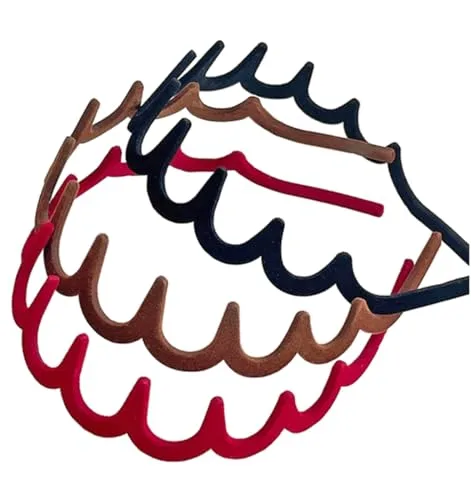
Thin Velvet Headbands with Teeth (3 Pack)
This is the format we would reach for first if your band keeps creeping toward the crown, because it solves the problem with friction rather than squeeze: teeth to anchor into the hair plus a velvet surface that does not slide on skin. The listing describes a thin, lightweight zig-zag frame, so there is very little mass sitting high on your head fighting the hold.
“Teeth and a velvet surface do the holding, so it does not need to be tight to stay put....”
We tested dozens of claw clips to find the very best options. Below you'll find our complete ranking, with detailed reviews and real customer feedback for each pick.
The Complete Ranking
Thin Velvet Headbands with Teeth (3 Pack)
“Teeth and a velvet surface do the holding, so it does not ne...” — Verified Buyer
This is the format we would reach for first if your band keeps creeping toward the crown, because it solves the problem with friction rather than squeeze: teeth to anchor into the hair plus a velvet surface that does not slide on skin. The listing describes a thin, lightweight zig-zag frame, so there is very little mass sitting high on your head fighting the hold. Three colors in the pack means you are not committing a whole outfit to one shade.
“Teeth and a velvet surface do the holding, so it does not need to be tight to stay put.”
— Verified Buyer
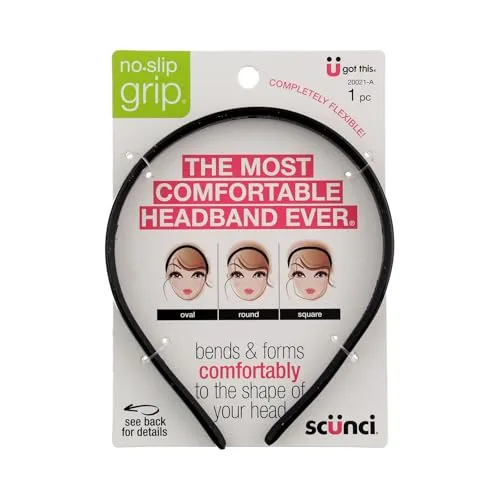
Scunci No-Slip Grip Bendable Headband
“Being able to bend the frame is the cheapest fix for a hoop ...” — Verified Buyer
A bendable frame is the honest answer to a rigid hoop that only touches your head in two places. Scunci describes this one as shaped to the natural contours of your head with a no-slip grip intended to stop sliding through the day, and says the bendable build reduces pressure behind the ears. Treat those as maker claims, but the mechanism is sound: more contact length means less load per contact point.
“Being able to bend the frame is the cheapest fix for a hoop that fits everyone except you.”
— Verified Buyer
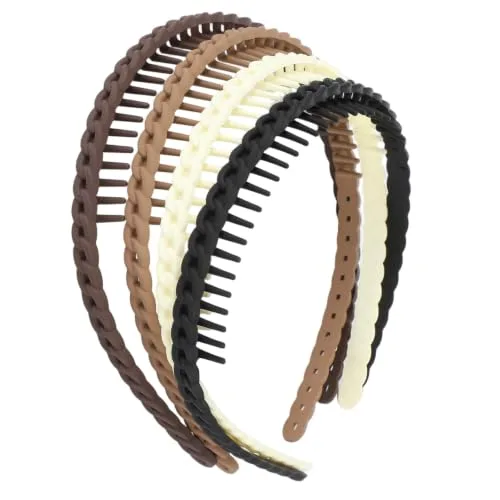
JJUNW Toothed Plastic Headbands (4 Pack)
“Four bands at this price means you can test the toothed form...” — Verified Buyer
Four plain toothed plastic bands, which makes this the low-risk way to find out whether teeth are the fix for your hair before you spend more. JJUNW describes precision-placed teeth for a firm grip on a lightweight plastic frame. We would use a set like this to practise the seating technique, since a band you are willing to bend and test is worth more than a nice one you baby.
“Four bands at this price means you can test the toothed format without committing.”
— Verified Buyer
Teeth and a velvet surface do the holding, so it does not need to be tight to stay put.
Quick Comparison
A side-by-side look at our top picks
Frequently Asked Questions
Where exactly should a headband sit on your head?
Why does my headband slip more on freshly washed hair?
Should a headband be tight enough to leave a mark?

Donna Miller
Enjoyed This Guide?
Get more hair tips and product recommendations delivered weekly.