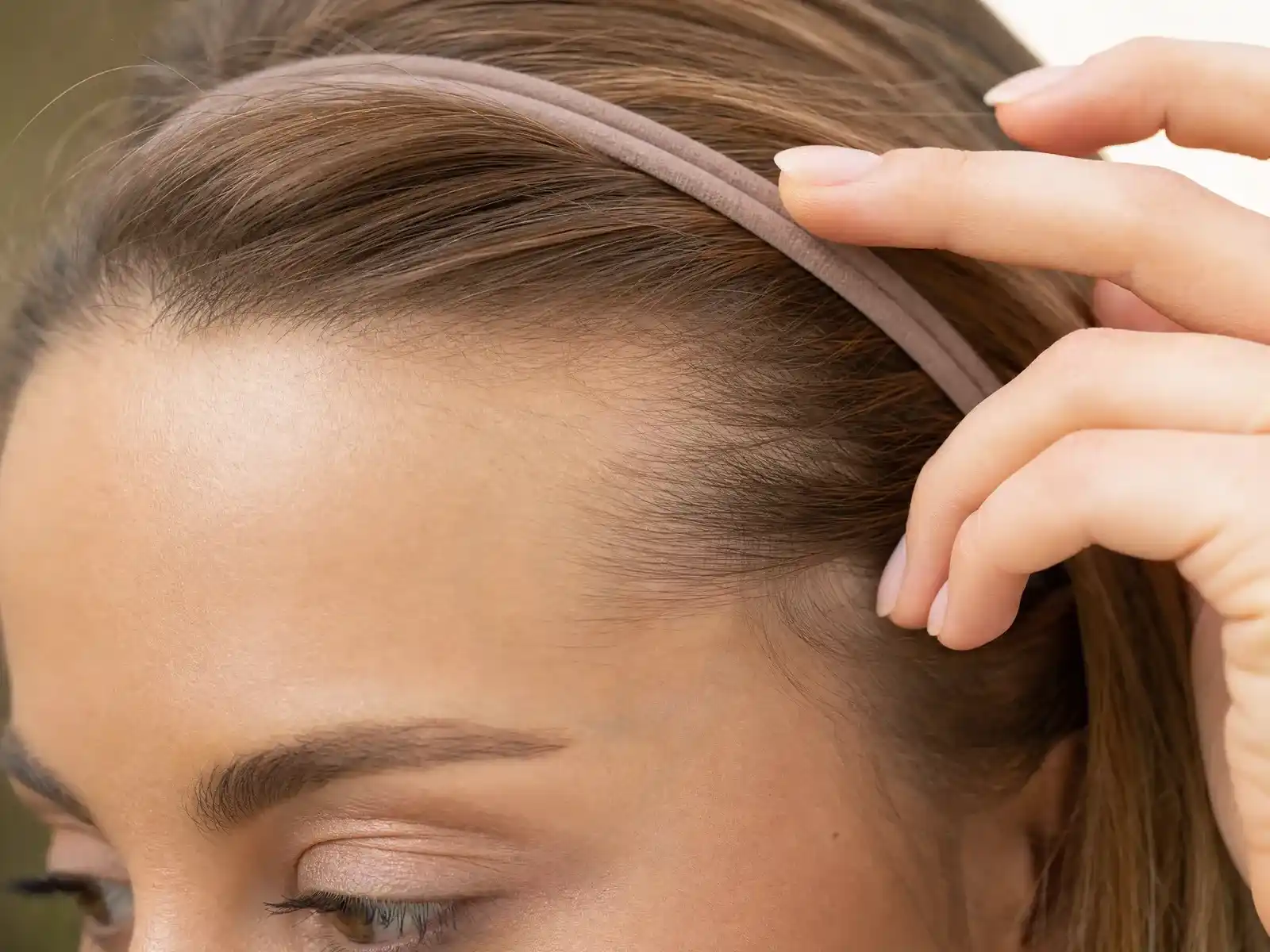
- Do headbands cause hair loss? What the research actually says
- Risk factor one: sustained tension
- Risk factor two: friction in the same spot every day
- Risk factor three: toothed and rigid bands worn tight
- Are headbands bad for thin hair? Who is most at risk
- Headband hair damage: the signs to watch for
- How to wear a headband safely
- Lower-tension headbands we reach for
- The verdict: are headbands bad for your hair?
Short answer: headbands are not inherently bad for your hair. A band resting on your head does nothing to a hair fibre by itself. Three specific habits cause the damage people blame on the accessory: sustained tension, repeated friction at the same spot on the hairline, and toothed or rigid bands worn tight. Fix those three and the headband is rarely the problem.
We may earn a commission from links on this page, at no cost to you.
People usually ask are headbands bad for your hair after noticing something specific — a halo of short broken hairs at the temples, a sore patch behind one ear, a hairline that looks slightly wider than last year. The useful answer is not yes or no. It is a question of load: how much force, for how long, and how often in the same place. Nearly all of that is decided by how a headband should fit, which makes this a solvable problem rather than a reason to bin your bands.
Do headbands cause hair loss? What the research actually says
Dermatology sources rarely single out headbands, but they do put them on the list. According to WebMD's overview of traction alopecia, the causes include frequent use of tight headbands or hats, and overuse of hair clips or accessories that pull on your hair. The American Academy of Dermatology's page on hairstyles that pull names hats, head scarves and other hair coverings among the contributors, and advises pulling hair back loosely beneath a covering.
Two different problems get lumped together here, and separating them is most of the answer.
Traction is a follicle problem. Tiffany Mayo and Valerie Callender, writing in the International Journal of Women's Dermatology, describe traction alopecia as developing from hairstyling techniques that pull the hair tightly, producing prolonged tension and damage to the hair shaft and follicle. They note it most commonly affects the frontotemporal hairline — precisely where a headband sits.
Breakage is a fibre problem. A strand snaps partway along its length because the cuticle, the overlapping outer scale layer, has been worn thin. The follicle is untouched.
Timing matters more than either mechanism. Mayo and Callender write that alopecia caused by traction is initially reversible but becomes irreversible with prolonged repeated damage. A 2021 review of traction alopecia's clinical and cultural patterns in the Indian Journal of Dermatology puts it the same way: the condition is biphasic, with early non-scarring disease and reversibility, whereas in the chronic state there is scarring and permanent hair loss.
So the risk is real but conditional, and it announces itself early. We go deeper on the mechanism in our guide to traction alopecia from hair accessories.
Risk factor one: sustained tension
A headband stays on by squeezing; that is the entire design. A band with no tension falls off, so every wearable headband sits somewhere between "stays put" and "hurts", and that gap is narrower than people assume. What turns ordinary squeeze into a problem is duration. Mayo and Callender note that pain, erythema, folliculitis (braid bumps) or serum crust precede visible hair loss — the scalp complains well before anything falls out. The AAD's signs that a style is too tight run along the same lines: pain, stinging on the scalp, crusts, and tenting, where sections of scalp are pulled up like a tent.
Our working rule: a headband should be forgettable. If you are still aware of it an hour in, it is too tight for an eight-hour day.
Two habits multiply the load: wearing a band through a workout, where sweat tempts you to cinch it tighter, and wearing one to bed, where you cannot feel the warning signs at all. The AAD flags styles requiring rollers worn to bed as a traction risk, and the logic carries straight over.
Risk factor two: friction in the same spot every day
Tension gets the attention. Friction does the quieter damage. Every time you push a band on, slide it back an inch, or drag it off over your ears, its surface travels across the same band of hair.
According to Hair Cosmetics: An Overview, a review in the International Journal of Trichology, weathering is the progressive degeneration from the root to the tip of the hair, and everyday grooming and shampooing friction may disrupt the cell membrane complex that binds the fibre's layers together. It also notes that splitting occurs when the cuticle is damaged and weakened.
None of that happens in a day. It happens over a year of the same movement. Headbands concentrate it because of placement: unlike a claw clip, a band seats itself in almost the identical line every time, because that is where the curve of the skull holds it. The fix is not to stop wearing headbands, but to stop wearing them in exactly the same place.
Risk factor three: toothed and rigid bands worn tight
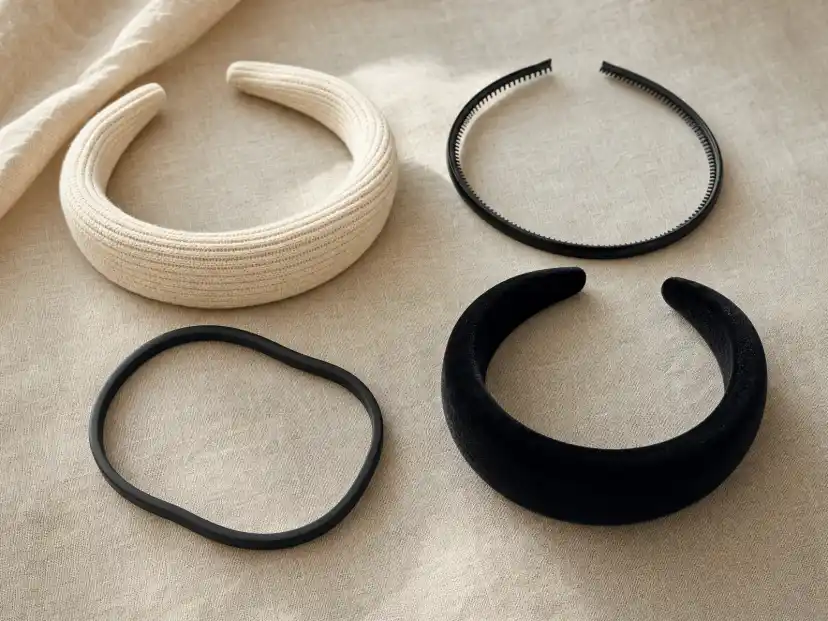
The third factor is design, and it is the one you can buy your way out of. Teeth are the obvious offender. A toothed plastic band grips by pressing a row of narrow points into the hair near the scalp, concentrating both the holding force and the friction into a handful of contact spots instead of spreading them out. Same trade-off we describe in safe vs damaging hair clips how to tell: the fewer square millimetres doing the holding, the more each one has to do.
Width is the counter-lever, and the arithmetic is simple. Spread the same force across a 50mm band instead of a 10mm one and the pressure at any single point falls by roughly a factor of five. Wide bands feel gentler because they physically are.
Rigidity is the third piece. A hard band moulded to an average head has to be smaller than your head to stay on, and it presses hardest where the curve does not match — usually just above and behind the ears. Bendable or knitted constructions tend to be easier to wear all day because they follow the head instead of compressing it.
Are headbands bad for thin hair? Who is most at risk
Three groups should be more careful than the rest of us.
Fine and thinning hair. Less fibre means the same force is carried by fewer strands, and a hairline that is already sparse has less margin before thinning shows. If your part or temples have changed in the last year, treat every accessory as a tension budget.
Chemically treated hair. Mayo and Callender note that traction alopecia is more common when tight hairstyles are combined with chemically relaxed hair. Relaxing, perming and bleaching all work by breaking bonds inside the fibre, so the hair a headband drags across starts out weaker.
Anyone with a long history of tight styling. That same Indian Journal of Dermatology review reports that in South African survey populations, up to one-third of adult women — 31.7 percent — showed hair changes consistent with traction alopecia. Those figures come from populations where high-tension styling is common, and they are a reminder that this damage accumulates across a lifetime of styles rather than from one accessory.
Thick hair is not exempt; its failure mode is just different. Bands slip, so people reach for tighter or toothed ones, and the tightness is what causes trouble. We work through that trade-off in best headbands for thick hair.
Headband hair damage: the signs to watch for
Check once a month, in good light, with the band off. The AAD recommends exactly that cadence of monthly checks for early signs of hair loss.
- Short, blunt-ended hairs along the band line. Noticeably shorter than the hair around them, standing up in a halo. A shed hair is full length with a pale bulb; a broken one is neither.
- A hairline that has moved. The AAD lists broken hairs around the forehead, a receding hairline, and patches of hair loss where hair is pulled tightly among the signs to watch for.
- Soreness, stinging or crusting. Pain is information, not something to push through.
- Small bumps. Healthline's traction alopecia guide, medically reviewed by Elaine K. Luo, MD, describes early symptoms including little bumps on your scalp that look like pimples, along with missing and broken hairs.
- A band of thinner hair in front of denser hair. Dermatologists call this the fringe sign, and that Indian Journal of Dermatology review found it in 90 percent of the patients in the cohort it describes.
If you are seeing scalp signs rather than plain breakage, the answer is not a different headband. Stop applying tension and see a dermatologist — early and chronic traction alopecia have very different outlooks.
How to wear a headband safely
- Size up on width. More contact area means less pressure per square inch at the same holding force.
- Move the placement. Shift the band half an inch forward or back between wears so the load never lands on one line.
- Cap the hours. Treat it as a several-hour accessory, not an all-day one, and give the hairline a day off each week.
- Take it off at the first ache. Discomfort is the earliest signal you get. Use it.
- Do not sleep in a rigid band. You cannot feel the warning signs while asleep, which is the whole problem.
- Loosen the hair underneath. The AAD's advice for anything worn over the hair is to pull it back loosely beneath the covering — a band over an already-tight ponytail stacks two tension sources on the same follicles.
- Lift, do not drag. Take the band off up and away from the head rather than over the crown, where most of the friction happens.
If soreness is the part bothering you most, we have a separate walkthrough on how to reduce the pressure your hair accessories put on your scalp.
Lower-tension headbands we reach for
Three bands that each attack one of the risk factors above. Prices are as of September 2026.
AUDTOPE Velvet Padded No-Teeth Headbands, 3 pack, 7.99 US dollars as of September 2026. No teeth at all, which removes the most common friction point in one move, plus a padded cushion behind the fabric. The maker lists three widths — 0.6 inch, 0.8 inch and 1.2 inch — and states that the cushion reduces scalp pressure and temple soreness and that the toothless construction avoids hair pulling and tangling. The three widths are the useful part: size up on days you want less pressure per inch.
Yazon Ribbed Knit Padded Headbands, 3 pack, 12.99 US dollars as of September 2026. According to Yazon, these are 50mm wide with a padded lining, shaped to the head curve to avoid pinching or deep indentations, with a ribbed surface that increases friction with hair to reduce slipping. That last claim is the one that matters here: if grip comes from texture, it does not have to come from tension.
Scunci No-Slip Grip Bendable Headband, 5.99 US dollars as of September 2026. Bendable, so you can open it out rather than living with a band that grips harder than you need. Scunci states it is engineered to reduce pressure behind the ears — the first place rigid bands usually hurt — and that its no-slip grip feature reduces sliding.
The verdict: are headbands bad for your hair?
Not on their own. The accessory is neutral; fit and routine decide the outcome. A wide, smooth, toothless band worn for a few hours and moved around the hairline is one of the lower-tension ways to keep hair off your face. A narrow toothed band worn tight in the same line from breakfast until bed is worth changing — and the good news in the dermatology literature is that the early stage is the reversible one.
Start with the two questions that actually predict damage: can you forget you are wearing it, and does it land in the same place every day. Everything else follows. For sizing, materials and the rest of the fit guidance, see our complete headband guide.
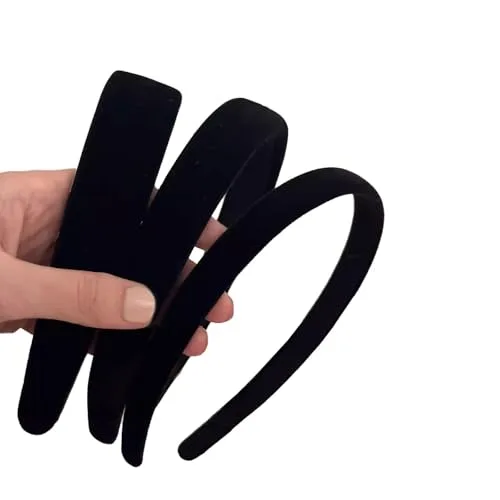
AUDTOPE Velvet Padded No-Teeth Headbands (3 Pack)
No teeth at all, which removes the single most common friction point, and a padded cushion behind the fabric. The three widths in the pack matter here: you can size up on days you want less pressure per inch.
We tested dozens of claw clips to find the very best options. Below you'll find our complete ranking, with detailed reviews and real customer feedback for each pick.
The Complete Ranking
No teeth at all, which removes the single most common friction point, and a padded cushion behind the fabric. The three widths in the pack matter here: you can size up on days you want less pressure per inch.
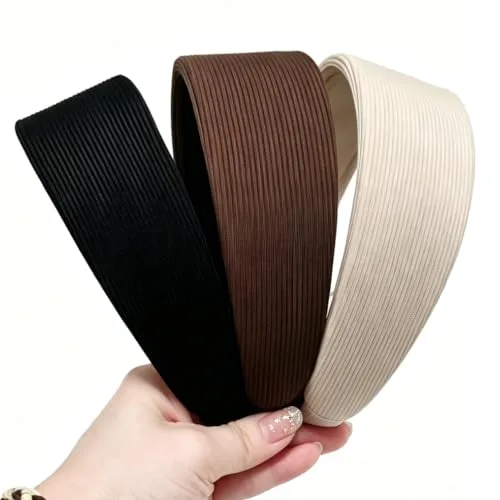
At a listed 50mm this is the widest option here, and width is the practical lever for reducing pressure at any one point on the scalp. The ribbed texture means grip does not have to come from tension.
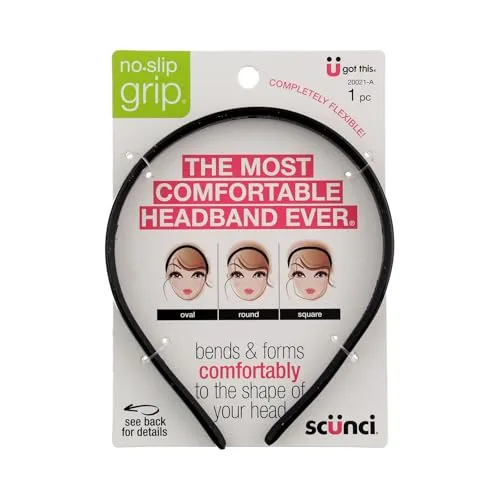
Bendable, so you can open it out rather than living with a band that grips harder than you need. Scunci states it is built to reduce pressure behind the ears, which is where rigid bands usually start to hurt first.
Quick Comparison
A side-by-side look at our top picks
Frequently Asked Questions
How tight is too tight?
Headband dent, or actual breakage?
Can a headband cause a receding hairline?

Donna Miller
Enjoyed This Guide?
Get more hair tips and product recommendations delivered weekly.