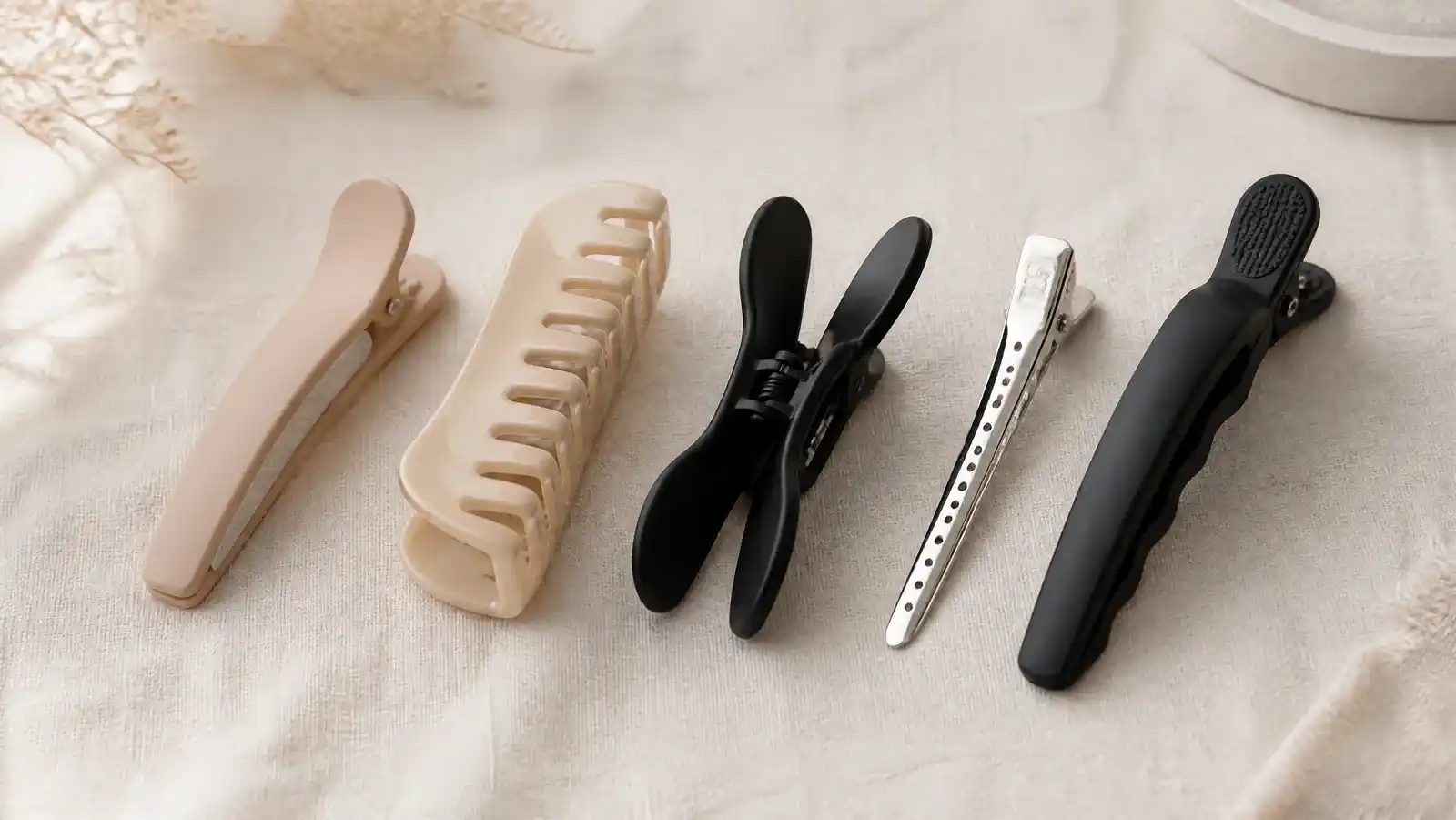
- What Sectioning Clips Actually Do
- The Clips We Keep in Rotation
- Types of Sectioning Clips
- Sectioning Clips for Thick Hair
- How to Section Hair with Clips
- Metal vs Plastic: Which Material Holds Better
- No-Crease Clips for Dent-Free Blowouts
- Non-Slip Clips for Fine and Slippery Hair
- Sectioning Clips for Curly and Coily Hair
- Sectioning for At-Home Color and Root Touch-Ups
- Sizes, Kits, and How Many You Need
- Sectioning Clips vs Claw Clips
- Explore the full series
A sectioning clip has one job: hold a chunk of hair completely still while you work on a different chunk.
We may earn a commission from links on this page, at no cost to you.
Hair sectioning clips are the flat, hinged, toothed clips stylists reach for before they touch a brush or a bottle of color: alligator clips, duckbill clips, croc clips and butterfly clamps. They are not decorative. A claw clip is designed to hold a finished style. A sectioning clip is designed to hold an unfinished one, and that turns out to be a different engineering problem. It has to grip damp, slippery, product-coated hair, stay out of the path of a dryer or a brush, and come off again without taking a dent or a tangle with it.
This guide covers the whole category: the shapes and what each one is for, metal versus plastic, how to divide a head of hair properly, which clips suit thick, fine, curly or color-treated hair, and how many you actually need to own. Every section below works as a standalone answer. The deeper dives publish as their own articles and get linked at the bottom as they go live.
What Sectioning Clips Actually Do
Sectioning reduces the amount of hair you are negotiating with at any one moment. That sounds obvious. The consequences are not.
Three things improve immediately. Coverage goes up, because you stop missing the panel behind your ear once it is physically clipped away until its turn. Precision goes up, because a half-inch subsection dries, curls or takes color evenly in a way a four-inch handful never will. And repetition goes down, because you pass over each piece of hair once instead of four times.
That last one is a hair-health argument, not just an efficiency one. A 2018 review in Clinical, Cosmetic and Investigational Dermatology says the hair loss seen in traction alopecia is "thought to be caused by the exertion of excessive pulling forces, leading to mechanical damage of the hair follicles," and the same review notes patchy loss occurring secondary to hair wefts, hair pins or clips. It also notes, more encouragingly, that most cases can be reversed if the problem is caught at an early stage.
Wearing a sectioning clip for twenty minutes during a blow-dry is nothing like wearing a tight braid for six weeks, and we are not suggesting otherwise. But it is plausibly the same mechanism scaled down, and it is a good reason to favor clips that hold through surface area and tooth geometry rather than brute spring pressure. We have written at length about the specific ways clips damage hair, and nearly all of it comes down to tension and friction rather than the clip itself.
The Clips We Keep in Rotation
The five clips on this page are not a ranked roundup. They are one representative of each major type, so you can see what the category actually contains.
The AIMIKE No-Crease Duckbill Sectioning Clips are the pick we reach for most, and the reason is a silicone band running along the jaw. AIMIKE says that band prevents creases or dents even after long wear, which is precisely the problem duckbills otherwise have. Six to a pack at $6.99 as of October 2026. Check the current price on Amazon.
The HH&LL Wide-Teeth Double-Hinged Alligator Clips are the baseline: all plastic, wide interlocking teeth, ten to a pack. HH&LL describes an upgraded dual metal spring for stronger clamping on thick hair, and states the design holds without leaving dents or kinks. We would treat both as claims to test on your own hair rather than as guarantees.
The Ondder Butterfly Sectioning Clips sit between a sectioning clip and a claw clip, with nine inner claws per clip instead of a flat toothed jaw. Twelve clips at 3.2 inches each. Ondder describes the claw edges as smooth and polished to limit pulling and snagging.
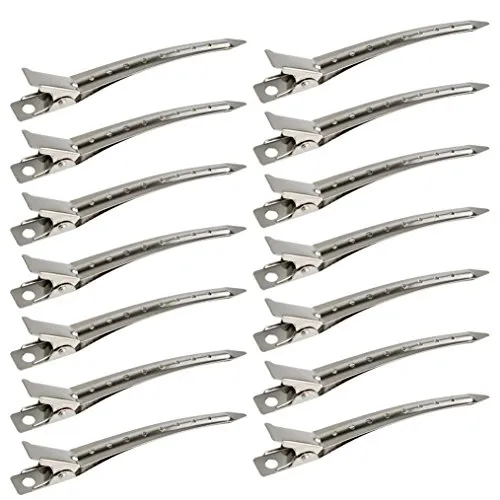
The Bantoye Metal Duck Bill Clips are the thin, flat, old-school option: nickel-plated, twenty-four to a pack. The listing is inconsistent about length, with the title saying 3.35 inches and the description saying 3.5 inches, so call it roughly three and a half inches and do not plan a technique around the difference.
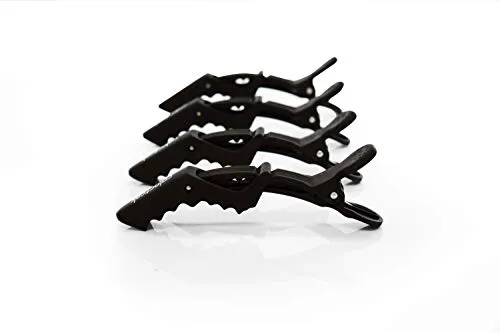
The Colortrak Rubberized Jumbo Croc Clips are the outlier at 5.3 inches, which Colortrak states is about an inch longer than their standard croc clip. Four to a pack, rubberized, double-hinged, with a thumb grip.
If you want a ranked comparison rather than one of each, our roundup of professional-grade clips covers that ground.
Types of Sectioning Clips
Once you can name the different types of sectioning clips, most of the buying decision makes itself.
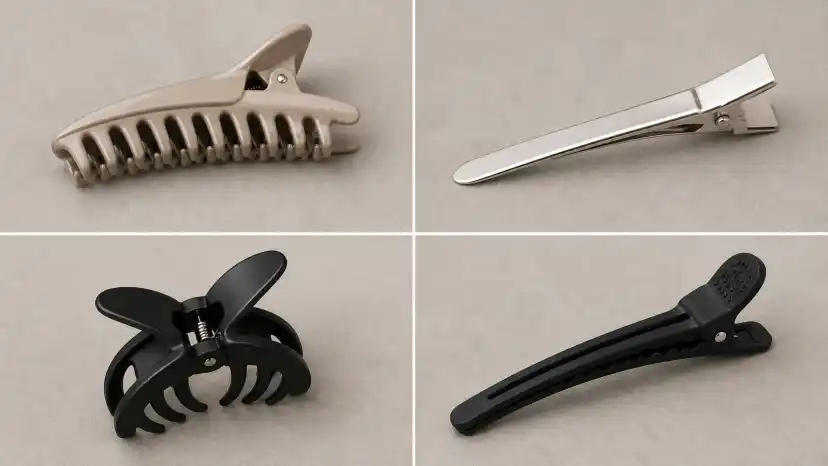
Alligator clips, also sold as croc clips, are the salon default: two hinged jaws with wide interlocking teeth, usually plastic, usually double-hinged so the jaws stay roughly parallel as they close. They hold a lot of hair for their size and they are the cheapest thing in the category.
Duckbill clips have a long, flat lower blade and a shorter upper jaw. The blade slides under a section without lifting it, which makes them the precision tool of the group: pin curls, wet sets, foil work, short haircuts. They come in metal and plastic, and the two behave very differently.
Butterfly clips, or clamps, are rounded rather than flat, with inward-facing claws instead of a toothed jaw. They grip a bundle of hair rather than pressing it into a line, which is gentler but less precise.
Jumbo croc clips are alligator clips scaled up past about five inches. They exist for one reason: a section of thick hair that a standard clip cannot close around.
Snap and pin-curl clips are the fifth category and the one we use least. They are single-hinge metal clips that clamp hard across a narrow line, which is excellent for setting a curl and bad for anything you need to leave in during a blowout.
Most people need two of these five. Which two depends almost entirely on hair density and whether you color at home.
Sectioning Clips for Thick Hair
What separates sectioning clips built for thick hair from the rest is span and spring, meaning how wide the jaws open and how hard they close. It is not tooth count.
A standard alligator clip runs around three to three and a half inches. On dense hair that is enough for a subsection and not enough for a quadrant. The gap shows up the moment you try to clip the whole back half of your head away and the clip either springs open or holds a tuft while the rest slides free.
The Colortrak Jumbo Croc at 5.3 inches is the answer to that, and Colortrak states it is about an inch longer than their standard croc clip. An inch does not sound like much, but across a clip jaw it is close to a quarter more gripping length. At $9.99 for four as of October 2026 it is the most expensive thing here per clip, and the only one we would call genuinely necessary for very thick hair. Check the current price on Amazon.
Two techniques matter more than the clip, though.
- Twist the section before you clip it. A twisted rope of hair is narrower and denser than a flat sheet, so a smaller clip can still close fully on it.
- Clip at the root, not at mid-length. Hair closest to the scalp is the most tightly packed and gives the teeth something to bite.
If a clip leaves a visible crease in thick hair, the usual cause is that you forced it shut on too much hair, not that the clip is badly made.
How to Section Hair with Clips
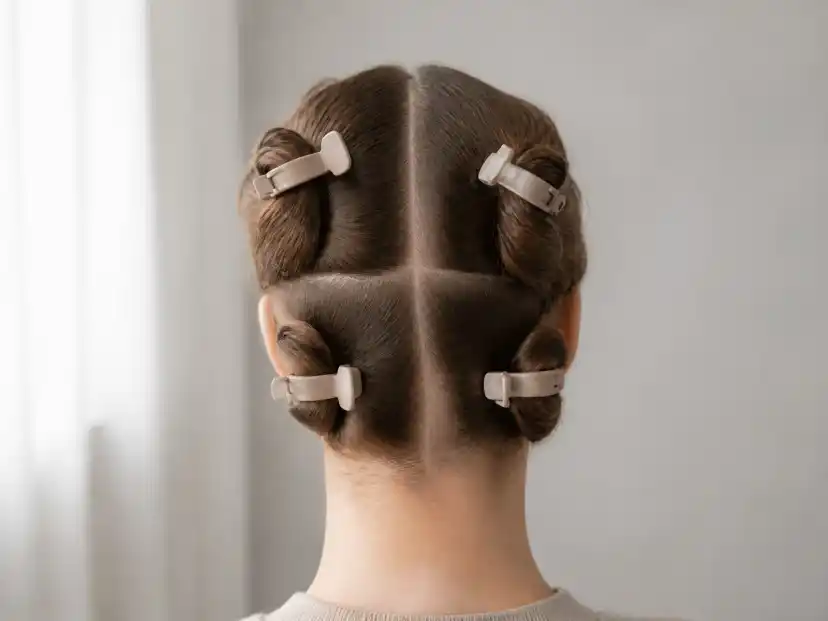
The standard answer to how to section hair with clips is the four-quadrant cross part, and it is the one worth learning first, because every other pattern is a variation on it.
L'Oreal Paris describes it this way for root color: part your hair down the middle from your forehead to the nape of your neck to create two halves, then make a horizontal part across the back of your head roughly from ear to ear, which gives four main sections, two at the front and two at the back. Clip each one securely so it stays out of the way while you work.
A few mechanics make the difference between a part and a mess:
- Use the tail of a rattail comb, not your fingers. Fingers produce a wandering line. A comb tail gives you one you can follow.
- Part on detangled hair. A part driven through a tangle is not a part.
- Twist each quadrant once before clipping. It roughly halves the width the clip has to close on.
- Work back to front. The back is hardest to see and easiest to rush if you leave it until last.
For anything detailed, including color, a precision blowout or a curl set, subdivide each quadrant into horizontal panels about a quarter to half an inch thick and clip the rest back up out of the way. You will use more clips than you expect, which is exactly why these things are sold ten and twenty-four to a pack.
Metal vs Plastic: Which Material Holds Better
The honest answer to how metal and plastic clips compare is that neither wins outright. They fail in opposite directions.
The sectioning-clip guide at Hey Mane puts the split clearly. Plastic duckbill clips, it says, are "perfect for styling dry hair when you want to avoid indents or clip marks," and good for "styling fragile hair that can't take the grip of stronger sectioning clips." Metal duckbills, by the same guide, "really shine when wet styling" and are "a stylist favorite when working on short haircuts that need a smoother, less bulky clip."
So metal grips harder and sits thinner. Plastic is kinder and bulkier. For most people at home that is a preference, not a verdict.
One thing is not a preference. The same guide states that metal duckbill clips "are not to be used with hair color application unless otherwise specified," and warns that metal clips can sometimes rust on the hair when color or bleach is involved. If you color at home, use plastic.
The two metal-bearing clips here handle this differently. The Bantoye duckbills are nickel-plated and described as rust-resistant, but they are still metal and we would keep them away from a color bowl. The AIMIKE clip is a hybrid, with an ABS plastic top and an electroplated metal lower jaw, and AIMIKE markets it for holding foils during color. That is a manufacturer claim rather than something we can verify.
Our default: plastic for color and for anyone whose hair dents easily, metal for wet sets and short-hair work.
No-Crease Clips for Dent-Free Blowouts
A crease is not really the clip's fault. It is physics.
Cosmetic chemist Michelle Wong, writing at Lab Muffin Beauty Science, lays out the cycle plainly: add water or heat and you break hair's hydrogen bonds, change the hair's shape, then remove the water or let it cool and new hydrogen bonds form, locking the style into place. She notes that while hydrogen bonds are individually weaker than hair's other bonds, "there are a lot more of them, so they can have a huge impact on the shape of hair."
Which means a clip clamped onto damp hair during a blow-dry is not marking your hair. It is setting it. The hair dries in the shape the jaw held it in, and that shape happens to be a line.
That is the entire design brief for no-crease sectioning clips: spread the contact, soften the edge, or both. The AIMIKE clip takes the first route with a silicone band running the length of the jaw, which AIMIKE says prevents creases or dents even after long wear. HH&LL states its wide-teeth alligator clips hold without leaving dents or kinks. Both are maker claims, and both are at least plausible given the geometry, since a wide, soft or toothed contact patch distributes the same force over more hair than a thin metal edge does.
Three habits help regardless of which clip you own:
- Clip hair that is mostly dry rather than soaking wet.
- Move the clip once part-way through drying so no single line gets set.
- Let the section cool before you unclip it. Cooling is when the new bonds form.
Non-Slip Clips for Fine and Slippery Hair
Fine hair fails clips in the opposite way thick hair does. There is not enough of it to fill the jaw, so the clip closes on air and then slides down the length under its own weight.
The fix is grip, not strength, which is the point of non-slip clips for fine hair. A stronger spring on a thin section just means a deeper crease and more tension at the root. What you want is a clip whose teeth actually engage the small amount of hair that is there.
Tooth geometry does most of that work. AIMIKE lists tiny teeth on the upper jaw of its duckbills, plus granulated non-slip handles, which is a sensible design for hair with little bulk to bite into. Wide-set teeth are the opposite: they are designed to let a thick section settle through them, and on fine hair they let everything through.
Hey Mane's recommendation for fragile hair is a plastic duckbill, specifically because it holds without the grip of a stronger sectioning clip. Gentler, but you have to accept that it holds less.
Two tricks are worth more than any product choice here:
- Twist, then clip. A twisted section has bulk that a flat one does not.
- Clip at an angle, biting in toward the root. A clip laid flat against the scalp has nothing to hold on to.
And size down. A 5.3-inch jumbo croc on fine hair is mostly empty clip, and the extra weight is what pulls it loose.
Sectioning Clips for Curly and Coily Hair
A reasonable case exists that sectioning clips for curly and coily hair are a different tool entirely, because the job changes. The clip has to hold a bulky, conditioner-slick section without flattening the curl pattern inside it.
Curl routines are built around sectioning in the first place. The detangling guide from Not Your Mother's advises separating hair into about four to six manageable sections and clipping away the rest, and holding the section above the area being detangled to reduce tugging at the roots, with the hair thoroughly wet and conditioner applied throughout before you start.
That use case asks three specific things of a clip.
- Span. Wet, conditioned coils take up more room than you expect once they are gathered into a single section.
- Smooth contact edges. Anything that snags will pull a curl clump apart. Ondder describes the claw edges on its butterfly clips as smooth and polished to limit pulling and snagging, which is the right property for this, even if we would read the phrasing as marketing.
- No flat compression. A butterfly or claw-style clamp holds a bundle in the round. A flat toothed jaw presses it into a sheet, and a pressed clump dries that way.
Practical rule: clip near the root, clip loosely, and never clip through the mid-lengths of a defined clump if you plan to air-dry. The clip is there to park hair, not to style it.
Sectioning for At-Home Color and Root Touch-Ups
The case for sectioning your hair for at-home color is less about tidiness than about coverage. Missed regrowth is the most visible at-home color mistake there is, and it happens in predictable places.
L'Oreal Paris notes that regrowth tends to be most noticeable around the hairline, the crown and behind the ears, which are exactly the three places a four-quadrant part puts a boundary line. Clip the quadrants, then work each one in horizontal panels about a quarter to half an inch thick, so the brush reaches scalp-level hair instead of skating across the top.
Two material rules here are not negotiable.
- Plastic only. Hey Mane states that metal duckbill clips are not to be used with hair color application unless otherwise specified, and that metal clips can sometimes rust on the hair when color or bleach is involved. That rules out the Bantoye metal duckbills for color work, however good they are elsewhere.
- Expect stains. Permanent color tends to mark plastic. Colortrak describes the rubberized finish on its jumbo crocs as stain-resistant, which we would call useful rather than absolute. Dedicate a set to color and stop worrying about it.
AIMIKE markets its silicone-band clips for holding foils during color, which is a reasonable fit for a plastic-topped clip with a thin profile. If you are doing highlights rather than a straight root touch-up, you will want more clips than you think, because every foil you place is a section that has to stay separated from the one next to it.
Sizes, Kits, and How Many You Need
The answer to how many sectioning clips you actually need comes down to one question: are you only parting hair, or are you working through it?
For a plain four-quadrant part, which covers a blowout, a quick root touch-up, or just keeping hair off your face while you do makeup, four clips is literally enough. For anything worked panel by panel, you want one clip per quadrant plus two or three in hand, so six to eight. For highlights, a full color application, or a curly wash day run across six sections, ten to twelve is the realistic floor. That is why the packs look the way they do: ten in the HH&LL set, twelve in the Ondder set, twenty-four in the Bantoye set.
Sizes cluster into three bands.
- Around 3 to 3.5 inches. The standard. The Ondder butterflies are 3.2 inches, and the Bantoye duckbills are roughly three and a half, with the listing itself disagreeing between 3.35 and 3.5 inches. This band handles subsections on any hair type and full quadrants on fine to medium hair.
- Around 4 inches. The in-between size, fine for quadrants on medium hair and the one you are least likely to miss if you skip it.
- 5 inches and up. Jumbo. The Colortrak is 5.3 inches. Quadrant duty on thick hair, and not much else.
Buy multiples of the small size and a few of the large, not the reverse. The same volume-matching logic governs everyday clips too, and we work through it properly in our guide to choosing a clip size by hair volume.
Sectioning Clips vs Claw Clips
The question of sectioning clips versus claw clips comes up constantly, and the short version is that they are built for opposite moments.
A sectioning clip holds hair that is mid-process. It is flat, it clamps along a line, and it is designed to go on and come off repeatedly inside ten minutes. It does not care how it looks, and it will happily leave a mark if you leave it in too long, because nobody was going to see that section anyway.
A claw clip holds hair that is finished. It wraps a twisted bundle in three dimensions, distributes pressure around a curve rather than along a line, and is meant to stay put for hours without turning into a headache.
Using the wrong one is the most common mistake we see. A claw clip is bad at sectioning because it gathers hair inward, pulling neighboring strands into the bundle, which is the exact opposite of what a clean section needs. A sectioning clip is bad at all-day wear because its grip is concentrated and one-dimensional. It slides, and then it creases.
The overlap case is the butterfly clamp, which borrows the rounded shape of a claw clip and the pack-of-twelve disposability of a sectioning clip. It is a fair compromise for anyone who would rather keep one drawer of clips than two.
If your real interest is the finished-style side of this, start with our complete claw clip guide instead.
Explore the full series
- Types of Sectioning Clips Explained: Alligator, Duckbill, Butterfly and Crocodile — The four clip shapes that do different jobs — and which one belongs in your kit.
- Best Sectioning Clips for Thick Hair That Actually Hold — Jaw width, spring tension and tooth depth — what a clip needs to survive dense hair.
- How to Section Hair with Clips: A Step-by-Step Guide for Blow-Drying and Styling — The four-section parting map stylists use, and the order to unclip in.
- Metal vs Plastic Sectioning Clips: Which Should You Buy? — Heat tolerance, weight and dent risk: where each material wins and loses.
- Best No-Crease Sectioning Clips for Dent-Free Blowouts — Flat jaws and smooth edges: the clips that hold a section without pressing a line into it.
- Best Non-Slip Sectioning Clips for Fine and Slippery Hair — Why fine hair slides out of a standard clip, and the grip features that stop it.
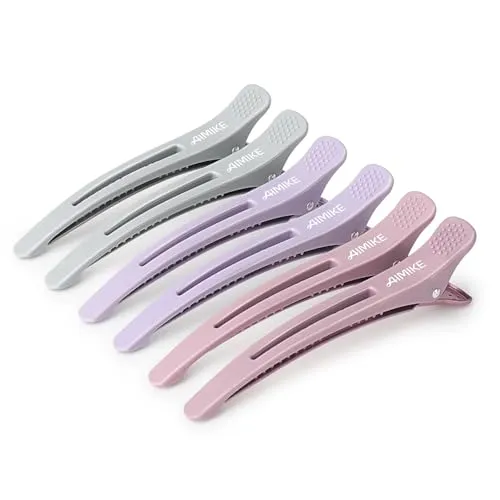
AIMIKE No-Crease Duckbill Sectioning Clips (6 Pack)
A duckbill clip with a silicone band running along the jaw, which is the feature that separates a crease-free clip from one that presses a line into a section. ABS plastic top, electroplated metal bottom, six to a pack.
“The silicone band along the jaw is the whole reason to buy this one. It is the feature that separate...”
We tested dozens of claw clips to find the very best options. Below you'll find our complete ranking, with detailed reviews and real customer feedback for each pick.
The Complete Ranking
AIMIKE No-Crease Duckbill Sectioning Clips (6 Pack)
“The silicone band along the jaw is the whole reason to buy t...” — Verified Buyer
A duckbill clip with a silicone band running along the jaw, which is the feature that separates a crease-free clip from one that presses a line into a section. ABS plastic top, electroplated metal bottom, six to a pack.
“The silicone band along the jaw is the whole reason to buy this one. It is the feature that separates a clip you can leave in through a long blow-dry from one that presses a line into the section.”
— Verified Buyer
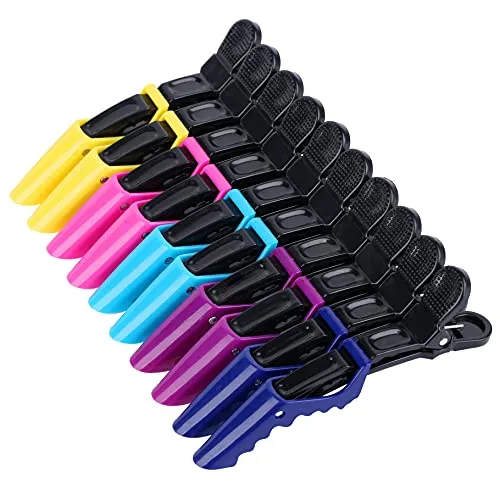
HH&LL Wide-Teeth Double-Hinged Alligator Clips (10 Pack)
“Wide teeth, a double hinge and an all-plastic body. This is ...” — Verified Buyer
The textbook alligator clip: two hinged jaws, wide interlocking teeth, all plastic. Cheap enough to buy ten and leave them in three rooms, which is how most people actually use sectioning clips.
“Wide teeth, a double hinge and an all-plastic body. This is the baseline sectioning clip, and ten to a pack is enough to leave a few in every room where hair actually gets done.”
— Verified Buyer
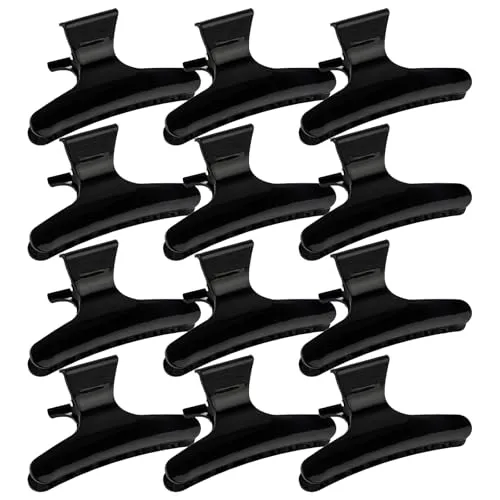
Ondder Butterfly Sectioning Clips (12 Pack, 3.2 in)
“Twelve clips at 3.2 inches each is enough to section a whole...” — Verified Buyer
Butterfly clips sit between a sectioning clip and a claw clip: a rounded clamp with inward-facing claws rather than a flat toothed jaw. Twelve 3.2-inch clips, which is enough to section a full head and still have spares.
“Twelve clips at 3.2 inches each is enough to section a whole head and still keep spares in the drawer, and the rounded clamp holds a bundle in the round instead of pressing it into a sheet.”
— Verified Buyer
Bantoye Metal Duck Bill Clips (24 Pack, 3.35 in)
“The thinnest profile in this guide. That flat lower blade sl...” — Verified Buyer
The all-metal duckbill: a thin, flat lower blade that slides under a section without lifting it. The classic pin-curl and wet-set clip, and the thinnest profile of anything in this guide.
“The thinnest profile in this guide. That flat lower blade slides under a section instead of lifting it, which is exactly what pin curls, wet sets and short-hair work ask for. Keep it away from color.”
— Verified Buyer
Colortrak Rubberized Jumbo Croc Clips (4 Pack, 5.3 in)
“At 5.3 inches this is the only clip here built for a genuine...” — Verified Buyer
At 5.3 inches this is the longest clip in the guide and the only one built for genuinely heavy sections. Rubberized finish, double-hinged, with a thumb grip. A salon color-bar tool rather than a bathroom-drawer clip.
“At 5.3 inches this is the only clip here built for a genuinely heavy section, and the rubberized finish and thumb grip make it feel like the salon color-bar tool it is.”
— Verified Buyer
The silicone band along the jaw is the whole reason to buy this one. It is the feature that separates a clip you can leave in through a long blow-dry from one that presses a line into the section.
Quick Comparison
A side-by-side look at our top picks
Frequently Asked Questions
What is a hair sectioning clip?
How many sectioning clips do you need?
Why do sectioning clips leave a crease?

Donna Miller
Enjoyed This Guide?
Get more hair tips and product recommendations delivered weekly.