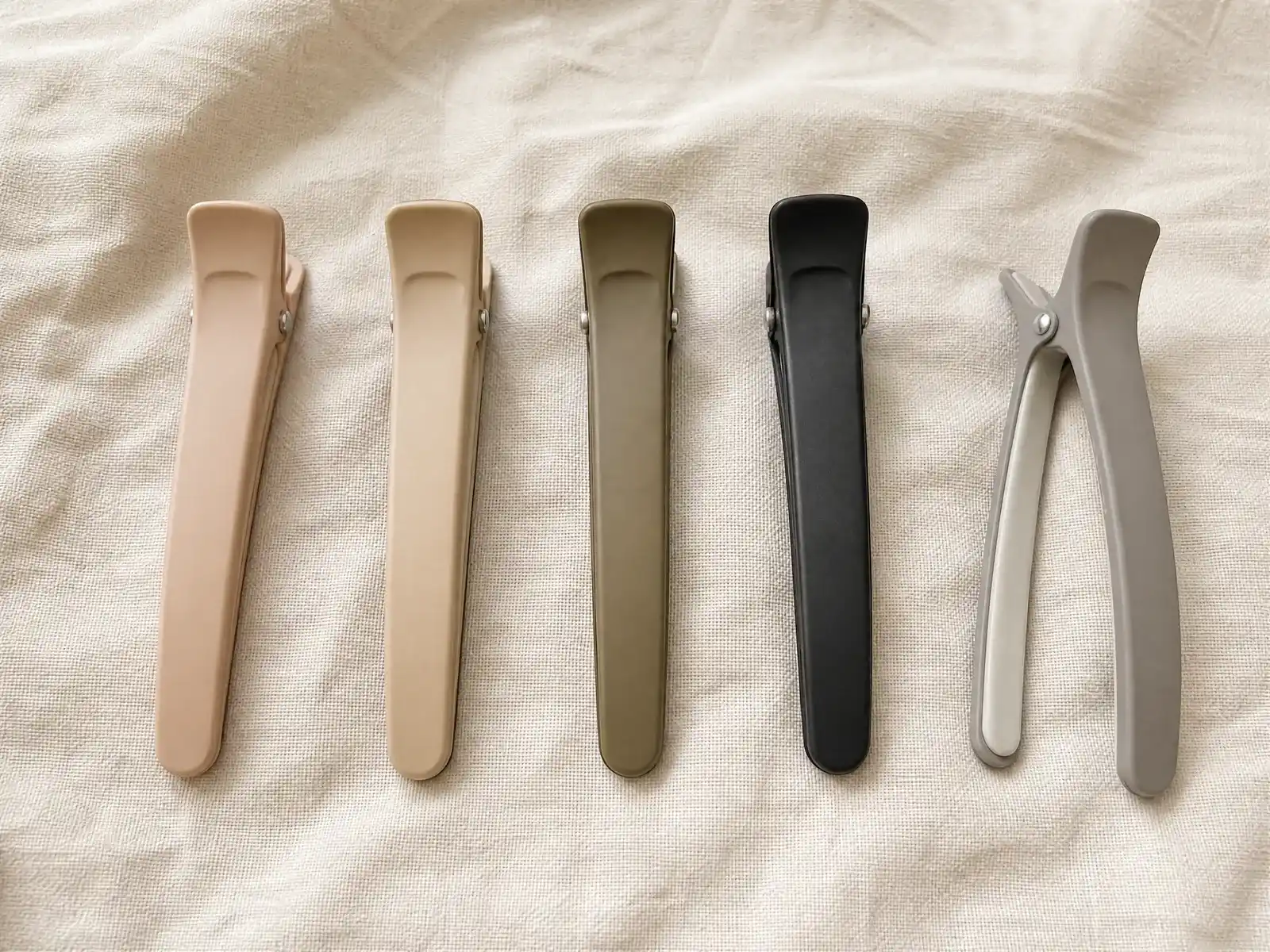
- Why Clips Leave a Dent in the First Place
- What Makes No-Crease Sectioning Clips Live Up to the Name
- Best Overall No-Crease Clip: AIMIKE Silicone No-Crease Duckbill Roller Clips
- Best Salon-Grade Pick: FRAMAR Neutral Creaseless Hair Clips (10 Pack)
- Best Budget Multipack: Zoolinn Matte Duckbill Styling Clips (12 Pack, 3.07 in)
- Best for Holding Rollers: AIMIKE Sectioning Clips with Silicone Band (6 Pack, Morandi)
- Best Toothless Clip for Fragile Hair: AIMIKE Neutral Duckbill Clips (No Teeth)
- Where Silicone Sectioning Clips Still Slip
- How to Use Them Without Creasing Anyway
- The Bottom Line
The best no crease sectioning clips earn the name through one feature, and it is not the brand on the handle: a silicone-lined or toothless jaw that spreads the spring's load across a wide flat band instead of concentrating it along a narrow row of teeth.
Check the inside of the jaw, not the packaging.
We may earn a commission from links on this page, at no cost to you.
Below are five clips ranked on that mechanism, from a silicone-banded duckbill to a toothless version for hair that cannot take a bite, each with its tradeoff. If you are still weighing shapes and lengths, start with what to look for in a sectioning clip. This article narrows to one question: which clips hold a section for the length of a blowout without leaving a line in it.
Why Clips Leave a Dent in the First Place
A crease is pressure plus time, and damp hair is what makes the result stay put.
Take the pressure first. A clip's spring delivers a roughly fixed force, and pressure is that force divided by the area it acts on. A thin duckbill blade, or a row of interlocking teeth, puts the whole spring load along a narrow contact line, so the pressure there is high even when the clip feels mild in your fingers. Spread that same force across a flat silicone band several times wider and the pressure at any one point drops in proportion. The spring did not change. The arithmetic did.
Now the hair. In her review of the science of hair drying, cosmetic chemist Michelle Wong writes that "the most important impact of water on hair is that it breaks hydrogen bonds", that wet hair "is weaker, because there are less hydrogen bonds holding it together", and that as hair dries, "the temporary bonds that re-form hold your hair in the new shape". That last clause is the real problem with clipping a damp section: the clip is not merely squashing strands, it is holding them in a shape while the bonds that record shape re-set around it.
The timing works against you in both directions. Wong summarises drying measurements from Crawford and colleagues, published in the Journal of the Society of Cosmetic Chemists in 1981, which recorded hair at 47 degrees C and dry in 60 seconds with a dryer 15 cm away, and 95 degrees C and dry in 15 seconds at 5 cm, against roughly two hours to air dry at room temperature. Air-dry a clipped section and the bonds have two hours to set around the jaw; run a nozzle over it and they set in under a minute, hot.
Wong also notes that wet hair is "much more prone to mechanical damage", which is why the narrow toothed edge that marks a damp section is the same edge that tends to snap strands where it bites. That is a separate failure mode, covered in why clips snap and break strands.
What Makes No-Crease Sectioning Clips Live Up to the Name
Four features do the work. The rest is colourway.
- A silicone band along the jaw. The single best predictor, because silicone grips by friction rather than by bite. The silicone extruder Jehbco describes the material as "naturally quite tacky, with a coefficient of friction of approximately 1.0 in many cases". Friction that high lets a clip hold with a gentler spring, and a gentler spring has less pressure available to mark with.
- Softness you can feel through the jaw. Wevolver's primer on Shore hardness puts silicone elastomers at roughly 20 to 70 Shore A, its scale for softer, flexible materials, while rigid thermoplastics such as ABS sit on the harder Shore D scale at about 70 to 85 D. The soft layer deforms around the hair; a hard shell makes the hair do the deforming.
- No teeth, or teeth small enough to be decorative. Teeth exist to stop a section sliding out. Hand that job to friction and you can delete them, along with every point where a strand gets pinched and bent sharply.
- A wide, flat contact area. A flat blade beats a ridged one and a long blade a stubby one, for the same reason a snowshoe beats a boot. If the shapes are still a blur, our breakdown of the four clip mechanisms sorts duckbill from alligator from butterfly.
A fifth factor is not the clip at all: how long it stays in, and how wet the hair is.
Best Overall No-Crease Clip: AIMIKE Silicone No-Crease Duckbill Roller Clips
The AIMIKE silicone no-crease roller clips are the clearest expression of the mechanism above, at $9.99 as of October 2026: a silicone band running the length of the jaw, a matte ABS top half, an electroplated metal lower plate, and a stiff spring. AIMIKE states that the silicone band prevents creases or dents even after long wear, and describes tiny teeth on the upper half working alongside the band to stop slipping and tangling. Those are the maker's claims rather than measured results, but they describe the construction that makes a creaseless hold plausible.
Who it is for: anyone who clips a section and leaves it clipped for several minutes. AIMIKE markets them for wet or dry hair, blow drying, curling, sectioning and foiling, and the granulated handles matter when your fingers are wet.
The tradeoff is the spring. Stiff is what gives this clip its hold on a substantial section, but it also means the small teeth on the upper half press with real force, so on fine or over-processed hair the toothless model below is the better call. The metal lower plate conducts heat, too, and will warm up in a dryer's path.
Best Salon-Grade Pick: FRAMAR Neutral Creaseless Hair Clips (10 Pack)
Ten clips for $9.99 as of October 2026 is a dollar a clip, salon-supply pricing rather than a drugstore two-pack. FRAMAR's design is the most mechanically interesting here: the company states the clips use two springs that self-adjust to the amount and thickness of hair, pairs a self-locking jaw with a silicone strip it credits for the creaseless hold, and describes a high-elasticity metal spring built to survive repeated use. FRAMAR also calls them the strongest clips you will ever use, which is marketing superlative, not fact.
Who it is for: the person who sections a whole head at once; ten is enough for a full foiling pass with spares.
The tradeoff is the latch. A self-locking clip holds at the tension it closes at, which helps on a thick section and hurts on a thin one, where it can close harder than the hair warrants. A latch also tends to want two hands, which is awkward when the other hand holds a dryer.
Best Budget Multipack: Zoolinn Matte Duckbill Styling Clips (12 Pack, 3.07 in)
Twelve clips at $4.59 as of October 2026 is roughly 38 cents each, in four colours (khaki, beige, black and apricot) at approximately 3.07 inches long. Zoolinn states that the curved shape and small plastic teeth grip without leaving dents or creases, with rounded edges intended not to snag or pull.
Be clear about where this one sits. It has teeth and no silicone band, so by the criteria above it is the weakest no-crease mechanism in the set: the grip comes from plastic teeth biting the section, the exact geometry that concentrates pressure on a line. The matte finish and rounded edges help, but on damp hair under a dryer this is the pick most likely to leave a mark.
Who it is for: sectioning dry hair, and anyone who loses clips. Treat them as the dry-hair workhorses and keep a silicone-banded pair for damp work.
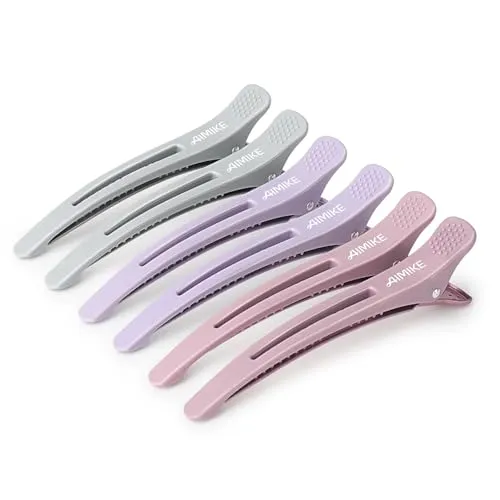
Best for Holding Rollers: AIMIKE Sectioning Clips with Silicone Band (6 Pack, Morandi)
This is the same platform as our top pick rather than an independent second opinion: six clips at $6.99 as of October 2026, the same silicone band along the jaw, the same ABS top and electroplated metal lower plate, in muted Morandi tones. AIMIKE markets this version specifically for rollers, curling and foiling, and states that the band prevents creases and reduces pulling.
Why it gets its own slot is the use case. A roller set is the one job where the hair is deliberately drying in the shape the clip holds, which is the mechanism above at full strength. A pin mark pressed into a roller-set curl is not a cosmetic nuisance, it is a flat spot in the finished shape, so a friction band that holds the roller without clamping a line across it is the right tool.
The tradeoff: six is not enough for a whole head, and sharing AIMIKE's construction likely means sharing its stiff-spring behaviour. For this mechanism in quantity, the ten-pack above is the better buy.
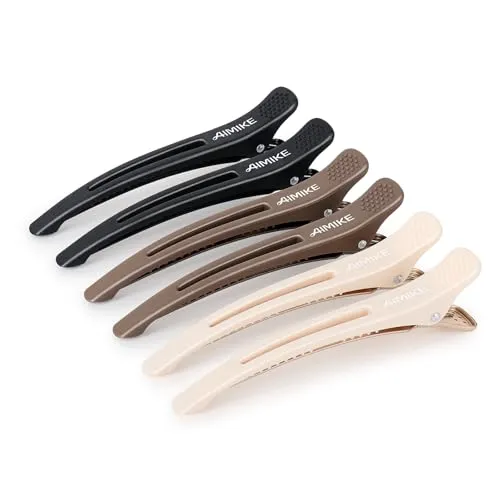
Best Toothless Clip for Fragile Hair: AIMIKE Neutral Duckbill Clips (No Teeth)
Sectioning clips with no teeth are the logical end of this argument, and this is that clip: $6.99 as of October 2026 for a plastic-topped duckbill with a smooth, rust-resistant metal bottom, a silicone anti-slip band, a stainless steel spring, anti-slip particles on the handles, and three neutral colours. AIMIKE states the no-teeth design goes on and off without pulling hair, and credits the steel spring and silicone band with holding wet or dry hair.
Who it is for: fragile, fine or over-processed hair. With nothing to interlock, no tooth catches a loop of hair and no ridge presses a line, so removal is a lift rather than a tug.
The tradeoff is bite. Fewer teeth means less mechanical purchase, so a heavy or coarse section can creep out of a toothless jaw over a long wear, especially if the hair is slippery with conditioner. This is not the universally best clip; it is the gentlest one. For dense hair, start from jaw length instead and see our picks for clips built for dense, heavy sections.
Where Silicone Sectioning Clips Still Slip
The friction that makes a silicone band gentle fails in a predictable place: water. Jehbco notes that a thin film of water on silicone acts as a lubricant and reduces its coefficient of friction. A clip whose entire holding strategy is tackiness is therefore weakest on soaking or freshly conditioned hair, which is also when you most want it in. The section slides down the clip rather than out of it, and you notice when it hangs two inches lower than you left it.
So rough-dry before you clip, which is the standard stylist sequence anyway. And if your hair is fine and slick enough that nothing stays put, the answer is grip rather than lining: our picks for clips that grip fine, slippery hair are chosen on that axis.
How to Use Them Without Creasing Anyway
A good clip lowers the pressure. Technique controls the time, and the time is half the equation.
- Rough-dry first, then section. Sam Villa's blow-drying tutorial has you dry hair until it is "80 percent dry" before the round brush comes out, and Hey Mane's sectioning guide suggests rough-drying "about 70% of the way" to speed up the rest, with the clips going in after that stage. Clipping then puts the clip on hair that has given up most of its water, shortening the window in which a shape can set.
- Clip the mid-length, not the root. The root is wettest, gets the most dryer time, and shows a mark most once the section falls. Catching the section further down costs nothing.
- Use fewer, bigger sections, and reuse the clip. Hey Mane's guide builds a horseshoe top section from temple to temple, a middle section held with one or two clips depending on thickness, and leaves the nape down because that is where the blowout begins. Sam Villa's version has you take the clip out of the top section and reuse it to hold the lower layers back and away, so one clip does two jobs and spends less time in any one spot. The full sequence is in our guide to sectioning your hair before a blowout.
- Move the clip once during a long process. On a colour service or a slow air dry, shifting a clip an inch after twenty minutes breaks the contact line up before it sets.
- Let the pain tell you. The American Academy of Dermatology's guidance on hairstyles and hair loss concerns tight ponytails, braids and buns rather than clips, but its test travels: "If your hairstyle feels painful, the style is too tight." It advises loosening a style so it does not pull. A clip aching at the root after twenty minutes sends the same signal.
Sam Villa's tutorial adds that sectioning clips may also prevent damage caused by overdrying sections: finished hair stays clipped up and out of the airflow instead of being re-heated.
The Bottom Line
Buy the mechanism, not the adjective on the bag. A silicone-banded duckbill like our AIMIKE top pick is the default for damp work; FRAMAR's ten-pack if you section a whole head; the Zoolinn twelve-pack as the cheap dry-hair workhorse, with the caveat that teeth and no band is the weakest version of this idea; the toothless AIMIKE if you need the gentlest jaw and can live with less bite.
No clip survives bad timing. Pressure on damp hair for the length of a dry will mark it eventually, which is why rough-drying first and clipping the mid-length does more for a dent-free blowout than any upgrade in the drawer. For the shapes, sizes and sectioning patterns that decide most of the outcome before a clip is chosen, see our full sectioning clip guide.
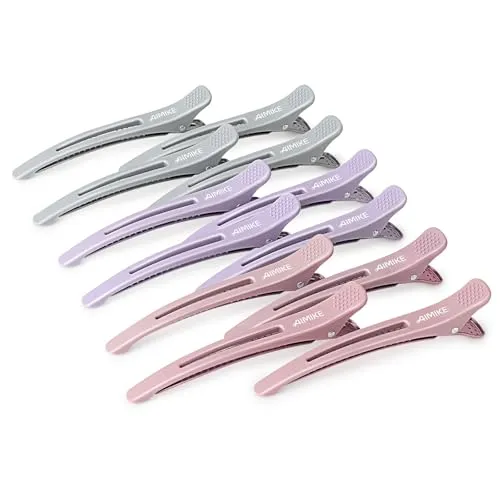
AIMIKE Silicone No-Crease Duckbill Roller Clips
A duckbill clip with a silicone band running the length of the jaw, which is the feature that actually prevents a crease line. Matte ABS top, electroplated metal bottom plate, and a stiff spring.
“A silicone band down the full length of the jaw, which is the one feature that separates a creaseles...”
We tested dozens of claw clips to find the very best options. Below you'll find our complete ranking, with detailed reviews and real customer feedback for each pick.
The Complete Ranking
AIMIKE Silicone No-Crease Duckbill Roller Clips
“A silicone band down the full length of the jaw, which is th...” — Verified Buyer
A duckbill clip with a silicone band running the length of the jaw, which is the feature that actually prevents a crease line. Matte ABS top, electroplated metal bottom plate, and a stiff spring.
“A silicone band down the full length of the jaw, which is the one feature that separates a creaseless clip from a clip with creaseless on the label.”
— Verified Buyer
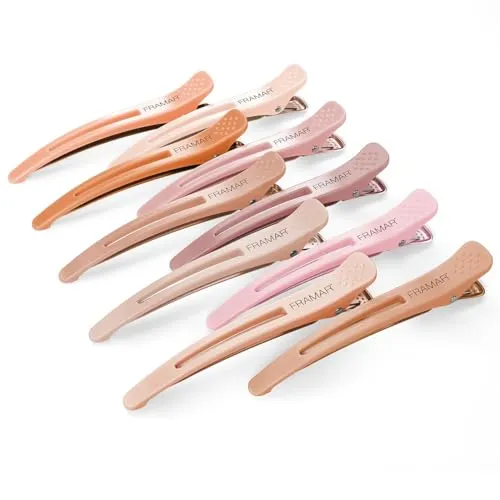
FRAMAR Neutral Creaseless Hair Clips (10 Pack)
“Ten silicone-strip clips in one box, which is the quantity a...” — Verified Buyer
The salon-supply option: ten self-locking clips with a silicone strip, built around a dual-spring mechanism that adjusts to the section rather than forcing you to match clip to hair volume.
“Ten silicone-strip clips in one box, which is the quantity a full foiling pass or a sectioned blow-dry actually requires.”
— Verified Buyer
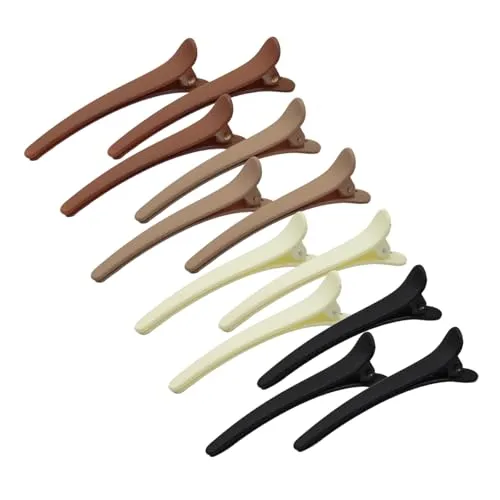
Zoolinn Matte Duckbill Styling Clips (12 Pack, 3.07 in)
“Twelve 3.07-inch duckbills for under five dollars, which is ...” — Verified Buyer
Twelve 3.07-inch matte duckbills for under five dollars, which is the right quantity for anyone who sections regularly and keeps losing clips. Small plastic teeth rather than a silicone band.
“Twelve 3.07-inch duckbills for under five dollars, which is cheap enough to keep a handful in every room where hair actually gets done.”
— Verified Buyer
AIMIKE Sectioning Clips with Silicone Band (6 Pack, Morandi)
“The same silicone-band jaw as our top pick, in the six-clip ...” — Verified Buyer
The same silicone-band mechanism as our top pick in a six-pack of muted Morandi tones, sold specifically for pinning rollers and set curls in place.
“The same silicone-band jaw as our top pick, in the six-clip size that suits pinning rollers and set curls rather than sectioning a whole head.”
— Verified Buyer
AIMIKE Neutral Duckbill Clips (No Teeth)
“With no teeth, nothing bites a single strand on the way in o...” — Verified Buyer
The toothless variant. Because there are no teeth to bite, it goes in and comes out without catching, and the silicone band does the holding instead. The gentlest option here for fragile or over-processed hair.
“With no teeth, nothing bites a single strand on the way in or out, and the silicone band carries the holding job instead.”
— Verified Buyer
A silicone band down the full length of the jaw, which is the one feature that separates a creaseless clip from a clip with creaseless on the label.
Quick Comparison
A side-by-side look at our top picks
Frequently Asked Questions
What is the difference between a no-crease clip and a regular duckbill clip?
How long can you leave a no-crease clip in before it marks?
Do no-crease sectioning clips hold thick hair?

Donna Miller
Enjoyed This Guide?
Get more hair tips and product recommendations delivered weekly.