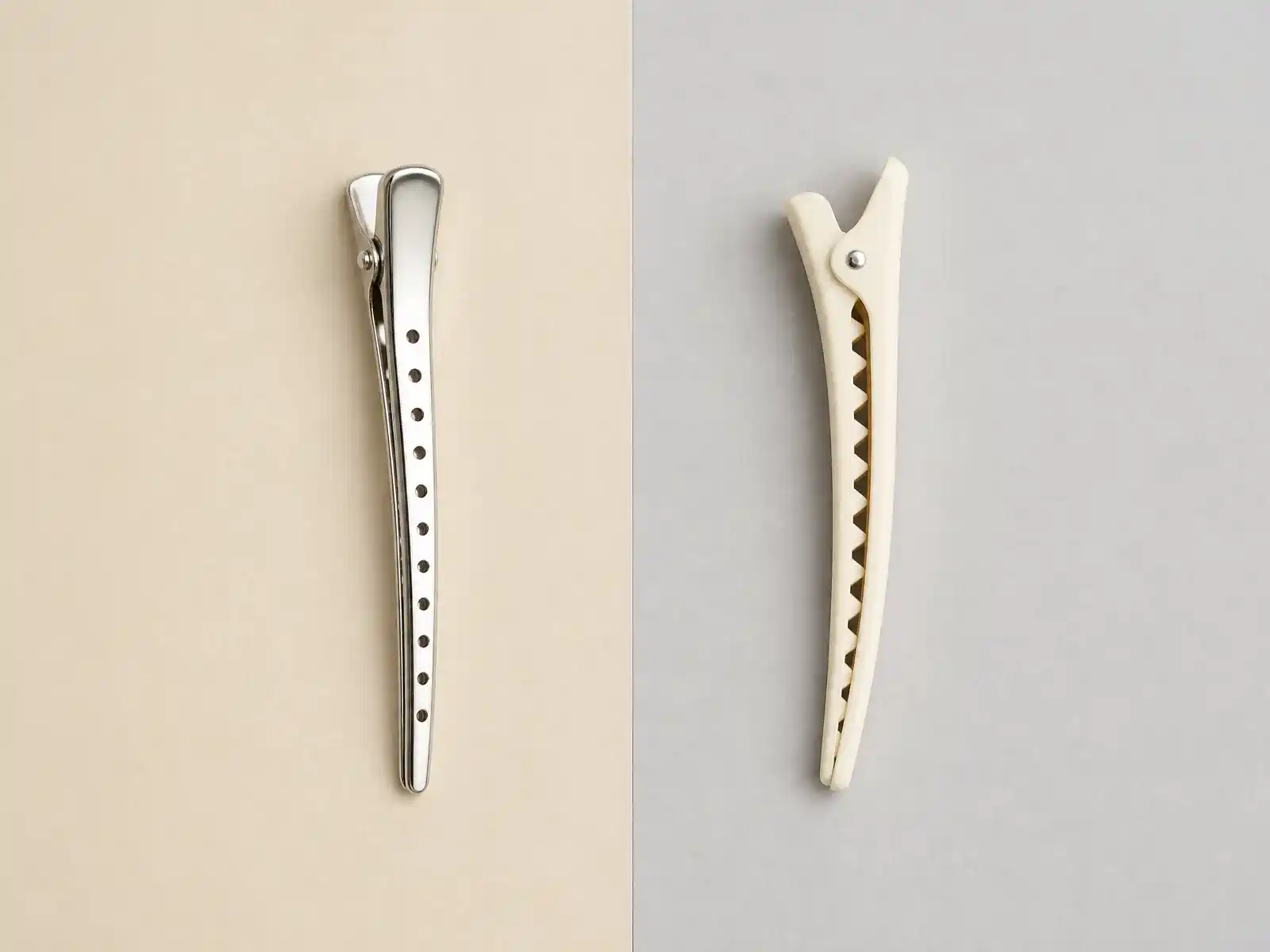
- What the Two Materials Actually Are
- Heat Tolerance: Where Metal Sectioning Clips Win
- Where Plastic Sectioning Clips Win: Weight and Scalp Comfort
- Resin and Acetate Sectioning Clips Are a Third Category
- Dent and Crease Risk Is Jaw Geometry, Not Material
- Durability and Spring Fatigue
- Which Should You Buy: Metal vs Plastic Sectioning Clips by Use Case
- The Bottom Line
The metal vs plastic sectioning clips question has no single winner, because the two materials fail in opposite directions.
Metal grips harder, sits thinner, and does not care how hot your dryer gets. Plastic weighs a fraction as much, ships by the dozen, and is the only one of the two you should let anywhere near hair color. Which of those matters more depends entirely on what you are about to do to your hair.
Both materials turn up in every shape the category sells: alligator, duckbill, croc, butterfly. If you are still sorting out which shape does what, start with the basics of hair sectioning clips and come back. This article asks one narrower question: holding the shape constant, what does the material actually change?
What the Two Materials Actually Are
Start with the fact that almost nothing in this category is made of one substance.
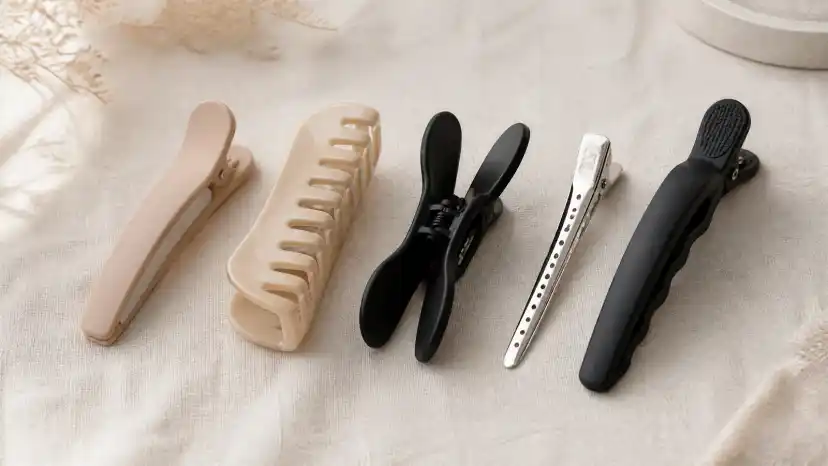
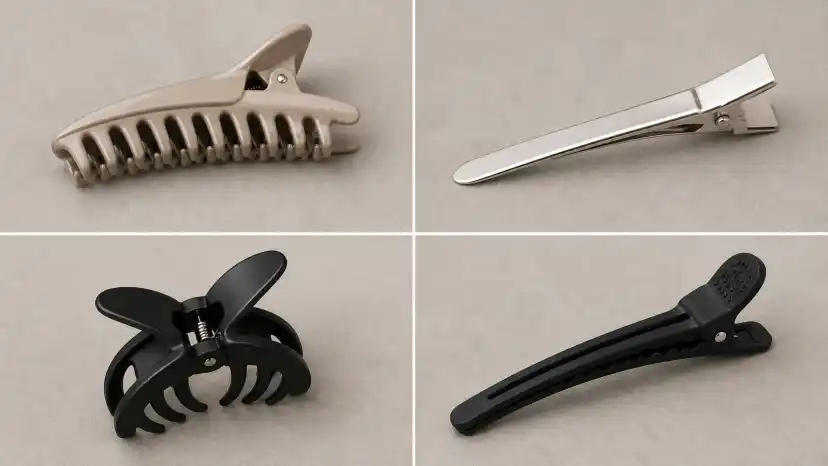
A "metal" sectioning clip is usually a pair of stamped steel jaws, plated for corrosion resistance, closed by a coiled steel spring at the hinge. Plenty of salon croc clips are metal-jawed with molded plastic handles and a rubberized grip, so the part touching your hair and the part touching your fingers can be different materials entirely.
A plastic sectioning clip is molded thermoplastic; manufacturer and retailer listings for salon sectioning clips most often specify ABS, usually paired with a stainless or spring-steel spring at the hinge. The plastic is the body; the metal is still the mechanism. So the honest framing is not metal versus plastic, it is which material forms the jaw and the teeth.
That distinction is where the numbers start to matter. MakeItFrom's side-by-side comparison of ABS against a stainless steel lists ABS at 1.0 to 1.4 grams per cubic centimeter against 7.9 for the steel, and an elastic modulus of 2.0 to 2.6 GPa against 200 GPa. Steel is roughly six times denser and about a hundred times stiffer. Every practical difference below follows from those two ratios, plus one more: heat.
If the jaw shape is still the open variable for you, our breakdown of the four clip mechanisms covers that first.
Heat Tolerance: Where Metal Sectioning Clips Win
This is the one axis where the materials are not merely different, they are in different categories.
Hong Kong's Consumer Council tested 13 hair dryers and reported that two models recorded outlet air temperatures above 96 C at certain operating distances, with one reaching a maximum outlet air temperature of 108.1 C, which the Council noted is hotter than boiling water. The report puts the recommended drying temperature at about 75 C, taken from the IEC standard, and cites an overseas study finding that drying hair at 95 C from 5 cm away could damage the cuticle, producing cracks and holes in it.
Now set that against the plastic. MakeItFrom lists unfilled ABS with a glass transition temperature of 100 C, a heat deflection temperature of 95 C under a 1.82 MPa load, and a maximum mechanical service temperature of 80 C. A sprung clip is a part under sustained load by definition. So the air leaving a hot dryer can, at close range, exceed the temperature at which the plastic in a clip stops reliably holding its own shape.
The caveat matters as much as the number. Air cools fast as it spreads, and nobody holds a nozzle against a clip for minutes. The realistic failure case is narrower: a plastic clip parked in the dryer's path at the crown for a whole blowout, or one resting against a flat iron plate. Over months, that is the likely route to plastic teeth losing their bite.
Metal does not deform at those temperatures. It does something else: it conducts. The EngineeringToolBox metals table lists Type 304 stainless steel at 14.4 W per meter-kelvin at 20 C, while Thermtest lists ABS at 0.14 to 0.21 W per meter-kelvin. Steel moves heat something like seventy to a hundred times faster, which is why a metal clip in a dryer's path can get genuinely hot, pass that heat into the hair it is clamping, and sting your fingers when you go to move it.
Practitioner guidance lines up with the physics. The sectioning-clip guide at Hey Mane says metal duckbill clips are "also wonderful for heat styling, but these little clips really shine when wet styling," and calls them a stylist favorite on short haircuts needing "a smoother, less bulky clip for defining small sections of hair." It points the other way for plastic: plastic duckbills are "perfect for styling dry hair when you want to avoid indents or clip marks."
And then the hard rule. That guide states that metal duckbill clips "are not to be used with hair color application unless otherwise specified," because metal clips can sometimes rust on the hair when color or bleach is involved. For at-home color, this is not a preference. Use plastic.
Where Plastic Sectioning Clips Win: Weight and Scalp Comfort
Six times the density is not an abstraction when the object is hanging off your hair.
For sectioning proper, weight barely registers: the clip is on for ninety seconds. It changes the moment a clip becomes semi-permanent, as in a 45-minute color process or a wash-and-go left to air dry. Now you have mass clamped near the root, and mass near the root means steady pull on the hair where it leaves the scalp.
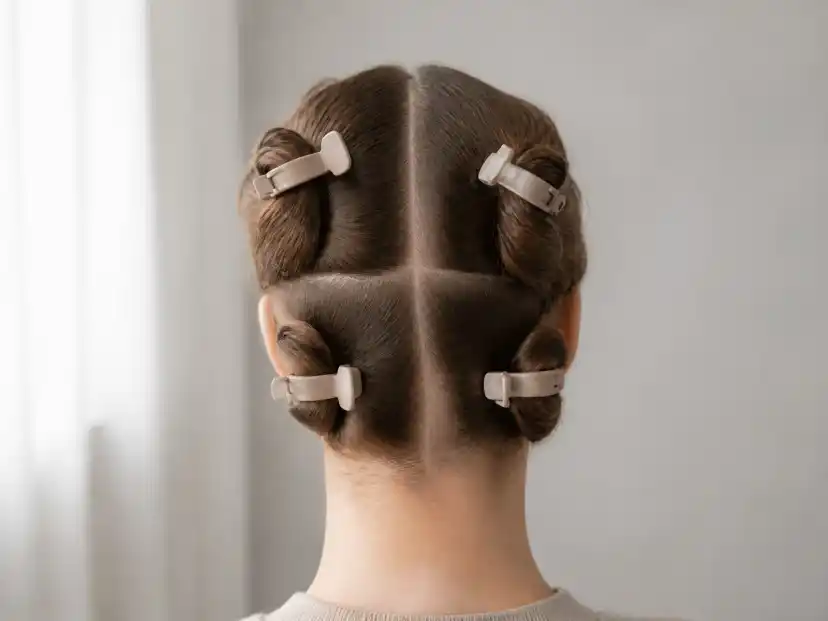
Weight also compounds with count. If you are running the four-section parting method, that is four clips on your head at once; a full foiling pass can run to ten or twelve. Four steel-jawed croc clips and twelve of them are different experiences.
The American Academy of Dermatology's guidance on hairstyling and hair loss is about tight ponytails, buns, up-dos and braids rather than clips, and it does not single out accessories. Its heuristic travels anyway: if your hairstyle feels painful, the style is too tight, and the Academy advises loosening a style so it does not pull. A clip that aches at the root after twenty minutes is giving the same signal. The lightest clip that still holds the section is the right one.
Plastic's second advantage is quieter: it typically sells in packs of a dozen or two dozen, which makes it painless to keep a dedicated color set, a blow-dry set and a travel set instead of asking four clips to do everything.
Resin and Acetate Sectioning Clips Are a Third Category
Resin and cellulose acetate clips get lumped in with plastic, and on the heat axis that is a mistake.
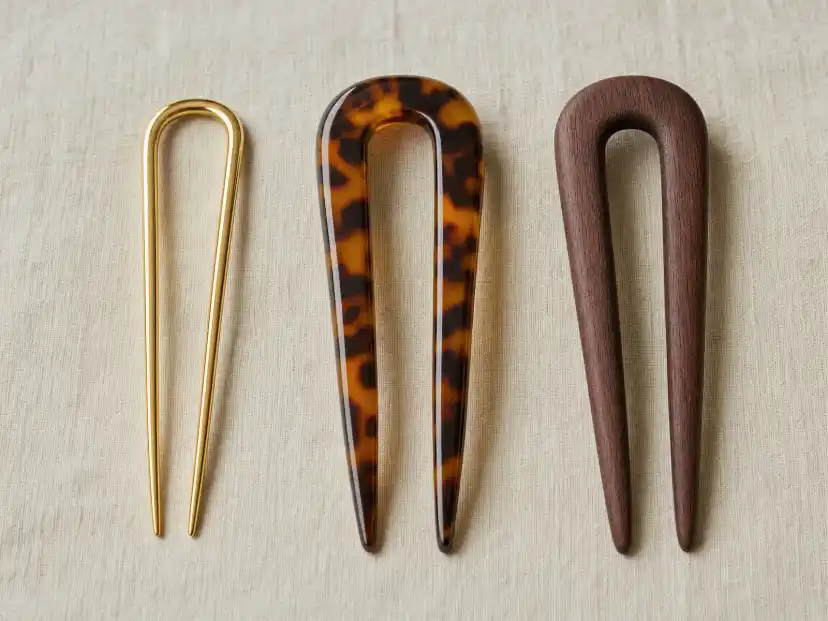
MakeItFrom lists cellulose acetate at 1.3 grams per cubic centimeter with a heat deflection temperature of 65 to 75 C under the same 1.82 MPa load where ABS manages 95 C. In other words, acetate is denser than ABS and gives up its shape under load at a lower temperature. On that spec, acetate sectioning clips are the worst of the three to leave in front of a dryer, and the best-looking of the three in a drawer. "Resin" covers several polymers, so treat those the same way absent a published figure.
Where acetate earns its price is surface. Sourcing guides for acetate hair clips describe the blanks as cut from sheet and then tumbled and hand-polished rather than injection-molded, so the inside of the jaw is less likely to carry a molding seam. We went through that argument in detail when we looked at how acetate compares with plastic in claw clips; the short version is that finish quality predicts snagging better than the name of the polymer does. Just do not confuse a gentle surface with heat tolerance.
Dent and Crease Risk Is Jaw Geometry, Not Material
The tidy conclusion would be that hard metal dents hair and soft plastic does not. The sources do not support it, and neither does the mechanics.
Look again at what the Hey Mane guide recommends plastic duckbills for: avoiding indents, yes, but in the same breath it recommends them for dry hair and for "styling fragile hair that can't take the grip of stronger sectioning clips." The common factor is grip strength and contact area. Material is how those get delivered, not what they are.
Pressure is force divided by area, and a crease is pressure plus time. A thin flat duckbill blade concentrates its spring load along a narrow line, so it leaves a defined mark whether that blade is steel or ABS. A wide rubberized croc bill spreads a considerably stronger spring across several times the contact area, so the pressure at any one point drops. Pad that bill with silicone and it drops again. You can build a creaseless metal clip and a crease-happy plastic one, and manufacturers do both.
Timing does the rest of the work. The Consumer Council's cited study is a reminder that heat at close range is what damages the cuticle, and a clip clamped at a damp root under a dryer is heat and pressure arriving in the same spot. Clip the mid-length rather than the root, move the clip once partway through a long dry, and the material question mostly stops mattering.
Durability and Spring Fatigue
The two materials do not wear out, they wear out differently.
On plastic clips, the failure points are the teeth and the hinge posts. ABS creeps under sustained stress, and a sprung clip stored closed in a hot bathroom is stressed the whole time. Teeth can stop interlocking, the jaw can develop a gap in the middle, and sections slide out of the end you cannot see.
On metal clips, the spring tends to outlast the body: steel is roughly a hundred times stiffer by MakeItFrom's figures, and it does not creep at bathroom temperatures. What goes first is the plating. Once chipped, the exposed steel at the chip is the part that corrodes, and that is the same vulnerability behind the color warning above. The Hey Mane guide calls most metal duckbills rust-resistant, which is a claim about the finish, not about the steel underneath it.
Neither is expensive to replace, so cost is not the deciding axis. Inspect for the failure mode your material actually has: on plastic, close the clip and look down the jaw line for daylight; on metal, look for chips and dull spots in the plating, especially on anything that has been near a bleach bowl.
Which Should You Buy: Metal vs Plastic Sectioning Clips by Use Case
- At-home color or bleach: plastic. The Hey Mane guide's warning about metal clips and color application is the one unambiguous rule in this whole comparison. Keep a separate plastic set for color days.
- Daily blowouts and heat styling: metal, with a caveat. It will not deform, and it sits thin enough to stay out of a brush's path. It will also get hot, given steel's conductivity, so move it with the clip body rather than the jaw.
- Hair that indents easily: plastic, or a padded metal bill. This is the case the Hey Mane guide calls for a plastic duckbill, and the geometry above says a wide silicone-lined jaw gets the same result.
- Wet sets, finger waves, short cuts: metal duckbills. Thin, flat, rust-resistant, and precise on small sections.
- Thick or heavy sections: jaw size over material. The same guide calls croc clips ideal for larger amounts of hair or thicker, coarse hair, and butterfly clamps the best choice for very thick hair. Our picks for clips built for dense, heavy sections are chosen on jaw length first.
- Fine hair: surface, not element. Neither bare steel nor glossy ABS grips fine hair well; grip comes from texture and tooth spacing. Start with grippier options for fine hair.
- Long wear or a tender scalp: plastic. Lowest mass for the same hold wins once the clip is in for half an hour.
- Travel: metal duckbills. They pack flat, and on plastic clips the teeth tend to be the first thing to snap in a toiletry bag.
The Bottom Line
If you are buying one set, buy plastic. It covers color, long wear, fine hair and tender scalps, and it is cheap enough to own in the quantity sectioning actually requires. Then add four to six metal duckbills for wet sets, short-cut precision and anything happening directly under a dryer. Between them they cover every case above.
What it will not fix is a clip of the wrong shape or the wrong length, which is the more common mistake by some distance. Our full guide to hair sectioning clips covers the shapes, the sizes and the sectioning patterns that decide most of the outcome before material ever enters the argument.
Frequently Asked Questions
Can you use metal sectioning clips with hair color?
Do plastic sectioning clips melt under a blow dryer?
Do metal sectioning clips hurt your scalp more than plastic?

Donna Miller
Enjoyed This Guide?
Get more hair tips and product recommendations delivered weekly.