- Why thick hair defeats a standard sectioning clip
- What makes a large sectioning clip actually hold
- HH&LL Large Alligator Sectioning Clips: best overall for thick hair
- Colortrak Rubberized Jumbo Croc Clips: best for very heavy sections
- Ondder Big Gator Sectioning Clips: best bulk set
- Mythos Metal Duck Billed Clips: best budget metal set
- LZIUOSH Duck Bill Sectioning Clips: best cheap starter set
- How many sectioning clips do you need for thick or long hair?
- What to skip
- The bottom line
Thick hair does not quietly slip out of a sectioning clip. It forces the jaw open and sends the clip skidding across the bathroom floor.
The best sectioning clips for thick hair are the big ones: large double-hinged alligator clips for routine sectioning, plus a 4.5 to 5.3 inch croc clip for sections heavy enough that nothing else will close over them. We may earn a commission from links on this page, at no cost to you.
We looked at five sets built for dense hair, from a ten-pack of large alligator clips to a jumbo salon croc clip and two metal duckbill sets. Four of the five publish real measurements, and those inches are the entire argument. Prices below are as of October 2026.
If you are starting from zero and want the full background on jaw shapes, materials and sizes before you spend anything, our guide to how to choose sectioning clips covers the ground this page takes for granted. What follows is for hair that has already defeated the clips in your drawer.
Why thick hair defeats a standard sectioning clip
The problem is load, not technique. According to Kibo Clinics, hair thickness describes the diameter of each individual strand while density describes how many strands grow per unit of scalp, and the hair most people call "thick" is usually high on both counts at once. Published micron guides commonly put fine strands under about 50 microns and coarse strands above roughly 80, with the full human range running from about 17 to 180 microns, so a coarse strand can be several times the width of a fine one before you multiply it across a dense head.
Gather that into one quadrant and clamp a 3-inch clip over it, and four things go wrong at once:
- Jaw width. The section is physically wider than the clip can open. Hair squeezes out of both ends and the clip rides on the surface.
- Spring tension. A standard spring is calibrated for a standard section. Under a heavy one it reaches the end of its travel and the jaw sits partly open, which means no real grip.
- Tooth depth. Short teeth only comb the top layer. The bulk underneath stays loose, so the whole section slides as a unit.
- Section weight. Wet, dense hair is heavy, and gravity pulls on the clip all the way through a blow-dry.
There is a scalp argument too. The American Academy of Dermatology warns that hairstyles which pull on the hair can cause traction alopecia, and advises keeping tight styles occasional rather than daily. The principle carries over: a clip that only holds when you first twist the section into a knot is the wrong clip. The right one holds a loose section without being wrenched into place.
What makes a large sectioning clip actually hold
After a lot of ruined blow-dries, this is the checklist we use for large sectioning clips:
- Length, and preferably 4 inches or more. Standard salon alligator clips are around 3.5 inches. For quadrant work on thick hair, 4-inch sectioning clips are the realistic floor and 4.5 to 5.3 inches is better.
- A double hinge. Two pivot points let the jaw open wider and close parallel rather than pinching at the tip.
- Deep, well-spaced teeth. Teeth have to reach through the section, not scrape across it. Widely spaced teeth also release without dragging.
- A spring with headroom. If it is already straining when the jaw closes, the clip is undersized for your hair.
- A finish that survives the job. Rubberized and coated bodies grip wet hair better than bare glossy plastic, and they put up with the steam and product a thick head of hair generates.
Shape matters as much as size here. According to MasterClass's rundown of hair clip types, duckbill clips are made with a large, flat prong that divides hair into sections so stylists can cut and style it, while alligator clips use a pinch-style clasp strong enough to stop hair slipping out. On thick hair that difference is what decides which one you reach for. If you are not sure which family you need, our explainer on types of sectioning clips walks through each mechanism. The short version for thick hair: alligators and crocs for the big sections, duckbills for the small ones.
HH&LL Large Alligator Sectioning Clips: best overall for thick hair
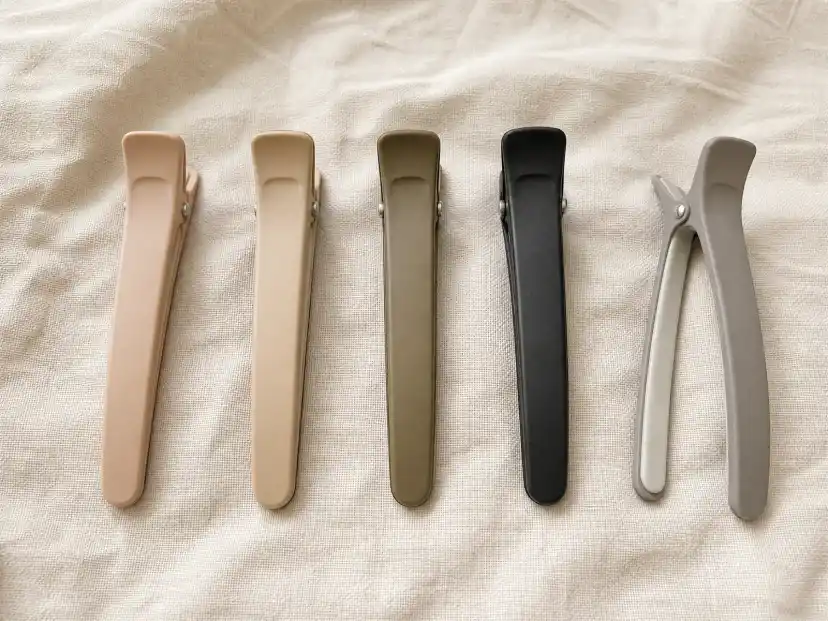
The HH&LL Large Alligator Sectioning Clips are the ones we would put in most drawers first. This is the large version of the brand's standard alligator clip, sold explicitly for thick hair, with the same double-hinged mechanism on a wider jaw. HH&LL states that an upgraded dual metal spring holds more thick hair with stronger clamping force, and lists the clips as barber clips for coloring and cutting as well as styling.
Ten clips for 4.99 dollars as of October 2026 is the part that makes this the default pick. Sectioning thick hair is not a one-clip job, and a set of ten means you can leave some in a travel bag and still have enough for a full head, in muted earth tones rather than the usual neon plastic.
The honest caveat: HH&LL does not publish a length for this clip the way Colortrak and Ondder do, so "large" is the brand's word rather than a measurement. The maker also states it holds without leaving dents or kinks, a claim we would treat as design intent rather than a guarantee on every hair type.
Buy it on Amazon.
Colortrak Rubberized Jumbo Croc Clips: best for very heavy sections
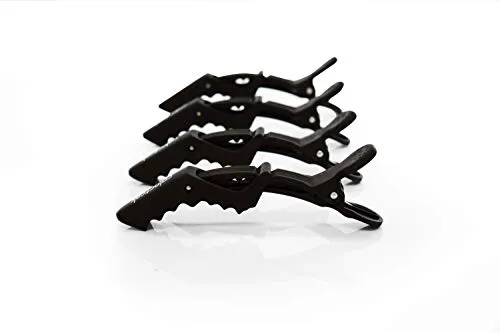
If one clip has to hold a genuinely enormous section, this is the one. At 5.3 inches, the Colortrak Rubberized Jumbo Croc Clips are the longest clip in this guide, and Colortrak states that is about an inch longer than their standard croc clip. An inch sounds trivial until you are holding a wet quadrant of waist-length hair and the jaw closes with room to spare instead of straining.
These are a salon color-bar tool rather than a bathroom accessory. The body is rubberized with an ergonomic thumb grip, the hinge is doubled, and Colortrak describes the finish as stain-resistant for color work. The rubberized surface is the part that should matter most in use, since a coated body has more friction against wet hair than bare glossy plastic. If you want more options in this category, we rounded up others in our guide to professional sectioning clips.
The trade-off is quantity. Four clips for 9.99 dollars as of October 2026 is roughly five times the per-clip price of the HH&LL set, and four clips is exactly a four-quadrant parting with nothing spare. Buy these as your heavy-duty pair and something cheaper for the rest. They are also simply large: on fine or shoulder-length hair, a 5.3-inch clip is overkill and will feel like clamping a stapler to your head.
Buy it on Amazon.
Ondder Big Gator Sectioning Clips: best bulk set
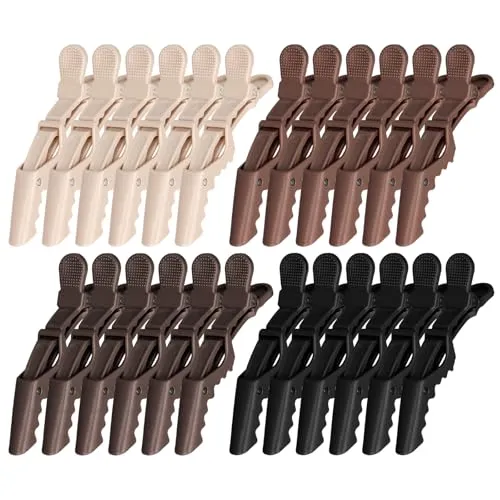
The Ondder Big Gator Sectioning Clips answer the question nobody asks until they are mid-blow-dry with wet hair in one hand: what happens when four clips is not enough? This is twenty-four clips at 4.5 inches each for 9.99 dollars as of October 2026, which works out to about 42 cents per clip for a size that genuinely counts as a jumbo sectioning clip.
The build is a smooth plastic surface over a metal body, and Ondder states a stainless steel spring for durability. The maker markets them for blow-drying, coloring, cutting and styling, wet or dry. At 4.5 inches they sit in the sweet spot for most thick hair: long enough to take a real quadrant, short enough not to feel absurd on a half-head section.
Twenty-four is more clips than one person needs on one day, and that is the point. Thick, long hair sectioned properly for a blowout can eat eight to twelve clips in a single session, and a bulk set means the dishwasher-bound ones, the car ones and the gym bag ones all come from the same pack. This is the set to buy if your usual failure mode is running out, not breaking them.
Buy it on Amazon.
Mythos Metal Duck Billed Clips: best budget metal set
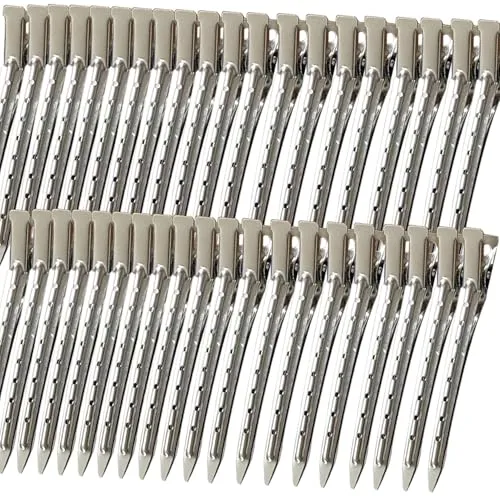
Duckbills work differently from alligators, and thick hair needs both. The Mythos Metal Duck Billed Clips are forty metal duckbills for 5.98 dollars as of October 2026, at approximately 3.46 by 0.4 inches each, with a moderate-tension spring and holes in the blade. The maker lists them for thin or thick curly hair and for roller work.
The flat blade is the whole design. It slips between layers without the bulk of an alligator jaw, which is what makes duckbills the standard choice for pin curls, roller sets and holding a finished curl while it cools. On thick hair you are not asking any single duckbill to hold a quarter of your head, you are asking forty of them to each hold a small piece, and that is a job they do well for fifteen cents a clip.
Who should skip these: anyone who wants one clip to control a whole wet section. A 3.46-inch blade with a moderate spring will pop off a dense quadrant, and that is not a defect, it is the format. Read the dimensions before you order and buy these as a complement to a large alligator clip, not a substitute for one.
Buy it on Amazon.
LZIUOSH Duck Bill Sectioning Clips: best cheap starter set
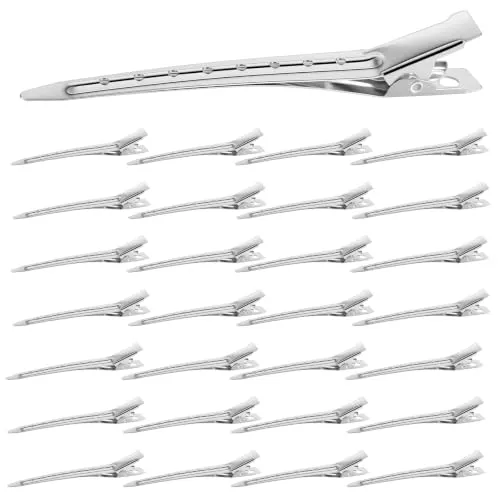
The LZIUOSH Duck Bill Sectioning Clips are the lowest-commitment way to find out whether metal duckbills belong in your routine. The set is 3.99 dollars as of October 2026, down from 4.99, with each clip 3.5 inches long and 0.4 inches wide.
What distinguishes them from the Mythos set is the coating. LZIUOSH describes the body as triple-coated steel and says it is rust-resistant against water, dye and steam, which is a real consideration if your clips live in a steamy bathroom or come anywhere near box color. The maker also says the duck-bill tip releases curls without leaving a crease mark. There is a hanging hole at the tip and the set ships in a reusable box.
One note before you buy: the listing is inconsistent about how many clips are in the set, with the title and the maker's own bullets disagreeing. We would not plan a full head of sectioning around an assumed count. Treat this as a starter set to test the format, and buy the Mythos forty-pack if you decide you want duckbills in volume.
Buy it on Amazon.
How many sectioning clips do you need for thick or long hair?
More than you think. The standard starting point is four: part down the center from forehead to nape, then ear to ear, and you have four quadrants. Clipping the rest of the head away first is the step every salon guide agrees on: American Salon's "four corners" blowout for textured hair, for instance, works each dried section from four different angles, which is only possible when everything else is pinned out of the way.
Four quadrants is where you begin, not where you end. Most salon blow-dry guides then work within each quadrant in horizontal subsections roughly one to two inches thick, drying from the nape upward so heat reaches every layer instead of cooking the top one. On thick hair, each subsection needs the rest of the quadrant clipped away, which is how the count climbs.
Our working numbers for thick hair:
- Four large clips for the quadrants, minimum. Make them your biggest.
- Six to eight total for a normal blow-dry, so you always have a spare in hand.
- Ten to twelve for color at home or a long detangle on sectioning clips for long hair, where sections stay pinned for much longer.
- A separate handful of duckbills for pin curls, roller sets and face-framing pieces.
That math is why a 24-pack at 42 cents a clip is less excessive than it looks, and why four jumbo clips alone will leave you improvising.
What to skip
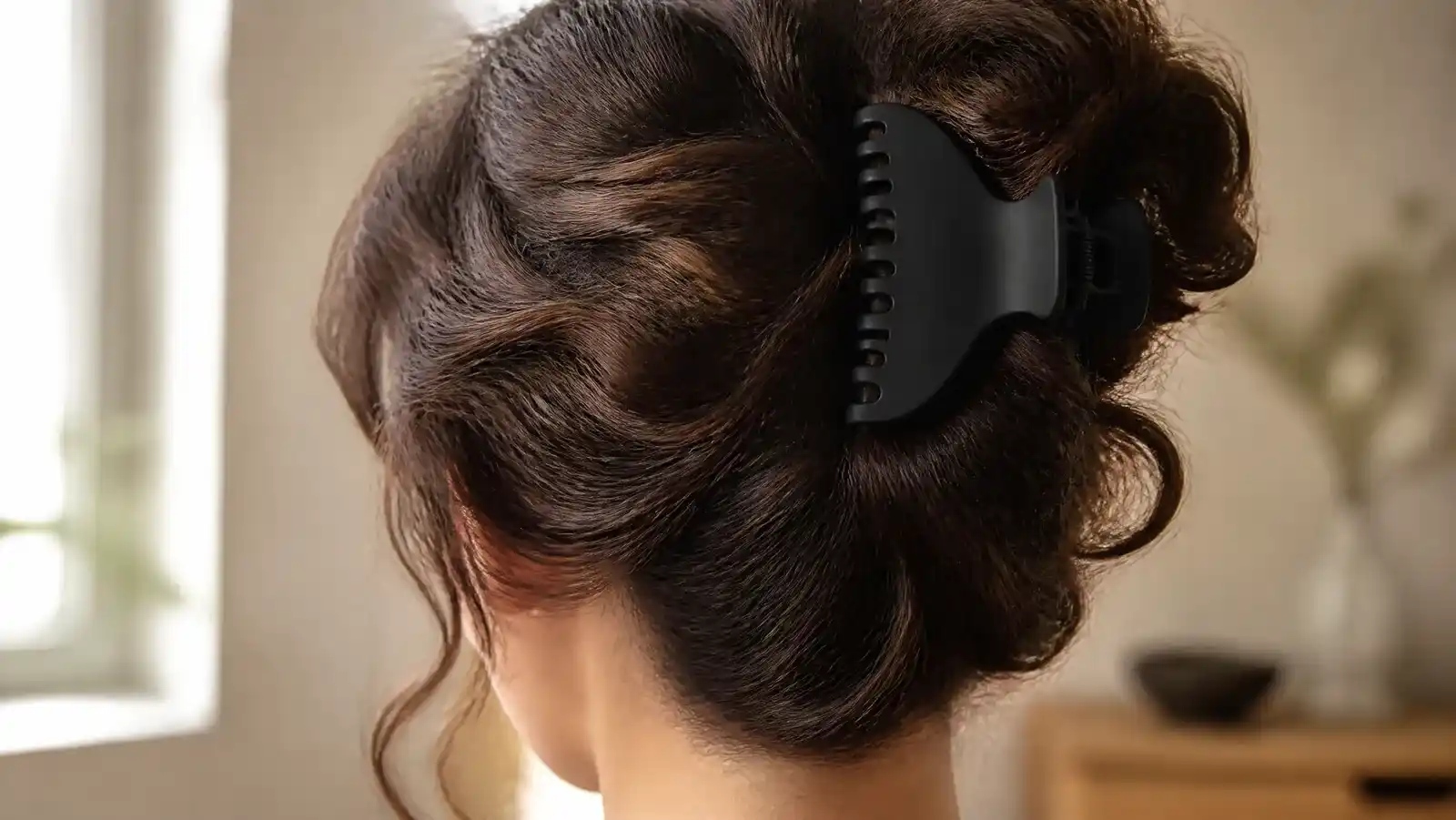
Small claw clips used as sectioning clips. A claw clip is designed to hold a finished style, not to sit flat against a wet, product-covered section while a dryer blasts it. If you want something to wear rather than work with, our picks for claw clips for thick hair and for large claw clips for heavy hair are built for that job instead.
Anything with a single hinge and a short jaw. Single-hinge clips pinch at the tip, so the back of the jaw never closes on the section. On thick hair that means the clip holds the outer inch of hair and nothing else.
Bargain clips with no published dimensions. When a listing will not tell you how long the clip is, assume it is a standard 3-inch clip with "large" in the title.
Clipping tight at the damp root for hours. Hair holds whatever shape it dries in. According to Hair.com's explainer on hair bonds, hydrogen bonds are broken and reformed by water and heat, which is why a style resets after every shower. The cosmetic chemistry site Lab Muffin Beauty Science notes that individual hydrogen bonds are weak but numerous enough to dictate the shape hair holds. Clip manufacturers' own explainers break creasing into three variables: grip pressure, the surface area that grip is spread over, and the geometry of the teeth. Thick, coarse hair resists a crease better than fine hair does, but the practical fix is the same for everyone. Clip the mid-length rather than the damp root, prefer a wider contact area, and shift the clip once during a long session.
The bottom line
For most people with thick hair, the HH&LL Large Alligator Sectioning Clips at 4.99 dollars as of October 2026 are enough clip for the job and cheap enough to buy in quantity. Step up to the Colortrak Rubberized Jumbo Croc Clips when a section is genuinely heavy and 5.3 inches of jaw is the only thing that will close over it, and add the Ondder Big Gator 24-pack if your problem is quantity rather than strength. The two duckbill sets are for the small work that happens inside each section, not for the sections themselves.
Buy for the measurement, not the adjective. Nearly every clip on Amazon calls itself large, and only some of them publish a number. If you want to go deeper on materials, jaw shapes and which clip belongs in which part of your routine, start with our guide to choosing the right sectioning clips.
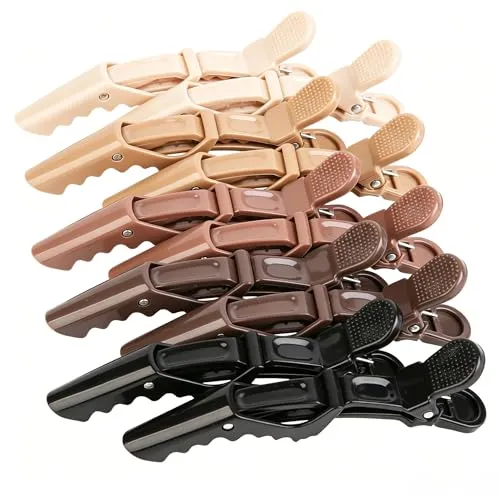
HH&LL Large Alligator Sectioning Clips, Earth Tones (10 Pack)
The large version of HH&LL's standard alligator clip, in muted earth tones, sold explicitly for thick hair. Same double-hinged mechanism, wider jaw, same low price.
“The double-hinged jaw is what earns this the top spot: it opens wide enough to take a dense section ...”
We tested dozens of claw clips to find the very best options. Below you'll find our complete ranking, with detailed reviews and real customer feedback for each pick.
The Complete Ranking
HH&LL Large Alligator Sectioning Clips, Earth Tones (10 Pack)
“The double-hinged jaw is what earns this the top spot: it op...” — Verified Buyer
The large version of HH&LL's standard alligator clip, in muted earth tones, sold explicitly for thick hair. Same double-hinged mechanism, wider jaw, same low price. Ten clips per pack.
“The double-hinged jaw is what earns this the top spot: it opens wide enough to take a dense section without the spring fighting you, and ten clips for under five dollars means you never run short mid-blow-dry.”
— Verified Buyer
Colortrak Rubberized Jumbo Croc Clips (4 Pack, 5.3 in)
“Colortrak's own spec is the whole argument: 5.3 inches, abou...” — Verified Buyer
At 5.3 inches this is the longest clip in the guide and the only one built for genuinely heavy sections. Rubberized finish, double-hinged, with a thumb grip. A salon color-bar tool rather than a bathroom-drawer clip.
“Colortrak's own spec is the whole argument: 5.3 inches, about an inch longer than their standard croc clip. That extra inch is what lets one clip hold a section the others have to split in two.”
— Verified Buyer
Ondder Big Gator Sectioning Clips (24 Pack, 4.5 in)
“Twenty-four clips at 4.5 inches each solves the problem nobo...” — Verified Buyer
Twenty-four 4.5-inch clips, the bulk option for anyone sectioning a very thick head of hair where six clips simply runs out. Plastic body on a metal spine with a stainless spring.
“Twenty-four clips at 4.5 inches each solves the problem nobody warns you about with thick hair: running out of clips halfway through sectioning and re-pinning a wet section with your teeth full of bobby pins.”
— Verified Buyer
Mythos Metal Duck Billed Clips (40 Pack, 3.5 in)
“Forty clips for under six dollars is the right way to buy a ...” — Verified Buyer
Forty metal duckbills for under six dollars. The thin blade suits roller sets and pin curls on thick hair, where you need a lot of clips at once and each one only has to hold a small section.
“Forty clips for under six dollars is the right way to buy a tool you use by the dozen. Read the dimensions before you order, though: at roughly 3.46 by 0.4 inches this is a small-section clip, not a quadrant clip.”
— Verified Buyer
LZIUOSH Duck Bill Sectioning Clips (3.5 in, Silver)
“A low-risk way to find out whether metal duckbills suit your...” — Verified Buyer
The cheapest way into metal duckbills, with a triple-coated steel body the maker says is meant to survive dye and steam. A hanging hole at the tip lets you keep the set on a ring rather than loose in a drawer.
“A low-risk way to find out whether metal duckbills suit your routine before spending more, and the hanging hole is a genuinely useful detail: the set stays on a ring instead of scattering through a drawer.”
— Verified Buyer
The double-hinged jaw is what earns this the top spot: it opens wide enough to take a dense section without the spring fighting you, and ten clips for under five dollars means you never run short mid-blow-dry.
Quick Comparison
A side-by-side look at our top picks
Frequently Asked Questions
How big should a sectioning clip be for thick hair?
Do metal sectioning clips crease thick hair?
Alligator clips or duckbill clips for thick hair?

Donna Miller
Enjoyed This Guide?
Get more hair tips and product recommendations delivered weekly.