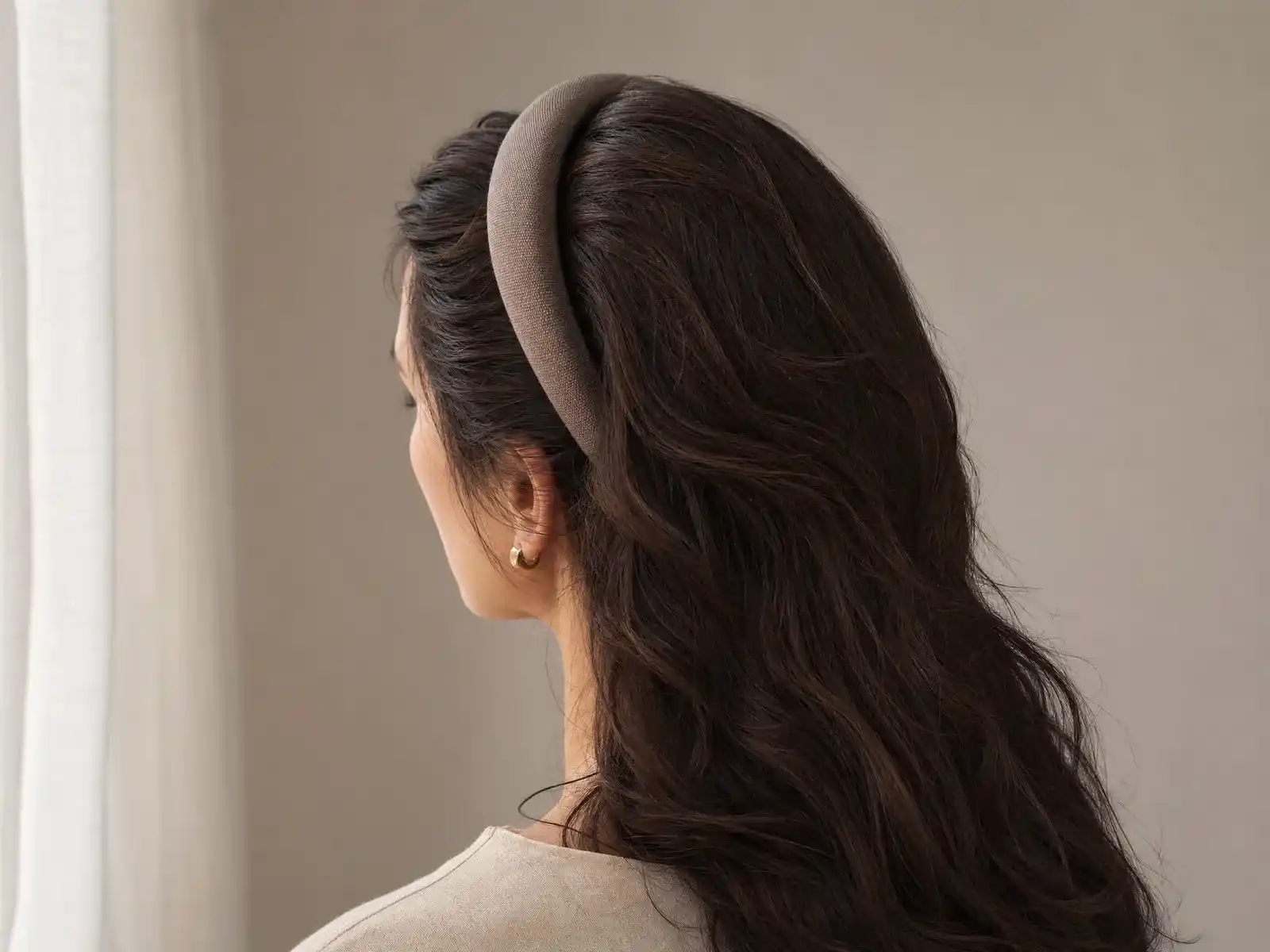
- Why headbands for thick hair slip, pinch, or do both
- What to look for in the best headbands for thick hair
- Yazon Ribbed Knit Padded Headbands: our pick for thick hair
- ACO-UINT Padded Fabric Headbands: best multi-pack for wide headbands for thick hair
- DiyJibb Thick Non-Slip Headbands: best everyday set
- Uchyius Wide Velvet Padded Headband: best velvet option
- Wecoe Thick Padded Fabric Headbands: best budget pick
- Fitting headbands that don't slip on thick hair
- Troubleshooting: still slipping, still aching
- The bottom line
The best headbands for thick hair are wide, padded and flexible — not tight. A band an inch or more across spreads its holding force over more scalp, and a frame that flexes accommodates volume instead of fighting it. A narrow band has to clamp to stay put, and clamping is what causes both the slipping and the headache. We may earn a commission from links on this page, at no cost to you.
Width and flex beat tightness. That is the whole argument here, and it cuts against the instinct most of us have after a band pings off the back of our head in a supermarket aisle: buy something tighter. Below: what actually fails on dense hair, the specs worth checking before you buy, and five padded bands that meet them. If you want the wider view of shapes, materials and occasions first, our guide to the best headbands for women covers the whole category. This page is only for hair that has already defeated the thin ones.
Why headbands for thick hair slip, pinch, or do both
First, what "thick" is doing here. According to Living Proof, hair density is the number of individual strands per square inch of scalp, while thickness is the width of each individual strand — and the brand points out that the common assumption that thick hair means high-density hair is not always true. Living Proof puts a typical scalp at 80,000 to 120,000 hairs. For headband purposes, the distinction matters less than the sum: more strands, wider strands, or both, all adding up to a deeper cushion of hair between the band and your skull.
Failure one: the band rides up and pops off. Pushed back over dense hair, a narrow band never reaches the scalp. It sits on a compressible layer that pushes straight back at it. So the band takes the path of least resistance and creeps up toward the crown until the circumference it is spanning is small enough for its own tension — where it either perches uselessly on top of your head or launches.
Failure two: the band stays put and you have a headache by noon. That failure has a clinical name. Under the ICHD-3 criteria for external-compression headache, the pain is brought on by and occurs within one hour of sustained external compression of the forehead or scalp, and resolves within one hour once the compression is relieved. A 2024 narrative review by Ole Hensel and Torsten Kraya in the journal Brain and Behavior lists headbands and hairbands among the triggers, alongside tight hats, helmets and goggles, and reports a lifetime prevalence of about 4 percent in adults aged 25 to 64. The authors note that resolution and prevention come from avoiding the precipitating cause. We go deeper into that mechanism in our piece on external compression headaches from hair clips.
There is a hair-health edge to the same question. The American Academy of Dermatology's guidance on hairstyles that pull is blunt — "If your hairstyle feels painful, the style is too tight" — and it lists pain, stinging on the scalp and crusts as signs to change the style. The AAD also recommends switching up your hairstyle regularly so your hair can recover. For the fuller picture on risk, see are headbands bad for your hair.
What to look for in the best headbands for thick hair
Five specs, in the order we would check them.
- Width, first and always. Pressure is force divided by the area it acts across. Double the width of a band and the same holding force presses half as hard on any given patch of scalp. On dense hair we would not buy anything under about an inch, and we would rather be closer to two.
- Padding under the surface. Padding does two jobs. It adds effective depth, and it lets the band conform to the curve of the skull instead of bridging across it and landing on two hard contact points.
- A frame that flexes. Volume is not a fixed number. It changes with the weather, the wash cycle and the style. A band with real give accommodates that; a rigid narrow band simply loses the argument and rides up.
- Grip from texture, not tension. This is the key move. Ribbed knit, sueded lining and velvet all hold by friction against the hair, which means the band does not need to be tight to stay in place. Smooth satin looks lovely and slides.
- How the ends sit behind the ears. The two ends are where a band concentrates the most pressure, because the head is narrowing and the band is not. Padded, rounded or softly finished ends are the difference between a band you forget about and one you notice by mid-afternoon.
Non slip headbands for thick hair get all five right at once. Most bands get one.
Yazon Ribbed Knit Padded Headbands: our pick for thick hair
The Yazon Ribbed Knit Padded Headbands are the closest thing here to a spec sheet written for dense hair. Yazon lists the band at 50mm wide with a padded lining, shaped to the curve of the head — and the maker says that shaping is specifically to avoid pinching and deep indentations. At roughly two inches, this is the widest band in the group, and width is the spec that does the most work.
The second half of the design is the ribbed surface. According to Yazon, the texture increases friction with hair to reduce slipping, and the knit is made to resist stretching out or deforming with repeated use. That is the right order of operations: grip from texture rather than grip from tension. You get three bands — black, warm brown and cream beige — for $12.99 as of September 2026.
Who it is not for: anyone who wants a thin, near-invisible band. This one is visible by design.
ACO-UINT Padded Fabric Headbands: best multi-pack for wide headbands for thick hair
The ACO-UINT Padded Fabric Headbands bring the same formula in a five-pack. ACO-UINT lists them at approximately 6.1 inches high and 1.2 inches wide, with a sponge-padded core wrapped in soft fabric, and states that they will not hurt behind the ears and are not easy to slip off. The maker also says the elastic adjusts to different head sizes.
Five bands at $9.99 as of September 2026 is the practical case here. Any fabric-over-elastic band loses tension eventually, and a rotation ages more slowly than a single band worn every day. The trade-off against our top pick is straightforward: 1.2 inches spreads load less effectively than 50mm does.
Who it is not for: anyone whose main complaint is pressure rather than slipping. Go wider.
DiyJibb Thick Non-Slip Headbands: best everyday set
The DiyJibb Thick Non-Slip Headbands are the plain-colours workhorse. DiyJibb describes a 1-inch-wide padded design in polyester, lightweight and flexible, made to hold its shape, and pitches the padding specifically against headaches and hair strain. Six bands cost $8.99 as of September 2026.
An inch is our floor rather than our target, so treat this as the sensible default for ordinary days rather than the answer to a genuine pressure problem. Where the six-pack earns its place is logistics: one in the gym bag, one in the car, one by the sink, and no more improvising with a hair tie when the band you wanted is in the wash.
Who it is not for: very heavy hair on a long day. The narrower the band, the sooner you notice it.
Uchyius Wide Velvet Padded Headband: best velvet option
The Uchyius Wide Velvet Padded Headband works on a different mechanism from everything above. It is a plastic hoop wrapped in velvet rather than fabric over elastic, listed by Uchyius at 5.7 by 6.69 by 1.18 inches. A hoop holds by spanning the head — resting on two sides and bridging the top — rather than by squeezing a closed loop around it, and plenty of thick-haired wearers get on better with that.
Uchyius calls the frame memory elastic plastic and claims it will not leave a dent even worn all day, and that the edges will not hurt behind the ears. Treat those as maker claims rather than verified results. What we can say is that velvet is a sensible surface for this job: the pile grips hair rather than sliding over it. It is $8.99 as of September 2026.
Who it is not for: workouts. A sprung hoop and a sweaty run are not friends.
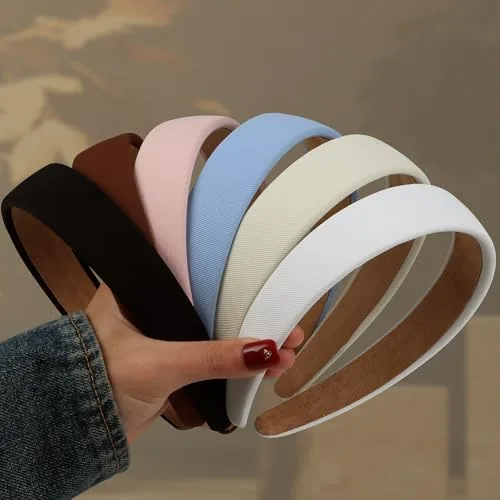
Wecoe Thick Padded Fabric Headbands: best budget pick
The Wecoe Thick Padded Fabric Headbands are the cheap way to find out whether the wide-and-padded format suits your hair at all. Four bands in black, white, soft pink and warm brown cost $4.49 as of September 2026. Wecoe says the padded construction adds height at the crown, that the core is flexible enough to fit most adult and child head sizes, and that the sueded-textured lining is there for grip.
That sueded lining is the reason this pick is on the list rather than the price. A textured underside is the mechanism that lets a band hold without clamping, and it is unusual to find it at this price.
Who it is not for: anyone wanting one band to last years. At four bands for under five dollars, these are consumables.
Fitting headbands that don't slip on thick hair
Fit is a placement problem before it is a product problem.
- Put it on front to back, not back to front. Set the band at the hairline first, then push the back edge down to the nape and let it settle. Dragging a band forward over the crown is how you drag volume with it.
- Tuck the ends behind the ears. The ear gives the band something to brace against, which stops the slow creep upward and takes pressure off the temples.
- Lift the crown afterwards. With thick hair, a band pressed flat looks severe. Pinch and pull a little hair upward at the crown once the band is seated.
- Move it a few millimetres each day. The AAD's advice to switch up your hairstyle so your hair can recover applies to bands too. The same band in the same line, daily, is the pattern that concentrates stress on one strip of hairline.
- Do not sleep in it. According to Trichogenics, a hair-restoration clinic, loose headbands worn for short periods are generally safe, while daily tight use or sleeping in them raises the risk of longer-term damage.
Troubleshooting: still slipping, still aching
Still slipping. Headbands of Hope suggests applying hairspray, pomade, gel or texturising spray to the spots where the band will sit, and pinning it in place with bobby pins pushed through the hair and down onto the band in a criss-cross, with the pin openings pointing downwards. The same guide makes a point worth repeating: a headband can slip precisely because it is too tight. A band under high tension is storing energy and looking for somewhere to release it.
Still aching. Take it off — if it is external-compression headache, the ICHD-3 criteria describe the pain resolving within an hour of the compression being relieved. Then change the variable, not the tightness. Go wider, go padded, or switch mechanism entirely. On a long day with heavy hair, a clip that carries the weight often beats a band that presses on it: our roundups of these 5 claw clips are the best for thick hair and best large claw clips for heavy hair cover the alternatives.
Worried about friction at the hairline. The AAD notes that head coverings made of silk or satin are gentler on hair than other materials, which is the logic behind our guide to silk and satin hair accessories. The trade-off is real, though: smooth is gentle and smooth also slides, which is why we favour textured grip on a wide band over slick fabric on a narrow one.
The bottom line
On thick hair, the band that stays put is almost never the band that grips hardest. It is the one wide enough to spread its load, padded enough to follow the curve of your head, flexible enough to move with your volume, and textured enough to hold without clamping. Buy width first, texture second, and price last. If you are weighing headbands against clips, combs and everything else, start with our guide to choosing the right headband for your hair and work back to the format that suits your hair, not the one that promises the tightest hold.
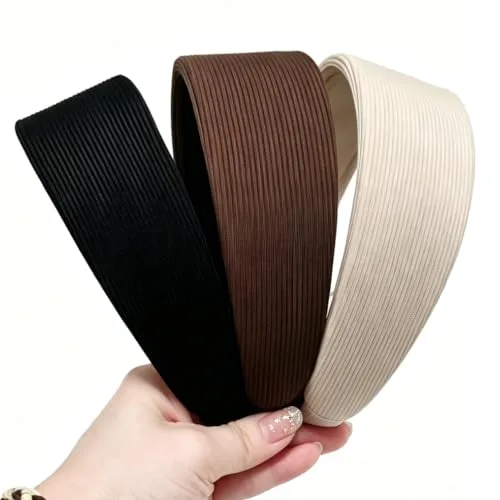
Yazon Ribbed Knit Padded Headbands (3 Pack)
The widest padded band in this group at a listed 50mm, which is the single spec that matters most on dense hair — load spread over more scalp instead of concentrated on two points. The ribbed surface is doing the grip work, so it does not need to be tight to stay put.
We tested dozens of claw clips to find the very best options. Below you'll find our complete ranking, with detailed reviews and real customer feedback for each pick.
The Complete Ranking
The widest padded band in this group at a listed 50mm, which is the single spec that matters most on dense hair — load spread over more scalp instead of concentrated on two points. The ribbed surface is doing the grip work, so it does not need to be tight to stay put.
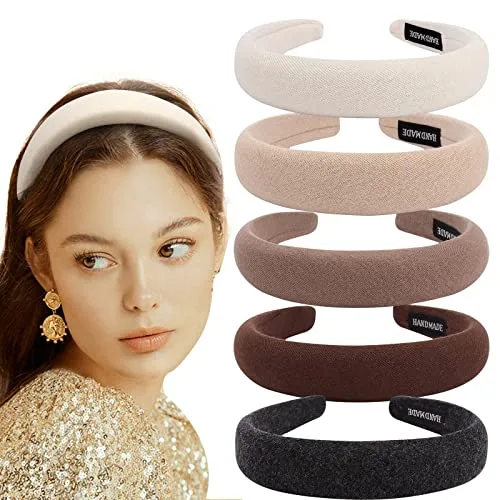
A five-pack of sponge-padded bands at a listed 1.2 inches wide. Useful if you want the padded-and-wide formula in rotation rather than one band you wear daily until it stretches out.
A 1-inch padded band — narrower than our top pick, so a step down on load spreading, but the six-pack makes it the easy default for plain daily wear.
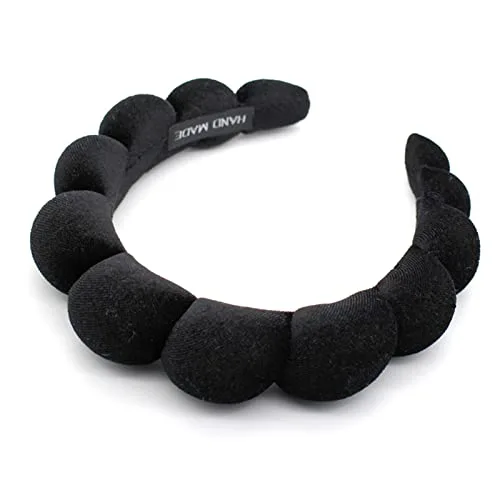
A velvet-wrapped plastic hoop rather than a fabric-over-elastic band. The rigid-but-sprung frame is a different mechanism: it holds by spanning the head rather than squeezing it, which some thick-haired wearers get on with better.
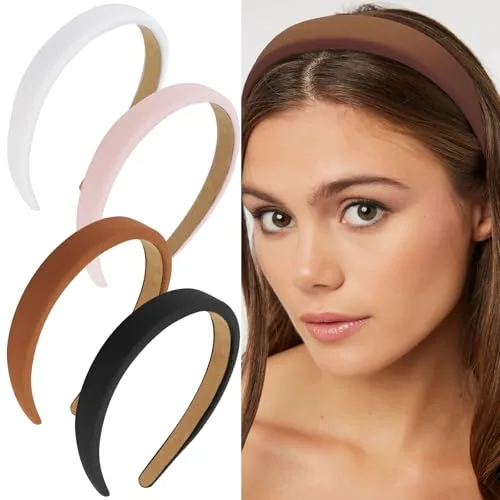
The cheapest way to test whether the thick-padded format works for your hair. Four bands with a flexible core and a sueded lining that grips rather than slides.
Quick Comparison
A side-by-side look at our top picks
Frequently Asked Questions
Why does my headband keep sliding off thick hair?
Can a headband actually give you a headache?
How wide should a headband be for thick hair?

Donna Miller
Enjoyed This Guide?
Get more hair tips and product recommendations delivered weekly.