- Metal vs Plastic Snap Clips: The Short Version
- The Spring Is Metal in Both Cases
- Coating Is the Variable That Touches Your Hair
- Where Dents and Creases Actually Come From
- Durability: Metal Takes a Set, Resin Cracks
- Weight, Visibility and Price per Clip
- Where Plastic and Acrylic Are the Better Choice
- Are Metal Hair Clips Bad for Hair?
- The Verdict, With Conditions
Metal snap clips fail more gradually than plastic ones, but neither material wins on hold: the spring inside an acrylic clip is metal too, so the honest metal vs plastic snap clips question is which material sits between that spring and your hair.
The spring sets the force. The surface sets the friction and the crease. The body sets the size, the weight and whether anyone notices it. We earn a commission from Amazon links on this page, at no cost to you.
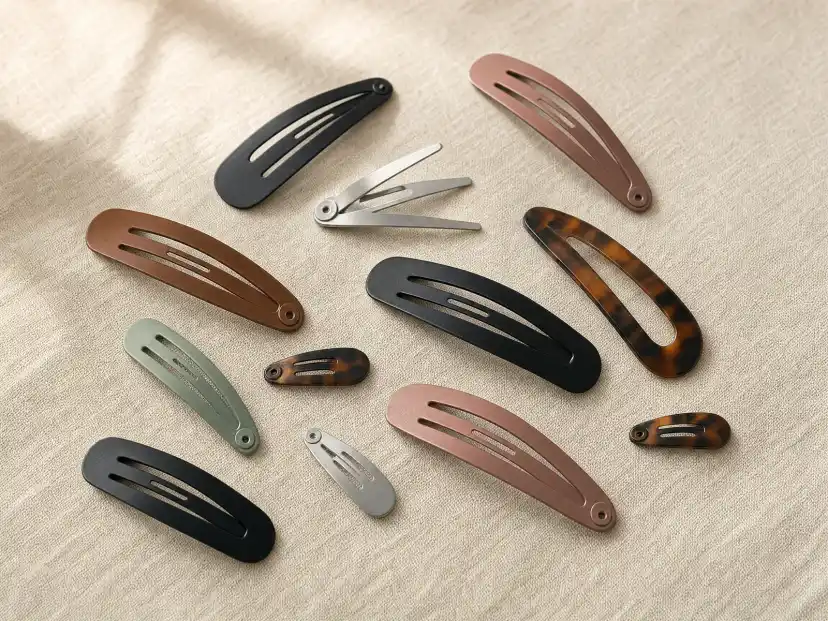
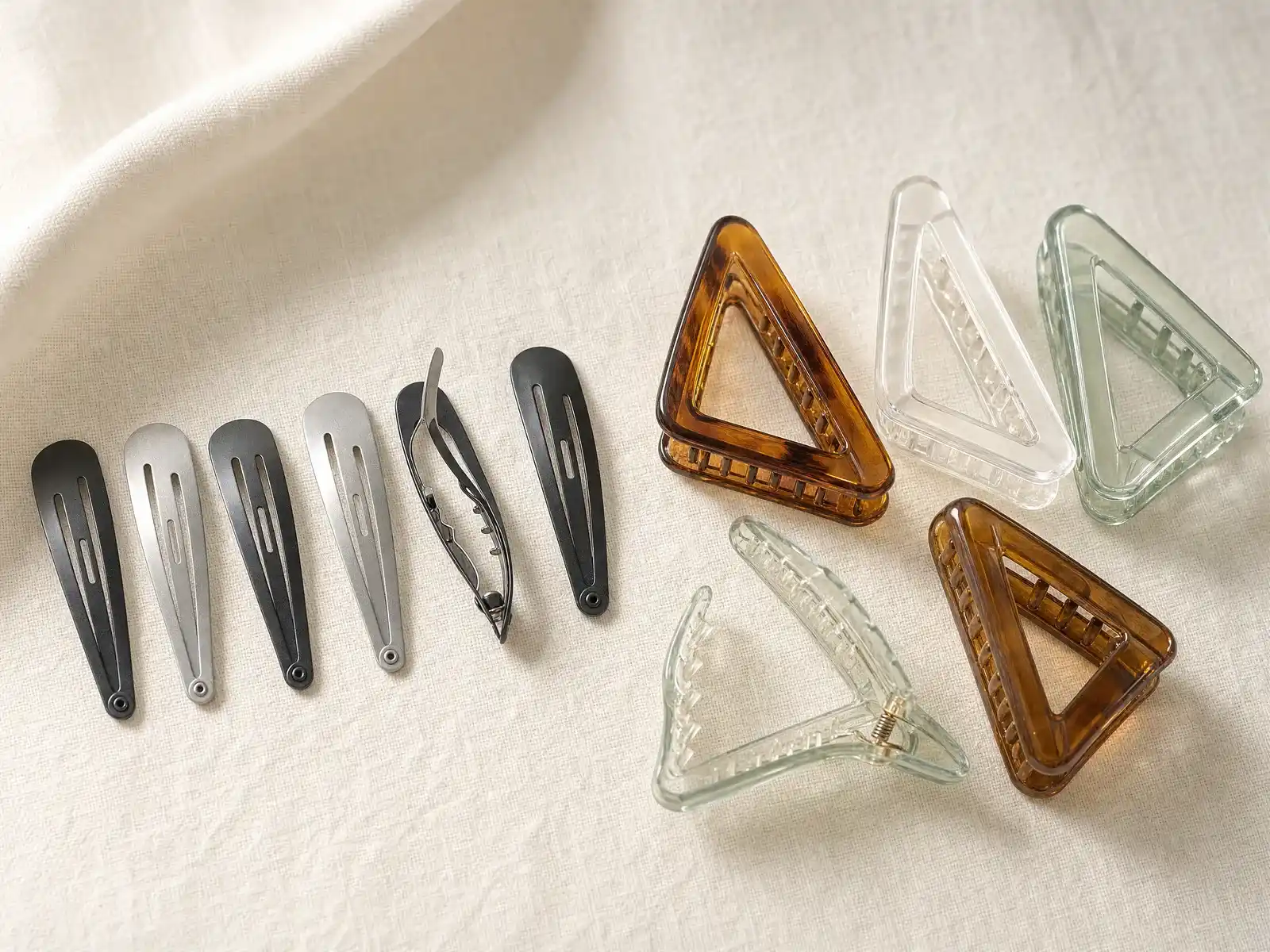
Four finishes cover the real range, and all four are here: bare painted metal, matte-coated metal, epoxy over metal, and an acrylic resin body on an alloy spring. If you want the whole category first, start with our guide to snap hair clips. This article holds size roughly constant and asks one question: what does the material change?
Metal vs Plastic Snap Clips: The Short Version
| Material | What touches your hair | In this comparison | Price per clip, November 2026 | How it fails |
|---|---|---|---|---|
| Bare painted metal | Paint over a stamped metal edge | FLOYEUML, 2 in, 60 clips | about 8 cents | Paint chips, then the bare edge drags |
| Matte-coated metal | A matte, higher-friction coat | B.PHNE, 2.1 x 0.7 in, 20 clips | about 40 cents | The coat wears through at the bite line |
| Epoxy over metal | A thick epoxy shell on a contour body | Goody Snap & Go, 12 clips | about 53 cents | Epoxy chips away in flakes |
| Acrylic resin on an alloy spring | Resin faces and interior teeth | Lawie, about 3 in, 20 clips | about 50 cents | The resin body cracks |
Everything below is the reasoning behind that table.
The Spring Is Metal in Both Cases
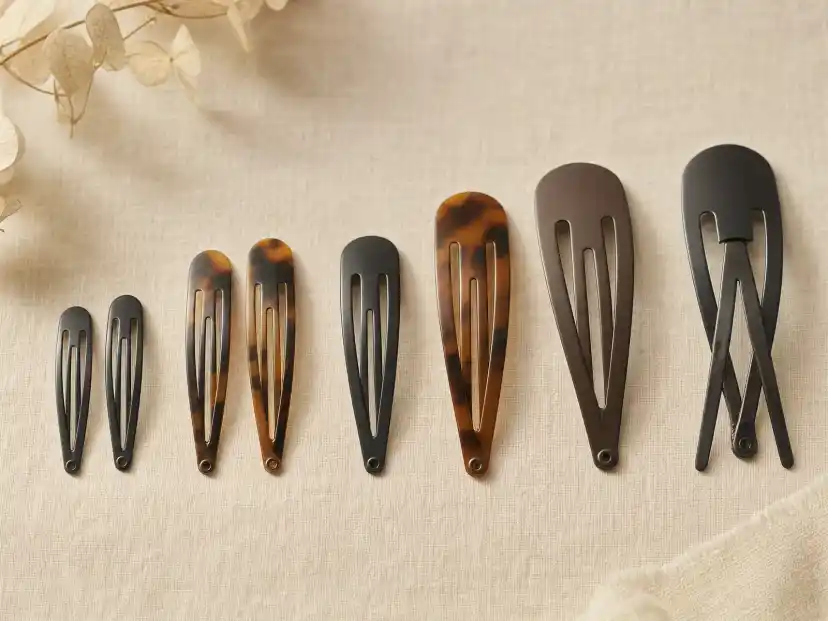
A snap clip is one strip of sprung metal fixed over a flat base plate, and it has two stable shapes: arced open, or flat and closed. Press the middle and the strip passes a high-tension midpoint, then jumps to the other shape. That jump is the snap, and the hold is the strip trying to get back to flat.
None of that is optional, and the sprung part is metal in every version we have handled. So when a listing says plastic or acrylic clip, it is describing the body, not the mechanism. The Lawie set here is explicit about it: the listing specifies acrylic resin and alloy, and the alloy is the sprung part.
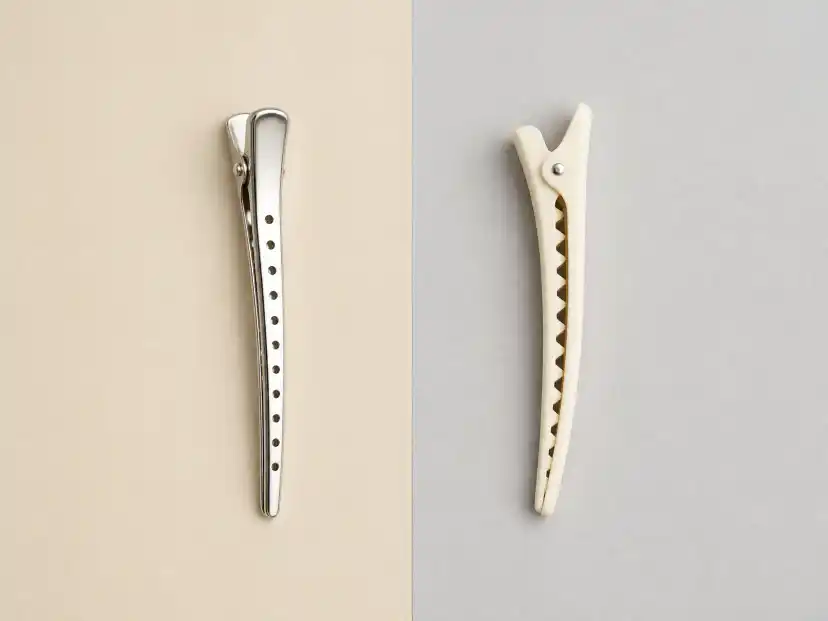
That precision matters. The Lawie is not a snap clip in the strict sense. It is a duckbill, which the listing describes as opening and closing as it slides into the hair, with interior teeth doing the gripping, rather than a plate that flips between two stable positions. Both tools hold hair with metal. Only one of them clicks.
The useful consequence: "plastic holds worse" is the wrong prediction to walk in with. Length rather than material decides how much hair a clip can close on. Material decides what the closing feels like, and how the clip eventually dies.
Coating Is the Variable That Touches Your Hair
The mechanism most metal snap hair clips live or die by is not strength. It is friction.
According to the background section of US patent application US20040065341A1, "Jaw hair clip for firmly holding hair," conventional clips "include hair contact surfaces which are smooth, thus having low coefficients of friction" and are therefore "prone to hair slipping out from between the clip's jaws during attachment or while in use." It describes those clips as "typically made of hard plastic or metal." Slipping is a surface problem in both materials, not a metal problem.
That sets up the three metal options cleanly:
- Bare painted metal is the slippery end. FLOYEUML sells 60 two-inch clips for $4.99 as of November 2026, and the maker describes them as sturdy metal with a smooth finish, gentle on hair and scalp. Smooth is the exact property the patent flags as a slip risk, so read that copy as honest rather than as a hold claim.
- A matte coat trades gloss for grip. The B.PHNE clips measure about 2.1 by 0.7 inches, 20 for $7.99 as of November 2026, and the maker markets a matte, non-slip surface with rounded edges that it describes as no-crease and lightweight. Those are the maker's words, not our test results, but the direction is right: a matte surface has more to catch on than a polished one.
- Epoxy puts the most material between metal and hair. Goody's Snap & Go epoxy contour clips put a cured resin shell over a metal contour body, 12 for $6.33 as of November 2026. Goody describes them as easy to use with a secure hold and markets the contour design for all-day wear.
Price per clip tracks the coating almost exactly: 8 cents bare, 40 cents matte, 53 cents epoxy. You are paying for the layer, not the spring.
Where Dents and Creases Actually Come From
A crease is bent hair, not broken hair, and the distinction is worth keeping.
The same patent background notes that hair "can be damaged when it becomes pinned or trapped between the two jaws of the teeth" and that such damage "may, for example, be in the form of hair deformation." Deformation is the honest word for what a clip leaves behind after two hours on damp hair.
Two geometry variables drive it, and neither is spelled "metal" or "plastic":
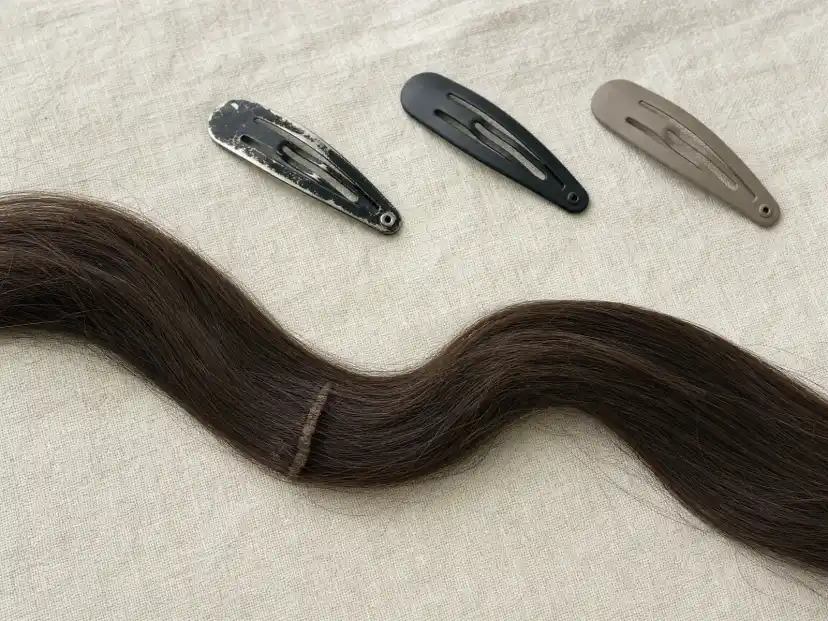
Edge radius. A sharp edge concentrates the spring's force on a narrow line; a rounded or coated edge spreads it across a wider patch, so pressure at any one point drops. That is why a chipped clip creases worse than the same clip did new, and why the epoxy shell on the Goody clips is doing real work rather than decoration.
Bite length. A long contact line distributes load; a short one concentrates it. Interior teeth, like the ones the Lawie listing describes, grip well precisely because they press at points rather than along a line, and points are what set a visible mark.
Add moisture and time and you get the familiar result: in our experience the crease sets in hair that goes under the clip damp and comes out dry, which is a drying problem as much as a hardware one. If creasing is what you are solving for, our picks for no-crease sectioning clips target exactly that failure.
Durability: Metal Takes a Set, Resin Cracks
The two materials do not fail at different rates so much as in different styles, and that is the practical difference.
Metal gives warning. The strip loses some of its force, so the click goes soft instead of decisive, or a prong ends up out of line. Both show before the clip stops working, and a bent prong can often be straightened once. We have no published fatigue data for hair-clip springs, so treat that as reasoning and the soft click as the symptom.
Acrylic gives no warning. It breaks at the thinnest point in the body, in our experience usually at the hinge end, in one event. According to the Wikipedia entry for poly(methyl methacrylate), the plastic sold as acrylic, "non-modified PMMA behaves in a brittle manner when under load, especially under an impact force," and its impact strength, while "higher than both glass and polystyrene," is "significantly lower than polycarbonate and some engineered polymers."
Heat barely arises for snap clips, which rarely sit in a dryer's path for a whole blowout. It matters enormously once a dryer is involved, which is why the sectioning-clip version of this comparison lands differently.
Weight, Visibility and Price per Clip
Neither listing publishes a gram weight, so we will not put a number on heaviness. Size is the available proxy: the Lawie clips run about 3 inches against 2 inches for the FLOYEUML metal, so the acrylic clip is the bigger object on your head.
Visibility is where the materials genuinely diverge, and acrylic snap hair clips are built to be seen. The Lawie set is a hollow geometric triangle with a see-through surface that the maker notes lets hair color show through, 20 assorted colors for $9.99 as of November 2026, about 50 cents a clip. Compare that with 60 metal clips in a storage box at about 8 cents each.
That gap decides more than it looks like it should. At 8 cents you replace rather than nurse a clip, so a chipped one goes in the bin. At 50 cents in a specific color, people keep wearing the cracked one.
Where Plastic and Acrylic Are the Better Choice
Three conditions, and they are real rather than consolation prizes.
When you want size. A longer metal strip has to get thicker to stay stiff, and a thicker strip takes more force to push through its snap point, which is likely why the metal format tops out in practice around 3.5 inches. A molded resin body scales up cheaply instead. The Lawie acrylic triangle clips are about 3 inches long, and the listing puts them on thick, thin, curly or long hair, plus salon sectioning, rollers and root lifting.
When the clip is the point. Nobody buys a 2-inch black metal clip to be looked at. A see-through acrylic triangle in one of 20 colors is a visible accessory, and the same argument runs through the claw family, where acetate and plastic behave differently again.
When you want no metal against your skin. A resin body keeps the alloy inside the clip. Our complete guide covers the nickel-release question behind that choice.
Where plastic is not the better choice: anywhere you need a flat profile, and anywhere you are buying in bulk to lose. For the everyday jobs in our snap clip styling guide, a 2-inch coated metal clip is still the default.
Are Metal Hair Clips Bad for Hair?
No more than plastic ones, and the variable the evidence actually points at is tension rather than material.
The American Academy of Dermatology lists the styles that can cause traction alopecia when they are too tight, naming "Buns, ponytails, and up-dos that are tightly pulled" along with tight braids, locs and extensions. Clips do not appear on that list at all. Its prevention advice: "Loosen up your hairstyle so it doesn't pull" and "Switch up your hairstyle regularly so your hair can recover from tight styles." Its test is the blunt one worth memorizing: "If your hairstyle feels painful, the style is too tight."
A snap clip is a fixed-force device. It closes to one position with one amount of spring force, so it is much harder to overtighten than a braid, and the material does not change that force. What the material changes is the surface at the bite line. The wider version of this question, including wear time and placement, is in do snap clips damage hair.
The Verdict, With Conditions
Buy coated metal by default, because the coating is the part that matters and it is cheap.
- Everyday hold, low profile, most hair types: matte-coated or epoxy-coated metal, at 40 to 53 cents a clip.
- Bulk, backups and bobby-pin replacements: bare painted metal at about 8 cents a clip, treated as a consumable and retired at the first chip.
- Larger sections, visible styling, color: an acrylic body on an alloy spring, accepting that it will crack rather than sag when it goes.
The one thing not to believe is that metal holds and plastic does not. Both hold with metal. The real choice is between a hard surface that is cheap to replace and a thicker, larger body that costs six times as much per clip and breaks in one piece. For the rest of that decision, our complete guide to snap clip materials and finishes goes further on coatings, nickel and when to retire a clip.
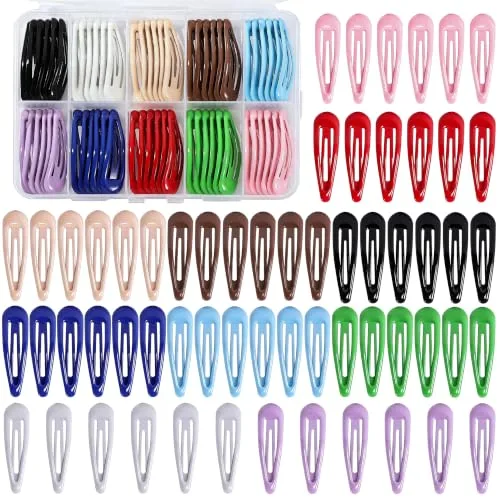
FLOYEUML 60 Pcs Metal Snap Hair Clips with Storage Box
The plain painted-metal baseline: 60 clips for under five dollars. Useful in this comparison as the reference point for what uncoated metal costs and how it behaves.
We tested dozens of claw clips to find the very best options. Below you'll find our complete ranking, with detailed reviews and real customer feedback for each pick.
The Complete Ranking
The plain painted-metal baseline: 60 clips for under five dollars. Useful in this comparison as the reference point for what uncoated metal costs and how it behaves.
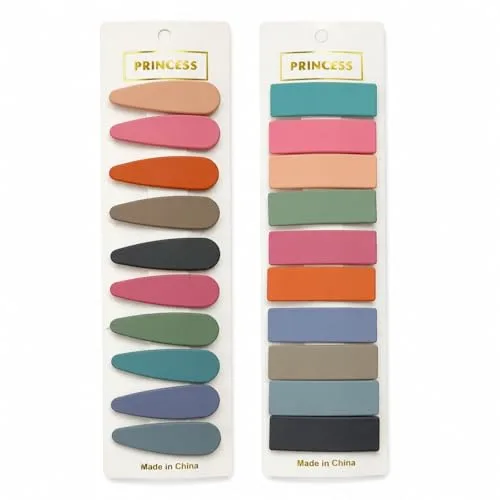
A matte-coated metal clip. The coating is the variable that matters here - it sits between the metal edge and the hair shaft, and the maker specifically markets it as no-crease.
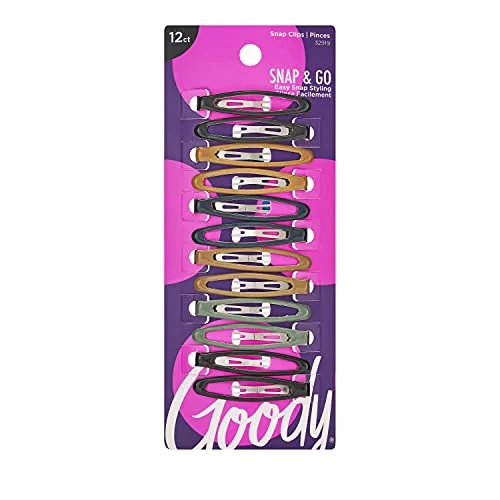
Epoxy coating over a metal contour body - the middle ground between bare metal and a plastic shell, from the brand most people already own.
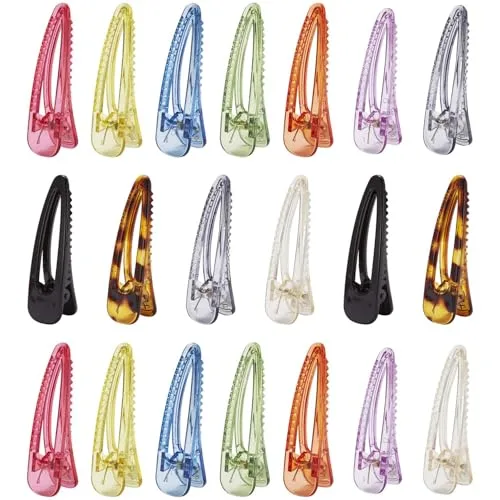
The acrylic-bodied counterpoint: a resin triangle on an alloy spring with a duckbill mechanism. Larger and more decorative than any metal snap clip in this comparison.
Quick Comparison
A side-by-side look at our top picks
Frequently Asked Questions
Are metal snap clips bad for your hair?
Do plastic snap clips hold as well as metal ones?
Which lasts longer, a metal snap clip or an acrylic one?

Donna Miller
Enjoyed This Guide?
Get more hair tips and product recommendations delivered weekly.