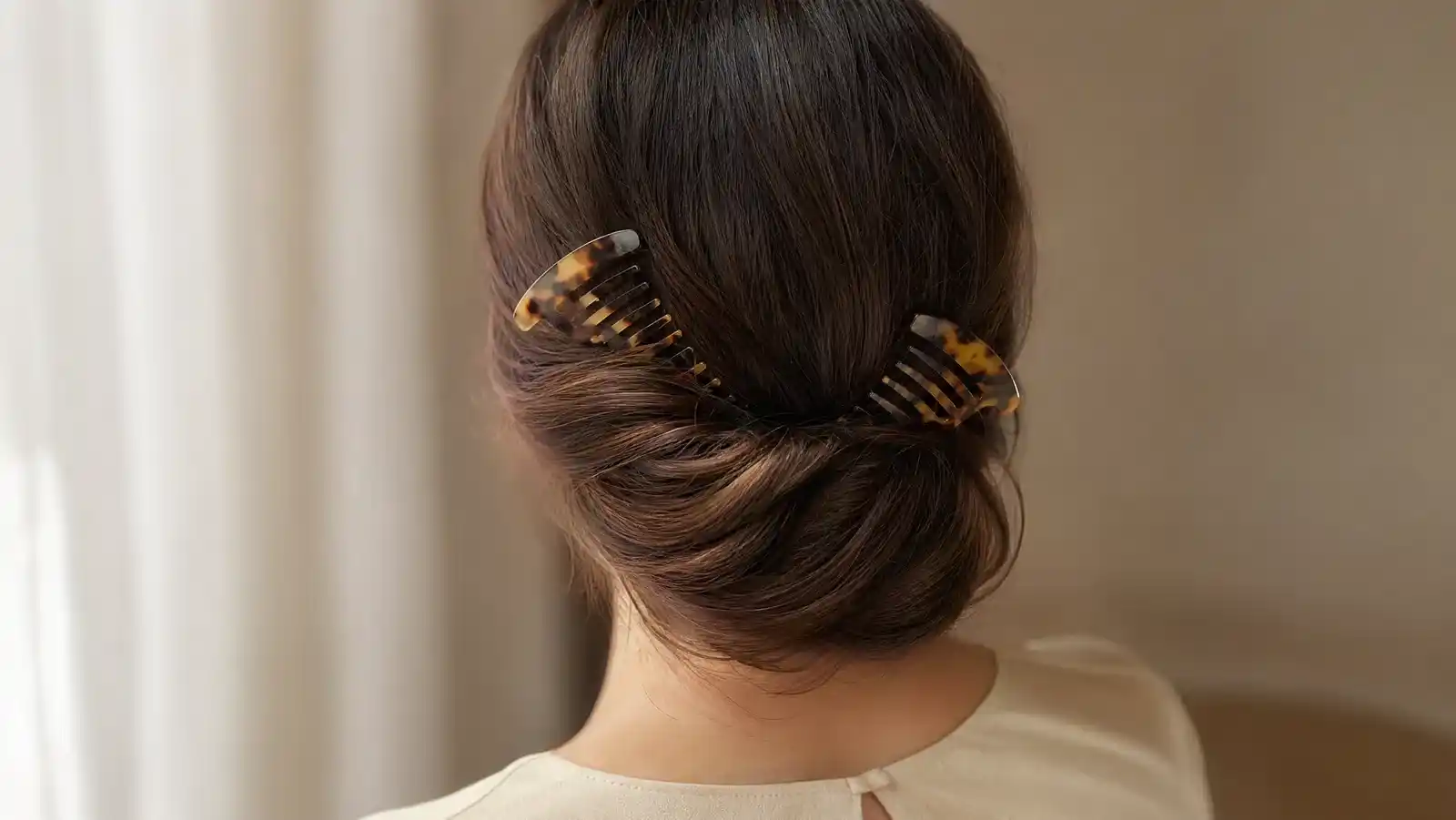
- How to Style Hair With Hair Combs: Three Rules First
- 1. The One-Comb Half-Up
- 2. The Classic French Twist With a Single Large Comb
- 3. The Twin-Comb Chignon
- 4. The Low Bun With a Comb Worn Upside Down
- 5. The Side-Swept Comb Over a Loose Knot
- 6. The Double-Comb Crown Braid Finish
- 7. The Comb-Anchored Ponytail
- 8. The Statement Comb on a Wet-Set Evening Wave
- Matching Decorative Hair Combs to Updos and Buns
- Comfort, Tension and How Long to Wear It
- Which One to Try Tonight
Decorative hair comb hairstyles all work on one principle: the comb is rotated upright so its spine levers against the hair, rather than pushed straight in flat. Get that rotation right and eight different updos open up, from a two-minute half-up to a full French twist that lasts a dinner. Below is each one, the number of combs it needs, and the single detail that keeps it up.
Some links below are affiliate links, which means we may earn a commission at no cost to you.
What follows is built on listed dimensions, materials and tooth counts, plus the geometry that applies to any comb. If the insert-push-rotate motion itself is new to you, start with our walkthrough on how to use a decorative hair comb and the wider mechanics in our guide to decorative hair combs. This article is what to build once your hands know the motion.
How to Style Hair With Hair Combs: Three Rules First
Every style below assumes three things; almost every collapse traces back to one.
- Teeth toward the scalp, spine rotated upright. Enter at a shallow angle, slide along the scalp, then lift the spine until the comb lies flush. Flat means ornament; upright means lever.
- Set the comb against the direction the twist wants to unwind. A roll of hair is a spring under tension that wants to open one specific way. A comb driven into the fold against that direction holds; the same comb driven in with it tends to work loose.
- Match the comb's span to the section. This is the failure almost nobody diagnoses: a comb too short closes on the outer half and lets the core slip. A whole twist wants roughly 4 inches of span, not 1.5.
A fourth rule covers the ornamental pieces. One Victoria and Albert Museum record for a 19th-century comb notes that this type was meant to be used as a decorative hair ornament rather than as something with which to actually comb the hair. Thin, high-backed statement combs are still decoration pushed into a style something else holds.
1. The One-Comb Half-Up
Combs: one. Difficulty: easy. The top section swept back and secured at the occipital bone, with the length left down.
- Part off the hair above a line running from temple to temple, over the top of the ears.
- Sweep it straight back and hold it where you want it to sit, a little higher than feels natural.
- Insert the comb from underneath the section, teeth pointing up toward the crown.
- Push half an inch along the scalp, then rotate the spine down and flush.
The hold point: insert from below, not above. Gravity then loads the comb into the section rather than out of it, and the loose length falls over the spine and hides it. It is also the one style where a 4-inch comb carries only half the mass.
2. The Classic French Twist With a Single Large Comb
Combs: one large. Difficulty: moderate. The vertical roll up the back of the head, closed by one comb along the seam.
- Gather all the hair at the nape as if starting a low ponytail, unfastened.
- Twist the tail clockwise until the whole length tightens into a rope, then fold it upward against the head.
- Tuck the loose ends down into the top of the roll.
- Insert the comb into the seam where the roll meets the scalp, teeth angled into the roll, then rotate upright.
The hold point: which side of the seam you enter. The roll wants to unwind anticlockwise, so the comb goes in resisting that, with the teeth catching both the scalp hair and the outer wall of the twist. A comb that only picks up one of the two is holding nothing. This is the style that most needs a long comb: the Grip-Tuth Frenchy measures 4 inches by 1.5 inches and its teeth touch rather than sitting spaced, so hair locks above them. Our french twist with a claw clip tutorial builds the same roll with a hinge instead; the comb version sits flatter under a collar.
3. The Twin-Comb Chignon
Combs: two, mirrored. Difficulty: moderate. A low coiled bun at the nape with a comb on each side, teeth meeting under the coil.
- Make a low ponytail at the nape, coil the tail around its own base, and pin the coil at three points.
- Insert the first comb from the left, teeth travelling right, into the join between the coil and the scalp.
- Rotate it upright so the spine lies along the lower edge of the bun.
- Repeat from the right; the two combs should nearly meet under the coil's centre.
The hold point: the two combs oppose each other, so each one's teeth are held down by the other's pull. That is why a mirrored pair outlasts two combs set the same way. The name describes the placement: Wikipedia's entry on the chignon notes the term comes from the French for a bun and usually abbreviates chignon du cou, a low bun at the nape. For the same shape on a single long pin, see how to do a chignon with a French hair pin.
4. The Low Bun With a Comb Worn Upside Down
Combs: one. Difficulty: easy. A plain low bun with a comb pushed up into it from below, spine down, so the decorative edge reads as a base.
- Build any low bun and secure it loosely with two pins.
- Turn the comb so the spine points down at the floor and the teeth point up into the underside of the bun.
- Push the teeth up into the bun's base, through the elastic if there is one.
- Rotate until the spine sits flat against the nape.
The hold point: the bun's weight sits on top of the teeth. Worn this way, the whole mass presses the comb closed instead of levering it open, which is the opposite of what happens when you set a comb spine-up over a heavy bun.
5. The Side-Swept Comb Over a Loose Knot
Combs: one. Difficulty: easy. Hair swept hard to one side, knotted once behind the opposite ear, with the comb crossing the sweep diagonally.
- Part deep on one side and brush everything across to the other.
- Tie the length in a single loose knot behind the far ear and tuck the tail under.
- Insert the comb on the sparse side, where the hair is travelling across and already under tension.
- Drive the teeth across the direction of the sweep, not along it, then rotate.
The hold point: the comb has to cross the grain. Teeth running parallel to the sweep slide along it like a rail; angled across it, each tooth is a small stop. A smaller comb suits this, which makes it a sensible use for the 7-tooth MEZYKAP crescents rather than a wide twist comb.
6. The Double-Comb Crown Braid Finish
Combs: two. Difficulty: moderate. A braid taken across the crown or around the head, with its tail ends hidden under combs at each temple.
- Braid a section from one temple back along the hairline, keeping it close to the scalp.
- Carry it across the crown and tuck the end under the hair above the opposite ear.
- Pin the tucked end, then set a comb over the pin, teeth pointing back and slightly down.
- Mirror with a second comb on the first temple so the pair frames the face.
The hold point: the combs hide pins, they do not replace them. A finished braid end is a closed bundle with nothing for teeth to bite into, so pin first and decorate second. Combs have done this job for centuries: according to the Pitt Rivers Museum, ornamental combs with long teeth and decorative headings designed to project above the coiffure developed rapidly in the 18th century and became an essential costume accessory for well-to-do women.
7. The Comb-Anchored Ponytail
Combs: one. Difficulty: easy. A mid or high ponytail where a comb sits over the elastic, hiding it and taking some of the load.
- Build the ponytail and fasten it with a thin elastic.
- Lift the tail forward out of the way.
- Insert the comb into the scalp hair just below the elastic, teeth pointing up toward it.
- Rotate upright so the spine covers the elastic band, then let the tail fall back over it.
The hold point: the comb carries scalp hair, not tail hair. Its teeth grip underneath the elastic, taking tension off the band and slowing the usual creep of a heavy ponytail, which means you can run the elastic a wrap looser.
8. The Statement Comb on a Wet-Set Evening Wave
Combs: one decorative. Difficulty: formal. A soft wave set the night before, pinned low on one side, with a wide decorative comb at the join.
- Set damp hair in large pin curls or two-inch rollers and let it dry completely.
- Brush the set out into one continuous wave and sweep it to one side.
- Pin the sweep behind the ear with two crossed grips.
- Set the decorative comb over the pins, teeth into the scalp hair, and rotate until flush.
The hold point: the set, not the comb. A paper in the Journal of Cosmetic Science describes wet setting as applying the setting strain while the fibre is wet, which assists the rapid breakdown of the weak interactions holding its current shape, so hair dried in position largely keeps it. Cosmetic chemist Michelle Wong's explainer on hair, water and hydrogen bonds covers the flip side: water from humid air replaces those bonds and relaxes the set. On a wet night the comb will still be there, the wave may not. Our roundup of bridal hair combs covers the heavier ornamental pieces built for this placement.
Matching Decorative Hair Combs to Updos and Buns
The four picks here are not a ranking. They are four spans and three materials, and the style decides which you want.
- Most updos, and anything mirrored: the MEZYKAP four-pack, about $8.99 as of November 2026. Four curved resin combs, 7 teeth each, two black and two brown. Few teeth rotate cleanly, the curve lets the spine sit flush, and four combs gives you the two matched pairs styles 3 and 6 need. MEZYKAP states they keep a hairstyle in place without unnecessary pulling or bulky weight and lists them as suitable for fine through thick hair; both are brand claims, not measurements.
- A twist that has slipped out of everything else: the Grip-Tuth Frenchy, about $9.99 as of November 2026 for a single comb. Its listing gives the tooth count as 21 or 22 across a 4-inch by 1.5-inch frame, and the teeth touch instead of sitting spaced, so hair locks above them rather than escaping between them. Good Hair Days states the teeth work like a flexible spring to prevent strands from slipping. The design is old: according to a brand history published by Vintage Hairstyling, Lester Thorndike Sawyer designed the original gripping teeth in the 1920s, with the first patent filed in 1926 and granted in 1928; the same post says the original designs and moulds are now held by Rosemary Pepin at Good Hair Days, Inc., the company she started in 1996, and that the comb is still made in the United States from that original patent design. Sold singly, so a mirrored style needs two.
- The best-looking option in a photograph: the Camila Paris AD66 four-pack, about $17.99 as of November 2026, roughly $4.50 a comb. Four 4-inch cellulose acetate combs, 23 teeth, curved frame, made in France, with a drawstring bag. Acetate is a material difference rather than a finish: Formerra describes cellulose acetate as a semi-synthetic thermoplastic derived from the cellulose in wood pulp and cotton fibres, and notes plasticiser typically makes up 15 to 35 percent by weight and drives final properties more than grade does, with elongation at break from 5 to 50 percent depending on that loading. On a comb this wide, flex before fracture is what matters.
- Tortoise print, with a caveat worth reading: the KAICCOSO four-pack, about $8.93 as of November 2026. Four 4-inch acetate combs, interlocking teeth, curved base. The maker says in its own listing that on thick or long hair the comb may not hold all your hair and suggests a half bun instead, so treat it as a fine-to-medium comb and use it for styles 1 and 5, not a full twist. On the print, Cooper Hewitt notes that the success of celluloid and 20th-century plastics that simulate tortoiseshell is fortunate, since hawksbill turtles are now critically endangered.
If you are hunting decorative silver hair combs for updos, none of these four are metal, and we would not drop a thin filigree metal comb into styles 2, 3 or 4 without pinning first. Our breakdown of the types of decorative hair combs explained sorts structural shapes from decorative ones, and for finer hair the span and tooth-count trade-offs differ enough that we covered them in best decorative hair combs for fine hair.
Comfort, Tension and How Long to Wear It
An updo that holds all evening and an updo that hurts are often the same updo.
A comb spreads its load across several teeth rather than one clamping point, which is a reasonable comfort argument but not a free pass. The American Academy of Dermatology lists tightly pulled buns, ponytails and updos among the styles that can cause traction alopecia, and gives a simple rule: if your hairstyle feels painful, the style is too tight. It names pain, stinging and crusts on the scalp as signs to change a style immediately, advises against frequently wearing styles that pull, and notes traction alopecia can become permanent the longer it goes untreated. A review in PMC adds that recurrent use of hair rollers, hair clips and other accessories may also contribute.
Two practical rules follow. Reposition rather than tighten: if a comb slips, move it to where the hair is denser instead of forcing it, which is the same logic as our notes on how to position hair clips to avoid headaches. And rotate your styles, so the same stretch of hairline is not carrying tension every day.
Which One to Try Tonight
Start with style 1 or style 4. Both need one comb, both forgive a bad insertion angle, and both teach you what a properly rotated comb feels like when it seats. Save style 2, the full French twist, for a weekend rather than ten minutes before you leave; it will also tell you immediately whether the comb in your drawer is long enough.
Two combs and a few pins cover every style here. For the mechanics rather than the recipes, our full guide to styling with decorative hair combs goes deeper on tooth count, materials and placement.
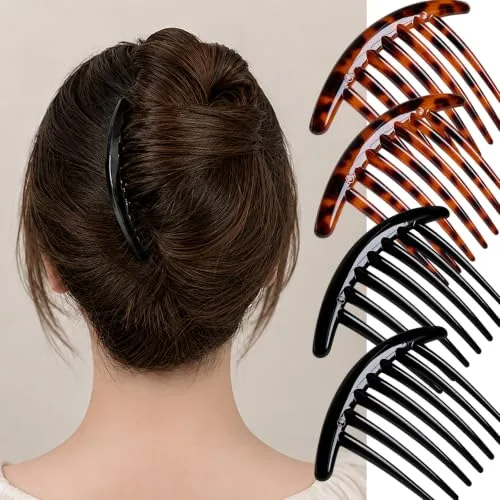
MEZYKAP French Twist Crescent Hair Comb Set, 4 Pack (2 Black, 2 Brown)
Four curved 7-tooth resin combs in black and brown. The crescent profile is the shape you want for a French twist or a low chignon: few enough teeth to rotate cleanly, curved enough to sit flush once it does.
We tested dozens of claw clips to find the very best options. Below you'll find our complete ranking, with detailed reviews and real customer feedback for each pick.
The Complete Ranking
Four curved 7-tooth resin combs in black and brown. The crescent profile is the shape you want for a French twist or a low chignon: few enough teeth to rotate cleanly, curved enough to sit flush once it does. Having four means you can leave one in a travel bag and still have a matched pair at home.
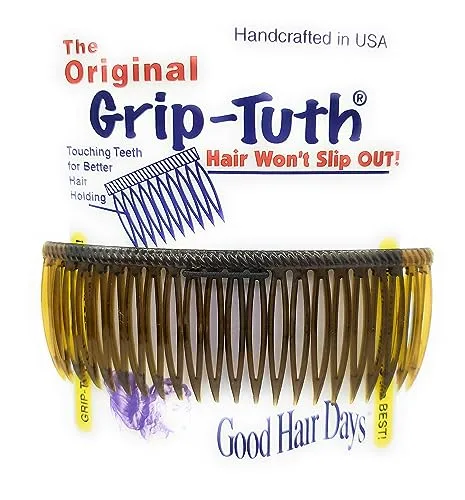
One 4-inch by 1.5-inch comb with 21 or 22 teeth that touch each other rather than sitting spaced apart, which is the whole mechanism — hair locks above the teeth instead of escaping between them. This is the one to reach for when a twist has slipped out of everything else. Made in the USA; sold singly, so buy two if you want a symmetrical style.
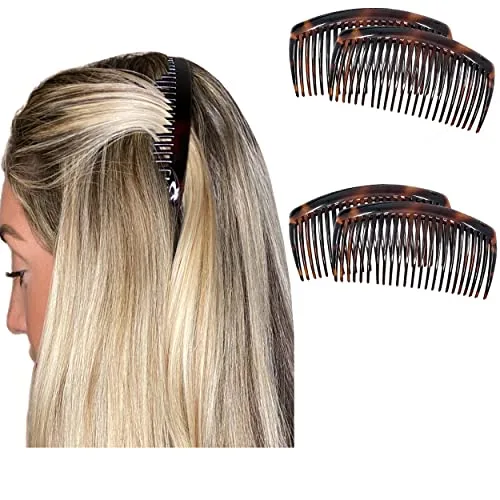
Four 4-inch cellulose acetate combs with 23 teeth, made in France. Acetate is the material upgrade over moulded plastic here — it has a glossier finish and more flex before it snaps, which matters on a comb this wide. The most expensive pick in this set at roughly four dollars a comb, and the one that looks least like a drugstore accessory in a photograph.
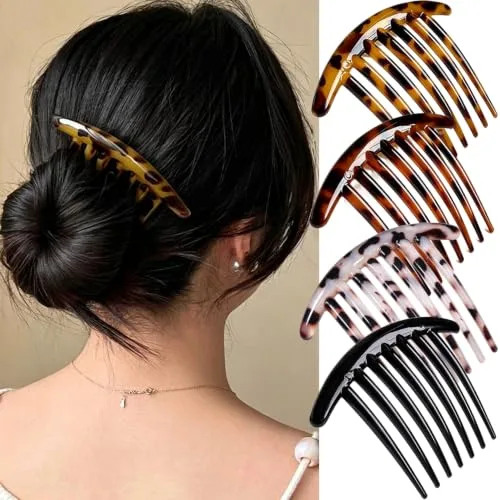
Four 4-inch acetate combs in a leopard-tortoise print, with interlocking teeth. Worth noting the maker is unusually candid in its own listing: it says that on thick or long hair this comb may not hold everything and is better used for a half-up. Read that as a sizing warning rather than a flaw — on fine to medium hair it closes fully, and the print hides regrowth lines better than a solid colour.
Quick Comparison
A side-by-side look at our top picks
Frequently Asked Questions
How many hair combs do I need for an updo?
Will a decorative hair comb hold thick or long hair in an updo?
How do I keep an updo from falling out all evening?

Donna Miller
Enjoyed This Guide?
Get more hair tips and product recommendations delivered weekly.