- What size comb does fine hair actually need?
- Why your comb keeps sliding out of thin hair
- Small versus large side combs for fine hair: the sizes to skip
- Best Overall for Fine Hair: Grip-Tuth Shorty Tuck Combs
- Best Tooth Density: TaShow 24 Teeth Side Combs for Fine Thin Hair
- Best Budget Set: Psiriol French Side Combs
- Best for Side-Swept Styles: Grip-Tuth 1.5-Inch Tuck Combs
- Best Size Sampler: Chuangdi Side Combs, 24 Pack in Three Sizes
- Resin, plastic and acetate on fine hair
- What we would buy
Our pick for fine hair is the Good Hair Days Grip-Tuth Shorty Tuck Combs: two mini combs, each 1 3/4 inches of actual width with 13 or 14 teeth packed into it, about $7.99 as of November 2026. Fine hair does not need a bigger comb. It needs more teeth across a shorter span, and roughly 2.75 inches of span is the ceiling we would shop to.
Some links below are affiliate links, which means we may earn a commission at no cost to you.
That sizing rule is the whole article, and it runs against the way these things are sold. Shopping for decorative hair combs for fine hair means reading two specs before you look at the finish: span and tooth count. The decorative combs that photograph best are four and five inches wide with teeth set well apart, and on fine hair those are the ones that gap at the ends, walk themselves loose over an afternoon and leave a visible ridge where the spine sits. If you want the format-by-format background before you shop, start with our guide to choosing decorative hair combs. If your problem is the opposite one, the same logic inverts in best decorative hair combs for thick hair.
What size comb does fine hair actually need?
Two numbers decide whether a comb holds: total span and teeth per inch. Span is how wide a section the comb can cross. Teeth per inch is how many points of contact share the work across that section. Fine hair gives you less material to grip, so you want the second number high and the first number low.
Run the arithmetic on the picks below and the gap is not subtle:
- Grip-Tuth Shorty, 1 3/4 inches, 13 or 14 teeth: roughly 7.4 to 8 teeth per inch.
- Psiriol French side comb, 2.76 inches, 14 teeth: roughly 5.1 teeth per inch.
- Grip-Tuth 1.5-inch tuck comb, 7 or 8 teeth: roughly 4.7 to 5.3 teeth per inch.
- A typical 4-inch statement comb with 23 teeth: roughly 5.75 teeth per inch.
The mini comb has roughly 30 to 40 percent more contact points per inch of hair than the big one, in a package less than half the width. And a 1 3/4-inch band of scalp is not a trivial amount of hair to anchor. A long-cited figure recorded in Harvard's BioNumbers database puts a normal healthy scalp at about 223 terminal hairs per square centimetre, inside a range of 175 to 300, so even a mini comb is crossing hundreds of strands.
The second half of the rule is leverage. A comb in your hair is a lever: the teeth are the fulcrum and everything above them is load. A long comb has a long unsupported stretch of spine, and every head turn, car headrest and coat collar works that stretch outward a fraction of an inch. A short comb barely has the geometry to walk itself out.
That is why we shop small hair combs for fine hair rather than statement pieces: the small ones are where the density lives.
Our rule, written down: on fine or thin hair, stay at or under about 2.75 inches of span, and prefer teeth that touch or nearly touch over teeth you can see daylight between.
Why your comb keeps sliding out of thin hair
Three causes, roughly in order of how often we think they apply.
One: too much comb for the hair. The teeth run out of section before they run out of comb, so the outer third of the comb is holding nothing and levering against the part that is.
Two: it was pushed in, not rotated. A comb that went straight into the hair is resting there. The motion that actually holds is insert, push under the section, then rotate the spine upright so the teeth press hair toward the scalp. We walk through it in how to use a decorative hair comb.
Three: the hair is too slippery to grip. Freshly washed and conditioned fine hair gives teeth very little to bite. Many wearers find day-two hair, or a light texture spray at the roots, holds an accessory noticeably better.
What we would not do is force the issue. Research summarised in the Journal of Cosmetic Science attributes breakage during grooming mainly to tangling, looping, knotting and impact loading, and notes that impact loading breaks hair at lower loads than steady tensile pulling. The same body of work reports that combing hair wet rather than dry increases the share of breaks that happen further up the fibre instead of at the ends. Translated to a comb in your hand: brush the section smooth first, insert slowly, and never jab a comb through a knot or into soaking hair.
Small versus large side combs for fine hair: the sizes to skip
A large statement comb on fine hair fails in two visible ways. It creates a bulge, because the spine is sitting on top of a thin section rather than inside a thick one. And it concentrates the whole load of the style on a narrow band of scalp instead of spreading it, which is the opposite of what you want from an accessory you plan to wear for hours.
We would skip, on fine hair:
- Anything much over 3 inches of span. The ends gap, and gapping is where sliding starts.
- Widely spaced teeth. Metal filigree and carved statement combs look wonderful and hold almost nothing on fine hair.
- Heavy ornament set high above the teeth. Mass at the top of a lever is load trying to rotate the comb out.
- Rigid, perfectly flat spines. A slight curve follows the head; a flat bar tents away from it.
If you are not sure what you are looking at, our breakdown of types of decorative hair combs explained sorts the formats by what they can structurally hold.
There is also a tension question worth taking seriously, without over-reading it. A lighter accessory worn in varied positions is the sensible default. The American Academy of Dermatology advises switching hairstyles regularly so hair can recover from tight styles, keeping tight styles to short periods, removing any style that hurts or irritates the scalp, and checking monthly for broken hairs at the forehead or a receding hairline. It also says the best way to halt this kind of loss is to see a board-certified dermatologist early, since traction alopecia can become permanent the longer it goes untreated. We go further into the risk, and what it is not, in traction alopecia from hair accessories.
Best Overall for Fine Hair: Grip-Tuth Shorty Tuck Combs
This is the tooth-density argument made physical. Two mini combs, each 1 3/4 inches of actual width by 1 inch deep, with 13 or 14 teeth in that span. Nothing else here puts that many contact points into that little comb, and the short span gives it almost no leverage to lever itself out of a thin section.
The crystal colourway is clear, so it reads as structure rather than ornament and effectively disappears on blonde, grey and lighter brown hair. The body is durable plastic and the combs are made in the USA. Good Hair Days says the design holds hair securely and comfortably; what we can verify from the listing is the geometry, and the geometry is right for fine hair.
Two mini combs for about $7.99 as of November 2026 also means you can run them as a pair, one on each side of a half-up, which spreads the load over two small anchors instead of one big one.
Check the Grip-Tuth Shorty on Amazon
Best Tooth Density: TaShow 24 Teeth Side Combs for Fine Thin Hair
Twenty-four curved plastic combs at 2.76 by 1.77 inches each, in black, transparent and light coffee, for about $8.99 as of November 2026.
One honest caveat on the headline number. The listing contradicts itself on tooth count — the product title says 24 teeth, a later bullet says 14 — so we treat the count as unconfirmed and would not quote you a figure. The span is confirmed, and the span is the number that matters more: 2.76 inches is a common size for small and mid-size French side combs, long enough to hold a half-up or a swept side, short enough not to gap on a fine section.
TaShow states the combs will not pull or damage hair and will hold it firmly and comfortably; those are the brand's claims, not findings of ours. Buy this one for the quantity. Twenty-four combs across three colours is enough to keep a pair in a bag, a pair in a desk and a pair in the car, which is how these actually get worn.
Check the TaShow side combs on Amazon
Best Budget Set: Psiriol French Side Combs
Eight resin combs at 2.76 by 1.77 inches with 14 fine teeth, two each in black, dark brown, light brown and clear, for about $5.39 as of November 2026. That works out to roughly 67 cents a comb.
At that price this is the cheapest way to answer the two questions you cannot answer from a product page: which colour vanishes in your hair, and whether the 2.76-inch span suits your section or is already too long for it. Fourteen teeth across that span is about 5.1 per inch, which is middling density; it is the colour range and the per-comb cost that earn this a spot.
Psiriol says the combs grip all hair types, whether fine, thick, straight or curly, and are comfortable to wear all day without pulling. Treat both as marketing. What is useful is the material note: these are thin resin pieces rather than thick cut acetate, so there is very little mass sitting above the teeth.
Check the Psiriol 8-pack on Amazon
Best for Side-Swept Styles: Grip-Tuth 1.5-Inch Tuck Combs
Two clear combs, 1 1/2 inches in width and length, with 7 or 8 teeth each whose tips touch for a spring action, handcrafted in the USA. About $8.99 as of November 2026, down from a $9.99 list price.
These are smaller and sparser than the Shorty above and they are for a different job. Good Hair Days positions them for securing side-swept hair, adding volume anywhere and holding short, layered ends, and says they grip all hair types, especially fine and hard to manage hair. We would read that positioning as the honest description of the format: this is a comb for one small section, not a comb to anchor a whole half-up.
It happens to be the fine-hair problem a big comb cannot solve. Short layers and grown-out fringe pieces are too little hair to fill a 4-inch span, which is exactly when a 1.5-inch comb with touching teeth is the right tool. If you need the same job done invisibly, best barrettes for fine hair covers the flat-clip alternative.
Check the 1.5-inch Grip-Tuth on Amazon
Best Size Sampler: Chuangdi Side Combs, 24 Pack in Three Sizes
Twenty-four curved plastic combs across three tooth counts — 9, 11 and 23 — in dark brown, light brown, transparent and black, for about $8.99 as of November 2026.
This is the diagnostic buy. Everything above argues that density and span decide the outcome, and this set is the cheap experiment that tells you where your own hair sits: a sparse 9-tooth comb, a middling 11 or the dense 23. If your fine hair is also fairly dense overall, the 23-tooth size is likely your answer; if it is fine and sparse, the 9 may hold more comfortably than you expect.
One caveat to honour, because it is the maker's own: Chuangdi notes that plastic combs can carry minor burrs or sharp edges and advises inspecting them. Run a finger along every tooth before the first wear and set aside any that catch. The brand also claims the combs will not damage hair and are strong and not easy to break, which is a claim, not a tested result.
Check the Chuangdi sampler on Amazon
Resin, plastic and acetate on fine hair
None of these five are cut acetate, and for fine hair that is not much of a loss. Thick acetate is prized for the way it takes colour and polish, and it is reasonably durable: MC Davidian, a French maker of acetate hair accessories, describes it as a refined, durable and comfortable medium that keeps its elegance for years when properly cared for, and says it can be repaired more easily than lower-grade materials. That same maker's care guidance is worth reading as a limit rather than a boast — it warns that hot water can warp acetate and that acetone-based products can damage or dissolve it. And acetate pieces tend to be thicker through the spine, and thickness is mass above the teeth.
We cannot tell you a density figure comparing resin, plastic and acetate, because manufacturers do not publish one. What you can judge in your hand is thickness and flex: a thin spine with a slight curve to it will sit closer to the scalp on a fine section than a thick, flat one.
Small side combs are also an old format rather than a new one. The Victoria and Albert Museum dates a set of two tortoiseshell combs with a matching case in its collection to 1673, and places it within a group of tortoiseshell objects it says were made in Jamaica between 1671 and 1690 — a reminder that the paired-set approach we are recommending here is centuries older than the plastic.
What we would buy
Start with the Grip-Tuth Shorty if you want the single best-matched geometry for fine hair, and wear the two combs as a pair. Buy the Chuangdi sampler instead if you genuinely do not know yet whether your hair wants sparse or dense teeth, then buy the size that wins in quantity. The Psiriol 8-pack is the colour-matching experiment for under six dollars, the TaShow 24-pack is the restock, and the 1.5-inch Grip-Tuth is for layers and swept pieces nothing else will hold.
The rule to carry into any other listing: span at or under about 2.75 inches, teeth as close to touching as you can get, and as little weight as possible above the teeth. If a comb still will not hold, the answer is a different format rather than a tighter style — best French hair pins for fine hair covers the two-pronged option that works by friction instead of clamping. And for the wider background on formats, materials and sizing, see our decorative hair comb guide.
Sources: American Academy of Dermatology on hairstyles that pull, BioNumbers on terminal hair density, Journal of Cosmetic Science on hair breakage during combing and brushing, Robbins, Hair breakage during combing IV (J. Cosmet. Sci.), MC Davidian on cellulose acetate, Victoria and Albert Museum on tortoiseshell combs from Jamaica.
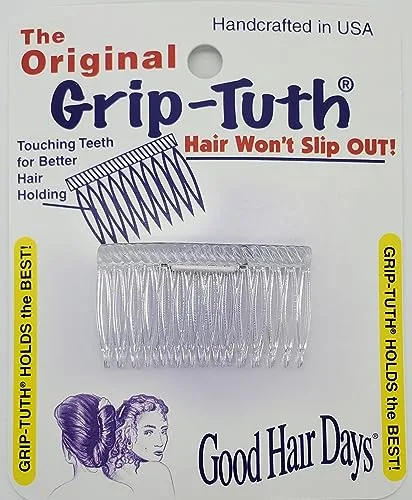
Good Hair Days Grip-Tuth Shorty Tuck Combs, 2 Pack (Mini 1 3/4" x 1", Crystal)
Two mini combs, each 1 3/4 inches of actual width with 13 or 14 teeth packed into it. That tooth density across a short span is exactly the geometry fine hair needs: more points of contact per inch, and no long unsupported stretch of comb to lever itself out.
We tested dozens of claw clips to find the very best options. Below you'll find our complete ranking, with detailed reviews and real customer feedback for each pick.
The Complete Ranking
Two mini combs, each 1 3/4 inches of actual width with 13 or 14 teeth packed into it. That tooth density across a short span is exactly the geometry fine hair needs: more points of contact per inch, and no long unsupported stretch of comb to lever itself out. The crystal colourway disappears on lighter hair. Made in the USA.
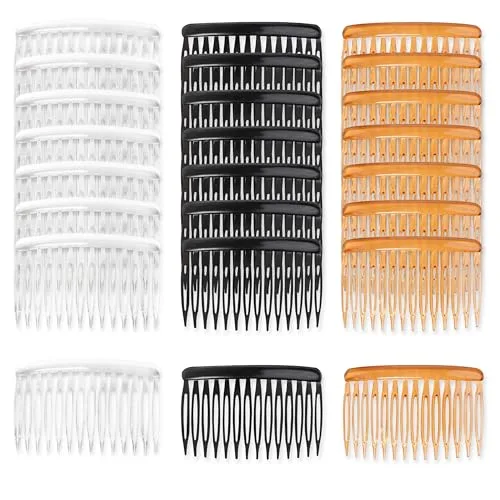
TaShow 24 Teeth Hair Side Combs for Fine Thin Hair, 24 Pack (Black, Transparent, Light Coffee)
Twenty-four combs at 2.76 by 1.77 inches each, in three colours. The listing is inconsistent about the tooth count — the title says 24 teeth and a later bullet says 14 — so treat the exact number as unconfirmed. What is confirmed is the span, and 2.76 inches is a sensible middle size for fine hair: long enough to hold a half-up, short enough not to gap. Buy this one for the quantity.
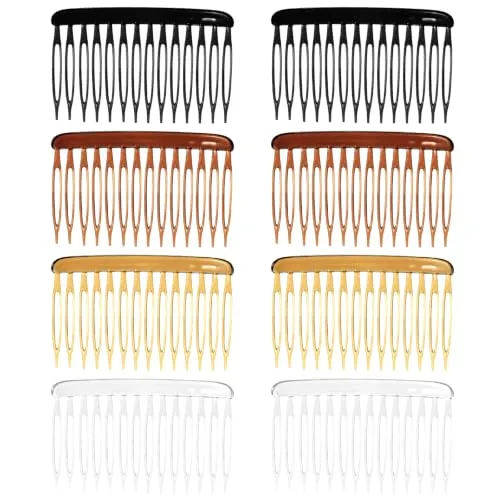
Eight resin combs at 2.76 by 1.77 inches with 14 teeth, in black, dark brown, light brown and clear — two of each. At roughly 67 cents a comb this is the cheapest way to find out which colour and span you actually reach for before spending more. The resin is lighter than acetate, which on fine hair is a genuine advantage rather than a compromise.
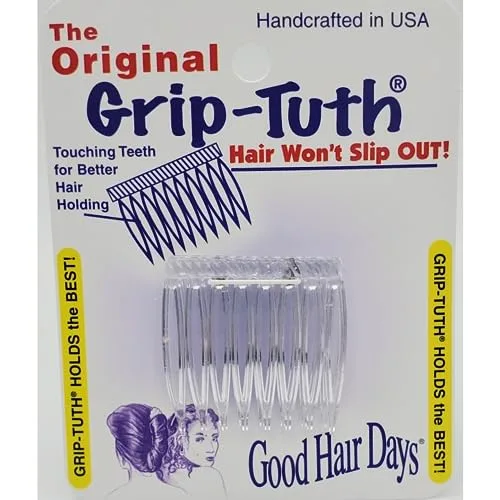
Two 1.5-inch combs with 7 or 8 teeth — smaller and sparser than the Shorty above, and meant for a different job. The maker positions these for securing side-swept hair, adding volume and holding short layered ends, which is the fine-hair problem a big comb cannot solve. Clear plastic, aimed at blonde, red or grey hair. Handcrafted in the USA.
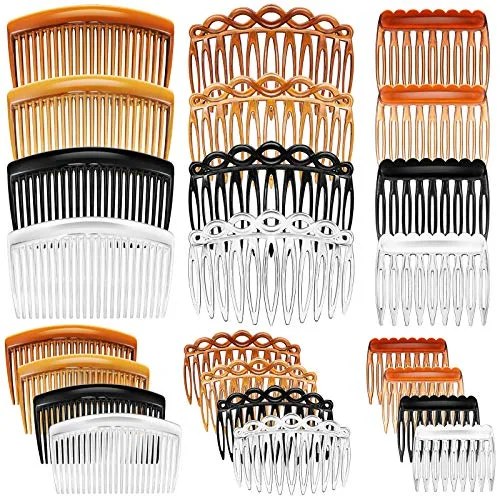
Twenty-four combs spanning three tooth counts — 9, 11 and 23 — in four colours. This is the diagnostic buy: if you do not yet know whether your hair wants a sparse 9-tooth or a dense 23-tooth comb, this set answers the question for under nine dollars. The maker notes plastic combs can have minor burrs, so run a finger along the teeth before the first wear.
Quick Comparison
A side-by-side look at our top picks
Frequently Asked Questions
What size decorative hair comb is best for fine hair?
Why does my hair comb keep falling out of thin hair?
Can I wear a decorative hair comb every day if my hair is fine?

Donna Miller
Enjoyed This Guide?
Get more hair tips and product recommendations delivered weekly.