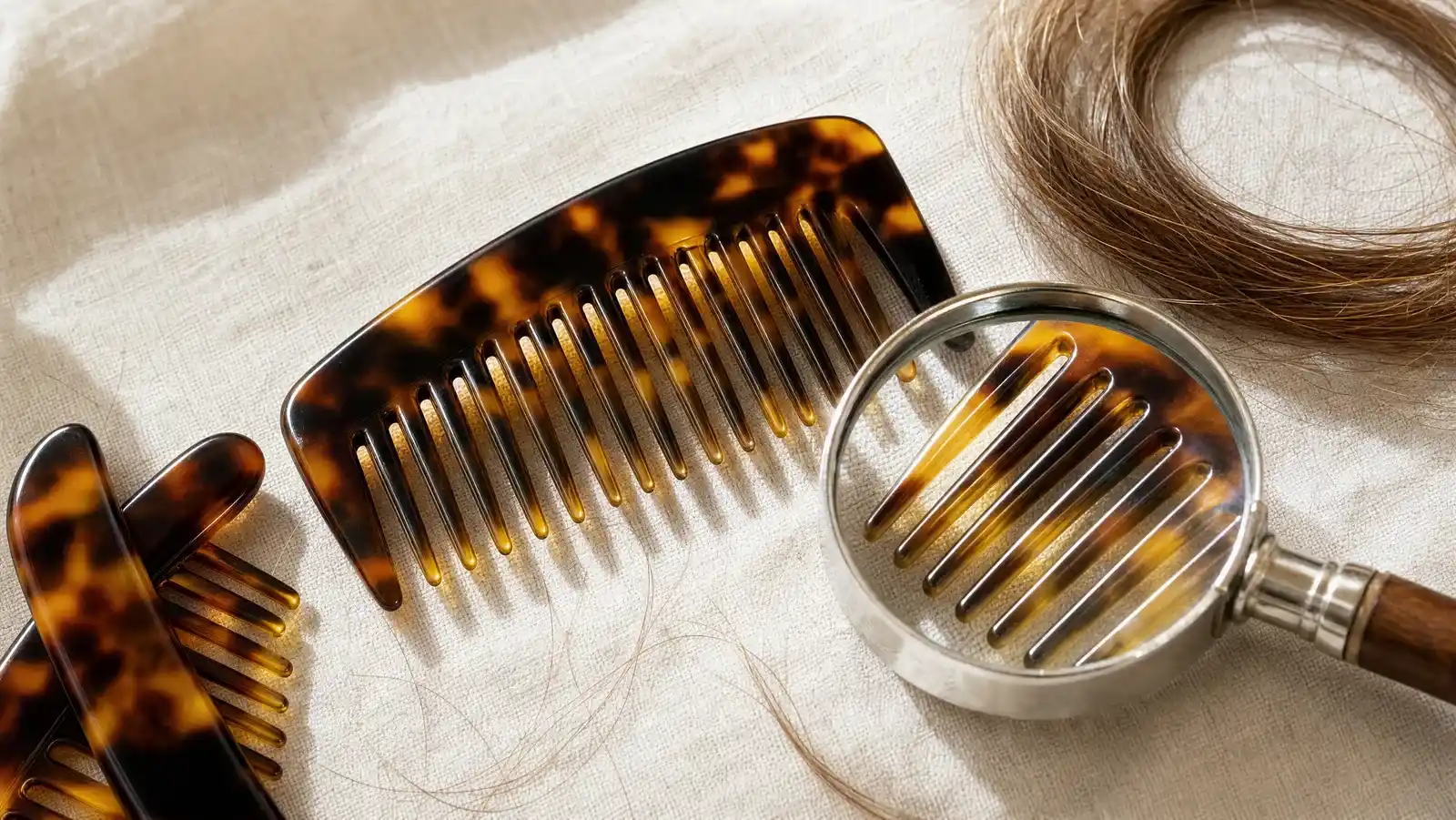
- Do Decorative Hair Combs Damage Hair? The Short Answer
- What Traction Alopecia Actually Is
- Why a Comb Spreads Load — And Why That Is Not a Safety Ranking
- Why Decorative Hair Combs Are Bad for Hair: The Three Real Mechanisms
- Does Wearing a Decorative Hair Comb Cause Hair Loss?
- Are Hair Combs Bad for Fine Hair?
- Which Decorative Hair Combs Are Safe? The Features That Matter
- Stop Wearing It If
- What We Would Actually Do
Do decorative hair combs damage hair? Worn correctly, they are unlikely to — the risk tracks tension and wear time, not the accessory category. A comb sitting loose for an evening is low-risk. A comb cranked tight into the same spot every day for months is not. The American Academy of Dermatology draws the line at pain.
Some links below are affiliate links, which means we may earn a commission at no cost to you.
What follows separates what dermatology sources actually say from what comb packaging says, and it is honest about where the evidence runs out. If the mechanics are new to you, read how decorative hair combs hold first and then come back, because most damage questions turn out to be grip questions in disguise.
Do Decorative Hair Combs Damage Hair? The Short Answer
The AAD's page on hairstyles that cause hair loss does not mention decorative combs at all. What it names are tightly pulled styles: cornrows, locs, tightly braided hair, buns, ponytails and up-dos that are tightly pulled, and hair extensions or weaves, especially on relaxed hair. The common factor is sustained pull, not the hardware doing it.
Its guidance is blunt, and it is the most useful sentence we have found on this subject. According to the American Academy of Dermatology, "If your hairstyle feels painful, the style is too tight." The same page says to change your hairstyle right away if you notice pain from tightly pulled hair, stinging on your scalp, crusts on your scalp, or tenting — sections of your scalp pulled up like a tent. It also tells you to check monthly for broken hairs around your forehead, a receding hairline, and patches of hair loss where your hair is pulled tightly.
A comb can produce every one of those conditions if you wear it tight enough for long enough. It can also produce none of them. That is the honest answer, and everything below is detail. For the long version of the condition itself, we have a separate explainer on traction alopecia and hair accessories.
What Traction Alopecia Actually Is
Traction alopecia is hair loss caused by pulling. According to a 2018 review in Clinical, Cosmetic and Investigational Dermatology by Billero and Miteva, it comes from "the exertion of excessive pulling forces, leading to mechanical damage of the hair follicles", that damage "induces an inflammatory response", and "chronic and repeated traction causes repeated follicular damage and eventually hair loss".
Two details in that review matter for anyone choosing accessories. The first is dose: the authors write that "the extent of pulling and the duration of traction increase the risk". Tension and time again. The second is timing. The review states that most cases can be reversed if treatment happens "at an early stage of the disease", while in later stages the condition "may progress into an irreversible scarring alopecia if traumatic hairstyling continues".
Pain is a common early experience rather than a rare one. The same review reports that only 18.9% of patients with traction alopecia denied ever experiencing painful symptoms during or following hairdressing. If an accessory hurts, you are not being precious by taking it out.
Nobody can tell you how common this is among comb wearers. The review is explicit that "there is a paucity of data concerning the prevalence of traction alopecia among the general population".
Why a Comb Spreads Load — And Why That Is Not a Safety Ranking
Here is the mechanical argument, stated as mechanics and nothing more. A side comb with ten or fourteen teeth transfers its holding force through ten or fourteen contact points, each engaging a small bundle of hair. A single-point clamp concentrates the same holding job into one closing jaw. Spread one load across more contacts and the force per contact drops. That is geometry, and it is why some wearers report a comb feels milder.
What it is not is a dermatological finding. We searched for a source — an association, a journal, a clinical review — that ranks combs as gentler than clips, and we did not find one. The hairstyle risk tiers published by Haskin and Aguh in the Journal of the American Academy of Dermatology in 2016, a review of 19 studies, sort practices by how much they expose follicles to tension, weight, heat and hair-altering chemicals, and place low-tension styles such as loose buns and loose-hanging hair in the low-risk group. They sort styles, not accessories. No comb appears in any tier.
So treat "a comb spreads the load" as a reason a comb can be worn gently, not as permission to wear one tightly. The same logic runs in reverse for clips, and the test is identical for both: does it hurt, and how long has it been in. For the hands-on version of that test, we wrote up how to spot a damaging clip.
Why Decorative Hair Combs Are Bad for Hair: The Three Real Mechanisms
When a comb does cause trouble, it is almost always one of these three, and the first one dominates.
- Excess tension, which is nearly always self-inflicted. You insert the comb, it feels loose, so you push harder and rotate further to stop it moving. Now a section of hair is under load for the rest of the day. The real fix is grip, not force: dry or day-two hair, a proper rotation, and the right size comb. We covered the slipping problem people over-tighten to solve on its own page, because solving it removes most of the damage risk on this one.
- Snagging on rough or seamed teeth. A moulded accessory can carry a seam along the tooth, and a cheap finish can leave a burr at the tip. Those catch rather than slide, and friction is the mechanism. A 2025 study in Tribology in Industry by Dewri and Gnanamoorthy measured the steady-state coefficient of friction of human hair at 0.13 ± 0.02 dry and 0.25 ± 0.03 wet, and the authors note that with a higher friction coefficient, "the susceptibility of hair damage under wet conditions is high compared to dry conditions". The practical reading: do not drag a comb through wet hair, and do not keep using one you can feel catching. That paper also notes damage tends to be more severe in long hair, over 25 cm.
- Sleeping or exercising in a rigid comb. A 3-inch piece of acetate becomes a lever once your head weight or your stride is behind it, and you are asleep for the part where you would normally notice discomfort. The AAD page already lists styles that require rollers worn to bed among those that can cause hair loss, and names constant rubbing from a hat or head covering as a contributor. We take combs out before bed and before the gym. There is no upside to leaving one in.
Does Wearing a Decorative Hair Comb Cause Hair Loss?
Not on its own, and not from one evening. The mechanism above needs repetition and sustained tension to get anywhere. Where a comb becomes a genuine hair-loss risk is habit: the same placement, the same section, every day, pulled tight because it keeps slipping. That is a traction pattern, and the AAD's advice applies to it — rotate your hairstyles, give your hair breaks from styles that pull, and note that it says every once in a while it is okay to wear your hair tightly pulled back. Frequency is the thing it warns about.
So move the comb. A couple of centimetres of new placement each day costs you nothing and stops you loading one patch of hairline indefinitely.
Are Hair Combs Bad for Fine Hair?
In our experience, fine hair is where this goes wrong fastest, and for a mechanical reason rather than a fragility one. A small section of fine hair gives a comb less to bite on, the comb slides, and the instinctive response is to over-tighten — which is mechanism one above, arriving by the back door.
What works better is counter-intuitive: a slightly wider comb than you think you need, set in a bigger section of hair, and rotated properly instead of jammed. Width is a free margin of safety, because a comb that comfortably spans the section does not need to be over-rotated to stay put. If a 2.5-inch comb keeps sliding out of fine hair, the answer is usually more hair in it, not more force on it.
Which Decorative Hair Combs Are Safe? The Features That Matter
No comb is certified safe and we will not pretend otherwise. These are the three features we look for, and the four combs in our list that carry them.
- Polished, rounded teeth with no seam. Run a fingernail down a tooth from base to tip and you want continuous smoothness. The UKSKS French Twist Side Combs are a 4-pack of 2.56-inch cellulose acetate combs with a curved profile, and the maker states each tooth is polished round and smooth so it will not pull or break hair. That is a manufacturer claim rather than a test result, but at about $9.99 as of November 2026 it is at least the right claim to be making.
- Acetate or hand-finished edges. The Camila Paris CP2430/2 Interlocking French Side Combs are a 6-inch cellulose acetate pair made in France, about $16.99 as of November 2026, sold for long and thicker hair. Camila Paris claims they hold without tugging and that other materials carry small ridges on each tooth that can damage hair. We cannot verify that comparison and found no independent source for it, so take the construction as the selling point. The France Luxe Elysee Side Comb, about $32 as of November 2026, is cellulose acetate cut and polished by hand in France at roughly 3 inches wide with closely set teeth. It is the most finished edge in this set, and stock was down to six units when we checked.
- Enough width that you are not over-tightening. Buying too small is the common mistake. The PKRFCJ Retro French Side Combs are the smallest here at 2.55 by 2.16 inches, a 4-pack of acetate in amber and dark tortoiseshell at about $7.49 as of November 2026, with a curved tooth profile meant to sit close to the scalp. They suit small sections and short fringe pieces. They are the wrong tool for anchoring a heavy twist, and using them that way is how you end up over-rotating.
One technique note worth copying whatever you own: France Luxe instructs you to weave the teeth back and forth through a gathered bun or twist rather than driving the comb in with one straight push. Weaving distributes the hold across more hair. A straight push concentrates it.
Stop Wearing It If
Take the comb out, and leave it out until things settle, if any of the following appear. These are the AAD's warning signs, not ours.
- It hurts. Pain from tightly pulled hair is the first sign the AAD lists as a reason to change your hairstyle right away.
- Your scalp stings, or you can see crusts. Both are on the same AAD list.
- You see tenting — a section of scalp pulled up like a tent.
- You find broken hairs around your forehead, a receding hairline, or a patch of loss where the comb sits. The AAD names these as the early signs to check for every month.
None of this is a diagnosis and we are not qualified to offer one. If your hairline is changing, see a dermatologist rather than a comb review site, and bear in mind the 2018 review's point that early intervention is what makes reversal likely. Our explainer on what traction alopecia looks like in practice covers the signs in more detail.
What We Would Actually Do
Buy for finish first and width second, then manage wear time yourself. Our own routine is unglamorous: a polished acetate comb sized to the section, rotated in rather than forced, placement shifted slightly each day, out before bed and out before exercise. Of the four combs here, the 2.56-inch UKSKS 4-pack is the sensible place to start, because four combs at about $9.99 as of November 2026 lets you test placements before committing to a single hand-finished piece.
If you are still working out which shape suits your hair, our guide to decorative hair combs walks through the types before you spend anything. Then do the fingernail test on whatever arrives, and take it out at night.
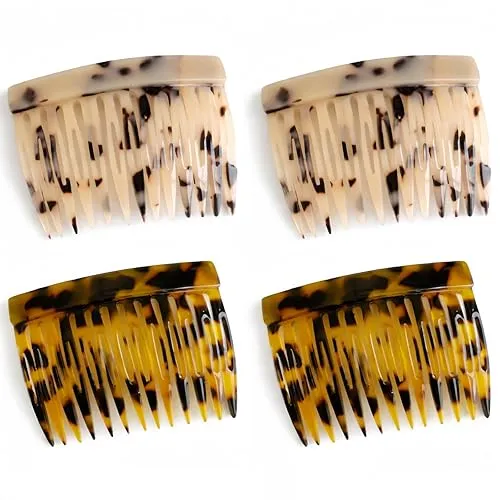
UKSKS French Twist Side Combs, 4 Pack (Tortoise Shell)
A 4-pack of 2.56-inch cellulose acetate combs with a curved profile, which is enough width to hold a section without over-rotating it.
We tested dozens of claw clips to find the very best options. Below you'll find our complete ranking, with detailed reviews and real customer feedback for each pick.
The Complete Ranking
A 4-pack of 2.56-inch cellulose acetate combs with a curved profile, which is enough width to hold a section without over-rotating it. UKSKS states each tooth is polished round and smooth so it will not pull or break hair, which is a manufacturer claim we cannot verify, but it is the right claim to be looking for.
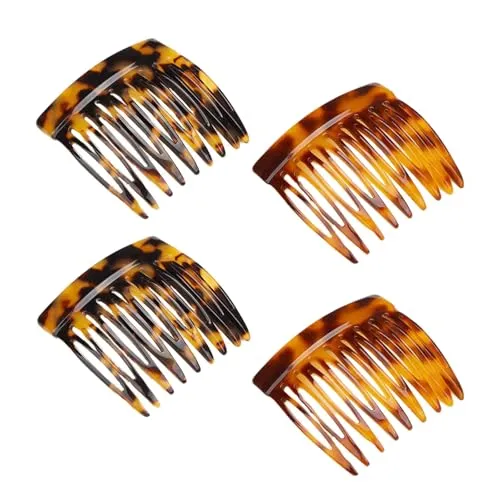
The smallest combs here at 2.55 by 2.16 inches, with a curved tooth profile intended to sit close to the scalp. Four acetate pieces in amber and dark tortoiseshell colours; the maker claims the acetate resists static, which we have not tested.
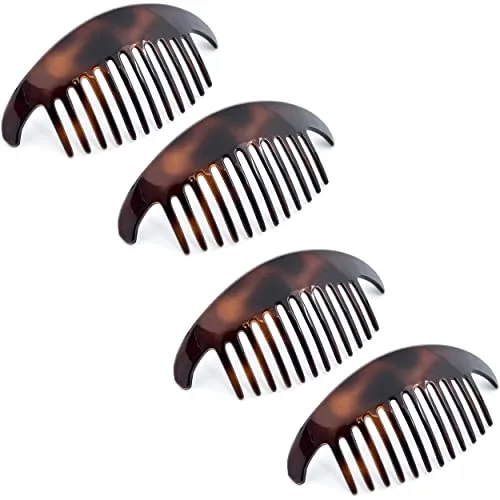
A 6-inch interlocking pair in cellulose acetate, made in France and sold for long and thicker hair. Camila Paris claims it holds without tugging and that other materials have small ridges on each tooth that can damage hair, which is a manufacturer comparison rather than an independent finding.
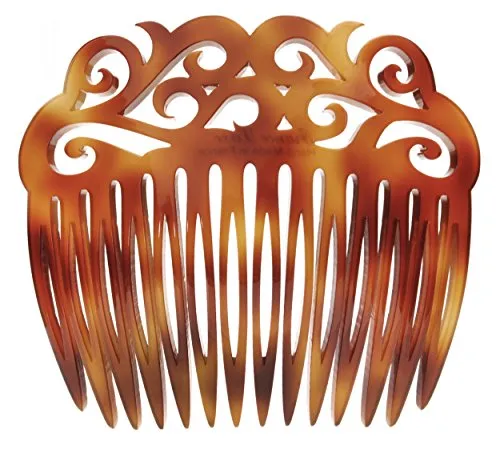
Cellulose acetate cut and polished by hand in France, roughly 3 inches wide with closely set teeth. The maker's own instruction is to weave the teeth back and forth through a gathered bun or twist rather than pushing straight in, which spreads the hold across more hair.
Quick Comparison
A side-by-side look at our top picks
Frequently Asked Questions
Can wearing a hair comb every day cause hair loss?
Is it safe to sleep in a decorative hair comb?
How tight is too tight for a hair comb?

Donna Miller
Enjoyed This Guide?
Get more hair tips and product recommendations delivered weekly.