- How to date a hair comb before you pay for it
- Celluloid and tortoiseshell: what you are actually buying
- Art Deco specifically: geometry, not flowers
- Japanese combs: kushi, kanzashi and kogai
- Why antique decorative hair combs are so expensive
- Buying a reproduction well
- The four reproductions we would start with
- Where to go next
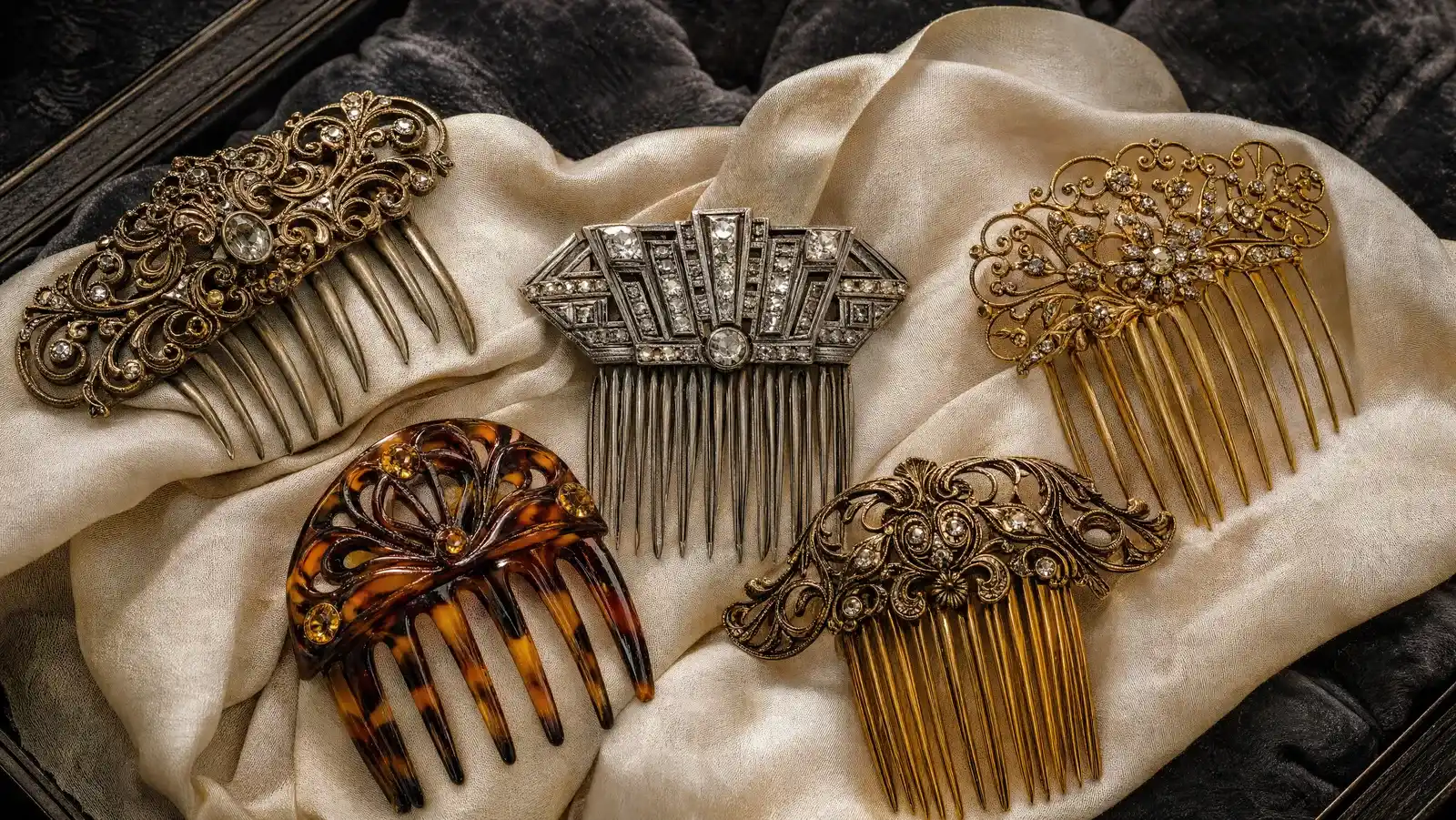
Antique decorative hair combs occupy a narrow band: made before roughly the Second World War, and valued on two things above all else — what the comb is made of, and whether every tooth is still attached. Material dates a comb faster than its ornament does, and a comb missing teeth is a display piece rather than something you can wear.
Some links below are affiliate links, which means we may earn a commission at no cost to you.
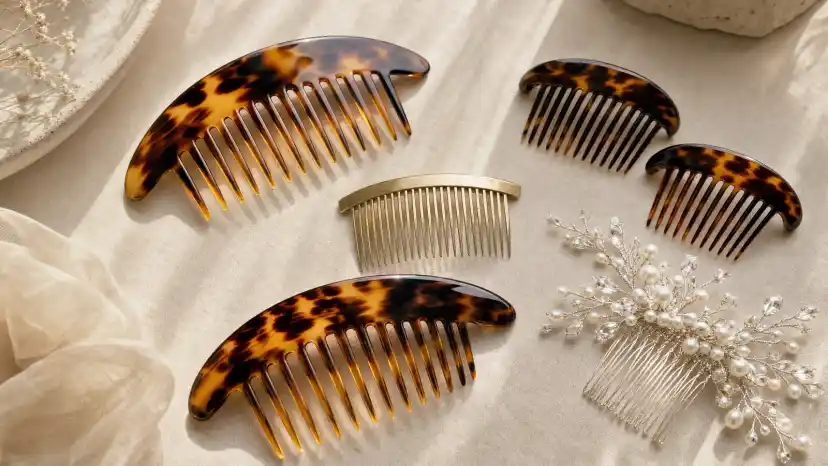
Say the hard part early. None of the combs we link below are antiques. They are current-production pieces in period styles, which is what most people searching for vintage hair combs for women actually want: something that reads 1925 at a wedding without costing a month's rent or shedding a tooth into an updo. A genuine antique comes from an auction house, an estate sale or a specialist dealer, not from a marketplace listing with eleven left in stock. For the longer arc of how these objects developed, we cover the history of decorative hair combs separately. What follows is how to date a real one, what the materials actually are, and how to choose a reproduction that does not announce itself as one.
How to date a hair comb before you pay for it
Work from the construction outwards, not from the sparkle inwards.
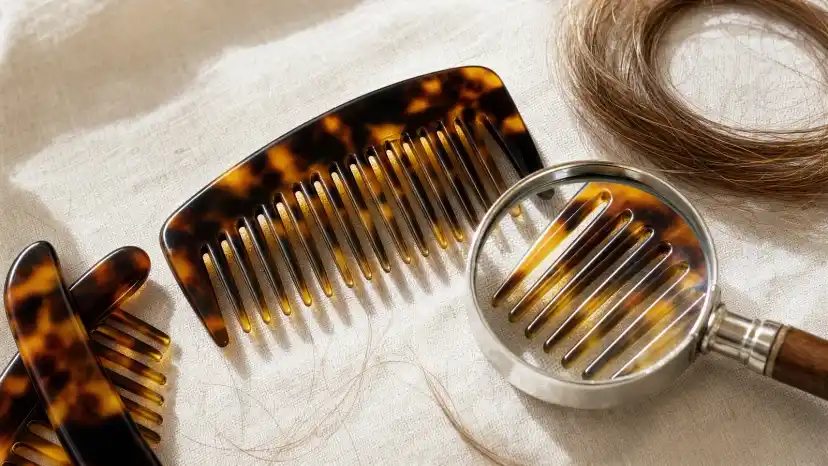
- Teeth. Hand-cut teeth are generally slightly uneven in width and spacing, and the gaps between them usually end in a small drilled or filed round rather than a crisp square. Moulded teeth tend to be identical to each other, often carry a faint parting line down the centre from the two halves of the mould, and can show a ragged flash of material at the tip.
- Joins. Many older ornamental combs are two objects: a decorative heading attached to a separate toothed comb. The Walters Art Museum's Lalique Orchid Comb of 1903 to 1904 is catalogued exactly that way — an orchid carved from a single piece of ivory whose stem, the museum's record says, is attached by a gold hinge to a three-pronged horn comb. A visible rivet, hinge or wire binding is a good sign; a single moulded piece carrying ornament and teeth in one material is usually modern.
- Marks. Silver and gold mounts may be hallmarked. Two cautions from the specialists: the State Library of Victoria's hallmarking guide notes that before 1975 the date letter varied for every assay office, so identify the town mark before you try to read the date letter, and the Antiques Trade Gazette notes that a date letter records the year a piece was assayed, not necessarily the year it was made. The Gazette also points out that a duty mark was used between 1784 and 1890, which usefully narrows that window, and that the date letter has only been voluntary since 1999.
- Wear. Genuine wear is concentrated where a comb was handled and where it pressed against a scalp: the tooth tips, the back of the heading, the high points of any ornament. Wear distributed evenly across a whole surface is usually a finish, not a history.
If the vocabulary itself is new, our breakdown of the types of decorative hair combs sorts side combs from forks, tiara combs and dressing combs before you start bidding on any of them.
Celluloid and tortoiseshell: what you are actually buying
These are the two words that decide an old comb's story, and both are widely misused.
Celluloid was the first mass-market plastic, and combs were one of its first products. According to the Science History Institute, John Wesley Hyatt took up the problem after a New York firm offered 10,000 dollars for an ivory substitute for billiard balls in 1863, and patented his process of combining pulverized pyroxylin and camphor under heat and pressure in 1870. The institute calls the result the first successful synthetic plastic, and notes that artisans turned it into imitation ivory, coral, semiprecious stones and tortoiseshell, with tortoiseshell imitations especially in demand for hair combs and eyeglass frames. Britannica adds that some historians trace the invention further back, to the English chemist Alexander Parkes, who was granted the first of several patents in 1856 on a material he called Parkesine.
The catch is in the chemistry. The Science History Institute writes that celluloid retained the flammability of its guncotton component, and that because people associated it with guncotton, tragicomic urban legends about exploding combs and buttons abounded. Worth being precise here, because the internet has inflated this: the institute treats the exploding-comb stories as legend and the factory fires as the real danger, describing celluloid as more dangerous to its makers than its consumers. Still, an old celluloid comb is not something to leave on a radiator or test with a flame.
Tortoiseshell is not a pattern. It is the shell of the hawksbill sea turtle, and it is restricted. NOAA Fisheries lists the hawksbill as endangered under the Endangered Species Act throughout its range, first listed in 1970, and as a CITES Appendix I species, and states plainly that the Convention on International Trade in Endangered Species forbids the trade of any turtle products on the international market, including hawksbill tortoise shell. NOAA adds that historical hunting for the shell nearly drove the species to extinction, and that shell is still carved into items such as jewellery and hair clips in the illegal wildlife trade. WWF lists the species as Critically Endangered on the IUCN Red List alongside its CITES Appendix I status.
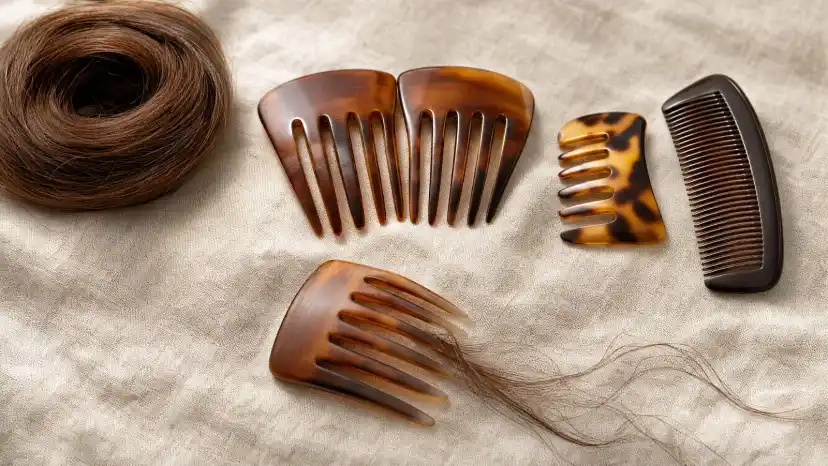
What that means at the point of purchase: almost every "tortoiseshell" comb on sale today is cellulose acetate or another plastic with the pattern worked into it, and that is the version you want. A seller claiming the genuine article is raising a legal question rather than quoting a premium. If you want to understand what modern acetate actually is, we compare metal, wooden and acetate hair combs in detail, and look at how acetate differs from moulded petroleum plastic in acetate vs plastic claw clips.
Art Deco specifically: geometry, not flowers
Art Deco combs look different from the ones immediately before them, and the difference is easy to see once you know what to look for.
The style takes its name from the Exposition Internationale des Arts Decoratifs et Industriels Modernes — the International Exhibition of Modern Decorative and Industrial Arts — held in Paris in 1925, as Dezeen's guide to the style's centenary explains, though Dezeen notes the shorthand was coined decades after the event itself. Dezeen also makes a useful admission that most style guides skip: Art Deco was never based on an intellectual theory, which is why its core characteristics are notoriously difficult to define. So rather than a checklist, use dated museum objects.
The Science Museum Group holds a cellulose nitrate hair comb made in 1925, in an ivory colour, with four teeth. Its catalogue describes a body trapezoidal in shape and decorated with a linear design of painted black edge, cut across by a cut-out design of black paste stones, with a right-angled line of black brilliants alternating with brass studs. That one record contains most of the Deco vocabulary: a flat geometric silhouette, straight lines and right angles rather than tendrils, high contrast, and paste — the catalogue word for cut glass set like a gemstone.
Compare that with what came immediately before. The Victoria and Albert Museum calls Rene Lalique Art Nouveau's most important jeweller, says he championed non-precious materials such as enamel, glass and horn, credits him with introducing horn into the jewellery repertoire, and describes his combs as moulded and sculpted in the shape of flowers, waves and butterflies. The Cleveland Museum of Art's Lalique Lily of the Valley comb, dated around 1900 in horn, enamel and gold, is catalogued as pearlescent horn forming the leaves of the lily of the valley, out of which the delicate, bell-shaped enamel flowers emerge.
Flowers emerging from horn in 1900; right angles of black brilliants in 1925. That is the whole shift. It also tells you what the heavily scrolled, pearl-studded sets sold as "vintage" today usually are: Baroque revival, not Deco. Both are fine to wear. They just belong to different outfits, the same way our types of barrettes explained guide separates families that get lumped together under one word.
Japanese combs: kushi, kanzashi and kogai
Japanese hair ornaments get flattened into "decoration" in most buying guides, and they deserve better, because they were a system rather than an accent.
The Victoria and Albert Museum's catalogue for a nineteenth-century Japanese hair ornament puts it compactly: during the Edo period, which it dates 1615 to 1868, women used a wide variety of combs (kushi), bodkins or hairpins (kanzashi) and hairpins (kogai) in a wide range of materials, such as wood, ivory and tortoiseshell, which were most commonly decorated with lacquer. The piece attached to that record is silver with black lacquer, decorated with autumn plants, and 16.62 centimetres long. Three object types, worn together, in a dressed hairstyle built to hold them.
The scale of the category is easy to underestimate. The Kushi Kanzashi Museum in Ome, western Tokyo, listed in Japan's government multilingual tourism database, holds more than 4,000 traditional hair accessories spanning the Edo period through the Showa era, with roughly 400 on display at a time. The same entry records the turn: as Japan modernised during the Meiji era, hair ornaments became smaller and less showy as women took up European hairstyles.
Two practical consequences. First, a kanzashi is not a comb, so do not buy one expecting a comb's grip. Second, lacquer wants careful handling: museum conservation guidance notes that contact with water or polar solvents can blanch an urushi surface, and that strong light and swings in temperature and humidity degrade it, which rules out most cleaning instincts.
Why antique decorative hair combs are so expensive
Five factors, in roughly the order they move a price.
- Maker. A documented maker changes the category entirely. The Cleveland Museum of Art records that its Lalique comb was bought by the Cleveland native Jeptha Homer Wade II directly from Lalique after he admired the designer's work at the 1900 Exposition Universelle in Paris, probably for his wife Ellen Garretson Wade. Named maker plus traceable provenance is what museum-grade means.
- Material. Horn and tortoiseshell were hand-worked, and tortoiseshell is now a restricted material under CITES per NOAA, so legitimate supply is fixed at whatever was already above ground.
- Hand work. Setting stones individually and piercing a heading by hand are hours of labour. A cut-out design like the Science Museum Group's 1925 comb is time, not machinery.
- Condition. Celluloid degrades. That is precisely why conservation departments, such as the Cincinnati Art Museum's, go through comb collections to identify which pieces are cellulose nitrate in the first place.
- Completeness. Teeth are generally the most common point of failure, and the hardest to repair invisibly. Dealers typically price a comb with losses well below the same comb intact, and a comb short two teeth is no longer reliably wearable.
Buying a reproduction well
Reproductions are where the practical money is, and the same five factors invert into a short checklist.
- Judge the geometry first. If you want Deco, you want symmetry, straight lines and stepped or stacked forms. Scrolls, cherubs and clustered pearls are Baroque revival in period dress.
- Prefer one good comb over a pile, unless you are learning. A multipack is a cheap way to discover which width your hair actually takes; a single is what you wear once you know.
- Check width against your hair, not against the photo. A 2-inch comb is an accent. A 4-inch comb is structural and needs real hair to anchor in.
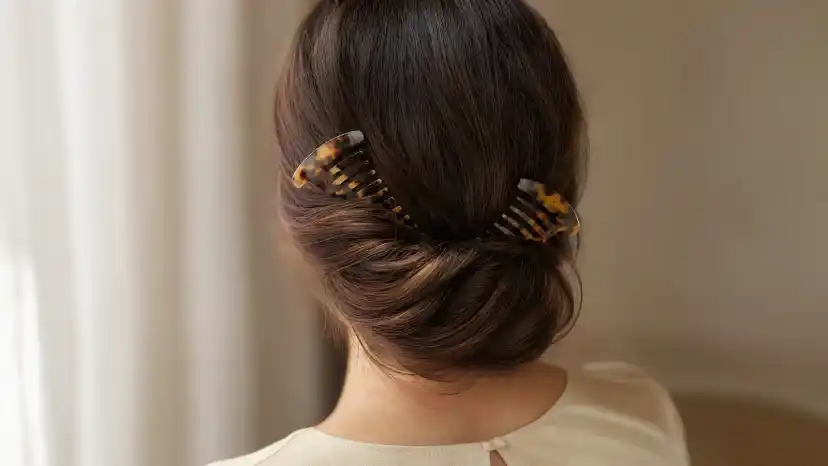
- Weight is a comfort spec. Metal and crystal headings are heavy, and placement matters more as weight goes up. Our notes on decorative hair comb hairstyles cover where a heavy comb actually sits, and the insert-push-rotate method in how to use a decorative hair comb is what stops a heavy piece from sliding out by mid-evening.
- Rounded tooth tips, always. Sharp or flashed tips catch. Our guide to safe versus damaging hair clips covers the tension side of that, which matters more than the material.
Distressed or damaged? One useful example
Applied patina is what separates a convincing reproduction from a shiny one, and it looks alarming the first time you unwrap it. The SICOPEE filigree trio is a good teaching case: the maker states the darkened colour on the teeth is an intentional distressed finish applied by rubbing with stone, not rust. Three combs at 2.76, 2.5 and 3 inches wide, in filigree, pearl-and-rhinestone floral and leaf designs, antique gold tone, about $9.99 as of November 2026. Knowing the difference saves you returning a comb that arrived exactly as designed. Genuine corrosion, by contrast, is uneven, sits in pits, and comes off orange on a cloth.
The four reproductions we would start with
All four are modern pieces in period styles, and we are ranking them on listed specifications and geometry rather than on handling them. The SICOPEE filigree trio covered just above is the fourth.
The EVER FAITH Art Deco crystal side comb is our pick for one reason: it is the only one here whose geometry genuinely reads Deco. The symmetry and the stepped crystal work belong to the 1920s vocabulary described in those museum records, rather than to floral revival ornament. It is a single comb, 8 by 4.5 centimetres (3.1 by 1.8 inches), 33 grams of Austrian crystal and silver-tone metal, supplied in a jewellery gift box, about $18.99 as of November 2026. EVER FAITH suggests placing it on a low side bun or a French pleat, which is sensible advice for a piece that weight. Note that stock was down to 13 units when we wrote this.
The XINHONGJIN five-piece set is the one to buy if you are still working out what width suits you. Five metal alloy combs in antique gold with filigree and set stones, spanning 5.2 to 10.2 centimetres (roughly 2 to 4 inches) — the 10 centimetre piece is a statement comb for an updo, the 5 centimetre ones cluster as accents. It is Baroque in its ornament, not Deco, so pair it accordingly. About $12.99 as of November 2026, with availability listed at 11 units when we wrote this, so treat both this and the EVER FAITH as short-supply listings rather than staples. XINHONGJIN describes the teeth as smooth and rounded and the stones as secure; those are the brand's claims, not findings of ours.
The Matwsec five-pack is the cheapest way in, at about $7.59 as of November 2026 for five alloy combs in antique gold with green crystal and turquoise-look stones. It arrives in a plain opp bag, which is the honest trade-off at roughly a dollar fifty a comb. Buy it to find out whether coloured stones suit you at all before spending ten times as much on one.
Where to go next
The short version: date a comb by its teeth, its joins and its marks, assume anything sold as tortoiseshell is acetate and be glad of it, and remember that Deco means right angles while the ornate pearl-and-scroll sets are Baroque revival in costume. Then buy a reproduction on width, weight and tooth shape, because those three decide whether you wear it twice or once.
If you want the wider map of the category — how side combs, forks, tiara combs and dressing combs differ, and which does what — start with our guide to decorative hair combs and work outwards from there.
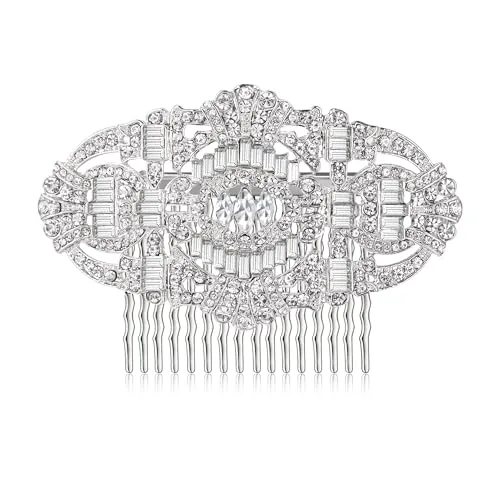
EVER FAITH 1920s Art Deco Austrian Crystal Bridal Side Comb (Silver-Tone)
A single 3.1 by 1.
We tested dozens of claw clips to find the very best options. Below you'll find our complete ranking, with detailed reviews and real customer feedback for each pick.
The Complete Ranking
A single 3.1 by 1.8 inch silver-tone comb set with Austrian crystal, weighing 33 grams. Of the reproductions here this is the one whose geometry actually reads as Deco rather than generically vintage — the symmetry and the stepped crystal work are period-appropriate rather than floral. The maker suggests it on a low side bun or a French pleat, which is the right placement for a piece this heavy.
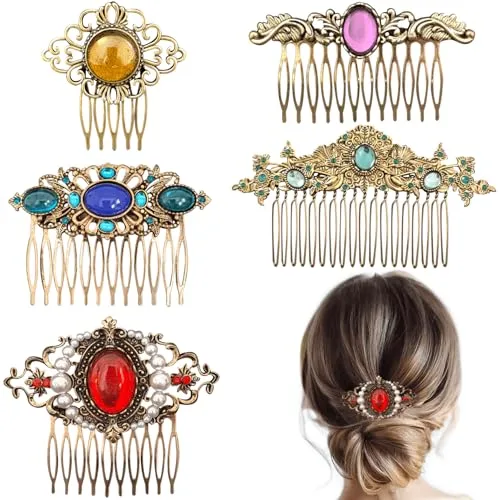
Five metal alloy combs in antique gold with filigree and set stones, ranging from 5.2 to 10.2 centimetres wide — roughly 2 to 4 inches. That spread is the reason to buy a set rather than a single: the 10 cm piece is a statement comb for an updo, the 5 cm ones are accents you can cluster. Baroque rather than Deco in its ornament, so pair it accordingly.
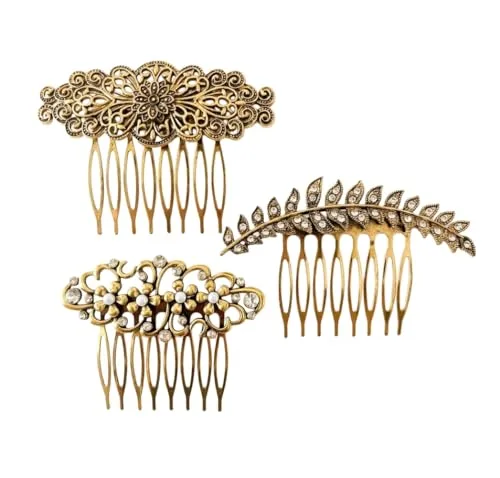
Three antique-gold metal combs at 2.76, 2.5 and 3 inches wide, in filigree, pearl-and-rhinestone floral, and leaf designs. One detail worth knowing before it alarms you: the maker states the darkened colour on the teeth is a deliberate distressed finish rubbed on with stone, not rust. That kind of applied patina is what separates a convincing reproduction from a shiny one.
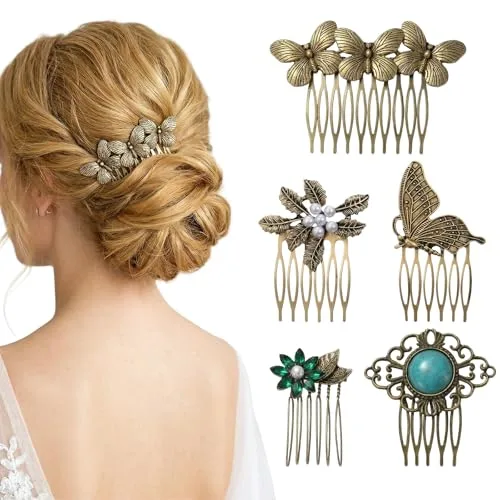
Matwsec Vintage Decorative Side Combs, 5 Pack (Antique Gold, Green Crystal and Turquoise)
Five alloy combs in antique gold with green crystal and turquoise-look stones, at about a dollar and a half each. This is the cheap way to find out whether coloured stones suit you at all before buying a single comb at ten times the price. Packaged in a plain opp bag, so it arrives looking like what it costs.
Quick Comparison
A side-by-side look at our top picks
Frequently Asked Questions
Are antique hair combs made of real tortoiseshell?
How can I tell if an old hair comb is celluloid?
What is the difference between an Art Deco and an Art Nouveau hair comb?

Donna Miller
Enjoyed This Guide?
Get more hair tips and product recommendations delivered weekly.