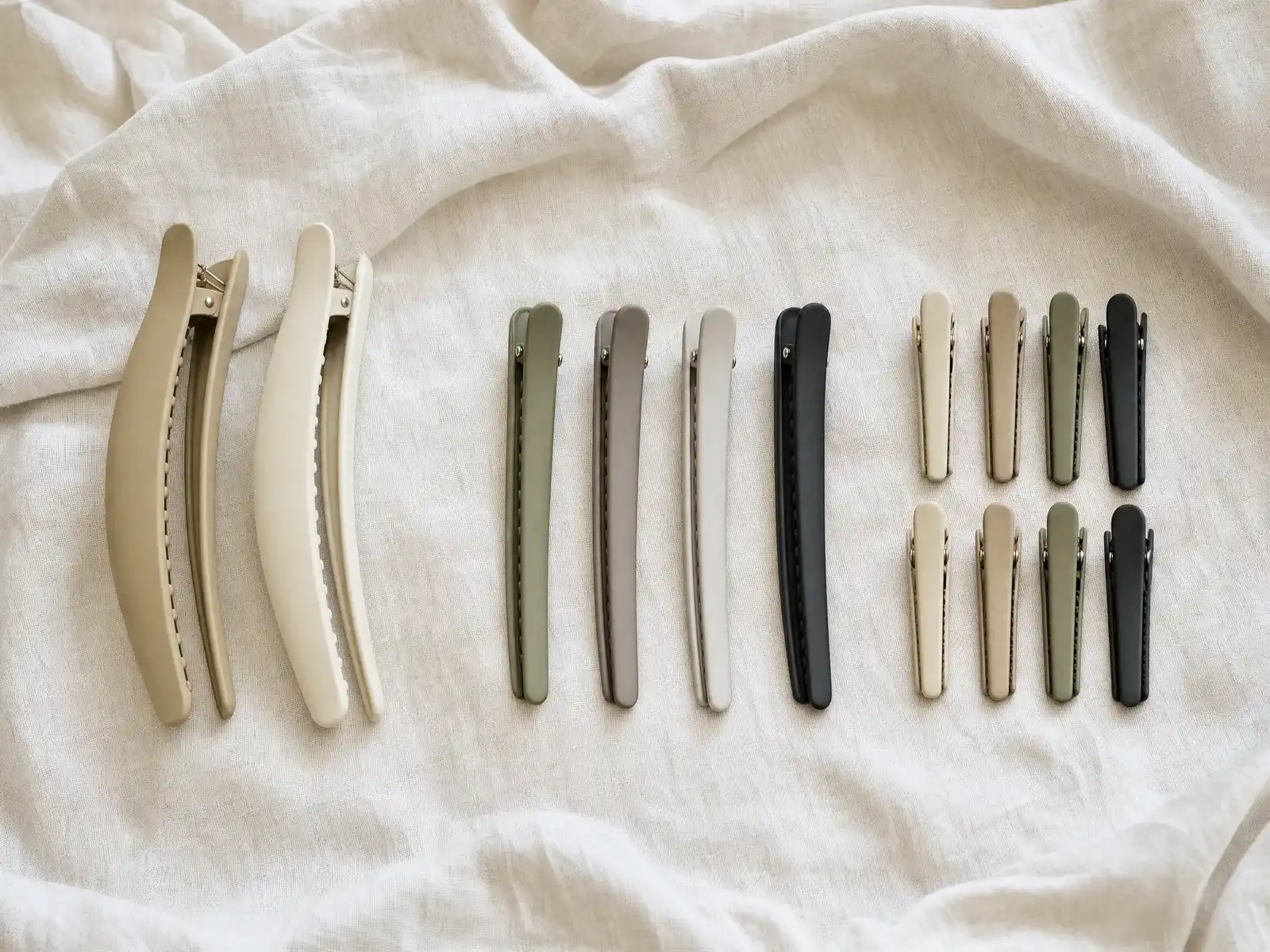
- Sectioning Clip Sizes: The Three Tiers That Actually Exist
- How Many Sectioning Clips You Actually Need
- Long Sectioning Clips Earn Their Length on Volume
- Small Sectioning Clips Do What the Long Ones Cannot
- Match the Section to the Tool, Then Count Clips
- What Belongs in a Sectioning Clips Kit
- Buying Sectioning Clips in Bulk
- Curly, Coily and Very Dense Hair Change the Math
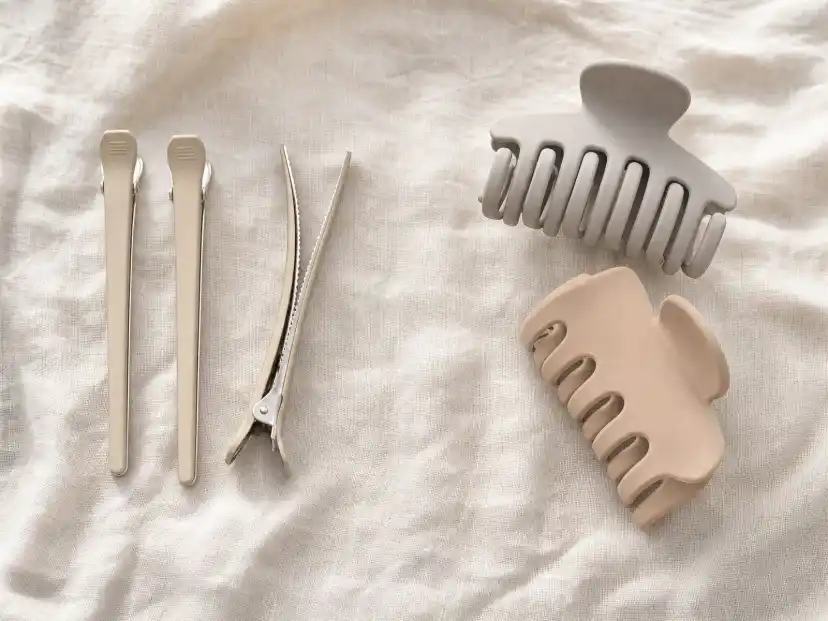
- Where a Claw Clip Can Stand In
- The Short Answer
Sectioning clip sizes come down to a single measurement — jaw length — and almost every head is served by just two of them: a long clip around 4.5 inches for holding quadrants and a short one under 2.5 inches for everything fiddly.
Six clips. That is the honest count.
Four hold the quadrants, one holds a crown panel, one holds the fringe or face-frame, and a spare or two covers the clip that always goes missing. Size matters more than count, because a clip that is too short for the section it is carrying will creep open no matter how many of them you own. If you want the mechanical background first, our guide to how sectioning clips work covers teeth, springs and jaw geometry. What follows is the buying math: which sizes genuinely exist, how many you need, what belongs in a kit, and when bulk is worth the money.
Sectioning Clip Sizes: The Three Tiers That Actually Exist
Salon suppliers sell a narrower range than the shopping results suggest.
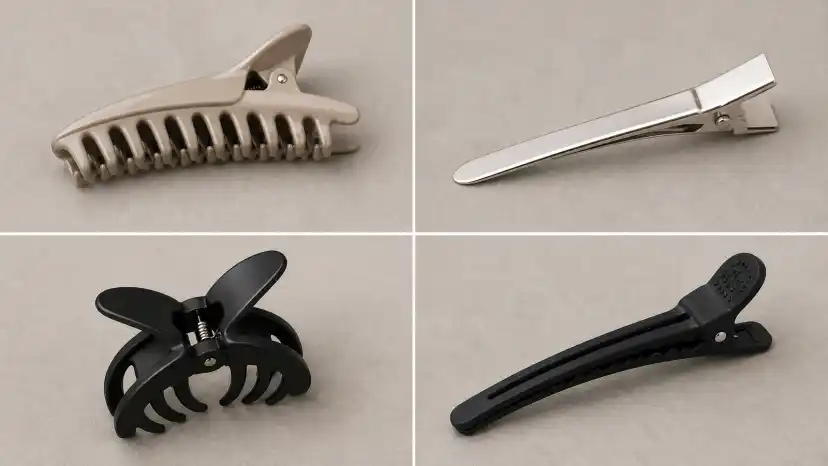
The standard is 4.5 inches. Pure Spa Direct's listing for its matte black hair sectioning clips gives the measurements as 0.63 inch by 4.5 inch (16 mm by 114.3 mm) — a jaw roughly four and a half inches long and barely more than half an inch wide. The same supplier sells assorted-color sectioning clips in a 4.5-inch set of four, and Colortrak's croc clip listing describes 4.5 inches as an ideal balance of reach and control. When a professional clip does not state a size, this is usually the size it is.
Jumbo is 5.5 inches. The Colortrak rubberized croc clip bucket sold by Beauty Plus Salon is a 12-pack that mixes eight regular 4.5-inch clips with four 5.5-inch jumbos, which is a useful ratio to notice: even a supplier building a professional set assumes you need twice as many standard clips as big ones.
Small means metal duckbills. The short end of the market is almost entirely pressed steel rather than plastic. A 60-piece metal duck-billed clip assortment listed by Carrefour sorts its clips into three tiers — 10 at 3.5 inches, 20 at 2.16 inches and 30 at 1.73 inches — and a separate Hicarer listing sells 3.5-inch metal duckbill sectioning clips 24 to a pack. So the practical small sizes land between about 1.7 and 3.5 inches.
The split between those groups is not cosmetic. Plastic croc clips go long because the jaw has to stay closer to parallel under load, and a long jaw gives the spring more hair to push against. Metal duckbills go short because they are holding ounces, not handfuls.
How Many Sectioning Clips You Actually Need
Start from the parting map, not from the pack size.
The BCcampus open textbook Hair Colour for Hairstylists Level 2 describes the standard application sectioning as dividing the hair into four quadrants with a comb and clips — nose to nape, then ear to ear. That is four clips, and it is the floor for any service. Add the crown panel you want to dry or style last, and a fringe or face-frame that needs to stay off the face, and you are at six. Two spares make eight. Our walkthrough of the four-quadrant parting map covers where those partings go and what order to release them in.
Here is the part that keeps clip counts sane: your subsections do not need clips. That same textbook has you work from the bottom of each quadrant upward in quarter-inch partings. Nobody clips a quarter-inch mesh. You pull it out of a quadrant that is already clipped, work it, and move on. Clip count tracks your holding sections, not your working sections.
Where the count genuinely rises is re-clipping. Sam Villa Pro's round-brush blow-dry tutorial has you roll each finished section into a barrel curl against the head and secure it with a dry sectioning clip, then let it cool and rest fully before the clip comes out. If finished hair gets clipped back up rather than dropped, you need enough clips to hold both the unworked sections and the done ones at the same time. That is the case for ten to twelve rather than six.
Long Sectioning Clips Earn Their Length on Volume
A longer jaw is not a stronger clip. It is a wider one.
Spring force is roughly fixed by the clip's hinge. What changes with jaw length is how much hair that force is spread across, which is why a four-and-a-half-inch clip holds a dense quadrant that a two-inch clip releases almost immediately. The two-inch clip is not weaker; it is concentrating the same push onto a smaller patch of hair and asking that patch to hold the weight of the whole section. Past a certain volume the jaws get levered past parallel, the teeth stop interlocking, and the clip creeps.
That is the same volume-first logic behind sizing a claw clip to the amount of hair you have rather than to the length of it.
Long clips concede something real, though. They sit proud of the head, so they collide with a dryer nozzle or a curling barrel in exactly the places you need clearance. They also press a longer line, which matters if the hair under them is still damp. A jumbo clip holding a wet nape section for ten minutes is one of the easier ways to end up with a crease in your own blowout.
Small Sectioning Clips Do What the Long Ones Cannot
The short clips in a kit are not a budget version of the long ones. They have their own job.
- The face-frame. A 1.7 to 2.2 inch duckbill holds the front pieces back without burying them under a clip the size of your palm.
- Single meshes. Lifting one thin slice out of the way, mid-blow-dry, so the next one sits flat.
- Nape hair and baby hairs. The short pieces that slip out of anything with a wide jaw.
- Pin curls and set work. Flat, low-profile hold where the shape is being locked in as the hair dries.
The duckbill shape is what makes this work: a flat, narrow lower blade slides under a parting without lifting it. The tradeoff is capacity and heat. These clips hold very little, and metal conducts, so a steel clip sitting against a damp section while you dry around it can warm up and press an edge into the hair at its most pliable. If a section is still wet, a smooth plastic clip or one of the clips designed not to leave a dent is the less risky choice. Mermade Hair, for instance, attributes its no-crease clips' behavior to a cellulose acetate body and a metal section with no teeth — a manufacturer claim rather than a tested one, but a claim that at least points at the right mechanism.
Match the Section to the Tool, Then Count Clips
Section size is set by the tool in your other hand, and clip count follows from section size.
Sam Villa Pro's professional blow-drying guide gives two numbers: never take a section wider than your brush, and keep section depth to about one to one and a half inches depending on the density of your hair. Behind the Chair's blowout tips make the same point from the other end, saying the size of your round brush should determine each section.
Run that forward. A large round brush means wide sections, few of them, and six clips is plenty. Switch to a one-inch iron and your working sections halve, the number of parted-off panels waiting their turn roughly doubles, and the kit that felt generous is suddenly short. This is why stylists carry more clips than their sectioning pattern implies. The pattern sets the minimum; the tool sets the real number.
What Belongs in a Sectioning Clips Kit
Commercial kits are inconsistent, which tells you something.
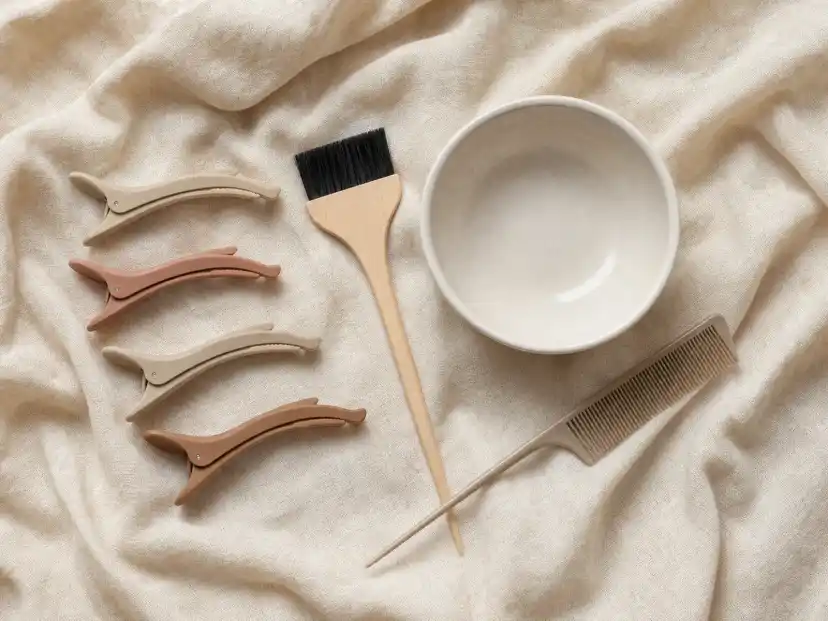
A Soft 'N Style balayage and ombre kit sold by Pure Spa Direct lists four sectioning clips among its boards, brushes and combs. SalonCentric's balayage bundle includes fifteen clips in red, silver and black. A FROMM foil kit includes three clips, described as hinging in the middle so they hold small or larger sections. Three to fifteen, for broadly similar work — so the number in the box is a packaging decision, not a recommendation.
A sectioning clips kit that actually covers a head looks more like this:
- Four long clips, around 4.5 inches — the quadrants, which is the non-negotiable core.
- Two jumbo clips, around 5.5 inches — only if your quadrants are dense or past shoulder length.
- Four small clips, under 2.5 inches — face-frame, nape, single meshes.
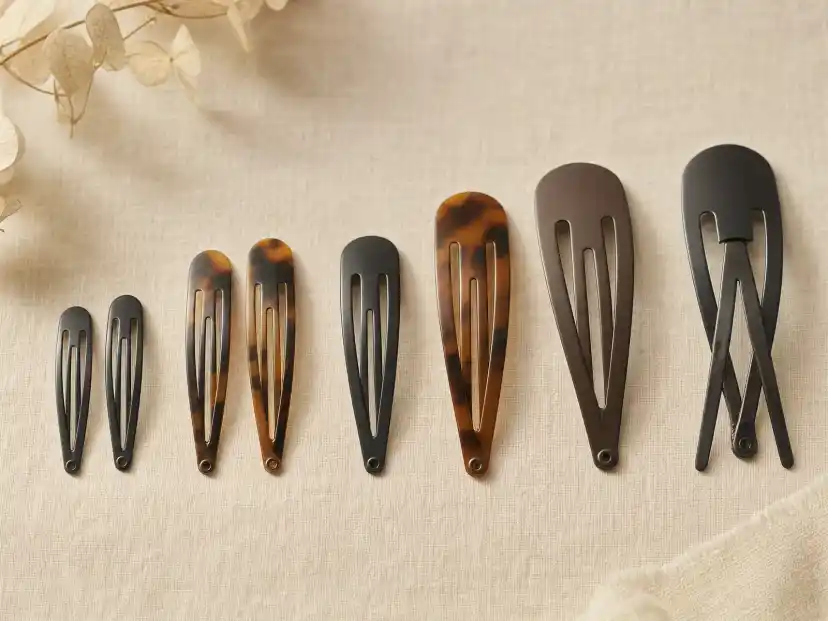
- Two smooth, toothless clips — for anything that is still damp or sitting near the hairline.
The most common mistake is buying twelve of one size. A 12-pack of identical 4.5-inch croc clips, which is the standard professional unit, leaves you with nothing that will hold a two-inch face-frame piece flat and nothing you would want to put on wet hair. Mixed sizes beat more clips.
Buying Sectioning Clips in Bulk
Bulk is a professional format, and it solves a professional problem.
Pure Spa Direct sells one of its sectioning clips as a case of 120, packed in six-packs with retail hang tabs, and Salonserve lists a box of 36. Those quantities exist because color-room clips lead short lives: they get dropped, borrowed, stained by lightener and left in towels. If you are doing color weekly, the per-clip price and the willingness to throw a bleached one out are worth more than any feature.
For one head of hair, a 12-pack is the right unit, and it happens to be the standard retail one — Product Club's no-crease clips come in twelves, and Salon Services sells its metal-base sectioning clips in packs of twelve. Buying 120 of anything to style your own hair mostly buys storage problems. There is also a quality floor to watch: very cheap bulk clips tend to be the lightest molding with the weakest springs, so the discount comes back as clips that hold for a minute and then slide. Fewer, better clips tend to be the better value at home.
Curly, Coily and Very Dense Hair Change the Math
Volume and strand count are different things, and clips respond to volume.
Curlsmith's hair texture guide puts fine strands under roughly 50 microns, medium at 60 to 80 and coarse above 80, and notes that African curly hair can have the smallest fiber diameter of all, averaging around 55 microns. A coily section can therefore fill a jaw completely while being made of individually fine strands. The implication for sizing is specific: what you need is jaw opening and depth, not spring strength, because a hard spring on a fine strand is a crease risk rather than extra security. Sections like these also tend to compress, so a clip that feels secure at the moment of closing can loosen as the hair settles. Our roundup of clips that suit curly and coily sections goes through that tradeoff in detail.
Where a Claw Clip Can Stand In
A claw clip is not a bad sectioning clip. It is a different tool with a different grip.
Claws cage a twisted rope between inward-facing teeth, which is why twisting first is correct for a claw and wrong for a toothed sectioning clip that wants a flat sheet across its jaw. For holding a whole quadrant out of the way while you work elsewhere, a medium claw does the job, and most people already own one. For anything that needs to lie flat against the head, or anything you will be running a brush past, the flat jaw wins. The full comparison of when each shape is the right pick covers the cases where substituting is fine and the ones where it is not.
The Short Answer
Two sizes, six to eight clips, mixed rather than matched.
Long clips around 4.5 inches hold quadrants. Short duckbills under 2.5 inches hold the fiddly parts. Jumbo 5.5-inch clips are for genuinely dense or long hair, and a 12-pack of one size is the purchase most people regret. If the clips you already own keep popping open, the fix is usually a longer jaw rather than more clips, and if they keep leaving marks, the fix is a smoother jaw rather than a gentler hand.
Everything past that is matching the hardware to your own hair, which is where our guide to choosing the right sectioning clips picks up.
Frequently Asked Questions
What size sectioning clips should you buy?
How many sectioning clips do you need for at-home styling?
Is it worth buying sectioning clips in bulk?

Donna Miller
Enjoyed This Guide?
Get more hair tips and product recommendations delivered weekly.