- Why Curls Break the Normal Clip Rules
- What to Look For in Sectioning Clips for Curly Hair
- Best Overall for Curly Hair: HH&LL No-Crease Sectioning Hair Clips
- Best for Large Curly Sections: GLAMFIELDS Wide-Teeth Alligator Clips
- Best Sectioning Clips on Locs and Retwists: PHSZZ Metal Duckbill Clips
- Best Large Multipack for Coily Hair: Dkpyt Wide-Teeth Alligator Clips
- Best Strong-Hold Premium Pick: FRAMAR Rose Gold Metal Hair Clips
- Where Metal Clips Cost More Than They Save
- How to Clip Coily Hair So Nothing Snags
- The Bottom Line
The best sectioning clips for curly hair are chosen on two specs, and neither one is a curl-type label printed on the bag: jaw capacity, so the clip can close around a bulky damp section, and tooth geometry, so nothing bites into a single coil on the way back out.
Capacity first. Teeth second.
We may earn a commission from links on this page, at no cost to you.
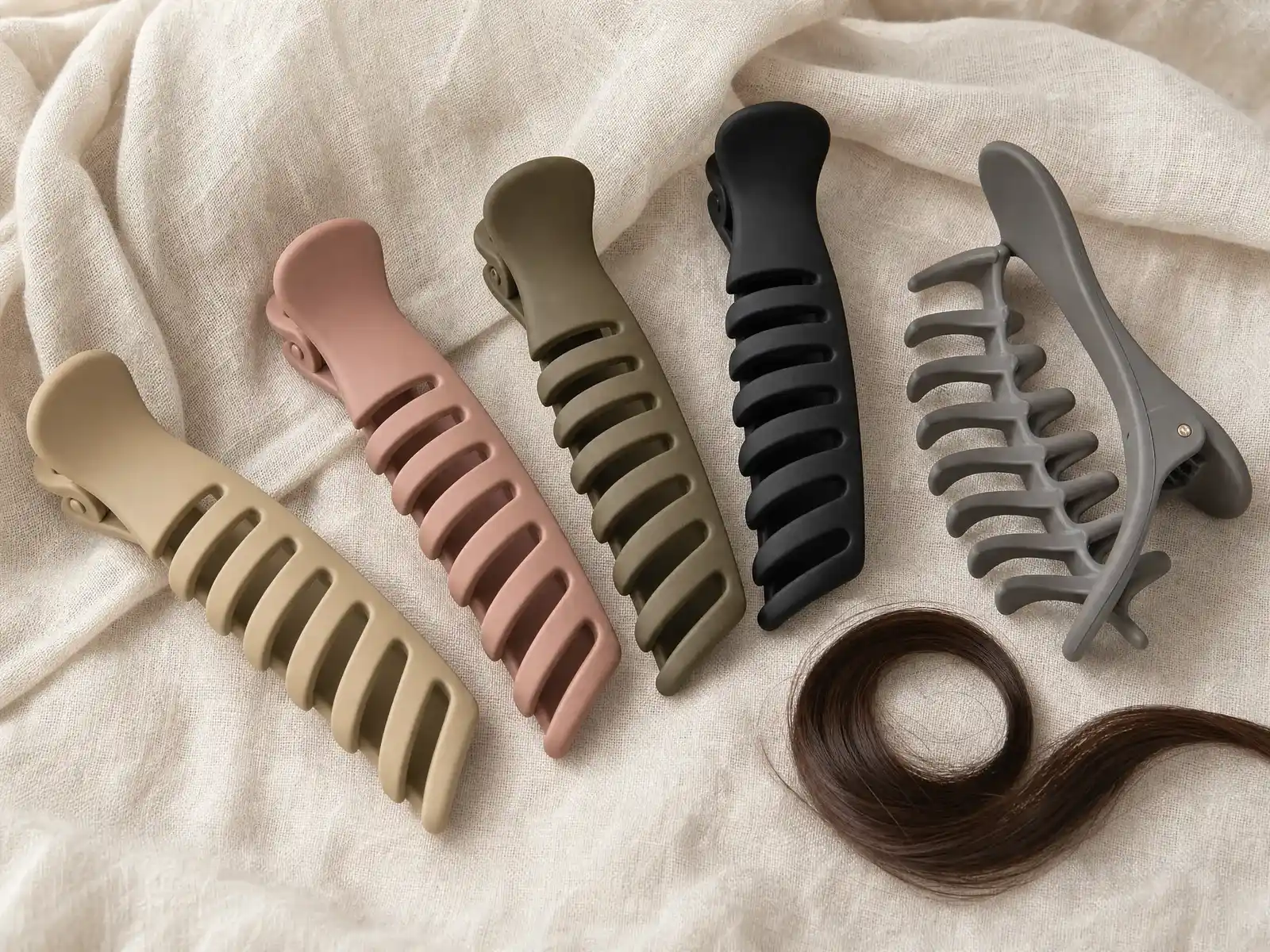
Curls change the problem in a specific way. A dense head gives you fewer, bulkier sections than straight hair of the same length, and those sections get clipped while soaking with conditioner or gel, which is the worst moment to put a narrow toothed edge across them. If the jaw shapes are still a blur, sectioning clip basics sorts duckbill from alligator from butterfly. Below are five clips ranked on capacity and tooth width, each with its tradeoff.
Why Curls Break the Normal Clip Rules
Three variables move at once: section volume, water, and where the fibre is weakest.
Volume is the easy one. Clip sizing is written against a straight-hair section, but a coil occupies roughly twice the space of the same mass of straight hair — laser-stereometry measurements published in the Journal of Cosmetic Science put a very curly tress at about 276 cubic centimetres against 123 for a straight tress of near-identical weight — so a jaw that swallows a straight section gapes on a curly one of equal weight. You run out of capacity long before you run out of spring, and a clip that cannot close fully holds on tooth tips: the weakest grip available at the highest pressure per tooth.
Water is the second, and curl styling is built around it. The Coveteur guide to wash-and-go routines puts it plainly: "You want to add in your styling products while your hair is still wet for more defined curls." Good for definition, bad for clipping. A paper on damaged hair in the Journal of the Society of Cosmetic Chemists states that "hydrogen bonds are reversibly broken every time hair is wet and are reformed again when it dries", and that "wet hair is far more susceptible to damage during grooming than dry hair". A clip is grooming, applied when hair is weakest.
Third is the fibre itself. In "Understanding breakage in curly hair", published in the British Journal of Dermatology in 2015, Camacho-Bragado and colleagues put African-American hair fibres under controlled mechanical stress and tracked the cracks by electron microscopy and X-ray tomography. The failure sequence they proposed starts with cuticle sliding, moves to failure of the cuticle-cortex interface, then ends with intercellular cracks forming at that junction and propagating. Coverage in CosmeticsDesign-Europe drew out the implication: grooming damage accumulates inside the fibre over its life.
So the brief for a clip is narrow. Hold a bulky section without clamping at full force, on hair weaker than usual, then release without dragging along the cuticle.
What to Look For in Sectioning Clips for Curly Hair
Five specs decide it. Colour is not one of them.
- Jaw length, before anything else. A clip only holds what its jaw spans. On a dense section, roughly 4 inches or more does work no amount of spring force will do on a 2-inch clip.
- Wide teeth or a double hinge, not fine teeth. Fine interlocking teeth find individual strands, which helps on slippery fine hair and hurts on a coil, where one tooth hooks a single spiral and holds it while the rest of the section moves. Wide teeth spread the job over more surface, and a double hinge keeps the jaw halves closer to parallel as they close, so the force is not all delivered at the tip.
- Smooth, rounded edges. The edge drags on the cuticle during removal, and per the sequence above, the cuticle is where failure starts.
- Quantity over refinement. Four clips is a straight-hair number. A wash-and-go or a retwist uses far more.
- Material, decided by chemistry rather than feel. Metal springs are stronger and last longer. They are also the wrong choice anywhere near peroxide, a tradeoff we work through in the metal-versus-plastic argument.
One thing that is not a spec: a sectioning clip is a styling tool, not something to wear out of the house. For a jaw that holds curls all day, see everyday claw clips that suit curls, and for which tool belongs in your hand when, sectioning tools against styling tools.
Best Overall for Curly Hair: HH&LL No-Crease Sectioning Hair Clips
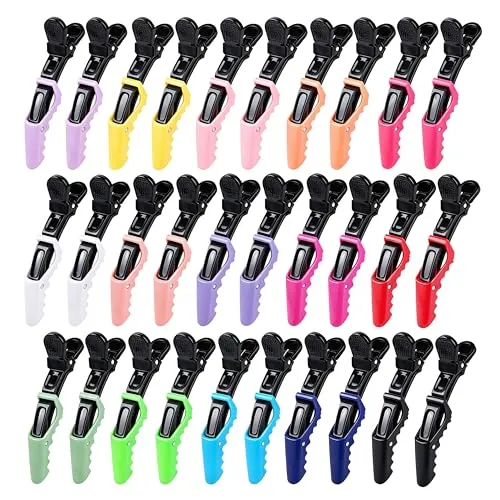
The HH&LL 30-pack is the pick, at $9.99 as of October 2026 for thirty clips in fifteen colours, each 4.5 by 0.6 by 1.4 inches. It is the only listing here whose copy names curly and wet hair explicitly. HH&LL describes upgraded wide double-hinged teeth and a high-elasticity metal spring that it says hold firmly on thick, curly or wet hair, plus smooth-edged clips that hold without dents or pulled strands. Those are the maker's claims rather than tested results, but they describe the construction the mechanism above asks for: double-hinged teeth for capacity, smooth edges for release.
Two numbers matter more than the copy. A clip 4.5 inches long overall — HH&LL publishes the clip's dimensions, not a jaw measurement — should reach across a quarter-head section on dense hair, and thirty clips runs a full twist-out with spares. HH&LL also specifies no coating, which is worth something after a year of gel.
Who it is for: anyone who sections damp and wants one box to cover it.
The tradeoff is the spring. High elasticity is the selling point, and on a thin section, a fringe or a nape panel of fine curls, it closes harder than the hair warrants. Plastic also has a shorter life than metal if clips land on tile.
Best for Large Curly Sections: GLAMFIELDS Wide-Teeth Alligator Clips
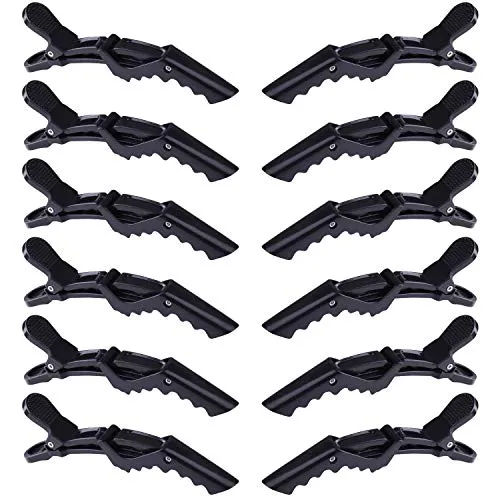
Twelve clips at $6.99 as of October 2026 works out near 58 cents each, and GLAMFIELDS leans entirely on capacity. The company states that the clips hold large sections without slipping, that the teeth come in different sizes so the jaw adjusts to any amount, thickness or type of hair, and that each clip is finger length and curved to the contour of the head, over a high-elasticity metal spring.
Why that suits curls traces back to the volume problem. Dense curly hair gives you four or six bulky sections rather than twelve thin ones, so the spec that runs out first is jaw capacity, not clip count. A curved jaw also sits along the skull instead of levering off it, which keeps a loaded clip from pivoting away and shedding its section.
Who it is for: four-to-six-section routines on thick, dense curls.
The tradeoff is the count. Twelve clips at this size is sensible for sectioning a head and poor for anything granular, so pin curls and individual twists are out of scope. And holding "any kind of hair" is marketing reach, not a measurement: a mixed tooth profile widens the range a clip copes with, it does not make it infinite.
Best Sectioning Clips on Locs and Retwists: PHSZZ Metal Duckbill Clips
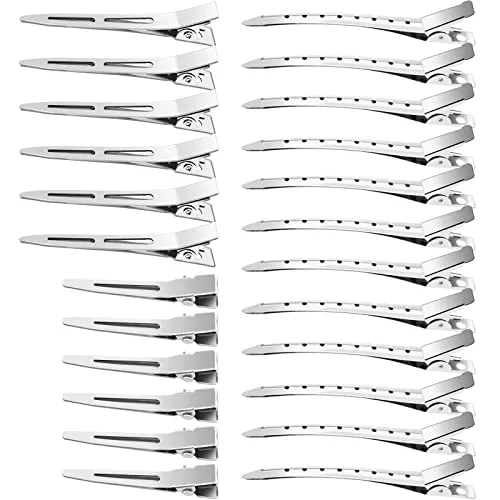
Sixty-five clips for $5.49 as of October 2026, in three lengths: ten at 3.5 inches, twenty at 2.16 inches and thirty-five at 1.73 inches. PHSZZ describes nickel-plated metal with a smooth, rust-resistant surface and a flexible spring at the base, and markets the set for pin curls, roller sets and as loc clips for retwists.
The size mix is the whole argument. A retwist, a two-strand twist set or a braid-out is not a four-section job. It is dozens of small sections, each needing a clip for the minute it takes to set. Thirty-five clips under 2 inches long is the right inventory for that, while the ten long ones handle parting work.
Who it is for: locs, retwists, twist sets, pin curls.
Two tradeoffs, and the second is serious. First, a thin metal duckbill has a narrow blade rather than wide teeth, so it is a precision tool: keep each section modest instead of forcing a bundle into a 1.73-inch jaw. Second, metal and peroxide do not belong on the same head. Arctic Fox's safety instructions for its bleach kit are blunt: "Use only plastic or glass utensils, clips or combs; never metal." A Michigan cosmetology exam study guide on colour-mixing safety gives the reason, explaining that hydrogen peroxide is unstable, reacts with metal and decomposes rapidly on contact, spending the developer's oxidising power before it reaches the hair. For a colour service, use the plastic picks here and follow our walkthrough for parting hair before a root touch-up.
Best Large Multipack for Coily Hair: Dkpyt Wide-Teeth Alligator Clips
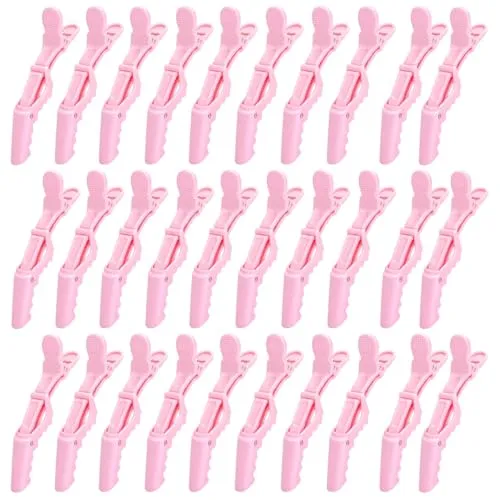
Thirty wide-tooth plastic alligator clips in pink, $9.99 as of October 2026. Dkpyt states that the wide teeth accommodate various hair types and thicknesses for a strong grip, that the clips secure hair without damage and leave no trace even on delicate strands, and that the body is lightweight and compact enough to travel with.
This is the quantity play in the plastic column, and on coily hair quantity is not a luxury. Eight or more sections for a wash-and-go, plus clips holding finished twists clear of the ones still being worked, plus the two behind the radiator: a four-pack does not survive that. Thirty does, and staying plastic keeps the box compatible with colour work.
Who it is for: high-section-count routines, and anyone who loses clips.
The tradeoff is that almost nothing is specified. The listing gives no jaw length and no tooth count, so you are buying a tooth profile rather than a known capacity. "Leaves no trace even on delicate strands" has no mechanism behind it either: no silicone band, no toothless jaw, just wide plastic teeth over a spring. Treat these as the workhorse layer under a better clip, not the gentle option.
Best Strong-Hold Premium Pick: FRAMAR Rose Gold Metal Hair Clips
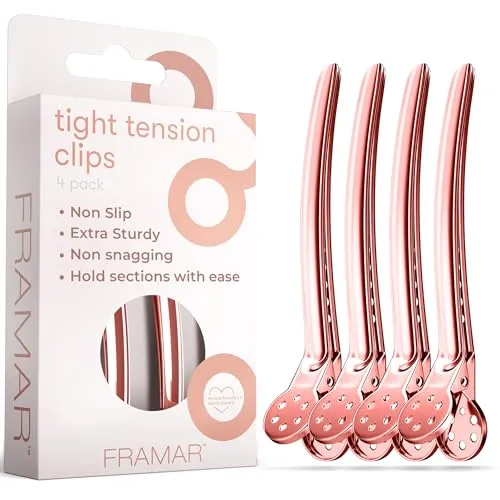
Four clips for $9.99 as of October 2026 is $2.50 each, between four and thirty times the per-unit price of everything above. What the money buys is a mechanism, not a finish. FRAMAR states that these use two springs that automatically adjust to any amount, thickness or type of hair, that they are stronger and more durable than plastic alligator clips, and that grip holes in the handles stop fingers slipping.
The dual spring is why this one earns a slot. The recurring failure on dense curls is mismatch: one fixed clamping force meeting sections that vary wildly in bulk between crown and nape. A jaw carrying two springs spreads its closing force across a wider range of openings, so one clip covers more section sizes instead of being right for one.
Who it is for: a small set of good clips, alongside a cheap multipack for everything else.
The tradeoffs are count and chemistry. Four clips divide a head into four parts and nothing finer, so this is a supplement rather than a kit. Being metal, they are also out for colour or bleach work, for the same peroxide reason as the PHSZZ set. "Stronger than plastic" is credible for a metal spring. "Any type of hair" is not a measurement.
Where Metal Clips Cost More Than They Save
Metal wins on spring life. It loses on two fronts, and the peroxide rule above is the first: if there is developer on the hair, the clip is plastic.
The second is skin. Nickel remains the leading cause of contact allergy, and a review in The Hospitalist reports nickel sulfate testing positive in 17.5 percent of patients patch tested in a 2015 to 2016 North American cohort, with reactions appearing wherever skin meets metal. Nickel-plated clips like the PHSZZ set rest against the scalp and hairline for the length of a retwist. If earrings or belt buckles give you trouble, the plastic picks are the safer default.
How to Clip Coily Hair So Nothing Snags
The clip sets a floor on pressure. Most snagging above that floor is a sequencing problem, not a hardware one.
- Detangle before you clip, never after. A jaw closing on a tangled section traps the knot inside it, and then you pull the clip through the knot. Since wet hair is "far more susceptible to damage during grooming than dry hair" in that same Journal of the Society of Cosmetic Chemists paper, the order of operations matters more than the clip does.
- Twist the section before the jaw closes. A loosely twisted rope presents a smooth outer surface to the teeth. A loose fan of coils presents a hundred individual spirals, each available to be hooked.
- Four sections is the sane default, and go up rather than down. The Coveteur routine describes separating hair into four parts and working product through each. On dense or long hair, more and smaller sections beat fewer and bulkier ones, because any section that overflows the jaw ends up held on tooth tips.
- Open the clip to remove it. Do not slide it out. Sliding drags teeth along the fibre in the one direction that lifts cuticle. Squeeze, lift, release.
- Clip the mid-length rather than the root. Scalp tension is the thing to design out. The American Academy of Dermatology lists locs, cornrows, tightly braided hair and tightly pulled buns and ponytails among the styles that can cause traction alopecia, and its test is simple: "If your hairstyle feels painful, the style is too tight." A clip comes out in minutes, so the risk is far lower than a months-old install, but the pain signal reads the same. A Johns Hopkins review covered by Practical Dermatology makes loosening high-tension styles the first line of treatment, and notes that untreated, unprocessed hair withstands greater traction than processed hair.
For the same problem from the density side, our picks for dense, heavy sections run the jaw-length numbers.
The Bottom Line
Buy for capacity and tooth width, then buy enough of them. The HH&LL thirty-pack is the default for most curly routines: 4.5-inch double-hinged clip, smooth edges, quantity. GLAMFIELDS if your hair divides into four bulky parts and capacity is the wall you keep hitting. The PHSZZ 65-piece mix for locs, retwists and twist sets, as long as no colour is involved. Dkpyt for plastic in volume. FRAMAR's dual-spring four-pack if you want a few better clips alongside a multipack.
No clip rescues a bad sequence. Detangling first, twisting each section, and opening the jaw instead of sliding it out is likely to do more for your curls than any upgrade in the drawer. For the jaw types, sizes and sectioning patterns that settle most of this before a product is chosen, see our complete sectioning clip guide.
HH&LL No-Crease Sectioning Hair Clips (30 Pack, 15 Colors)
Thirty 4.5-inch clips with wide double-hinged teeth, smooth edges and a metal spring.
“A wide double-hinged jaw with smooth edges, which is the combination that lets a clip close on a dam...”
We tested dozens of claw clips to find the very best options. Below you'll find our complete ranking, with detailed reviews and real customer feedback for each pick.
The Complete Ranking
HH&LL No-Crease Sectioning Hair Clips (30 Pack, 15 Colors)
“A wide double-hinged jaw with smooth edges, which is the com...” — Verified Buyer
Thirty 4.5-inch clips with wide double-hinged teeth, smooth edges and a metal spring. The only listing here whose copy names curly and wet hair explicitly, which matters because curls are almost always sectioned damp.
“A wide double-hinged jaw with smooth edges, which is the combination that lets a clip close on a damp coil without one tooth hooking into it.”
— Verified Buyer
GLAMFIELDS Wide-Teeth Alligator Clips (12 Pack)
“Jaw capacity is the spec dense curls run out of first, and t...” — Verified Buyer
Twelve wide-tooth alligator clips, finger length and curved to the contour of the head. GLAMFIELDS says the mixed tooth sizes adjust to the amount and type of hair and hold large sections without slipping.
“Jaw capacity is the spec dense curls run out of first, and this is the pick sold specifically on holding a large section without slipping.”
— Verified Buyer
PHSZZ Metal Duckbill Clips (65 Pack, 3 Sizes)
“Three lengths in one box, which is what a retwist actually n...” — Verified Buyer
Sixty-five nickel-plated duckbills in three lengths, 3.5, 2.16 and 1.73 inches, marketed for pin curls, roller sets and loc retwists. The small sizes are the point: individual sections need many small clips, not six big ones.
“Three lengths in one box, which is what a retwist actually needs: dozens of small clips for individual sections rather than a handful of large ones.”
— Verified Buyer
Dkpyt Wide-Teeth Alligator Clips (30 Pack, Pink)
“Thirty wide-tooth clips in one box, which is the quantity a ...” — Verified Buyer
Thirty wide-tooth plastic alligator clips. A quantity play rather than a design one: a twist-out on coily hair burns through clips faster than any four-pack can cover, and plastic keeps them usable around colour.
“Thirty wide-tooth clips in one box, which is the quantity a twist-out or a fully sectioned wash day genuinely consumes.”
— Verified Buyer
FRAMAR Rose Gold Metal Hair Clips (4 Pack)
“Two springs that adapt clamping force to section volume, ins...” — Verified Buyer
Four metal clips built around two springs that FRAMAR says self-adjust to the amount and thickness of hair, with grip holes in the handles. The dual-spring mechanism is the reason to pay many times the per-clip price.
“Two springs that adapt clamping force to section volume, instead of making you match clip size to how bulky the hair happens to be.”
— Verified Buyer
A wide double-hinged jaw with smooth edges, which is the combination that lets a clip close on a damp coil without one tooth hooking into it.
Quick Comparison
A side-by-side look at our top picks
Frequently Asked Questions
What size sectioning clips are best for curly hair?
Should you section curly hair wet or dry?
Can you use metal sectioning clips on locs or coloured hair?

Donna Miller
Enjoyed This Guide?
Get more hair tips and product recommendations delivered weekly.