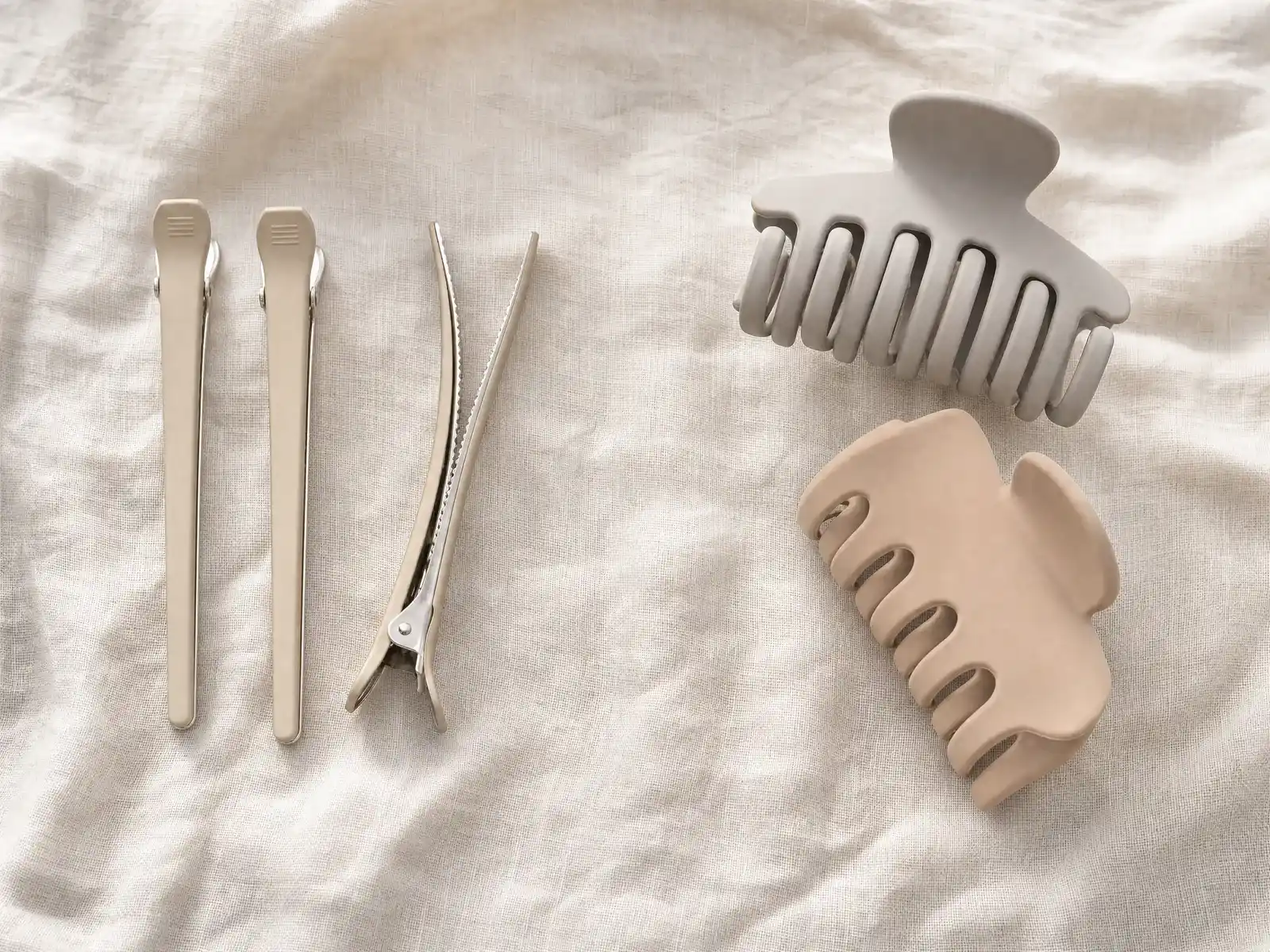
- Sectioning Clips vs Claw Clips: The Short Verdict
- How Each Clip Holds Hair: Sheet Versus Rope
- Alligator Clips vs Claw Clips: Where the Names Blur
- Styling Clips vs Claw Clips for a Blow-Dry
- Crease and Dent Risk Runs Both Ways
- Sectioning Clips or Claw Clips for All-Day Wear
- Hair Type Shifts the Answer More Than Price Does
- When to Use Each: The Decision List
- The Bottom Line
The honest answer to sectioning clips vs claw clips is that they are not really competitors: one holds a flat sheet of hair still for four minutes while you work beside it, the other cages a twisted rope for eight hours while you get on with your day.
Different geometry, different job.
Pick the wrong family and the failure is immediate. A claw clip asked to hold a combed-flat quadrant for a blow-dry creeps and drops, because a claw has nothing to bite into. A sectioning clip asked to carry a full twist through a workday either gives up or digs in. If you want the hardware picture before the decision, our guide to hair sectioning clips covers types, sizes and materials. This article is narrower: which of the two to reach for, and the physical reason why.
Sectioning Clips vs Claw Clips: The Short Verdict
| Axis | Sectioning clips | Claw clips |
|---|---|---|
| What it holds | A combed-flat sheet of hair | A twisted or folded mass of hair |
| Where grip comes from | Spring force along a straight jaw, plus interlocking teeth | Two curved combs closing around volume |
| Designed wear time | Minutes, while you work on something else | Hours, as the finished style |
| How it sits | Flat to the head, clear of a round brush | Proud of the head, meant to be seen |
| Typical failure | Section too dense for the jaw, so the jaws bow open | Hair too flat, short or slick to fill the claw |
| Mark it can leave | A straight line across the strand | A soft bend where the hair folded |
Everything below is the reasoning behind that table, because the edge cases are where people get it wrong.
How Each Clip Holds Hair: Sheet Versus Rope
A sectioning clip is a line-contact tool.
Its spring pushes two straight jaws together along their whole length, and most versions add interlocking teeth that press the hair into a shallow wave so a section cannot slide out as a sheet. That design carries one requirement: the hair has to arrive flat. Give a toothed jaw a combed sheet and the spring force distributes across every strand in the section. Give the same jaw a twisted lump and all of that force lands on a contact patch about the width of your thumb.
A claw clip inverts nearly every part of that. Two curved, toothed combs are hinged at the back under spring load, and they close around a mass rather than across a plane. A claw does not flatten hair; it needs the hair to fill the cavity so the two rows of teeth can mesh through it and lock. That is why twisting first improves a claw's hold — the twist manufactures the volume the clip was built to close on — and why the same clip slides out of a thin, smooth, freshly brushed section within a minute.
So the two tools fail in opposite directions. A sectioning clip fails on too much hair. A claw clip fails on too little.
Alligator Clips vs Claw Clips: Where the Names Blur
Most of the confusion here is a retail problem rather than a hair problem.
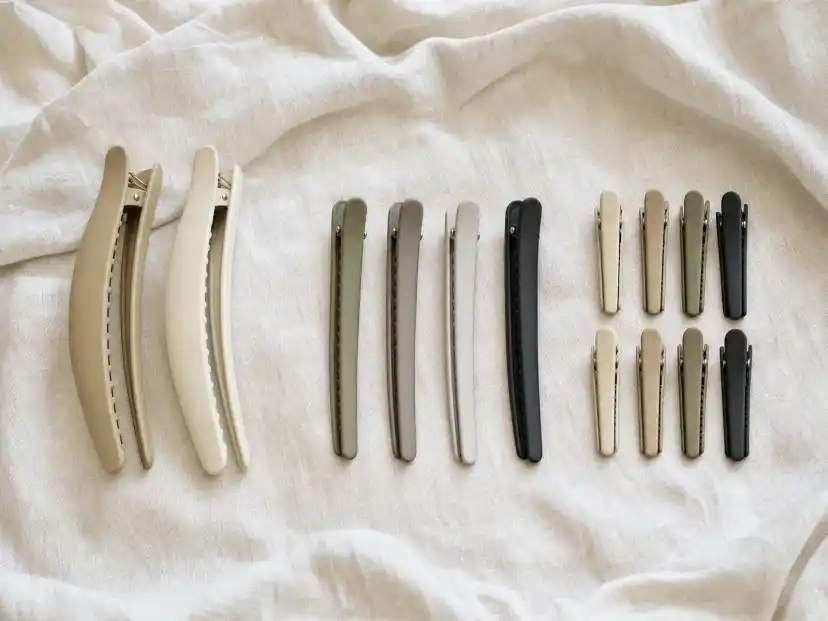
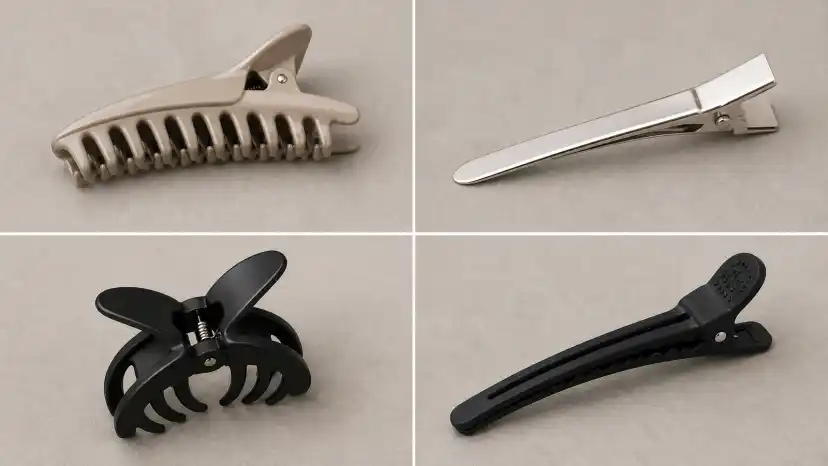
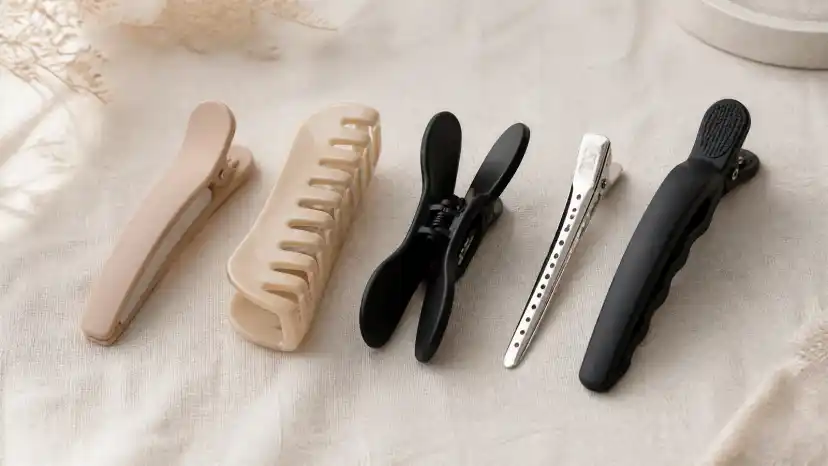
Search for sectioning clips and half the listings use "alligator", "croc" and "duckbill" interchangeably for the same long-jawed tool, while "claw" and "butterfly" get swapped around too. The useful split is structural: one straight jaw is a sectioning clip, two curved combs on a hinge is a claw.
Hair brand Mane's guide to sectioning clips sorts the professional end of that family by job rather than by name:
- Croc or alligator clips are, in that guide's words, "ideal for sectioning off larger amounts of hair or a thicker, coarse hair type", and it notes they work well with the round of the head.
- Plastic duckbill clips are for "styling dry hair when you want to avoid indents or clip marks", and for "fragile hair that can't take the grip of stronger sectioning clips".
- Metal duckbill clips it rates for heat styling and especially wet styling, with one hard limit: the same guide warns that "metal duckbill clips are not to be used with hair color application unless otherwise specified". Carry that into any at-home color or root touch-up session, where clip material matters as much as the parting map.
- Butterfly clips it calls "the best sectioning clip for anyone with uber-thick hair type", holding any small or large amount of hair, wet or dry. The stated tradeoff is real: a butterfly has no bill, so you often comb the part line in first rather than letting the clip do it.
Notice what is missing from that taxonomy. Claw clips are not in it at all. The clip families stylists keep on a trolley are sorted by how precisely they can place and hold a parting, and a claw does not compete on that axis — which is a description of what it was built for rather than a criticism.
Styling Clips vs Claw Clips for a Blow-Dry
This is where the two get swapped in real bathrooms, and where the swap costs you the most time.
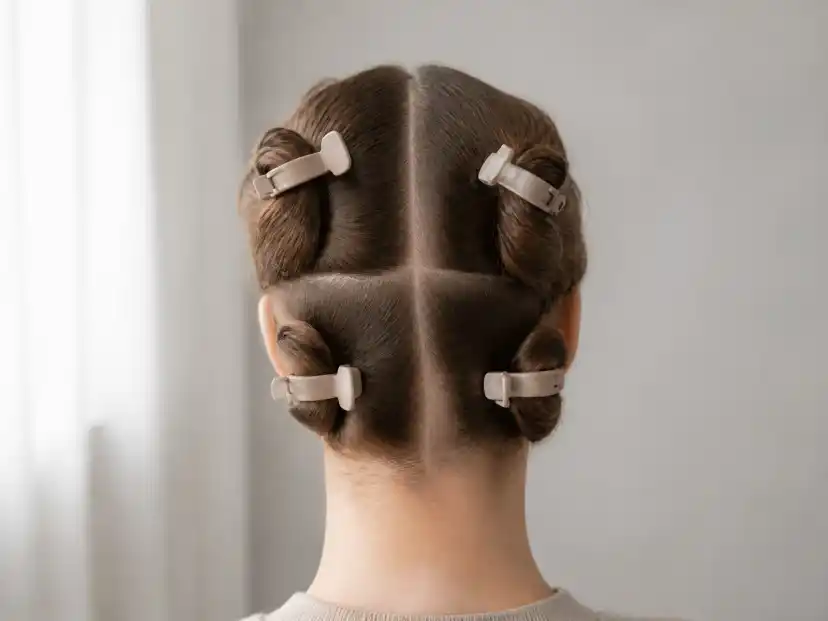
Mane's blow-dry sectioning guide describes the standard map in three parts: "the nape, the occipital bone and areas above and around the ears, and the top (or everything around the crown)". It has you dry the nape first because more moisture lives in that area, then work upward, and it notes that depending on your hair's thickness you may need two sectioning clips for the middle section rather than one. That count question is its own rabbit hole, and we worked through how many clips a home setup actually needs separately.
Three things go wrong when a claw clip stands in.
It forces you to twist. Getting a claw to hold at all means gathering and twisting, which converts a tidy horizontal section into a rope. Ropes dry unevenly, and the parting line you combed in disappears as soon as the hair is gathered.
It sits proud of the head. A claw is designed to be seen, so it tends to stand off the scalp — exactly the space a round brush needs when you reach the section underneath.
It releases everything at once. A sectioning clip opens, slides down a slice and re-closes on the hair you just finished. Open a claw and the whole mass drops over your work. Re-clipping finished hair up and out of the airflow is what makes a blowout efficient, and it is a straight-jaw move. Our step-by-step sectioning walkthrough covers that order of operations in detail.
Crease and Dent Risk Runs Both Ways
Both clips can mark hair. They mark it differently, which changes how you avoid it.
A sectioning clip leaves a straight line, because a toothed jaw on damp hair is a defined edge pressing on a pliable fiber. The industry's answer is to remove either the teeth or the pressure. Professional brand Sam Villa sells its dry sectioning clips for sectioning before highlighting, dry cutting or styling, and the product copy claims they "never slip, slide or leave marks in the hair", with a silicone band inside each clip giving grip described as working on everything "from baby-fine to coarse and curly". Treat that as manufacturer copy rather than independent testing, though the pattern holds across the category: a smooth or silicone-lined contact face instead of interlocking teeth. Mane's advice points the same way from the material side, assigning plastic duckbills to dry styling specifically to avoid indents and clip marks.
A claw clip leaves a bend, not a line. Hair is folded over itself and held in a curve for hours, so what you see on release is a wave through the mid-lengths rather than a crimp at one point. On a style you were going to re-brush anyway that is a non-issue. Before a photo, it is not.
The practical rule: into damp hair, prioritize a smooth contact face, and clips chosen specifically not to dent are the usual fix. Into dry hair you plan to wear down later, a claw's fold is the gentler of the two marks.
Sectioning Clips or Claw Clips for All-Day Wear
Here the claw clip wins outright, and the reason is dose rather than build quality.
A sectioning clip is a minutes tool. Nothing about a short, strong jaw is built for eight hours against a scalp, and the stronger the spring, the less you want it parked in one spot. A claw spreads its load across two long combs and a folded mass of hair, which is why it is the format people actually wear out of the house — our full claw clip guide covers the sizing and shape decisions that follow.
Long wear is also where tension stops being theoretical. The American Academy of Dermatology lists "buns, ponytails, and up-dos that are tightly pulled" among the styles that can cause traction alopecia when they are too tight, notes that "your hairline is one of the first places you can see traction alopecia", and gives a rule that transfers cleanly to clips: "If your hairstyle feels painful, the style is too tight." Its advice is to loosen the style so it does not pull, and to change it immediately if pulled hair is causing pain.
Clip-specific guidance runs along the same lines. A widely syndicated beauty feature on claw clips, “The Truth About Claw Clips — And Whether They’re Damaging Your Hair,” which quotes New Jersey salon owner and hairstylist Michelle Cleveland and Los Angeles dermatologist Dr. Mina Amin, concludes that claw clips can cause breakage when they are fastened too tightly or used in the same spot repeatedly; celebrity hairstylist Jennifer Korab, quoted in the same piece, recommends clips with smooth edges, since sharp edges can snag strands. None of that makes claw clips damaging by default. It makes placement and wear time the variables that matter, and moving the clip between wears tends to help more than upgrading it.
Hair Type Shifts the Answer More Than Price Does
Density decides which failure mode you meet first.
Thick, coarse hair overwhelms short jaws, which is why Mane's guide pushes very thick hair toward butterfly clips and coarse textures toward crocs; the butterfly is the one that guide says will hold any small or large amount of hair, wet or dry. On the claw side, dense hair is the easy case: there is plenty of volume to fill the cavity. Fine hair has the mirror-image problem. Mane routes fragile hair to plastic duckbills on the grounds that it cannot take the grip of stronger sectioning clips, and a small, smooth section may never fill a claw's jaws enough for the teeth to mesh. Curls land in between: the volume helps a claw, while the spring in the hair means a toothed jaw can set a visible section line.
When to Use Each: The Decision List
- Blow-drying, flat-ironing, curling — sectioning clips. You need flat sections, low-profile hardware and the ability to re-clip finished hair.
- Color, highlights, root touch-ups — sectioning clips, in plastic. Precise partings plus a material that will not react with the product.
- Parking your hair to wash your face, cook or train — claw clip. Nothing needs to stay parted.
- A finished style you will wear for hours — claw clip, every time.
- Air-drying curls in sections — either, leaning claw, since clipped volume is the point and no brush needs to get past.
- Keeping a fringe off your forehead for five minutes — the smallest clip you own, probably a duckbill.
Honest limitation: for one quick section on fine hair, a mini claw genuinely works, and nobody needs a dedicated kit to hold half their hair up while they dry the other half. The case for sectioning clips strengthens as the job gets more precise.
The Bottom Line
The comparison resolves as soon as you stop treating it as a ranking.
Sectioning clips hold a deliberately parted sheet of hair still and out of the way while you work next to it. Claw clips hold a twisted mass up as a style for hours. The straight jaw and the curved combs answer different questions, and each is poor at the other one. The only real mistake is asking a claw to keep a parting line, or asking a toothed sectioning clip to be comfortable all afternoon.
If the clips themselves are the limiting factor — sections bowing the jaws open, lines on a fresh blow-dry, a claw that will not stay put — the complete hair sectioning clip guide is the next stop.
Frequently Asked Questions
Can you use a claw clip to section hair?
Are alligator clips and claw clips the same thing?
Which is gentler on hair, a sectioning clip or a claw clip?

Donna Miller
Enjoyed This Guide?
Get more hair tips and product recommendations delivered weekly.