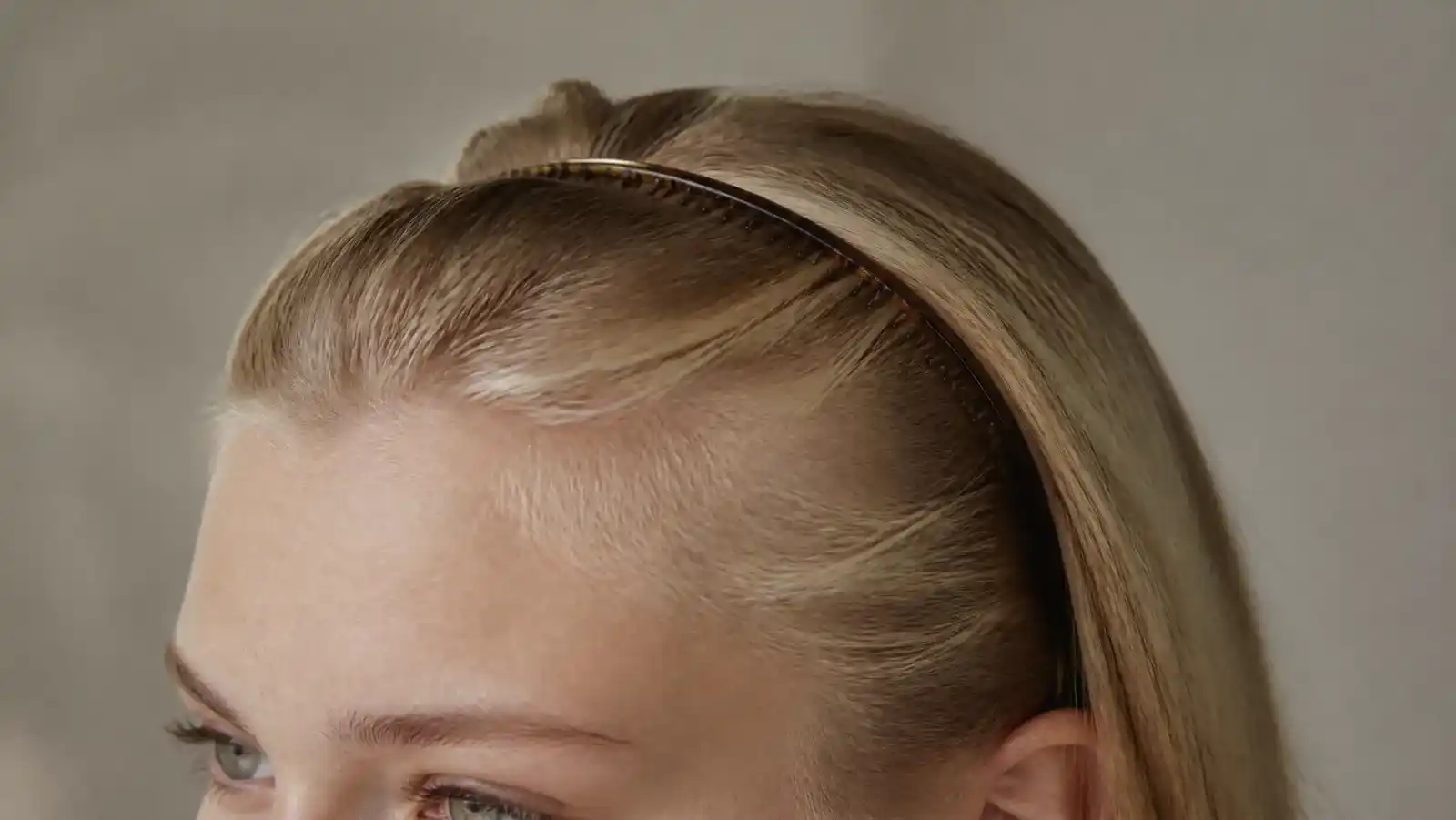
- Fine hair and thin hair are two different problems
- Why the tighter band always fails
- What to look for in the best headbands for thin hair
- Thin Velvet Headbands with Teeth: our pick for fine hair
- lumitrail Silicone Comb Headbands: best for all-day comfort
- JOBAND Non-Slip Zig Zag Teeth Headbands: best grip-to-width ratio
- Duufin Teeth Comb Headbands: best multi-pack
- JJUNW Toothed Plastic Headbands: best budget pick
- How to wear a headband on fine hair without causing breakage
- The bottom line
The best headbands for thin hair grip with teeth or texture, not tension. Fine hair gives a smooth band almost nothing to hold on to, so the band answers by squeezing — and squeezing is what causes the sliding, the sore hairline and the headache. Buy grip mechanically and you can wear the band loose. We may earn a commission from links on this page, at no cost to you.
That is the whole argument, and it is the opposite of the advice most people follow, which is to keep sizing down until something finally stays put. Below: why fine hair defeats ordinary bands, the four specs worth checking, and five toothed or textured bands from $5.49 to $13.99 (prices as of September 2026) that hold without clamping. If you want the underlying rules on how a headband should fit before you shop, start there and come back.
Fine hair and thin hair are two different problems
Worth separating, because they need different things from a band. Speaking to PureWow, hair transplant surgeon Dr. Rae Lynne Kinler described the distinction plainly: fine hair comes down to the thickness of each individual strand, while thin hair is about density. Colour specialist Seamus McKernan, in the same piece, made the point that the two travel independently — it is possible to have fine hair at very high density, or coarse hair that is thinning.
The numbers make it concrete. According to Carol's Daughter's hair-texture guide, a fine strand measures roughly 50 microns across, which is about half the thickness of a sheet of printer paper, while a coarse strand runs around 120 microns, nearly double. The same guide suggests a test you can do at the bathroom sink: lay one shed strand next to a piece of sewing thread. Thinner than the thread is fine hair.
Fine hair is a friction problem. Thin hair is a volume problem. Fine strands are slick and narrow, so there is very little surface for a band to rub against. Low density means there is simply less hair in the band's path, so a band sized for an average head arrives at your scalp sooner and presses harder. Most readers have some of both, which is why a band that grips mechanically and sits light solves the pair of them at once.
If your hair is the other extreme — dense, heavy, pushing bands up and off — the failure mode is inverted and so is the fix. Our guide to the Best Headbands for Thick Hair That Don't Slip or Pinch covers that case, where width and padding matter more than teeth.
Why the tighter band always fails
Tension is the wrong lever, for two reasons.
The first is mechanical. A band held on by friction alone needs the friction to exceed the forces trying to move it. On fine hair the available friction is low, so the only variable left is clamping force. Crank that up and the band stores more elastic energy, which means that when it finally does start to move — and it will, every time you laugh or lean forward — it moves faster and further. A tighter band on fine hair is a band that slips more dramatically, not less.
The second is physiological. Sustained compression around the head has a formal diagnosis attached to it. The ICHD-3 entry for external-compression headache describes headache resulting from sustained compression of pericranial soft tissues, for example by a tight band around the head, hat or helmet, and its criteria require the pain to be brought on by and to occur within one hour during that compression. A 2024 narrative review by Ole Hensel and Torsten Kraya in the journal Brain and Behavior lists headbands and hairbands explicitly among the triggers, alongside tight hats, helmets, goggles, hijabs and headphones. We go further into that mechanism in our piece on external compression headaches from hair clips.
There is a hair-health cost too, and on thinning hair it is the one that matters. The American Academy of Dermatology warns that hairstyles which repeatedly pull on the hair can lead to traction alopecia, and that once it advances far enough the hair cannot grow back. Its test is one sentence long: if your hairstyle feels painful, the style is too tight. For the wider picture, see are headbands bad for your hair.
What to look for in the best headbands for thin hair
Four specs, in the order we would check them.
- Teeth, and how long they are. Teeth are the single biggest upgrade for fine hair. They reach past the slippery surface layer and hold hair between them, so grip stops depending on how hard the band presses. Longer teeth reach deeper. A listed tooth length near 1.5cm is doing real work; a token ridge on the underside is not.
- A high-friction surface, not a pretty one. Velvet, sueded fabric and textured silicone all raise the coefficient of friction against hair. According to TRI Princeton, a hair-science research institute, testing by Dr. Ernesta Malinauskyte, Dr. Xuzi Kang and Dr. Marcella Gabarra found velvet registered 37.4 percent more friction than cotton and 76.5 percent more than satin. That makes satin the wrong outer layer if you want the fabric itself to hold, and velvet close to the best.
- Light and narrow beats wide here. This is where fine-hair advice diverges from everything we say about dense hair. With less hair to hold, a heavy wide band has more mass to keep in place and nothing to brace against, so it sinks to the scalp and presses. A thin band with good teeth outperforms a wide band with none.
- Adjustability, if your head is between sizes. Fixed plastic hoops come in one circumference. A wire-cored band can be bent open or closed, which lets you set pressure deliberately rather than accept whatever the mould produced.
Format matters as much as spec. If you are still deciding between a hoop, a wrap, a padded band and a knotted one, Types of Headbands Explained: 12 Styles and What Each Does is the faster way to narrow the field before you compare products.
Thin Velvet Headbands with Teeth: our pick for fine hair
The Thin Velvet Headbands with Teeth win because they run two grip mechanisms at once. The frame is a wavy zig-zag plastic hoop, so the band itself weaves in and out of the hair instead of resting on top of it, and the listing describes the anti-slip velvet covering as what holds hair in place. Put the TRI Princeton friction figures next to that and velvet is close to the best surface you can wrap a band in when you actually want hold.
The rest of the spec is restraint. The listing calls these lightweight and thin, which on fine hair is a feature and not a compromise: less mass to keep seated, less bulk sitting on a visible scalp. Three colours — black, wine red and brown — for $7.99 as of September 2026.
Who it is not for: anyone who wants a band they can barely feel. Zig-zag frames announce themselves against the scalp.
lumitrail Silicone Comb Headbands: best for all-day comfort
The lumitrail Silicone Comb Headbands are the answer to a specific complaint, which is a band that is fine at 9am and a headache by 2pm. lumitrail builds these on a memory metal wire core under a silicone outer layer, and states that the tightness is adjustable by bending the wire. That is the rare spec on this page that lets you tune pressure rather than shop for it.
Grip comes from comb teeth plus anti-slip points on the silicone, so again the hold is mechanical rather than compressive. The maker describes the micro-fold ends as having no pressure points, which is a claim rather than a measurement, though the reasoning behind it is sound — the ends of a hoop are where pressure concentrates, because the skull narrows and the band does not. Two bands, tortoise and black, at $13.99 as of September 2026.
Who it is not for: anyone who wants to buy once and never think about it. Wire you can bend is also wire that can be bent out of shape.
JOBAND Non-Slip Zig Zag Teeth Headbands: best grip-to-width ratio
The JOBAND Non-Slip Zig Zag Teeth Headbands have the most interesting numbers here. JOBAND lists the band at about 0.8cm wide and the teeth at about 1.5cm long — the gripping element is nearly twice the width of the band carrying it. On fine hair that ratio is exactly what you want, because it puts the hold deep in the hair and keeps the part touching your scalp narrow and light.
JOBAND also says the teeth are positioned to control the short hairs near the forehead, which is the most common reason fine-haired wearers give up on bands altogether, and that the tooth position can be adjusted, more easily after warming the band with a hair dryer. Treat the hair-dryer trick as the maker's instruction rather than our recommendation. Four bands in a resin and cotton blend, $13.88 as of September 2026.
Who it is not for: sensitive scalps that dislike hard teeth. Resin teeth are unforgiving compared with silicone.
Duufin Teeth Comb Headbands: best multi-pack
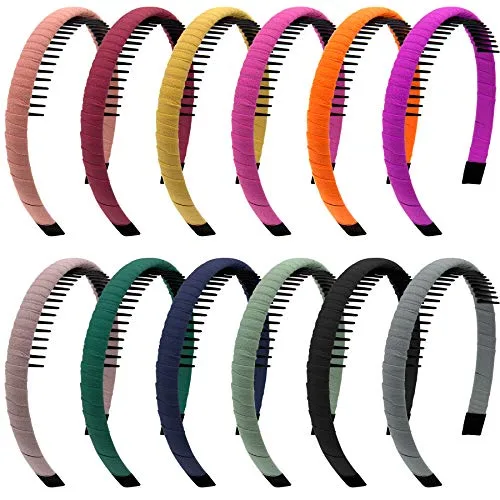
The Duufin Teeth Comb Headbands are the volume option: twelve bands in twelve colours for $9.99 as of September 2026. Duufin lists them at approximately 12cm in diameter and 13.5cm in height, with a band width of about 1cm, built as a toothed plastic frame under a satin fabric covering.
Be clear about which part is working. Satin sat near the bottom of the TRI Princeton friction comparison — velvet registered 76.5 percent more friction, and TRI reports luxury silk was the smoothest material it tested — so satin is the decorative layer here, not the grip layer, and the teeth are carrying the whole load. That is acceptable on fine hair, where teeth are the mechanism we wanted anyway, but it does mean this is a toothed band in a pretty coat rather than a textured band in the sense our top pick is.
Who it is not for: anyone hoping the fabric will add hold. It will not. Buy this for colour choice.
JJUNW Toothed Plastic Headbands: best budget pick
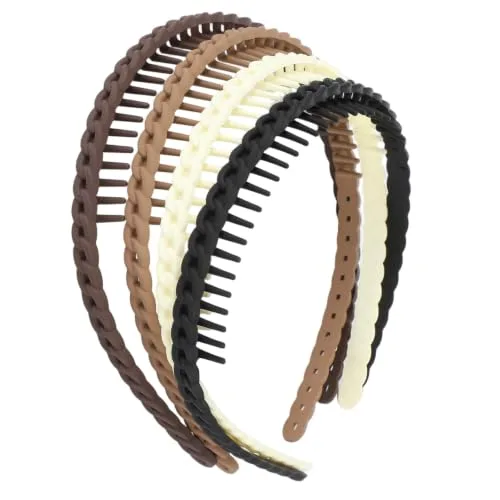
The JJUNW Toothed Plastic Headbands exist to answer one question cheaply: do teeth work on your hair? Four bands in black and white for $5.49 as of September 2026, built on a lightweight plastic frame with the teeth placed along it for grip. No velvet, no wire, no satin.
We would not expect these to be the band you wear to a wedding. We would expect them to tell you, for the price of a coffee, whether you should spend $13.99 on an adjustable silicone one — and that is a genuinely useful thing for a cheap accessory to do. Light is the operative spec, and plain plastic is light.
Who it is not for: long days. Bare plastic teeth on a bare scalp get noticed eventually.
How to wear a headband on fine hair without causing breakage
Placement does as much work as the product.
- Seat it at the hairline first, then push back. Set the band where you want it and let the teeth engage as you ease it backwards. Dragging a toothed band forward over the crown rakes it against the hair growth direction.
- Let the teeth take the hold, and stop there. Once the band is engaged, resist the instinct to push it tighter. On fine hair the extra pressure buys no extra grip — it only buys the sore spot.
- Move it a few millimetres every day. The AAD advises switching up your hairstyle regularly so your hair can recover from tight styles. The same band in the same line day after day concentrates stress on one narrow strip of hairline.
- Stop at the first warning sign. The AAD says to change your hairstyle immediately if you notice pain from tightly pulled hair, stinging on your scalp, crusts, or tenting. On hair that is already thinning, that is not a suggestion to ration.
- Keep a second format in rotation. A band and a clip do not stress the same places. Our picks for the Best Barrettes for Fine Hair: Lightweight Picks That Actually Hold cover the alternative for days when you want the hairline left alone entirely.
The bottom line
On fine and thin hair, the band that stays put is never the band that grips hardest — it is the one that grips differently. Teeth beat tension. Velvet and textured silicone beat satin and smooth plastic. Light and narrow beat wide and padded, which is the exact reverse of what we would tell someone with dense hair. Start with the velvet toothed three-pack at $7.99 if you want the best odds cheaply, and move to the adjustable lumitrail band if pressure rather than slipping is your real complaint. For the fuller view of shapes, materials and fit across the whole category, our complete headband guide is the place to go next.
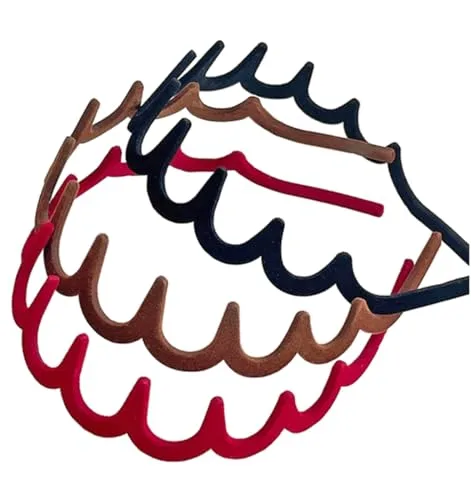
Thin Velvet Headbands with Teeth (3 Pack)
This is the combination we would buy for fine hair: a zig-zag plastic frame that weaves through the hair rather than resting on top of it, wrapped in velvet, which is one of the highest-friction surfaces you can put against a hair shaft. Two grip mechanisms working at once means the band does not need to be tight, and tight is what fine hair cannot afford.
“Three colours of a genuinely lightweight band that grips by shape and surface instead of squeezing....”
We tested dozens of claw clips to find the very best options. Below you'll find our complete ranking, with detailed reviews and real customer feedback for each pick.
The Complete Ranking
Thin Velvet Headbands with Teeth (3 Pack)
“Three colours of a genuinely lightweight band that grips by ...” — Verified Buyer
This is the combination we would buy for fine hair: a zig-zag plastic frame that weaves through the hair rather than resting on top of it, wrapped in velvet, which is one of the highest-friction surfaces you can put against a hair shaft. Two grip mechanisms working at once means the band does not need to be tight, and tight is what fine hair cannot afford.
“Three colours of a genuinely lightweight band that grips by shape and surface instead of squeezing.”
— Verified Buyer
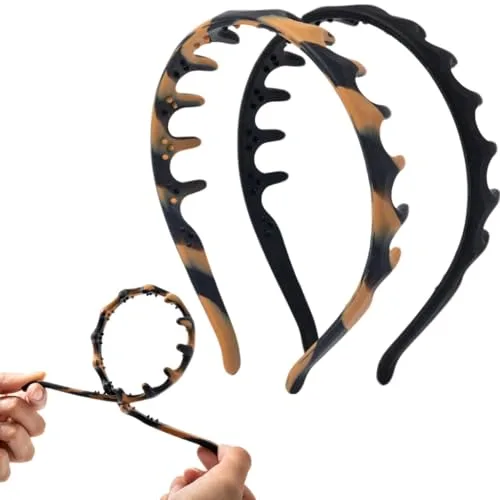
lumitrail Silicone Comb Headbands (2 Pack)
“Bendable wire means you can dial the pressure down instead o...” — Verified Buyer
The only band here whose tension you can actually set: a memory metal wire core inside a silicone sleeve, bent tighter or looser to suit your head. For anyone whose real complaint is a sore spot above the ears by mid-afternoon, an adjustable frame solves a problem that no amount of shopping around a fixed-size band will.
“Bendable wire means you can dial the pressure down instead of living with whatever the factory set.”
— Verified Buyer
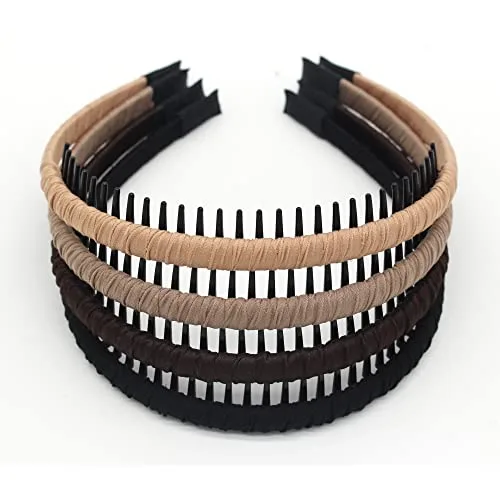
JOBAND Non-Slip Zig Zag Teeth Headbands (4 Pack)
“Long teeth reach past the surface layer and catch the short ...” — Verified Buyer
A listed 0.8cm band carrying listed 1.5cm teeth, which means the gripping part is nearly twice the width of the band it hangs from. That ratio is the whole argument for toothed bands on fine hair: hold comes from how far the teeth reach into the hair, not from how hard the band presses on the scalp.
“Long teeth reach past the surface layer and catch the short hairs that usually escape at the forehead.”
— Verified Buyer
Duufin Teeth Comb Headbands (12 Pack)
“Twelve colours at this price makes matching a band to an out...” — Verified Buyer
Twelve colours of a listed 1cm toothed band under a satin wrap. The satin is the cosmetic layer rather than the working one, so the teeth are doing all of the holding here, which is fine on fine hair and worth knowing before you buy it expecting a grippy surface.
“Twelve colours at this price makes matching a band to an outfit a non-decision.”
— Verified Buyer
JJUNW Toothed Plastic Headbands (4 Pack)
“Four bands for the price of a coffee, and light enough that ...” — Verified Buyer
The cheapest way to find out whether teeth are the answer for your hair before committing to anything nicer. A plain lightweight plastic frame with the teeth placed along it, in black and white, and nothing else going on.
“Four bands for the price of a coffee, and light enough that you forget you have one on.”
— Verified Buyer
Three colours of a genuinely lightweight band that grips by shape and surface instead of squeezing.
Quick Comparison
A side-by-side look at our top picks
Frequently Asked Questions
Why do headbands always slip off my fine hair?
Are headbands bad for thin or thinning hair?
What are the best headbands for older women with thin hair?

Donna Miller
Enjoyed This Guide?
Get more hair tips and product recommendations delivered weekly.