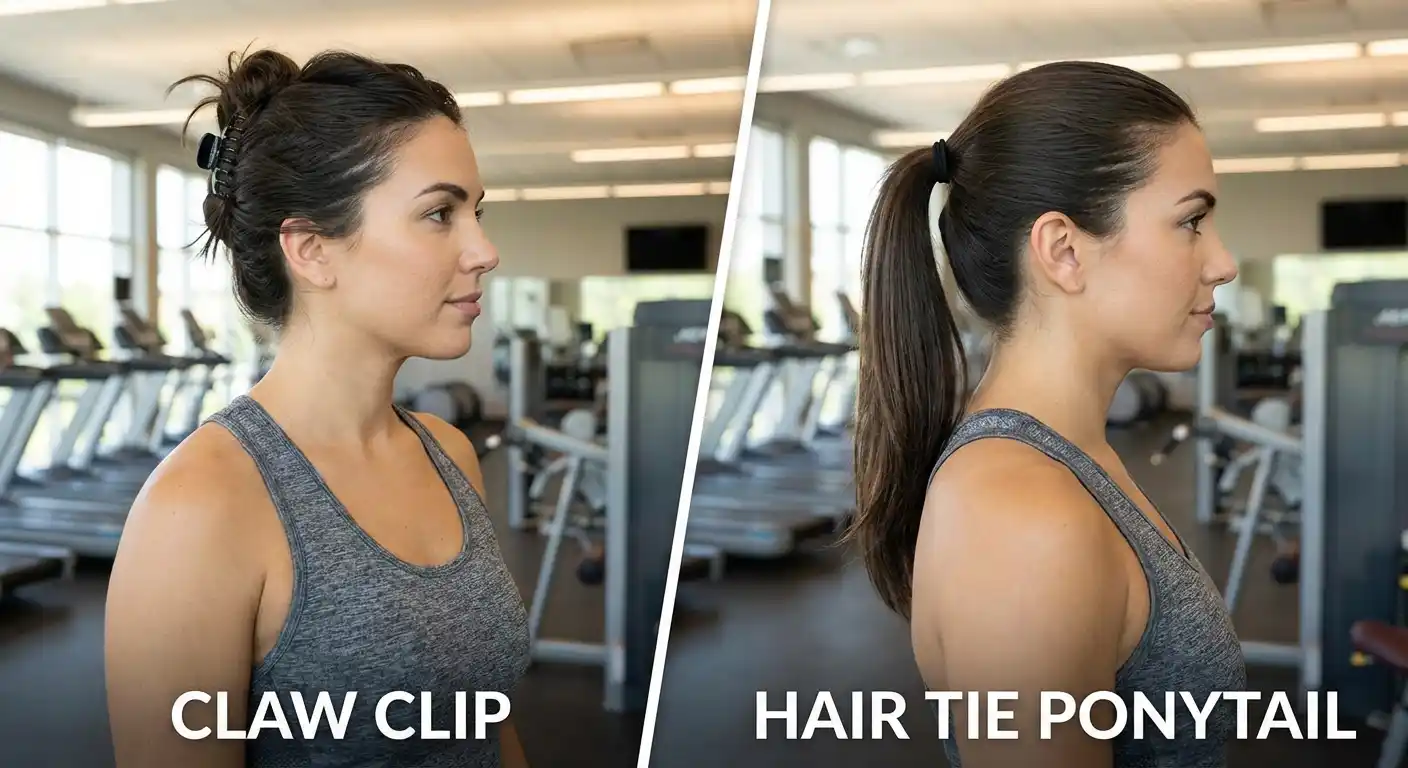
Hair ties have been the gym default for decades. But claw clips offer real advantages—if you use them right.
The question isn't which is "better" overall. It's which is better for your specific workouts, hair type, and priorities. Both have clear strengths and weaknesses that matter during exercise.
We've tested both extensively across every workout type. Here's the honest breakdown.
For claw clip recommendations, see best claw clips for the gym. For our existing comparison, check claw clips vs hair ties: which is better?.
The Workout Comparison Table
| Factor | Claw Clips | Hair Ties | Winner |
|---|---|---|---|
| Hair health | Much better | More damaging | Claw Clips |
| Security (high-impact) | Good with technique | Better | Hair Ties |
| Security (moderate) | Excellent | Good | Claw Clips |
| Comfort (long sessions) | Better | Can cause headaches | Claw Clips |
| Floor work | Better (with flat clips) | Ponytail bumps | Claw Clips |
| Ease of use | Learning curve | Instant | Hair Ties |
| Post-workout appearance | More polished | Basic | Claw Clips |
| Works on wet hair | Poorly | Well | Hair Ties |
| Price for quality | Higher | Lower | Hair Ties |
| Breakage over time | Minimal | Significant | Claw Clips |
Summary: Claw clips win on hair health, comfort, and styling. Hair ties win on security and simplicity. Neither is universally better.
The Hair Health Factor
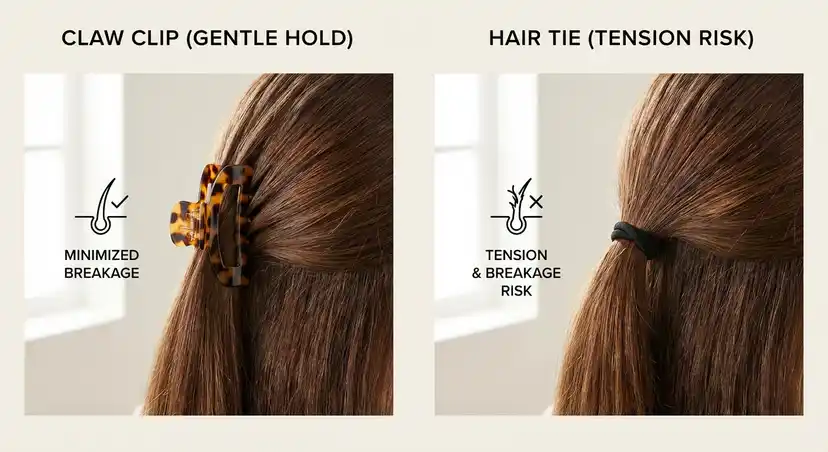
This is the biggest difference, and it compounds over time.
How Hair Ties Damage Hair
Tension damage:
- Constant pulling at hairline
- Stress on the same spots daily
- Can contribute to traction alopecia with repeated tight use
Breakage points:
- Where tie wraps around hair
- Where metal clasp (if present) contacts hair
- Where hair bends sharply over elastic
The crease problem:
- Hair bends at a sharp angle
- Repeated creasing weakens hair structure
- Creates breakage at that point
How Claw Clips Are Gentler
Distributed pressure:
- Weight spreads across entire clip
- No single point of high tension
- Hair isn't wrapped or bent sharply
No crease damage:
- Hair lies naturally in the clip
- Remove clip, hair falls without marks
- No repeated bending at same point
Less pulling:
- No tension at hairline
- Clip holds by gripping, not stretching
- Can be adjusted without removing
Long-Term Impact
If you work out 5x per week:
| Timeframe | Hair Tie Impact | Claw Clip Impact |
|---|---|---|
| 1 month | Minor breakage | Minimal |
| 6 months | Noticeable thinning at tie point | Minimal |
| 1 year | Significant breakage, possible hairline recession | Still minimal |
| 5 years | Serious cumulative damage | Hair health maintained |
For daily gym-goers, this is the most compelling reason to switch to claw clips.
The Security Factor
Hair ties have a genuine advantage for high-impact activity.
When Hair Ties Hold Better
Maximum impact activities:
- Running (especially long distance)
- HIIT with lots of jumping
- Box jumps and plyometrics
- Rope jumping
Why they hold:
- Elastic maintains constant tension
- No mechanical parts to fail
- Tested by millions of athletes
When Claw Clips Hold Just As Well
Moderate-impact activities:
- Weightlifting
- Yoga and Pilates
- Cycling and spinning
- Walking and hiking
- Moderate cardio
With proper technique:
- The double-twist lock (see gym styling guide)
- Metal-spring clips with matte surfaces
- Correct positioning for activity
The Technique Gap
Hair ties require almost no technique. Claw clips require learning:
- How to twist hair correctly
- Where to position for each activity
- Which clip type for which workout
This learning curve is real, but the techniques are simple once learned.
Comfort Comparison
For longer workouts, claw clips typically win on comfort.
Hair Tie Discomfort
Common complaints:
- Tension headaches after 30+ minutes
- Pulling at temples and hairline
- Having to loosen mid-workout (reduces security)
- Sore spots where tie sits
The tightness trap:
- Loose = hair falls
- Tight = discomfort
- Hard to find middle ground
Claw Clip Comfort
Advantages:
- No constant tension
- Can reposition without removing
- No hairline pulling
- Comfortable for extended sessions
Potential issues:
- Wrong clip can dig into scalp
- Poor positioning causes pressure points
- Solved by: flat clips for floor work, proper sizing
Floor Work Differences
During ab work, yoga, or Pilates:
Hair ties: Ponytail creates a bump when lying down. Either uncomfortable or forces you to position head oddly.
Claw clips: Flat-back clips lie flush. No bump, no discomfort. Clear advantage for floor-based exercises.
Workout Type Recommendations
Best Choice by Activity
| Workout | Recommended | Why |
|---|---|---|
| Running (5K+) | Hair tie | Maximum security for duration |
| Running (short) | Either | Both work for shorter distances |
| HIIT | Hair tie | Jumping demands security |
| CrossFit | Hair tie | Too varied to rely on clips |
| Weightlifting | Claw clip | Comfort for long sessions, no jumping |
| Yoga | Claw clip | Flat clips for floor work |
| Pilates | Claw clip | Same—floor work needs flat clips |
| Spinning | Either | No impact, no floor work |
| Swimming | Hair tie | Clips can open on water impact |
| Walking/Hiking | Claw clip | Hair health for regular activity |
| Stretching | Claw clip | Comfort priority |
The Hybrid Approach
The smartest athletes use both.
Example: Mixed Workout
Warm-up (10 min): Claw clip
- Comfortable for stretching
- Easy to adjust
- Looks polished if arriving from elsewhere
Main workout - HIIT (30 min): Hair tie
- Maximum security for jumping
- No adjustment needed
Cool-down (10 min): Claw clip
- Comfort for stretching
- Transitions well to post-gym activities
Keep Both in Your Gym Bag
One small hair tie takes zero space. Having both options means using the right tool for each portion of your workout.
Breaking the Hair Tie Habit
If you want to try claw clips for workouts, here's how to transition:
Start with Lower-Impact Workouts
- Week 1: Use clips for warm-up/cool-down only
- Week 2: Add clips for weightlifting
- Week 3: Add clips for yoga/Pilates
- Week 4: Try clips for moderate cardio
Keep Hair Ties as Backup
Don't throw away your hair ties. Keep them for:
- High-impact activities
- Days your clip fails
- Backup if you forget clip technique
Learn Proper Technique
The double-twist lock makes the biggest difference. See how to use a claw clip at the gym for complete instructions.
Special Considerations
For Very Long Hair
Hair ties: Work well but create more damage at contact point Claw clips: Need larger size (XL) and possibly double-clip technique
Long hair benefits most from claw clips due to cumulative breakage from hair ties.
For Very Thick Hair
Hair ties: May need multiple ties or thick elastic bands Claw clips: Need XL sizing with strong springs (see thick hair gym clips)
For Fine Hair
Hair ties: Cause noticeable breakage over time Claw clips: Need textured surfaces for grip (see fine hair clips)
Fine hair is most fragile—claw clips' gentleness matters most here.
For Curly Hair
Hair ties: Disrupt curl pattern, cause frizz Claw clips: Preserve curls better, less frizz when removed
Curly hair definitely benefits from claw clips.
FAQ
Is it bad to wear a hair tie every day for workouts?
Yes, daily tight hair tie use can cause breakage and traction alopecia over time. If you work out daily, consider alternating with claw clips or using them for lower-impact portions.
Do claw clips work for marathon running?
For most marathons, hair ties are more reliable. The 3-4 hour duration with constant impact tests even the best clips. Some runners use clips successfully with double-twist technique, but hair ties are the safer choice for race day.
Can I use both in the same workout?
Absolutely. Many people clip for warm-up, tie for intense portions, clip for cool-down. Use the right tool for each phase.
Which is better for hair health?
Claw clips, clearly. Less tension, no crease damage, no hairline pulling. The difference is significant for daily gym-goers.
Why don't more athletes use claw clips?
Habit and simplicity. Hair ties have been the default forever. Claw clips require learning technique. But the hair health benefits are driving more athletes to switch.
The Bottom Line
Claw clips are better for:
- Hair health (significant long-term advantage)
- Comfort during longer sessions
- Floor work and yoga
- Post-workout appearance
- Daily exercisers
Hair ties are better for:
- Maximum security during high-impact
- Simplicity (no technique needed)
- Swimming
- Running races
The best approach: Use both. Claw clips for most activities, hair ties for high-impact portions. Your hair will thank you.
For claw clip recommendations, see best claw clips for the gym. For styling techniques, see how to use a claw clip at the gym. For the complete workout hair guide, see our ultimate guide to claw clips for working out.
Frequently Asked Questions
The hair health factor
The security tradeoff
Why not both?

Donna Miller
Enjoyed This Guide?
Get more hair tips and product recommendations delivered weekly.