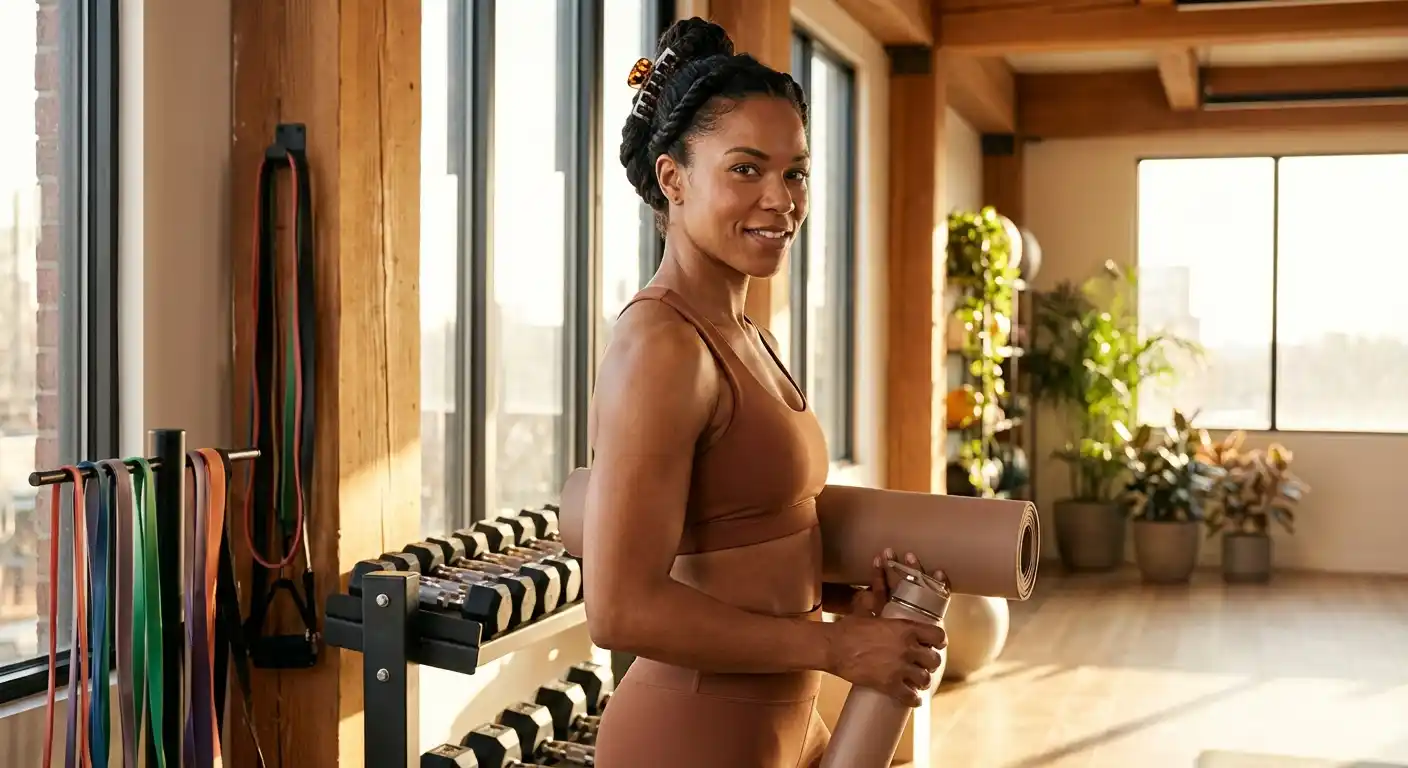
- Why Workout Hair Needs Different Clips
- Best Clip Features for Working Out
- Claw Clips by Workout Type
- Workout Claw Clip Hairstyles
- Claw Clips vs Other Accessories
- Workout Clips by Hair Type
- Keeping Your Clip Secure
- Gym-to-Going-Out Transitions
- Sweat-Proof Features
- Mini Clips for Gym Half-Up Styles
- Building Your Gym Clip Collection
- FAQ
- The Bottom Line
Your claw clip falling out mid-workout isn't a technique problem—it's an equipment problem.
The clip that holds beautifully for coffee and errands wasn't designed for burpees, downward dogs, or treadmill miles. Workout conditions create challenges that standard clips can't handle: sweat that acts as lubricant, movement that tests spring strength, and positions that put pressure on clip placement.
But the right clips—with the right techniques—actually outperform hair ties for many workouts. Less breakage. More comfort. Better post-workout appearance. And once you nail the approach, fewer mid-workout adjustments.
This guide covers everything: which clips work for which workouts, styling techniques that actually hold, troubleshooting common failures, and specific recommendations for every workout type and hair situation.
For our general claw clip guidance, see the ultimate guide to claw clips.
Why Workout Hair Needs Different Clips
Standard claw clips fail at the gym for three reasons:
The Sweat Factor
Sweat changes everything. It acts as a lubricant between your hair and clip surfaces, turning secure grip into gradual slide. Shiny, smooth clips become useless within minutes. Even textured clips struggle if they weren't designed for moisture.
What sweat does:
- Reduces friction between hair and clip teeth
- Makes smooth surfaces slippery
- Degrades plastic springs over time
- Creates environments for bacteria if clips aren't dried
What works:
- Matte and rubberized surfaces (some actually grip better when damp)
- Metal springs that resist moisture degradation
- Non-porous materials that don't absorb sweat
- Quick-dry construction
For sweat-specific recommendations, see best sweat-proof claw clips.
Movement and Impact Stress
Walking around with a clip is different from jumping, running, or inverting. Each movement pattern creates specific stresses:
| Movement Type | Stress Pattern | What Fails |
|---|---|---|
| Running/jumping | Constant vertical jarring | Weak springs, loose positioning |
| Yoga inversions | Upside-down gravity | Wrong placement, inadequate grip |
| Floor work | Pressure against ground | Clips with bumpy profiles |
| Weight training | Extended duration | Spring fatigue over time |
| Swimming | Water impact + chlorine | All non-waterproof materials |
Your workout type determines which clip features matter most.
Post-Workout Transitions
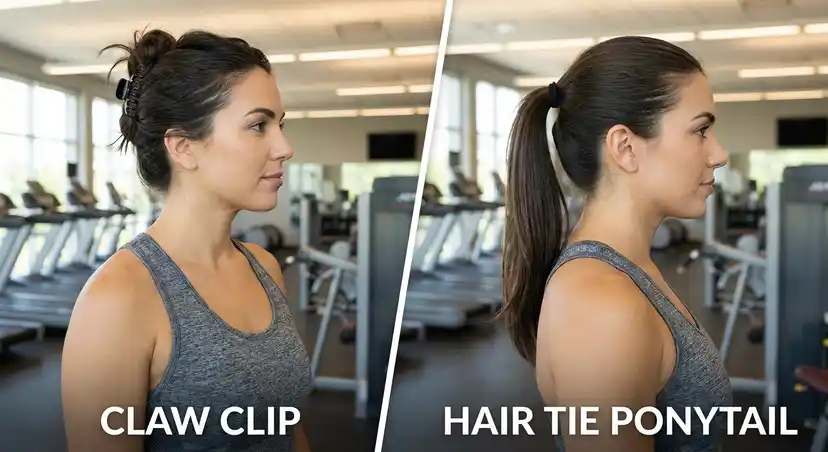
Many people head somewhere after the gym—coffee, errands, even dinner. Hair tie ponytails look like... gym hair. Claw clips transition better, looking intentionally styled rather than purely functional.
The right workout clip doesn't just survive your session—it creates a style that works for whatever comes next.
For transition techniques, see gym to going out claw clip transitions.
Best Clip Features for Working Out
Not all clips handle workouts. Here's what separates gym-ready clips from clips that will fail you:
Spring Strength Requirements
Spring strength is the single most important factor.
Standard clips: 5-7 coil springs, fine for sitting still
Workout clips: 7-10+ coil springs, designed for sustained grip under stress
How to test: Open the clip. If it snaps back forcefully, that's workout-ready. If it closes gently, save it for brunch.
Metal vs. plastic springs:
- Metal: Maintains tension longer, resists moisture degradation
- Plastic: Weakens faster, especially with sweat exposure
For sweaty workouts, metal springs matter. Plastic-spring clips may need replacement every 2-3 months with daily gym use.
Grip Surface and Teeth Design
Smooth, shiny surfaces fail when damp. Look for:
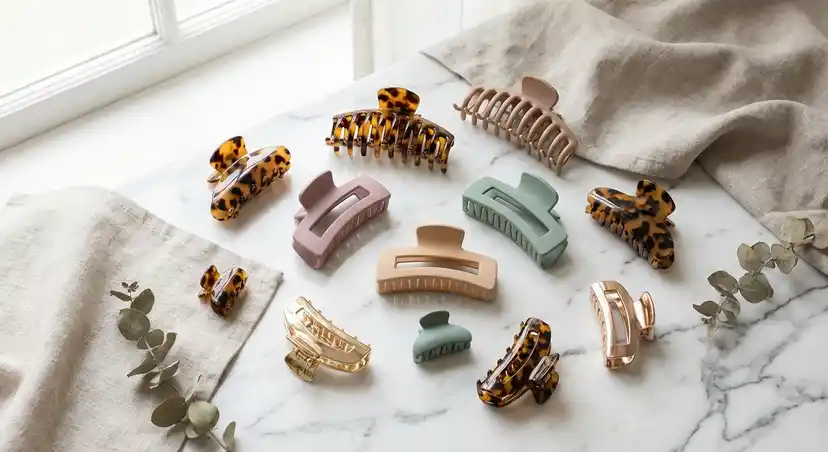
Matte finishes: Create micro-texture that maintains friction Rubberized coatings: Some grip better when slightly damp Widely-spaced teeth: Allow interlocking even with thick hair between them Textured inner surfaces: Provide additional grip points
The wet-finger test: Run damp fingers across the clip surface. If it still feels grippy rather than slick, it handles sweat.
Material Considerations
| Material | Workout Performance | Best For |
|---|---|---|
| Matte plastic | Good (with metal spring) | Most workouts |
| Rubberized coating | Excellent | Sweaty conditions |
| Cellulose acetate | Good (smooth, durable) | Premium choice |
| Shiny plastic | Poor | Not for workouts |
| Fabric-covered | Poor | Absorbs sweat, bacteria |
Avoid fabric elements, exposed foam, or any materials that absorb moisture.
Size for Activity
| Activity | Recommended Size | Why |
|---|---|---|
| Weightlifting | Large (4-4.5") | Security during extended sessions |
| HIIT/CrossFit | Large-Jumbo (4-5") | Maximum security for impact |
| Yoga/Pilates | Medium-Large flat | Floor work comfort |
| Running | Large (4-4.5") | Security for duration |
| Cycling/Spin | Medium-Large | Less impact stress |
| Swimming | Medium with secure grip | Water resistance |
| Half-up styles | Small-Medium (2-3") | Partial hair only |
For complete sizing guidance, see claw clip size guide.
Claw Clips by Workout Type
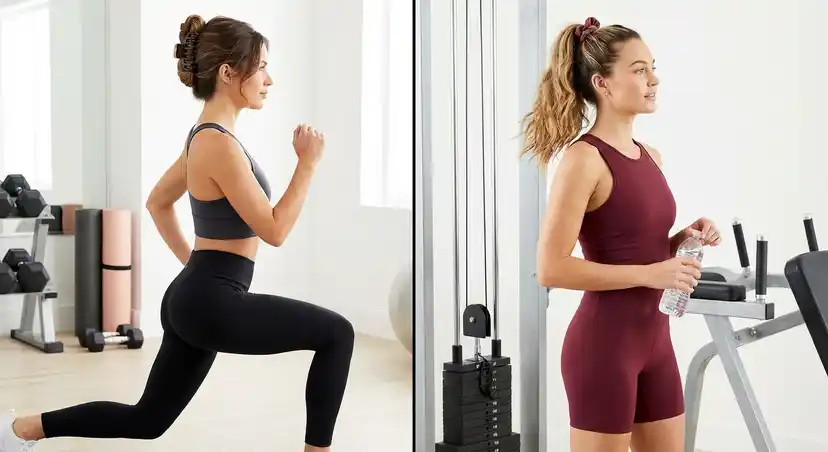
Different workouts need different clips. Here's the breakdown:
Gym and Strength Training
Weightlifting sessions typically last 45-90 minutes with moderate movement but extended wear time.
Key challenges:
- Duration (spring fatigue)
- Overhead movements (barbell clearance)
- Sweat accumulation
- Lying on benches
What works:
- Strong 7-10 coil metal springs
- High bun positioning (clears barbells)
- Matte surfaces for sweat grip
- Mid-size clips unless hair is thick
Recommended styles:
- High twisted bun for most movements
- Forward-positioned clip for bench work
- Double-twist lock for extra security
For complete gym clip recommendations, see best claw clips for the gym.
Yoga and Pilates
Floor work dominates these practices, creating unique positioning challenges.
Key challenges:
- Lying on your back (clip pressure)
- Inversions (gravity reversal)
- Long holds (comfort matters)
- Transitions between poses
What works:
- Flat-back clips that lie flush
- Low positioning at nape
- Strong grip despite flat profile
- Comfortable for 60-90 minute sessions
Recommended styles:
- Low flat bun for most practices
- Forward-tilted positioning for savasana
- Remove entirely for advanced inversions
For yoga-specific recommendations, see best flat claw clips for yoga and pilates.
Running and HIIT
High-impact activities create the most demanding conditions for clips.
Key challenges:
- Constant vertical jarring
- Sweat (lots of it)
- Duration (long runs)
- Need for zero adjustments
What works:
- Strongest springs available (10-coil)
- Maximum grip surfaces
- Secure positioning
- Matte/textured finishes
Recommended styles:
- Double-twist lock (essential)
- High tight bun positioning
- Consider double-clip for long runs
For running-specific recommendations, see best claw clips for running and HIIT.
Swimming and Beach Days
Water creates unique challenges that most clips can't handle.
Key challenges:
- Water impact on diving/swimming
- Chlorine degradation
- Salt water corrosion
- Sand in mechanisms
What works:
- Plastic or acetate (no metal to corrode)
- Strong springs that work wet
- Easy to rinse and dry
- Inexpensive enough to replace
Recommended approach:
- Use clips for lounging, not intense swimming
- Braid before securing with clip
- Rinse immediately after pool/ocean
- Designate specific "water clips"
For water activity recommendations, see best claw clips for swimming and beach days.
Cycling and Spinning
Stationary cycling eliminates impact but adds sustained sweat and duration.
Key challenges:
- Helmet compatibility (outdoor cycling)
- Extended sweat exposure
- 45-60+ minute sessions
- Forward-leaning position
What works:
- Moderate spring strength
- Matte sweat-resistant surfaces
- Low positioning (under helmet)
- Comfortable for duration
Recommended styles:
- Low bun at nape (helmet-compatible)
- Half-up for shorter hair
- Mid-height bun for spin class (no helmet)
Workout Claw Clip Hairstyles
Technique matters as much as the clip itself. These styles maximize security during movement.
The Double-Twist Lock (Most Secure)
This is the essential workout technique. It creates multiple grip points that resist unwinding.
How to:
- Divide hair into two sections (left and right)
- Twist left section clockwise until tight
- Twist right section counter-clockwise until tight
- Cross right over left at the back of head
- Continue twisting both together
- Coil the combined twist into a bun
- Clip through multiple layers of the twist
Why it works: The opposing twist directions lock together. When one tries to unwind, the other resists. The clip secures multiple layers rather than a single strand.
Best for: HIIT, running, any high-impact activity
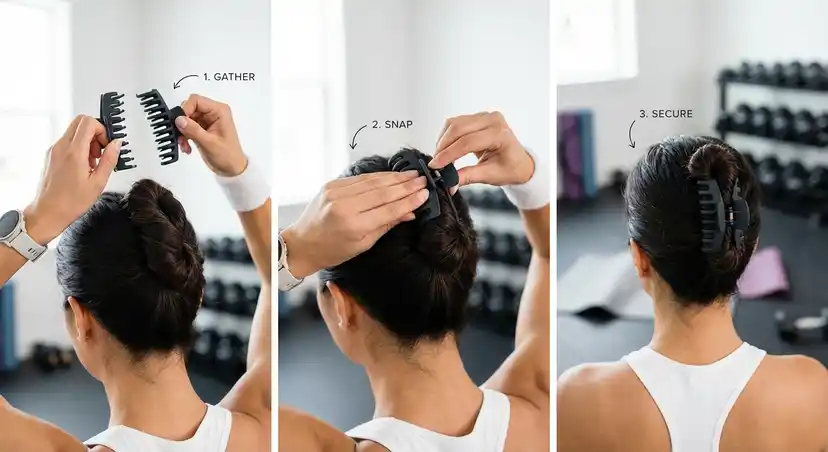
The Secure High Bun
Standard for most gym activities.
How to:
- Gather all hair at crown
- Twist the length tightly
- Coil into compact bun
- Position clip horizontally through center
- Ensure clip catches hair from multiple angles
Positioning tips:
- High enough to clear barbells for overhead movements
- Forward enough to avoid bench pressure when lying down
- Centered for balanced weight distribution
Best for: Weightlifting, cardio machines, moderate activity
The Low Flat Bun
Essential for yoga and Pilates.
How to:
- Gather hair low at nape
- Twist loosely (not tight)
- Coil into wide, flat shape
- Secure with flat-back clip horizontally
- Ensure bun lies flush against head
Why flat matters: During savasana and floor poses, a bumpy clip creates pressure points. Flat clips distribute weight and lie comfortably.
Best for: Yoga, Pilates, any floor-based workout
The Half-Up Athletic
Perfect for lighter activity or shorter hair.
How to:
- Section top third of hair (temples to crown)
- Gather at mid-crown position
- Twist once lightly
- Clip horizontally
- Let remaining hair fall freely
Why it works: Secures hair out of face without full updo commitment. Less stress on smaller clips since only partial hair is secured.
Best for: Stretching, light cardio, warm-up/cool-down, shorter hair
The Braided Combo
Maximum security for longest workouts.
How to:
- Create a standard braid (or two braids)
- Coil braid into bun shape
- Secure with clip
Why it works: Braiding adds structure before clipping. Hair can't escape the braid, and the braid can't escape the clip.
Best for: Marathon training, multi-hour activities, very long hair
For complete styling tutorials, see how to use a claw clip at the gym.
Claw Clips vs Other Accessories
How do claw clips compare to alternatives for workout use?
Claw Clips vs Scrunchies
| Factor | Claw Clips | Scrunchies |
|---|---|---|
| Security | Good with technique | Good |
| Hair health | Excellent (no creasing) | Good (less tension than elastics) |
| Comfort | No pulling | Can feel loose |
| Post-workout look | Polished | Casual |
| Floor work | Flat clips work | Ponytail bump |
| Learning curve | Higher | None |
Bottom line: Scrunchies are simpler but create ponytail bumps during floor work. Claw clips offer better transitions and floor comfort with the right technique.
For the full comparison, see claw clip vs scrunchie for workouts.
Claw Clips vs Hair Ties
| Factor | Claw Clips | Hair Ties |
|---|---|---|
| Security (high-impact) | Good with technique | Better |
| Security (moderate) | Excellent | Good |
| Hair health | Much better | More damaging |
| Comfort (long sessions) | Better | Can cause headaches |
| Floor work | Better (flat clips) | Ponytail bumps |
| Post-workout | More polished | Basic |
Bottom line: Hair ties win on maximum security for high-impact. Claw clips win on hair health, comfort, and appearance. Many athletes use both—ties for intense portions, clips for warm-up, cool-down, and transitions.
For the full comparison, see claw clips vs hair ties for working out.
The Hybrid Approach
You don't have to choose just one. Consider:
For mixed workouts:
- Claw clip for warm-up (comfortable, stylish)
- Hair tie for HIIT portion (maximum security)
- Claw clip for cool-down and post-gym (transitions well)
Keep both in your gym bag. Use the right tool for each phase of your workout.
Workout Clips by Hair Type
Your hair type affects which clips work best.
Thick Hair at the Gym
Thick hair creates extra challenges: more weight for springs to hold, more volume for jaws to accommodate.
What thick hair needs:
- Jumbo sizing (5+ inches)
- 10-coil industrial springs
- Wide-opening jaws
- Widely-spaced teeth that interlock even with thick hair
Techniques that help:
- Double-twist lock (essential)
- Double-clip method for very thick hair
- Pre-workout dry shampoo for texture
Standard "large" clips often aren't large enough. Size up.
For thick hair gym recommendations, see best claw clips for thick hair at the gym. For general thick hair guidance, see best claw clips for thick hair.
Fine Hair at the Gym
Fine hair has different challenges: slippery texture, less grip surface for clips.
What fine hair needs:
- Textured grip surfaces (matte essential)
- Closely-spaced teeth for grip on thinner sections
- Medium sizing (large may be overkill)
- Pre-workout texture products
Techniques that help:
- Dry shampoo before styling (essential)
- Skip conditioner on gym days
- Extra twisting for texture
- Consider braided base for more structure
Slippery fine hair needs textured clips and textured hair.
For fine hair recommendations, see best claw clips for fine hair.
Curly Hair at the Gym
Curly hair has natural texture that can help—but needs gentle handling to preserve curl pattern.
What curly hair needs:
- Wide-spaced teeth (don't crush curls)
- Smooth materials (reduce frizz)
- Loose styling (don't flatten curls)
- Careful removal technique
Techniques that help:
- Pineapple-inspired high positioning
- Gentle twist (not tight)
- Looser bun to preserve volume
- Careful unclipping to avoid tangles
Claw clips actually work better for curly hair than hair ties, which disrupt curl patterns.
For curly hair recommendations, see best claw clips for curly hair.
Keeping Your Clip Secure
Even the right clip needs proper technique and troubleshooting.
The Pre-Workout Prep
Set yourself up for success before your workout starts:
Add texture:
- Apply dry shampoo at roots
- Let it absorb for 2-3 minutes
- Provides grip surface for clip teeth
Skip conditioner:
- On gym days, skip conditioner entirely
- Or apply only to ends and rinse thoroughly
- Conditioner makes hair slippery
Dry hair properly:
- Style when hair is 80%+ dry
- Wet hair is heavier and more slippery
- Damp hair loosens clips faster
Right timing:
- Style immediately before workout
- Don't style hours in advance (will loosen by gym time)
Common Failures and Fixes
Problem: Clip slides down during workout
- Cause: Not enough twist, smooth hair
- Fix: More twist, add dry shampoo, use matte-surface clip
Problem: Clip pops open suddenly
- Cause: Hair volume exceeds clip capacity
- Fix: Larger clip, split into sections, use double-clip method
Problem: Clip gives you a headache
- Cause: Too much tension, wrong position
- Fix: Looser twist, reposition clip, try larger size
Problem: Clip worked but now fails
- Cause: Spring wearing out from sweat exposure
- Fix: Replace clip, rotate between 2-3 clips, switch to metal springs
Problem: Hair looks terrible after workout
- Cause: Wrong clip type, too-tight styling
- Fix: Looser initial style, use flat clips, embrace some looseness
For complete troubleshooting, see how to keep claw clip from falling during workouts and why your claw clip keeps falling out.
Gym-to-Going-Out Transitions
One of claw clips' biggest advantages: post-gym appearance.
The 3-Minute Refresh
When you're heading somewhere after the gym:
Step 1: Absorb sweat (30 seconds)
- Spray dry shampoo at visible roots
- Focus on hairline and sweatiest areas
- Let absorb briefly
Step 2: Release and assess (30 seconds)
- Take hair down
- Shake gently
- Add more dry shampoo if needed
Step 3: Restyle for going out (2 minutes)
- Lower the position (mid to nape)
- Loosen the twist
- Pull face-framing pieces out
- Clip with intentional looseness
The Key Differences
| Element | Gym Style | Going Out Style |
|---|---|---|
| Tightness | Tight for security | Loose for polish |
| Position | High for movement | Mid or low for elegance |
| Face framing | Pulled back completely | Some pieces out |
| Clip visibility | Functional | Intentional/styled |
The transition is essentially: tighter → looser, higher → lower, all-back → face-framing pieces.
For complete transition techniques, see gym to going out claw clip transitions.
Sweat-Proof Features
For hot yoga, intense cardio, or summer outdoor workouts, sweat-proof features matter.
What Makes a Clip Sweat-Resistant
Matte/rubberized surfaces: Create micro-texture that maintains friction even when damp. Some clips actually grip better with light moisture.
Metal springs: Don't degrade from moisture exposure. Plastic springs can weaken within 2-3 months of sweaty use.
Non-porous materials: Don't absorb sweat, don't harbor bacteria, don't develop odor.
Quick-dry construction: Minimal hidden cavities where moisture collects. Dries within 30-60 minutes of rinsing.
Sweat-Proof Clip Care
After every sweaty workout:
- Rinse briefly under cool water
- Shake out excess moisture
- Leave open to air dry
- Don't store until completely dry
Weekly:
- Soak in warm, slightly soapy water (5 minutes)
- Scrub teeth and hinges with old toothbrush
- Rinse thoroughly
- Air dry completely
Signs your clip needs replacing:
- Spring tension noticeably weaker
- Grip surfaces feel smoother than when new
- Odor persists after cleaning
- Visible residue won't wash away
For sweat-proof clip recommendations, see best sweat-proof claw clips.
Mini Clips for Gym Half-Up Styles
Not every workout needs a full updo. Mini clips fill the gap.
When Mini Clips Work
Great for:
- Warm-up and stretching
- Yoga and Pilates (lighter activity)
- Light cardio (walking, moderate cycling)
- Strength training (most lifts don't jostle clips)
- Short hair that can't reach full buns
- Half-up styling by definition
Not ideal for:
- Running and HIIT (impact defeats small clips)
- Full updos on thick hair
- Heavy sweating (less surface area)
What Makes a Mini Clip Gym-Worthy
Even small clips need specific features:
- Strong springs relative to size: Metal springs preferred
- Textured surfaces: Grip matters more with less surface area
- Appropriate sizing: 2-2.5" for half-ups, 2.5-3" for larger sections
For mini clip recommendations, see best mini claw clips for half-up gym styles.
Building Your Gym Clip Collection
For regular gym-goers, having the right clips on hand makes everything easier.
The Essential Gym Bag Kit
Minimum:
- 1-2 large matte-surface clips (main workout use)
- Dry shampoo travel size
- Small mirror
Recommended additions:
- 1 flat clip for yoga/floor work
- 2-3 mini clips for half-up options
- Bobby pins for fine hair touch-ups
- Second "going-out" clip for transitions
Rotation Strategy
Don't use the same clip every day:
- Rotate between 2-3 clips
- Allows clips to dry completely between uses
- Extends spring life significantly
- Prevents bacteria buildup
Replacement Schedule
With regular gym use:
| Usage | Quality Clip Lifespan | Budget Clip Lifespan |
|---|---|---|
| Daily | 4-6 months | 2-3 months |
| 3-4x weekly | 6-9 months | 3-4 months |
| 1-2x weekly | 9-12 months | 4-6 months |
Budget for replacement. Worn springs are the main cause of workout clip failures.
FAQ
Are claw clips better than hair ties for working out?
For most workouts, yes—with proper technique. Claw clips cause less hair damage, are more comfortable for long sessions, and look better post-workout. Hair ties may be better for maximum-impact activities like HIIT and running. Many athletes use both: clips for most activity, ties for highest-impact portions. See claw clips vs hair ties for working out for the complete comparison.
Will my claw clip stay in during HIIT?
With the right clip and technique, usually yes. Use a strong-spring matte clip, apply dry shampoo for texture, use the double-twist lock technique, and position high and tight. Some people keep hair ties as backup for the most intense portions. See best claw clips for running and HIIT for specific recommendations.
What size claw clip do I need for the gym?
For full updos, start with large (4-4.5 inches). If that struggles with thick hair, move to jumbo (5+ inches). For half-up styles, medium (2.5-3 inches) usually works. The clip should close completely around your hair with room to spare—if you're forcing it closed, size up. See claw clip size guide.
Can I wear a claw clip for yoga?
Yes, but use a flat-back clip and position low at the nape. Standard clips create uncomfortable bumps during floor poses. Flat clips lie flush against your head. See best flat claw clips for yoga and pilates.
How do I keep my claw clip from falling during workouts?
The key factors: 1) Use clips with strong springs and matte surfaces, 2) Add texture with dry shampoo before styling, 3) Use the double-twist lock technique, 4) Position appropriately for your activity, 5) Replace worn clips. See how to keep claw clip from falling during workouts for the complete guide.
Can I swim with a claw clip?
Not recommended for intense swimming—the water impact often defeats clips. For lounging poolside and light wading, clips work fine. Use plastic or acetate (no metal to corrode), rinse immediately after, and designate specific "water clips" you don't mind replacing. See best claw clips for swimming and beach days.
How often should I replace gym claw clips?
With daily sweaty use, every 4-6 months for quality clips, every 2-3 months for budget clips. Replace sooner if spring tension weakens or grip surfaces become smooth. Rotating between 2-3 clips extends each clip's lifespan.
What's the best clip for thick hair at the gym?
Jumbo sizing (5+ inches) with 10-coil springs. Standard "large" clips often aren't large enough. The TOCESS 5-Inch clips with 10-coil springs are specifically designed for thick hair under workout stress. See best claw clips for thick hair at the gym.
The Bottom Line
Workout claw clips are different from everyday clips. They need:
- Stronger springs that maintain tension through movement and sweat
- Matte surfaces that grip rather than slip when damp
- Appropriate sizing for your hair type and activity
- Proper technique that creates multiple grip points
The investment pays off: less hair damage than daily hair ties, more comfort during long sessions, better post-workout appearance, and fewer mid-workout adjustments once you nail the technique.
Start with best claw clips for the gym for general recommendations. Add flat clips for yoga, stronger clips for running, and mini clips for half-up options as needed. Master the double-twist lock technique from how to use a claw clip at the gym. Keep dry shampoo in your gym bag.
Your clip falling out mid-workout isn't inevitable. With the right equipment and technique, claw clips become the better choice for most workouts.
For our general claw clip guidance, see the ultimate guide to claw clips.
Frequently Asked Questions
Your regular claw clips weren't designed for this
Different workouts need different clips
The hair health advantage

Donna Miller
Enjoyed This Guide?
Get more hair tips and product recommendations delivered weekly.