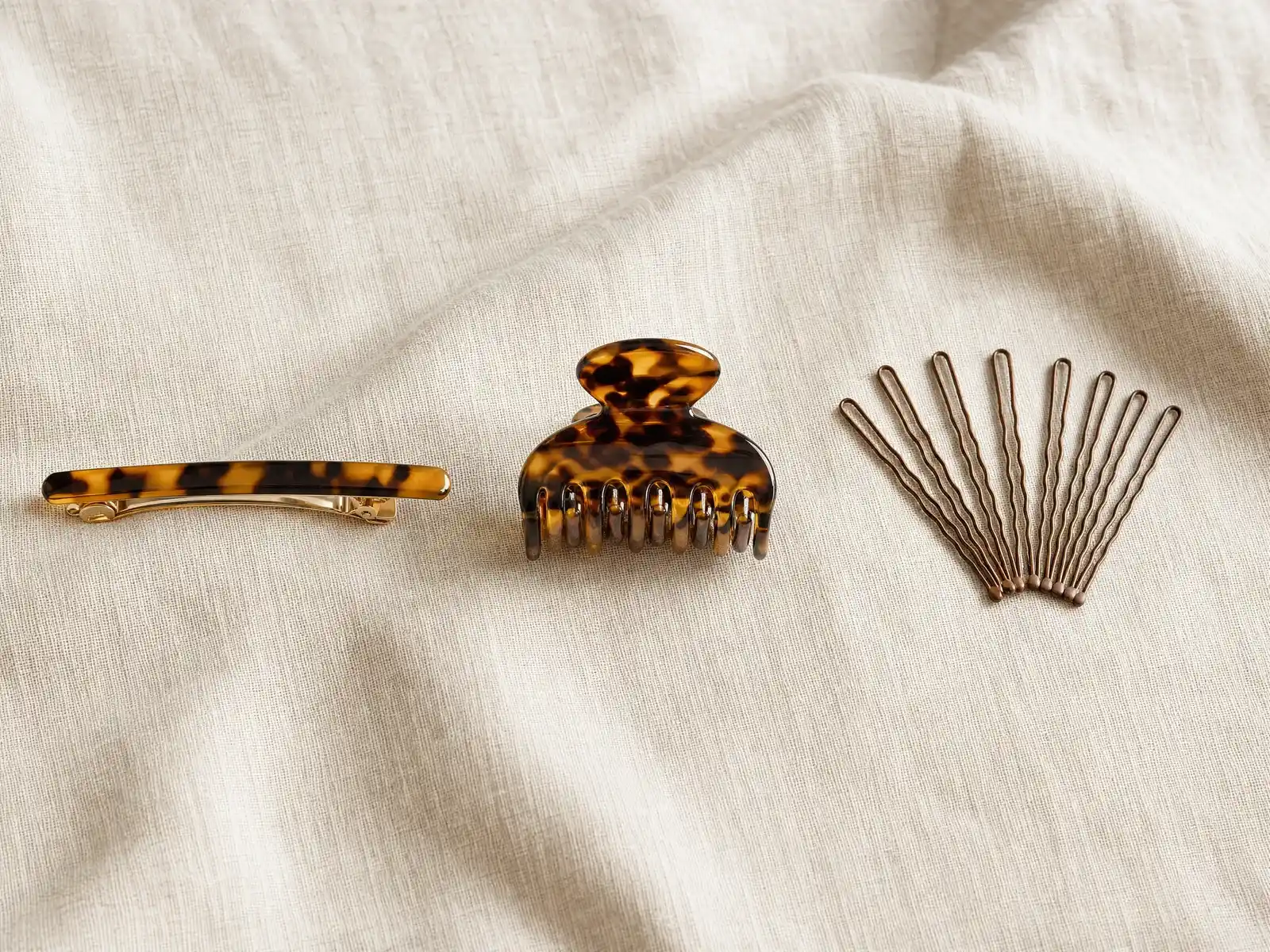
- Barrettes vs claw clips vs bobby pins at a glance
- What a barrette does best, and where it fails
- What a claw clip does best, and where it fails
- What a bobby pin does best, and where it fails
- Head-to-head: which one wins each job
- The combinations that actually work
- Which to buy first if you own none
- The decision list
A barrette closes one fixed clasp across a defined section. A claw clip grips a twisted mass from both sides at once. A bobby pin anchors hair to other hair instead of clamping a section at all. Every practical difference in the barrettes vs claw clips vs bobby pins question falls out of those three mechanics — hold, speed, capacity, and where each one quietly fails.
Best Claw Clips is reader-supported. When you buy through links on our site, we may earn an affiliate commission at no extra cost to you.
All three live in our kit, and we swap between them constantly. Our full overview of hair barrettes covers materials and sizing in depth; this guide is the triage version — which of the three you should reach for in front of the mirror, and why the barrettes vs claw clips debate so often has a third answer that nobody asked about.
Barrettes vs claw clips vs bobby pins at a glance
| Barrette | Claw clip | Bobby pin | |
|---|---|---|---|
| Hold strength | Firm on a set section; fixed capacity | Strong on a twist; slips if overloaded | Weak alone; very strong in numbers |
| Hair volume suited | Fine to medium sections | Small twists up to a full thick length | Any, but only a few strands per pin |
| Speed to use | 3-5 seconds, two hands | Under 5 seconds, often one hand | Slowest; 6-20 pins for a full style |
| Visibility | Meant to be seen; it is jewelry | Seen, but reads as functional | Meant to vanish into the hair |
| Best use case | Half-up, swept fringe, one side back | Full gather-up, wash days, desk work | Updos, tucked ends, flyaways |
Read the table as a shape rather than a scoreboard. Barrettes are precise and decorative, claws are fast and high-capacity, pins are invisible and infinitely adjustable. Nobody wins overall, because those are three different jobs.
What a barrette does best, and where it fails
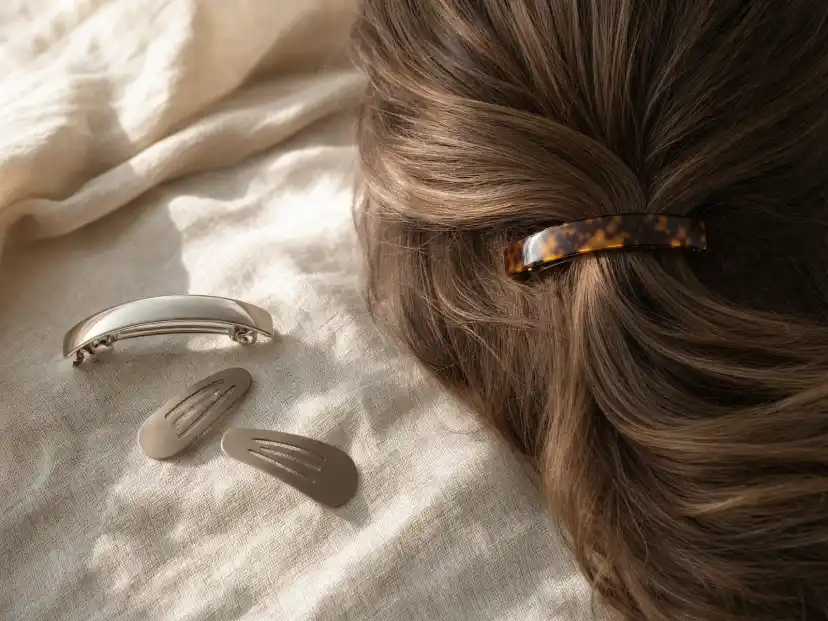
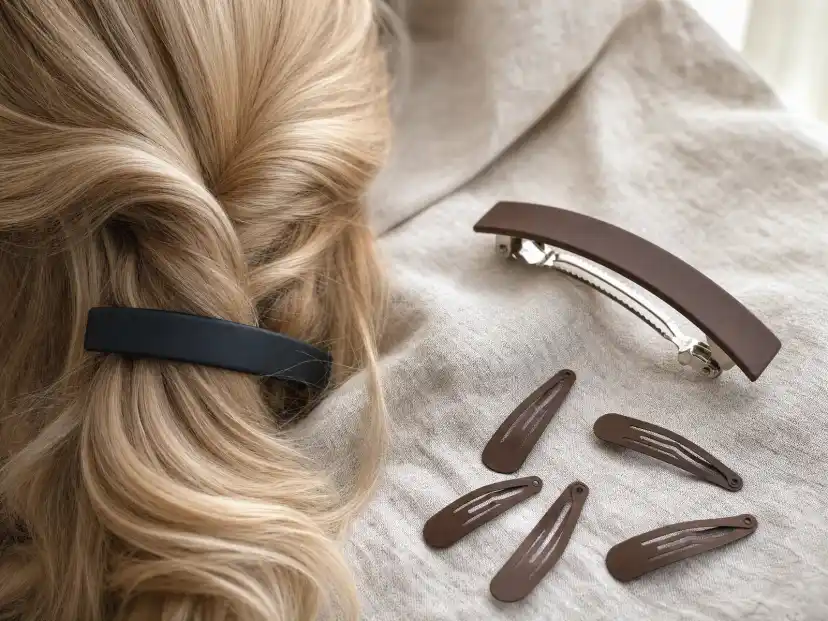
A barrette is a clasp with a fixed opening. You lay it across a section, close it, and the section is captured between the base and the bar. Because that opening does not stretch, a barrette is the most predictable of the three: the same clip, in the same spot, holds the same amount of hair every morning.
That predictability is the whole appeal. When we want a half-up crown that will not creep down the back of the head by 2 p.m., we use a barrette, not a claw. The WILLBOND Skinny Acetate Hair Barrettes are a good archetype here — a 3.3 by 0.7-inch slim bar over a metal core, which is the classic half-up shape. The maker specifies it for thin to medium hair and half-up styles, and that is exactly the right lane.
Where barrettes fail is capacity and versatility. Load one past its opening and it will not close, or it will close and then pop mid-afternoon. The word "barrette" also covers several different clasp mechanisms — French, automatic, snap, banana — and each holds differently, which is worth understanding before you blame the clip. Our breakdown of the types of barrettes walks through each mechanism. The other limitation: a barrette is visible by design. It is a piece of jewelry that happens to hold hair, so it has to suit the outfit, not just the section.
What a claw clip does best, and where it fails
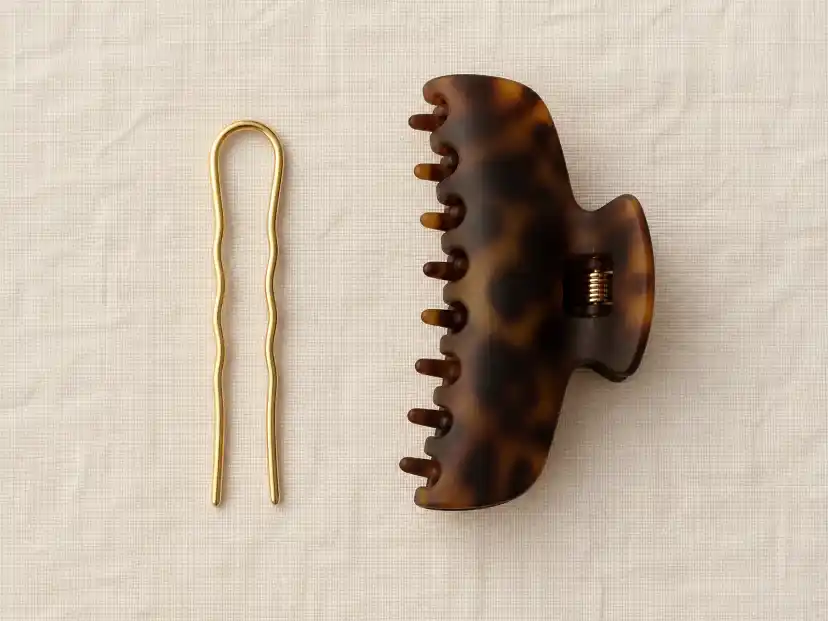
A claw clip is a spring hinge with two opposing rows of teeth. You twist the hair, open the jaws, and the clip grips the twist from both sides simultaneously, using the hair's own bulk as the anchor. That is why it is the fastest of the three and the least fussy about placement — you do not have to catch a neat section, you just have to catch enough.
According to the Wikipedia entry on the claw clip, the design is credited to French businessman Christian Potut, whose company CSP Diffusion opened its first factory in Oyonnax, France, in 1986 producing plastic goods such as combs. The idea was to merge a comb and a clip into one object, and that lineage explains the tool: it is a comb that closes.
The TELETIES Small Hair Claw Clip is our concrete example at the small end, at 2.75 inches with bendable nylon teeth and hidden springs. TELETIES says the nylon bends rather than breaks and the teeth keep their shape.
Claws fail in two directions. Overload them and the spring loses to gravity — in our experience, a clip sized for a bob tends to creep and drop out of thick, heavy hair within an hour. Underload them and there is nothing for the teeth to bite, so fine or short hair slides straight through. They are also the worst of the three for precision work: you cannot ask a claw to hold one deliberate twist against the scalp. If you are choosing only between these two tools, our dedicated comparison of bobby pins vs claw clips goes further on that head-to-head.
What a bobby pin does best, and where it fails
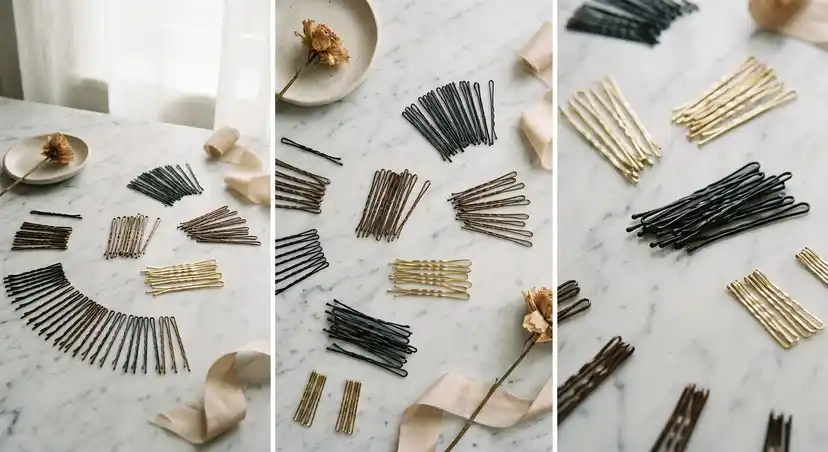
The bobby pin is the odd one out, and understanding why solves most pin frustration. It does not clamp a section between two rigid parts. It has two legs — one straight, one wavy — that slide over hair and hold by friction against the hair already there. A pin needs neighbours. Push one into an isolated section with nothing around it and it will walk right out, no matter how good the pin is.
That mechanic is also its superpower. Because a pin borrows its grip from surrounding hair, it can secure a tucked end anywhere on the head, at any angle, invisibly. This is why every finished updo ends in pins and never in a claw clip.
The Cyluer Brown Bobby Pins are the workhorse version — 2 inches, wavy, with gloss balls on both ends and a case, in a count high enough that losing them stops mattering. The wavy side is not decoration; it is the part that supplies grip, and it should face the scalp.
According to Wikipedia, the bobby pin was invented by Luis Marcus, a San Francisco cosmetics manufacturer, after World War I, and it became popular in the United States in the 1920s to hold the newly fashionable bobbed hairstyles. That origin is the clearest statement of what the tool is for: short hair with no bulk to clamp, where the only available anchor is other hair.
Pins fail at bulk and at speed. One pin holds a few strands. A full French twist in thick hair can take fifteen or more, and putting them in takes minutes, not seconds. In our experience they are also the easiest of the three to over-tighten, which matters: the American Academy of Dermatology warns that hairstyles which pull on the hair can cause traction alopecia, and that if the tension continues, the hair loss can become permanent.
Head-to-head: which one wins each job
Thick hair. Claw clip, by a wide margin, but sized up. A barrette's fixed opening runs out of room, and pins would take a dozen. Reserve barrettes for a half-up section of thick hair rather than the whole length.
Fine hair. Barrette first, pins second. Fine hair slides through claw teeth because there is not enough bulk to grip. A slim barrette closes on whatever is there and holds it.
Short hair and bobs. Bobby pins and small barrettes; claws are usually a size problem here. Length is often what decides the winner outright, and we cover the specifics in our guide to wearing barrettes with short hair.
Workouts. Claw clip, and nothing else. It is the only one you can redo one-handed mid-set, and pins work loose with bouncing.
Formal updos. Bobby pins, with a decorative barrette as the visible finish. A claw is a lounging tool, not an evening one.
Sleeping. None of the three, ideally. Every one of them concentrates pressure on a small area for hours at a stretch, and the AAD's hair-styling guidance is to avoid pulling and tugging on your hair and to wear it loosely pulled back. That guidance is about styling rather than about clips in bed, but we apply it overnight too. If you must, a loose claw is the least bad, because it can be sized to sit slack.
All-day desk work. Claw clip if you lean back, barrette if you do not. In our experience, a claw pressed against a headrest is the most common reason a style collapses by 3 p.m.
Wet hair. Go loose and go slow. The AAD notes that wet hair breaks more easily when combed or brushed and advises that most people handle wet hair as little as possible, with tightly curled or textured hair the exception — the AAD says that type is better brushed while wet, to reduce breakage. Either way, this is not the moment to force a tight clasp or drag pins through tangles.
The combinations that actually work
The real answer for most people is not one tool but two:
- Claw clip plus two pins. Gather and twist with the claw, then pin the loose ends at the nape that the claw could not catch. It is the fastest secure updo we know.
- Barrette over pins. Build the shape with pins, then set a barrette on top as the visible finish. The pins do the structural work; the barrette does the aesthetic work and hides the pins.
- Two small barrettes instead of one large one. In our experience, two slim clips spaced an inch apart distribute their grip over a wider area than a single wide clasp, and they hold a half-up section more comfortably on fine hair.
What does not work: pins as a substitute for a claw on a full ponytail, or a claw as a substitute for pins on a tucked end. Those are mechanical mismatches, not quality problems.
Which to buy first if you own none
Buy in this order:
- A multipack of bobby pins. Cheapest, most versatile, and the only one that can rescue the other two. Match the colour to your hair.
- One claw clip sized to your hair. Small for fine, short, or bobbed hair; larger for thick or long. This becomes the tool you use daily.
- Two barrettes. One plain for work, one decorative. This is the piece you buy for how it looks, so buy it last and buy it deliberately.
The decision list
- Section that must stay put, and be seen: barrette.
- Whole length up in five seconds: claw clip.
- A tucked end, a flyaway, or an updo: bobby pin.
- Thick hair, full gather: claw clip, sized up.
- Fine hair, half-up: barrette, slim.
- The gym: claw clip.
- The wedding: pins, with a barrette on top.
There is no overall winner here, and any article that names one is comparing a hammer to a screwdriver. The honest test is the section in your hand: how much hair is it, does it need to be invisible, and how many seconds do you have. Answer those three and the tool picks itself. For a deeper look at clasp types, materials, and sizing, read our complete guide to barrettes next.
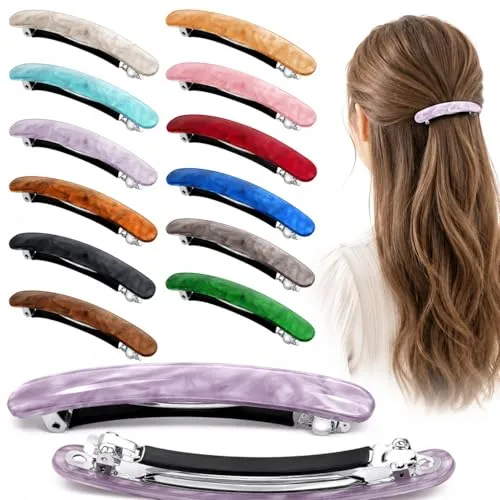
WILLBOND Skinny Acetate Hair Barrettes (12 Pcs)
Twelve skinny cellulose-acetate barrettes at 3.3 x 0.
“The slim 3.3-inch profile is the classic half-up barrette shape, and the maker specifies it suits th...”
We tested dozens of claw clips to find the very best options. Below you'll find our complete ranking, with detailed reviews and real customer feedback for each pick.
The Complete Ranking
WILLBOND Skinny Acetate Hair Barrettes (12 Pcs)
“The slim 3.3-inch profile is the classic half-up barrette sh...” — Verified Buyer
Twelve skinny cellulose-acetate barrettes at 3.3 x 0.7 inches over a metal core. This is the barrette archetype for the comparison: one fixed clasp that closes across a defined section and then stays exactly where you put it.
“The slim 3.3-inch profile is the classic half-up barrette shape, and the maker specifies it suits thin to medium hair and half-up styles.”
— Verified Buyer
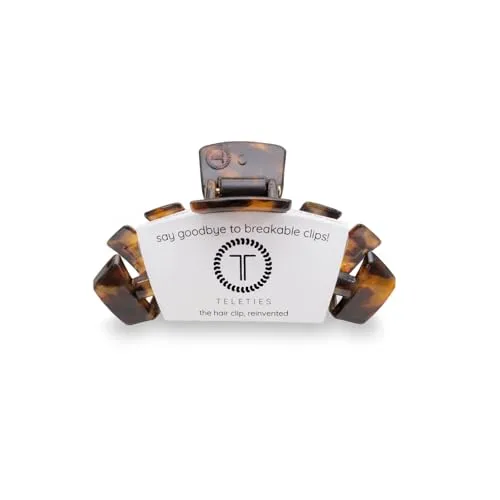
TELETIES Small Hair Claw Clip, 2.75 in
“The bendable nylon teeth flex instead of snapping, and the c...” — Verified Buyer
A 2.75-inch nylon claw with hidden springs and bendable teeth. The claw is the opposite design philosophy from the barrette: it grabs a twisted mass of hair from both sides at once, which is why it is faster to use and less precise about placement.
“The bendable nylon teeth flex instead of snapping, and the curved shape keeps the clip from digging into the scalp during a long day.”
— Verified Buyer
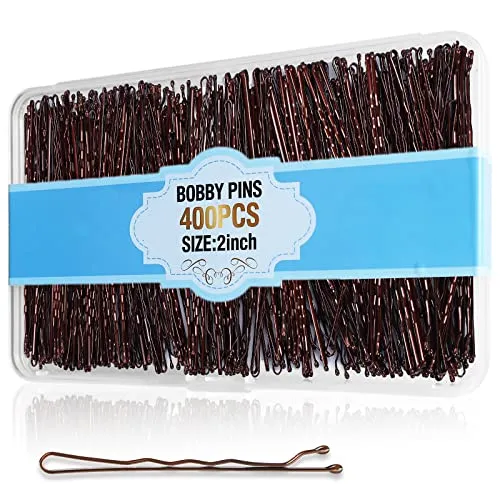
Cyluer Brown Bobby Pins, 2 in (400 Pcs with Case)
“Gloss balls on both ends keep the pin from scratching the sc...” — Verified Buyer
Four hundred 2-inch wavy bobby pins with glossy ball tips, in a storage case. The bobby pin is the only one of the three that anchors hair to other hair rather than clamping a section, which is what makes it the tool for updos and the wrong tool for a ponytail.
“Gloss balls on both ends keep the pin from scratching the scalp, and the wavy side is what supplies the grip that a straight pin lacks.”
— Verified Buyer
The slim 3.3-inch profile is the classic half-up barrette shape, and the maker specifies it suits thin to medium hair and half-up styles.
Quick Comparison
A side-by-side look at our top picks
Frequently Asked Questions
The one job each tool owns outright
A bobby pin is not a small barrette
Most failures are sizing errors, not quality errors

Donna Miller
Enjoyed This Guide?
Get more hair tips and product recommendations delivered weekly.